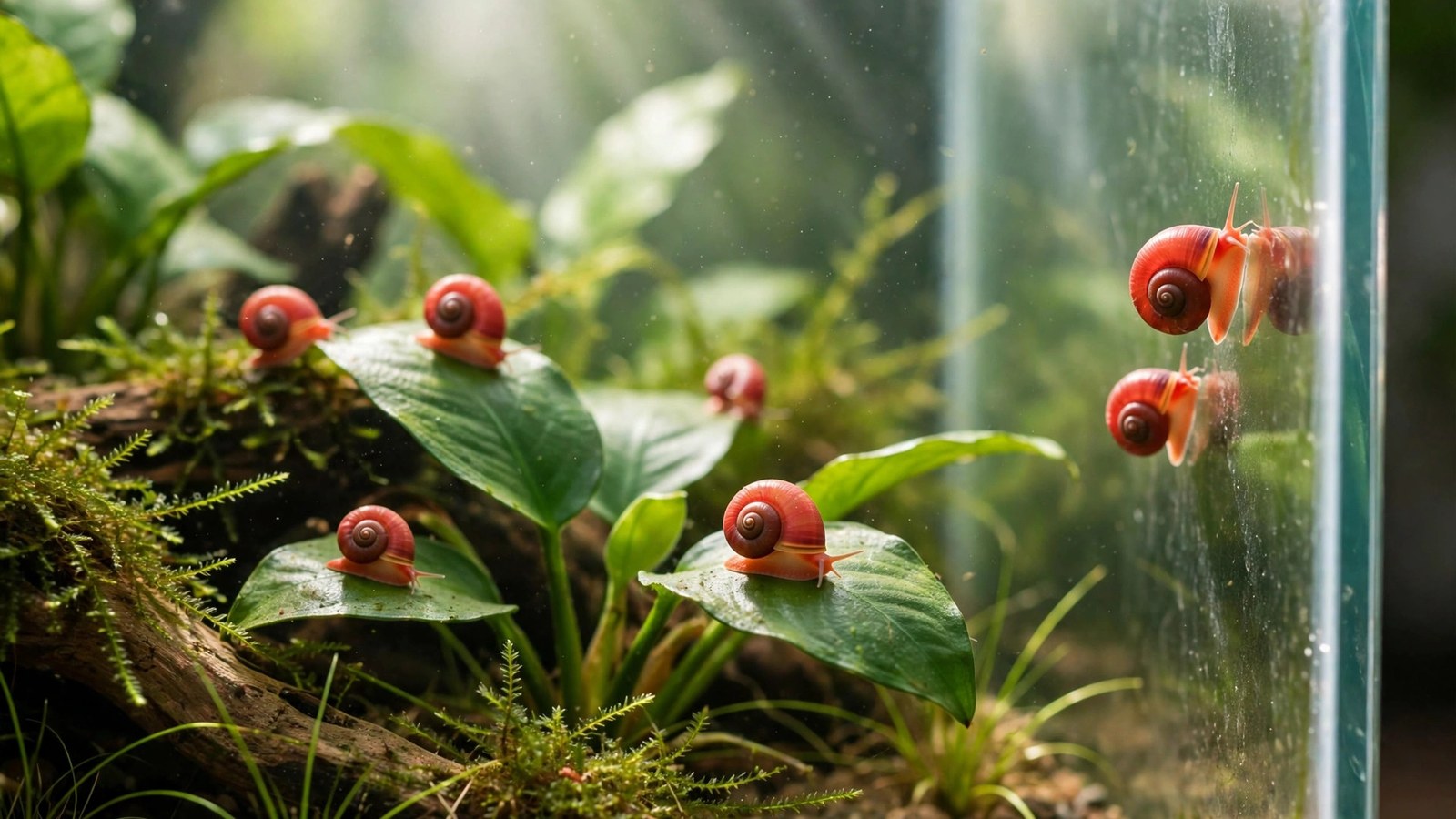
Here's the mistake that ruins ramshorn tanks: you buy five snails as a cleanup crew, overfeed just a little, and by month three you're scooping out two hundred. Getting ramshorn snail care right isn't about keeping them alive — they're nearly indestructible — it's about keeping numbers at crew size. These flat-spiraled grazers work around the clock on soft algae, leftover food, and dying leaves. But they breed exactly in proportion to the food on offer, which makes you, the feeder, the population dial.
Are ramshorn snails good or bad for a planted tank? Good — as long as you control the food. A colony of 20–30 adults in a 60-liter planted tank strips soft algae and detritus without touching healthy leaves. They only become a pest when food is constant: each adult can lay jelly clutches holding 10–50 eggs at a time, so the population tracks your feeding. Feed like a miser and the colony self-regulates; feed like a saint and you'll be rehoming snails by the cupful.
Ramshorn Snail Care: The Five Basics That Matter
Start with water, because everything else is easy. Ramshorns thrive from 18–27°C and pH 7.0–8.0, building their strongest shells in moderately hard water — if your tap is very soft, add cuttlebone or crushed coral so new growth comes in thick instead of pitted (see our snail shell erosion and calcium guide for the full routine). If snails are the stars of your tank, read our planted snail tank setup guide first — substrate, planting, and flow choices all shift when grazers, not fish, are the priority.
Acclimate new snails like shrimp: float the bag, then drip tank water in for 30–45 minutes — a pH shock can make them clamp shut for days. Quarantine in a fish-free tank for a month, since pond-reared ramshorns can carry parasitic flukes. One honest species note: the small red "ramshorns" in most shops are Planorbella duryi, not Planorbarius corneus — Wikipedia's ramshorn snail overview covers the split. Smaller, equally useful, cared for identically.
What Ramshorns Eat (and What They Won't Touch)
Let's kill the myth first: ramshorns do not eat healthy aquarium plants. They rasp leaves that are already dying — the tissue is soft and breaking down — which is why people blame the snail instead of the leaf. A healthy stand of aquarium plants for fish tanks shrugs off a ramshorn colony completely; holes in firm new growth point to a lighting or nutrient problem, not snails.
What they genuinely eat, around the clock: soft green algae, diatoms, biofilm, uneaten fish food, and decaying plant matter — the tank's compost crew. Supplement with blanched zucchini, spinach, or cucumber two to three times a week, removing leftovers after 24 hours, because rotting veg fuels the population boom you're avoiding. An algae wafer once or twice a week works too — see our best algae wafers guide for ones that hold together. Sinking pellets for bottom-feeders are fine as well; our best sinking pellets guide lists low-copper formulas, which matter in any snail tank.
Feed less than you think. Every uneaten crumb is snail fuel: a fed colony breeds, while a lean one merely maintains.
Color Morphs: Red, Pink, Blue, and Leopard
Color is the one thing you get to choose — all common morphs are the same easy snail under different paint, with identical care, parameters, and breeding. The catch: mix colors in one tank and offspring drift toward wild-type brown within a generation or two. Want red babies? Keep only reds.
| Morph | Look | What to know |
|---|---|---|
| Red | Brick-red shell, red body | The classic: hardiest, cheapest, easiest to find |
| Pink | Translucent pink shell | Palest shell; new growth is easy to spot |
| Blue | Slate-blue shell and body | Rarer and pricier; keep the line pure |
| Leopard | Spotted or mottled shell | Pattern variant; breeds like the rest |
Buy from a single color line, and rehome off-color juveniles if the shade matters. For breeding and hatching notes beyond this guide, the ramshorn snail care guide from Fish Laboratory is a solid second reference.
Population Management: Keeping the Colony at Crew Size
Here is the entire secret: the population matches the food, not the calendar. Feed a 60-liter tank like it holds only fish, and ten starter ramshorns stabilize around twenty to thirty adults. Double the food and you'll watch the glass fill up. So management is disciplined feeding: one wafer at a time, veg removed after a day, no "extra, for the snails."
Adults lay clear jelly clutches on glass, leaves, and decor — if you want to recognize them, our aquarium snail eggs identification guide shows exactly what to look for. And if numbers truly run away despite lean feeding, assassin snails are the reliable biological fix — our assassin snail planted tank guide covers how to use them in a planted setup without crashing the ecosystem.
Frequently Asked Questions
Will ramshorn snails eat my live plants?
No — not healthy ones. Ramshorns rasp soft algae and decaying tissue; a firm, growing leaf is too tough to interest them. If you find holes in new growth, check lighting, nutrients, or CO2 first, and consider tougher species from the easiest aquarium plants for a beginner community tank. One exception: delicate stems like cabomba can get nibbled when the colony is starving — a feeding problem, not a snail problem.
How many ramshorn snails should I start with?
Ten is plenty for a tank up to 60 liters. A dozen becomes a working colony within two months, and starting small lets the population settle at the size your feeding supports. Adding fifty at once just means fifty competing mouths — the colony ends up the same size, with more waste along the way.
How fast do ramshorn snails breed?
Fast enough to surprise you. Adults are hermaphroditic — any two can mate — and in warm, well-fed water each adult can lay jelly clutches holding 10–50 eggs, several times a month. Babies hatch in about a week and mature in four to six. In a food-rich tank, ten starters can become hundreds within three months; in a lean tank, they barely replace themselves.
What tank mates are safe with ramshorn snails?
Most community fish ignore adult ramshorns: tetras, rasboras, guppies, corydoras, and shrimp all coexist peacefully. The risk runs the other way — puffers, loaches, and many gouramis hunt snails, and curious bettas may pick at juveniles. Assassin snails are the one deliberate predator: they eat ramshorns on purpose, which is why they're the go-to biological control.
Do ramshorn snails need a heater or a filter?
They don't demand either, but both help. Ramshorns tolerate 18–27°C, so a room that stays above 18°C needs no heater; a gentle sponge filter cleans the water without sucking up babies. What they truly need is stable water and zero copper — parameter swings stress them more than a cool room, and copper-based treatments are lethal at any dose.
Should You Keep Ramshorn Snails?
Yes — if you feed with discipline. A lean-fed ramshorn colony is the hardest-working cleanup crew you can get for free: constant algae grazing, detritus removal, and a built-in early warning, because a population spike always means you're overfeeding. Buy five to ten, feed the tank and not the snails. Just remember: the snails are never the problem. The feeding schedule is.