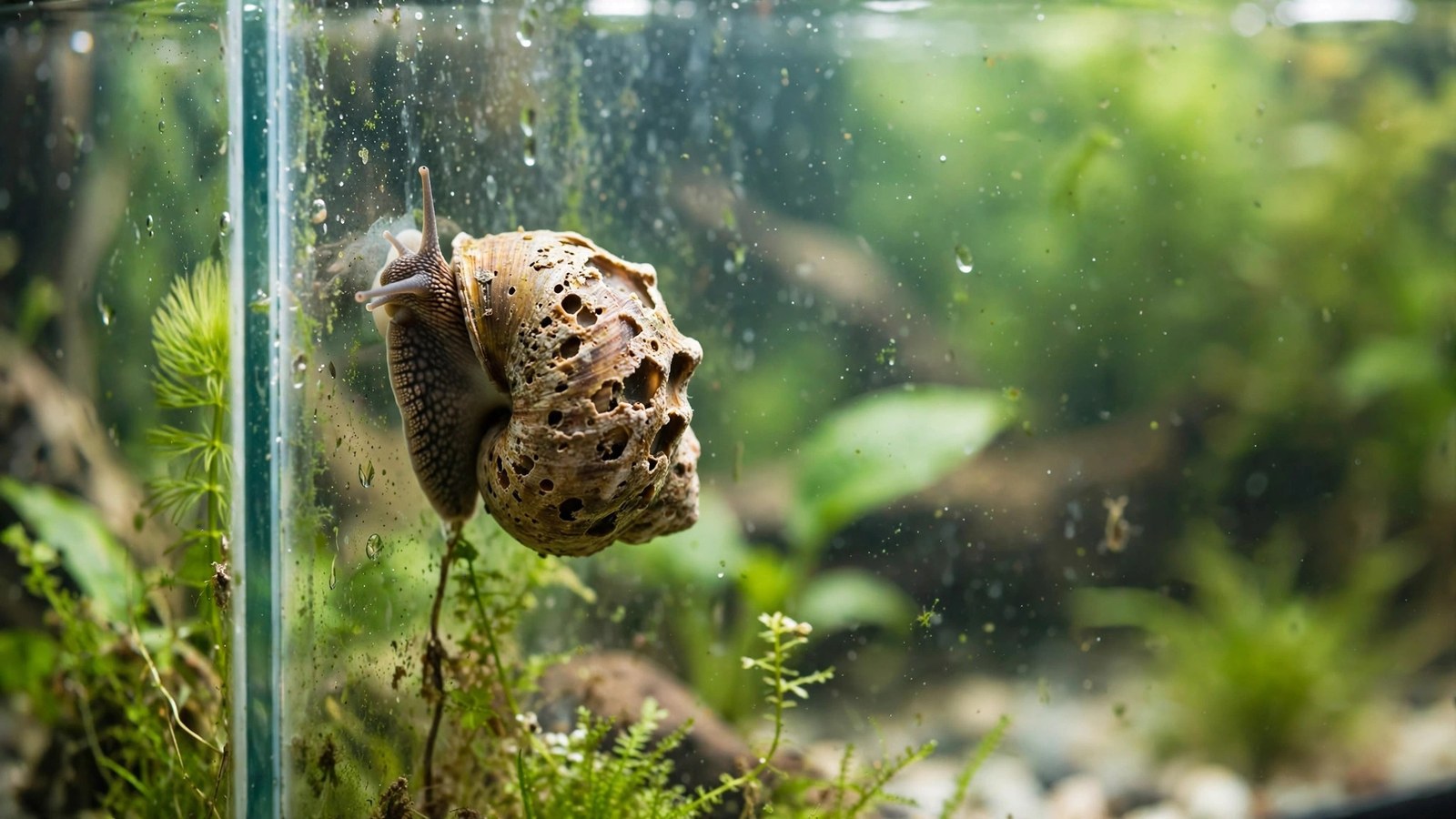
One month your mystery snail's shell is a glossy amber spiral; the next, a chalky white pit appears near the tip — and it keeps growing. Most keepers blame old age, but that whitening is calcium carbonate dissolving out of the shell — and a lasting snail shell erosion fix starts with the water, not the food. Snails earn their place in beginner-friendly planted community setups, polishing algae off leaves — and this guide shows you how to tell erosion from normal wear, find the cause with two test kits, and rebuild shell health.
Snail shell erosion is the shell's calcium carbonate dissolving into tank water. Keep water above pH 7.0 — below that, dissolution accelerates sharply — and hold GH at 8–12 dGH so calcium is available for repair. Cuttlebone, crushed coral, or a GH remineralizer supply water-column calcium; calcium-rich foods like blanched kale feed new growth. Old damage never reverses, but smooth new growth appears at the shell edge within 2–6 weeks once conditions are fixed.
What Shell Erosion Looks Like vs Normal Wear
Erosion starts subtly: chalky white patches or fine pitting on the older whorls near the tip, edges that feel thin or crumbly instead of glassy, and in advanced cases small holes or flaking layers. The damage begins at the tip, whose calcium has faced your water longest.
Normal wear looks different: growth lines, darker bands, a slightly worn tip on a large old snail. The keeper's test is progression — photo the shell today and compare in seven days. Wear stays the same; erosion spreads. This guide covers mystery and nerite snails — the ones you bought on purpose. If your tank suddenly holds dozens of pea-sized hitchhikers that rode in on plants, check our guide to pest snails in planted aquariums first; they erode too, but population control is the bigger issue there.
The 3 Causes That Dissolve Snail Shells
Erosion means calcium is leaving the shell faster than the snail can replace it — in practice, one of three causes:
| Cause | How to diagnose | The fix |
|---|---|---|
| Acidic water (pH below 7.0) | Liquid pH test reads under 7.0, often in CO2-injected or soft-water planted tanks | Raise pH to 7.2+ with crushed coral in the filter; retest in 48 hours |
| Low GH (under 6 dGH) | GH test kit reads low — common with soft tap water or RO water used straight | Remineralize to 8–12 dGH with a GH-specific product before water changes |
| Calcium-poor diet | Snail eats only algae wafers and fish flakes, no supplemental calcium | Offer calcium-rich foods 2–3 times weekly alongside water fixes |
Calcium shortages show up elsewhere too — shrimp keepers know the white ring of death in shrimp, a molting failure with the same root cause. pH and GH work as a pair: acidic water dissolves the shell, while low GH means the snail cannot rebuild it.
The snail shell erosion fix: a 4-step recovery plan
Step 1 — Test, then buffer pH. Run a liquid pH test (strips are too coarse). Under 7.0, add half a cup of crushed coral in a filter media bag per 40 liters and retest after 48 hours. Coral dissolves only as fast as the water is acidic, so it self-limits — but measure to confirm.
Step 2 — Remineralize GH to 8–12 dGH. If GH reads below 6 dGH, your water lacks the calcium and magnesium snails need. Use a GH-specific remineralizer — follow the manufacturer's dosing directions for Seachem Equilibrium (roughly one tablespoon per 80 liters raises GH by 3 dH) — mixed into new water during water changes, never dumped dry into the tank. Add cuttlebone to the tank or filter as a slow calcium source. Our cuttlebone calcium guide covers sizing, placement, and how long a piece lasts.
Step 3 — Feed calcium 2–3 times a week. Blanched kale, spinach, or zucchini are the easy wins; calcium-fortified snail foods are better. This supports new shell growth from the inside while the water chemistry stops the loss from the outside.
Step 4 — Give it 2–6 weeks and watch the edge. Snails grow new shell only at the aperture rim; once water and diet are corrected, a smooth band forms there. Old pitted areas will not smooth out — they are scars. Steady new growth is the proof the fix is working.
Cuttlebone is the primary calcium fix in this recovery plan — snails rasp it directly, snail-specific use verified on the listing: a piece of cuttlebone like the Sepia King 12-pack ★4.5.
When Erosion Is Cosmetic and When It's Dangerous
Most erosion is cosmetic: chalky whitening on the tip of an older snail, slightly thin edges, or a rough patch stable for months. If the snail is active, eating, and growing a smooth new band at the shell edge, fix the water and give the new growth time.
The danger line is depth and location: a pit revealing body tissue, a crack in the body whorl, or the shell crumbling at the aperture. Hobby-standard practice at that stage is the same fix, applied fast: correct pH and GH immediately, offer calcium foods daily, and minimize handling. No hobby-level treatment patches an existing hole, so fast chemistry correction is everything. Keeping the whole system balanced is part of prevention; a complete guide to freshwater aquarium plants helps you build a stable planted setup where snails, shrimp, and greenery thrive together.
Frequently Asked Questions
Will an eroded snail shell heal or grow back?
Old pitted areas never smooth over — they are permanent scars. But snails add new shell at the aperture edge, so once pH and GH are corrected a smooth, glossy band of fresh shell forms there within 2–6 weeks. Judge recovery by that new growth band, not by old damage disappearing.
Can a snail survive with a hole in its shell?
Small surface pits are usually survivable — many snails live normal lives with them. The serious cases are holes deep enough to reveal body tissue, especially in the body whorl. Hobby-standard response is immediate water correction (pH above 7.0, GH at 8–12 dGH), daily calcium foods, and hands-off monitoring.
Is cuttlebone enough to fix shell erosion on its own?
In medium-hard water above pH 7.0, cuttlebone is often enough as maintenance. In soft or acidic water it is not: it dissolves slowly and barely moves pH or GH. Pair it with crushed coral in the filter or a GH remineralizer to fix the water first, then let cuttlebone maintain it.
Will crushed coral hurt my plants or push pH too high?
Used correctly, no. Crushed coral dissolves in proportion to acidity, so it self-limits — but still test weekly. Most community plants tolerate pH 7.2–7.8. Keep it in a filter media bag, start with half a cup per 40 liters, and adjust after 48 hours.
How long until I see improvement in the shell?
Expect a visible band of smooth new growth at the shell edge 2–6 weeks after correcting pH and GH. Full repair takes months, since snails lay shell down slowly. If nothing improves after six weeks, retest GH and KH — a hidden pH crash or depleted buffering is the usual culprit.
Do nerite snails need calcium supplements too?
Yes, but differently. Nerites are grazers that rarely take prepared foods, so dietary calcium is hard to deliver — water-column calcium matters more. Keep GH at 8–12 dGH and pH above 7.0 for nerites, with cuttlebone in the tank as a passive backup.
Erosion looks alarming, but it is one of the most fixable problems in a snail tank: two test kits, two numbers, and a clear target. Get pH above 7.0, GH into the 8–12 dGH band, keep calcium in the diet, and your snails will lay smooth new shell week after week.