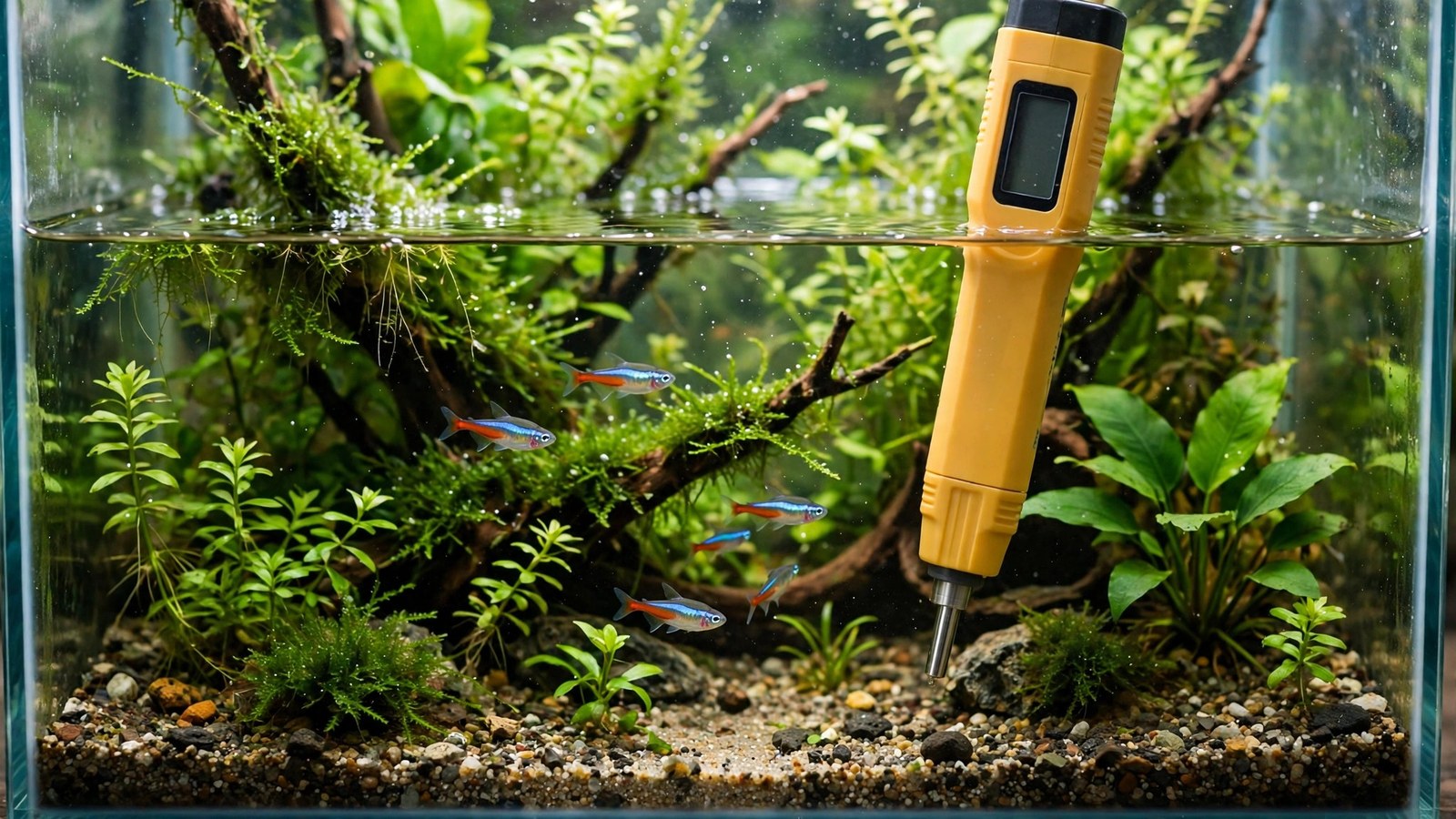
A dying pH pen doesn't die — it starves. The glass bulb needs to stay hydrated in potassium chloride storage solution, and almost nobody does it, which is why so many meters "work for a month, then go crazy." If you're hunting for the best pH pen aquarium keepers can rely on, the winning pick is almost never the most accurate one on paper — it's the one whose owner actually calibrates it and stores it wet.
The best pH pen for aquarium use is one you'll maintain, not the most accurate on paper: a ±0.1 pH pen calibrated monthly and stored wet in KCl storage solution beats a ±0.01 pH pen stored dry. Wet storage in KCl (never distilled water) is what separates a pen that lasts 1–2 years from one that drifts into uselessness in weeks.
Why a pH pen earns its keep in a planted tank
pH sits at the center of planted-tank chemistry. It shows whether your aquasoil is still buffering, whether water changes moved the needle, and — most usefully — how much CO2 is actually dissolved in the water. A drop-checker gives you a color guess; a pen gives you a number in seconds. Before you shop, get clear on which water tests actually matter for planted tanks — a pH pen is one tool in the kit, not the whole kit.
A pen is a spot-check tool: dip, read, rinse, cap. If you want a probe that lives in the tank 24/7 and switches your CO2 solenoid, that's a pH controller — a different product class. And drift is normal, so calibration habits beat the spec sheet.
What separates a good pen from a disposable one
Five things decide whether a pH pen becomes a trusted tool or drawer clutter:
- Accuracy that matches the job. Planted tanks live roughly between pH 6.0 and 7.8. A ±0.1 pH pen is plenty — the pH/KH/CO2 estimation method breaks down below that anyway.
- Easy calibration. Look for automatic 2-point calibration with recognized pH 4.00 and 7.00 buffers. Pens that need a screwdriver and patience get calibrated never.
- A rugged, waterproof body. IP67 waterproofing and a floatable body protect the glass bulb against the inevitable tank dunk.
- Automatic temperature compensation. pH readings shift with temperature; ATC removes that variable.
- A sealing storage cap. The cap should hold a few drops of storage solution against the bulb. Pens that can't be stored wet die young.
The best pH pen aquarium keepers can buy: 5 testers compared
Every pen below is a real, widely used model with verifiable specs. Prices are approximate street prices; what matters is the trade-off each one forces.
| Pen | Accuracy | Calibration | Standout trait | Approx. price |
|---|---|---|---|---|
| Apera Instruments PH20 | ±0.1 pH | Auto, 1–3 point | IP67 waterproof, floats | ~$50 |
| Apera Instruments PH60 | ±0.01 pH | Auto, 1–3 point | Replaceable probe | ~$80 |
| Hanna HI98107 (pHep) | ±0.2 pH | Auto, 1–2 point | Sliver-thin, easiest to carry | ~$35 |
| Milwaukee pH600AQ | ±0.1 pH | Manual, 2-point | Workhorse reliability | ~$40 |
| VIVOSUN pH pen | ±0.1 pH | Auto, 1–3 point | Buffers included, cheapest decent option | ~$14 |
Apera Instruments PH20 — the best all-rounder
The pen you'll see most in experienced keepers' kits. ±0.1 pH accuracy is right-sized for aquarium work, automatic calibration takes under a minute, and the IP67 waterproofing plus floatable body shrug off the tank dunk that kills most meters.
Apera Instruments PH60 — for the precision-minded
Same brand, one step up: ±0.01 pH resolution with a replaceable electrode, for dialing in CO2 via the pH-drop method or running demanding shrimp. About 60% pricier — you'll rarely use the extra digit, but the replaceable probe extends the pen's life past the point a sealed pen becomes trash.
Hanna HI98107 pHep — the pocket classic
Hanna's pHep is the slim veteran of the category: automatic 1–2 point calibration and a case barely bigger than a highlighter. Its ±0.2 pH accuracy is the loosest of the five — fine for routine checks, not for precise CO2 drop math. Pick it when portability and simplicity beat precision.
Milwaukee pH600AQ — the set-and-forget workhorse
The old-school choice: ±0.1 pH accuracy with manual 2-point calibration via a small trimmer screw. Calibration takes longer than auto-cal pens, but the meter is famously durable. A solid pick if you prefer simple tools.
VIVOSUN pH pen — the honest budget pick
Roughly a quarter of the PH20's price: ±0.1 pH accuracy, automatic 3-point calibration, buffer sachets in the box. The catch is consistency — quality control is less uniform than Apera or Hanna. The best way to try a pH pen without commitment, and a fine backup.
How pH readings guide your CO2 setup
The most valuable pH reading in a planted tank is the CO2 drop: measure pH before the CO2 turns on (degassed baseline) and at peak injection. A drop of about 1.0 pH point corresponds to roughly 30 ppm of dissolved CO2 — the sweet spot for most tanks. Read our guide to setting up CO2 in a planted tank before chasing numbers. In a low-tech planted tank setup with no injected CO2, still use a pen for tracking aquasoil buffering — just skip the drop math.
Calibration and storage: the care routine that makes any pen work
Buy pH 4.00 and 7.00 buffers with the pen — they cover the freshwater range. Calibrate on arrival (new pens ship uncalibrated), then monthly, and any time a reading surprises you. If your tank has read 6.8 for months and today says 5.9, the answer is almost always "calibrate," not "panic."
Between uses, the bulb should never sit dry — fill the cap with KCl storage solution, not buffer, not tap water. If readings drift within days of calibration, soak the probe in probe-cleaning solution (diluted white vinegar works in a pinch). Keep the pen away from the bleach dip you use for new plants — chlorine on the bulb ruins calibration fast. A probe that won't hold calibration after a cleaning soak has reached end of life, usually 1–2 years for sealed pens.
Frequently Asked Questions
Do I need a pH pen if I already have test strips?
For planted tanks, yes — or at least a liquid test. Strips resolve pH in coarse 0.5–1.0 steps with colors that are hard to read consistently. A pen resolves 0.1 pH in seconds, which the CO2-drop method and long-term aquasoil tracking need.
How often should I calibrate my aquarium pH pen?
Calibrate a new pen on arrival, then monthly with pH 4.00 and 7.00 buffers — that covers the freshwater range. Recalibrate any time a reading looks wrong or after weeks of disuse. Wet-stored pens hold calibration far longer than dry-stored ones.
Can I use a pH pen in a saltwater or brackish tank?
Yes — all five pens here read the full 0–14 range and work in marine water. High-salt solutions can shorten electrode life and slow response slightly, so rinse well and store the probe properly between uses.
Why does my pH pen give different readings every time?
Almost always one of three causes: a dry-stored probe (soak it in storage solution for a few hours), an overdue calibration, or a bulb coated in fertilizer salts and aquasoil acids. Clean the bulb with probe cleaner or diluted white vinegar, then recalibrate.
Is a ±0.01 pH pen worth the extra cost over ±0.1?
Only for precision CO2 tuning (the pH-drop method for high-tech tanks) or sensitive shrimp, where tenths matter. For routine monitoring — is my aquasoil still buffering, did my water change move pH? — ±0.1 pH is plenty.
The bottom line
The best pH pen aquarium keepers actually benefit from is the one that gets calibrated and stored wet — which makes the Apera PH20 the default: accurate enough, waterproof, and painless to maintain. Whichever you choose, buy storage solution on the same order. Apera's official PH20 specifications confirm the ±0.1 pH accuracy and IP67 rating quoted above.