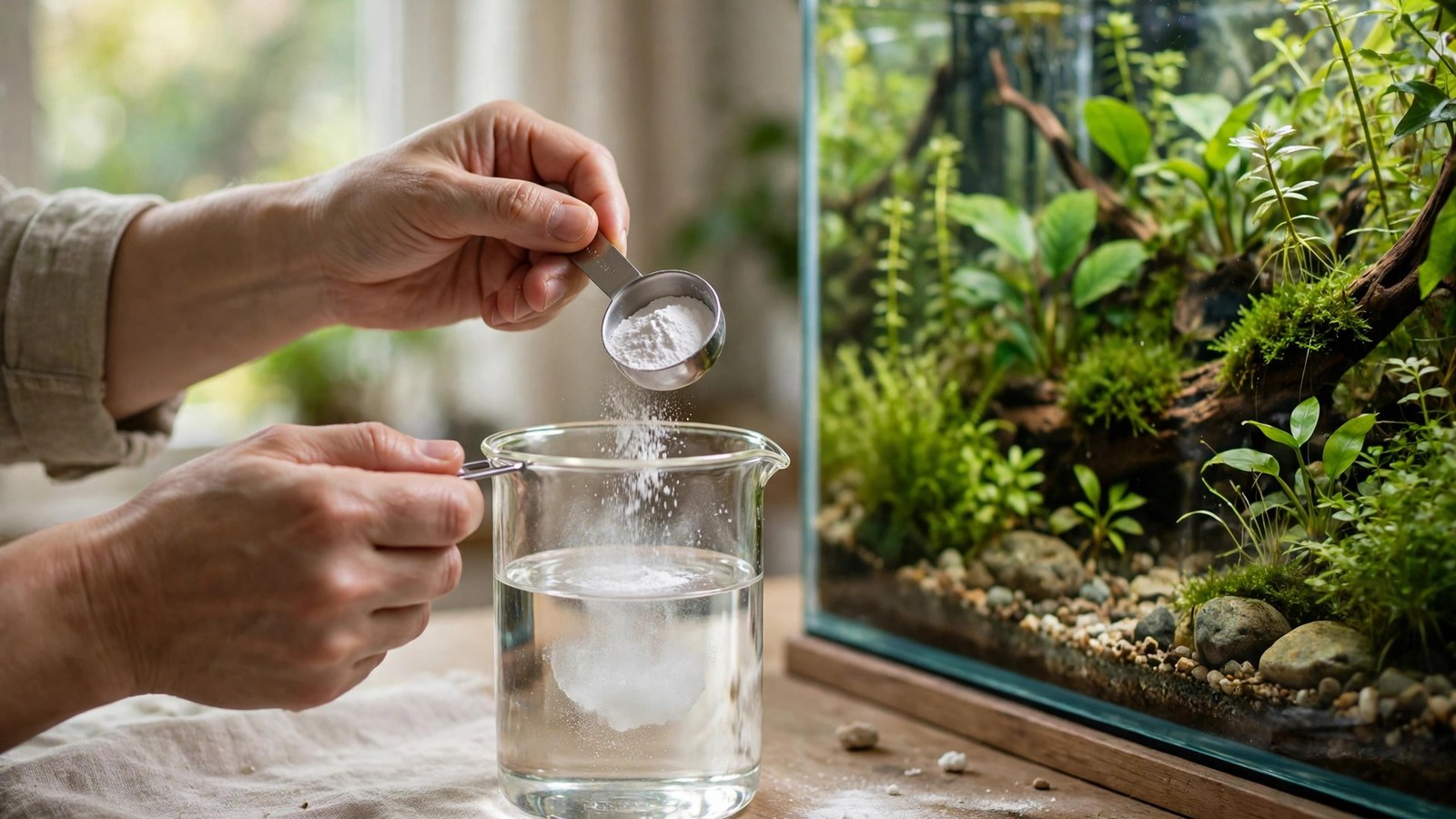
Reverse-osmosis (RO) water is the blank slate of the hobby: pure H₂O with virtually nothing dissolved in it. That purity is exactly why sensitive plants, shrimp breeders, and precision-focused keepers love it — and exactly why using it straight will wreck your tank. Pure RO has no carbonate hardness (pH crashes), no general hardness (plants can't get calcium or magnesium), and no buffering against anything. Remineralizing RO water — adding back the right minerals in the right amounts — turns that blank slate into ideal planted-tank water. Here's how.
Why Remineralize: What Pure RO Lacks
Plants need dissolved minerals that pure RO doesn't have:
- Calcium (Ca) and magnesium (Mg) — the core of general hardness (GH). Calcium builds cell walls; magnesium sits at the center of every chlorophyll molecule. Without them, new growth twists, deforms, and pales — deficiencies no fertilizer fixes, because fertilizers don't supply GH minerals.
- Carbonates/bicarbonates — carbonate hardness (KH), the pH buffer. Zero KH means pH swings wildly with CO2 injection or even day/night cycles. Livestock stress, biofilter instability, plant stress.
- Trace minerals — tap water carries small amounts of everything; RO strips them all. Fertilizer covers most, but the mineral baseline matters.
The symptoms of unremineralized RO use: twisted, stunted new growth (calcium deficiency), interveinal chlorosis on new leaves (magnesium deficiency — often misdiagnosed as iron deficiency), pH crashes, and livestock stress. If you're on RO and seeing these despite good fertilizing, minerals — not fertilizer — are the gap.
Understanding GH and KH Targets
Before mixing anything, know your targets. For most planted community tanks:
| Parameter | Target range | Why |
|---|---|---|
| GH (general hardness) | 4–8 dGH | Supplies Ca/Mg for plants and livestock; 6 dGH is the sweet spot |
| KH (carbonate hardness) | 2–5 dKH | Buffers pH; 3 dKH handles CO2 injection safely |
| Ca:Mg ratio | ~3:1 to 4:1 | Plants use more calcium; excess Mg relative to Ca causes issues |
| TDS | 120–200 ppm | Rough proxy for total minerals; confirms your mix |
Special cases: shrimp breeding (caridina) often wants lower KH (0–2 dKH) with buffering soil; very soft-water plants tolerate GH 3–4; hard-water species (vallisneria, some swords) appreciate GH 8–12. But 6 dGH / 3 dKH grows essentially everything well — it's the universal starting point.
Pair with Equilibrium: the test kit verifies GH actually hits the target the powder is dosed for: API GH & KH Test Kit.
Remineralizers: Products and DIY
Commercial remineralizers
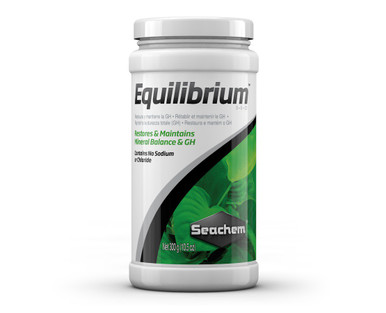
- GH-only products (Salty Shrimp GH+, Seachem Equilibrium): add calcium, magnesium, and potassium without carbonates. The standard choice for aquasoil tanks — the soil already buffers pH low and strips KH, so adding KH fights the soil. GH-only + aquasoil is the classic combination.
- GH/KH combined products (Salty Shrimp GH/KH+, Seachem Alkaline Buffer + Equilibrium): add both. For inert substrate tanks where you want the full buffer.
- Follow the product's dosing to reach your target — most are calibrated so a measured scoop per gallon hits a known dGH. Verify with your own test kit the first few batches (products vary, and your RO unit's output varies).
 ★4.7
Seachem Equilibrium 300g
Check Price on Amazon ★4.7DIY remineralizing
- GH: calcium sulfate (CaSO₄, gypsum) + magnesium sulfate (MgSO₄, Epsom salt) in ~3:1 ratio. Roughly 1.5 g CaSO₄ + 0.5 g MgSO₄ per 10 gallons raises GH by ~2 dGH. Dissolve fully before adding.
- KH: sodium bicarbonate (baking soda, NaHCO₃) — ~0.5 g per 10 gallons raises KH by ~1 dKH. Or potassium bicarbonate (KHCO₃) if you want the KH boost to double as potassium supplementation.
- DIY is dramatically cheaper for large volumes but requires a gram scale and test-kit verification. Commercial products are pre-balanced and foolproof — worth the premium for most keepers.
The Remineralizing Procedure
- Start with verified RO water. Check TDS — good RO reads 0–10 ppm. If it's creeping above 15–20 ppm, your membrane needs replacing, and you're remineralizing on top of unknown minerals.
- Add remineralizer to the storage container (not directly to the tank). Dose per product instructions or your DIY recipe for the target GH/KH.
- Mix thoroughly — stir or shake, then wait 10–15 minutes for full dissolution. Undissolved powder settling in the tank causes localized parameter spikes.
- Test GH and KH of the mixed water. Adjust if needed (more product if low; dilute with plain RO if overshot).
- Match temperature to the tank (within 2°F), then use for water changes normally — see our water change technique.
- Log your recipe. "2 scoops per 5 gallons = 6 dGH" — write it on the container. Consistency is the entire point of RO; a logged recipe makes every batch identical.
Top-offs vs. water changes: evaporation removes pure water, leaving minerals behind — so top off evaporated water with plain RO (no remineralizer), and use remineralized RO only for actual water changes. Remineralizing top-off water causes hardness to creep upward relentlessly. This is the most common RO beginner mistake.
A reliable pick here is HM Digital TDS-3.
RO + Aquasoil: The Special Relationship
RO water and aquasoil are the precision keeper's combination, but they interact:
- Aquasoil strips KH and releases humic acids — with RO's zero KH, pH settles low (5.5–6.5). This is normal and desirable for most planted setups and caridina shrimp.
- Use GH-only remineralizer with aquasoil — adding KH fights the soil's buffering and exhausts it faster. Let the soil do the pH work; you supply the GH.
- Aquasoil's KH-stripping means your tank KH reads near zero even though that's fine — don't "fix" it with baking soda. The soil is the buffer now.
- As aquasoil ages and its buffering depletes (see old tank syndrome), pH may start swinging — that's the signal the soil is exhausted, not that your remineralizing is wrong.
RO + CO2: pH Behavior
With low-KH RO water, CO2 injection drops pH more dramatically than in hard tap water — a 1.0 pH drop from CO2 is normal and safe (it's carbonic acid, which livestock tolerates far better than mineral-acid pH drops). Don't chase a "target pH" — chase the 1.0 pH drop from degassed baseline, which indicates ~30 ppm CO2 regardless of KH. Measure baseline by letting a cup of tank water sit out 24 hours, then compare to tank pH mid-photoperiod.
Troubleshooting Remineralized RO
- Twisted new growth persists: calcium too low relative to magnesium, or overall GH too low. Verify Ca:Mg ratio (~3:1) and raise GH toward 6–8.
- pH crashes: KH too low for your setup (non-aquasoil tanks need 2+ dKH). Add KH via baking soda or switch to a GH/KH remineralizer.
- GH creeps up over weeks: you're remineralizing top-off water. Top off with plain RO only.
- White crust on lid/equipment: normal mineral deposits from evaporation — wipe during maintenance. Excessive crusting suggests GH set too high.
- Plants fine, shrimp dying: TDS or GH swings between batches — your mixing isn't consistent. Measure every batch until the recipe is dialed, then spot-check monthly. Shrimp punish inconsistency harder than plants do.
- Green spot algae explosion after switching to RO: sometimes the purity reveals a phosphate limitation that hard tap water was masking (tap often carries phosphate). Slightly increase phosphate in your fertilizer — the RO didn't cause a problem, it revealed one.
Frequently Asked Questions
Is RO water worth it, or is my tap water fine?
Test your tap first. If it's moderately hard (GH 4–12, KH 3–8), low in nitrates/phosphates, and consistent year-round, tap water grows beautiful planted tanks — most keepers never need RO. RO earns its keep when: tap is extremely hard/soft, carries high nitrates or contaminants, fluctuates seasonally, or you're breeding sensitive shrimp or growing demanding soft-water species. Don't buy an RO unit to fix a problem you don't have.
Can I mix RO and tap water instead of remineralizing?
Yes — cutting tap with RO is a legitimate middle path. A 50/50 mix halves your tap's hardness and contaminants while retaining enough minerals to skip remineralizing (verify with GH/KH tests). It's less precise than full RO + remineralizer but far simpler and cheaper. Many keepers run 50/50 or 70/30 RO/tap blends happily for years.
How do I store RO water?
Food-grade brute trash cans or dedicated water barrels with a lid — keep it dark (light grows algae in stored water) and use within a week or two. A small powerhead for circulation prevents stagnation; a heater brings it to tank temperature before use. Label remineralized vs. plain clearly — grabbing the wrong container is an easy mistake with real consequences.
Do I need to remineralize for a low-tech tank?
If using RO, yes — low-tech plants need calcium and magnesium just as much as high-tech ones (arguably more, since growth is slower and deficiencies accumulate silently). The targets are the same (4–8 dGH); only the fertilizer gets leaner, not the minerals. Unremineralized RO in a low-tech tank produces the same twisted, pale growth — it just takes longer to notice.
What's the difference between GH booster and a full remineralizer?
GH boosters (like Seachem Equilibrium) add general hardness minerals (Ca, Mg, K) but no carbonates — they raise GH only. Full remineralizers (like Salty Shrimp GH/KH+) raise both GH and KH. Use GH-only with aquasoil (soil handles pH/KH); use GH/KH with inert substrates (nothing else buffers pH). Matching the product to the substrate is the key decision.
Blank Slate, Built Right
RO water's promise is total control — the same water, every time, tuned exactly to your tank's needs. Remineralizing is the price of that promise: a measured scoop, a test kit check, a logged recipe, and the discipline to top off with plain RO. Do it right and your water becomes the most boring, predictable, drama-free part of the hobby — which is exactly what water should be.