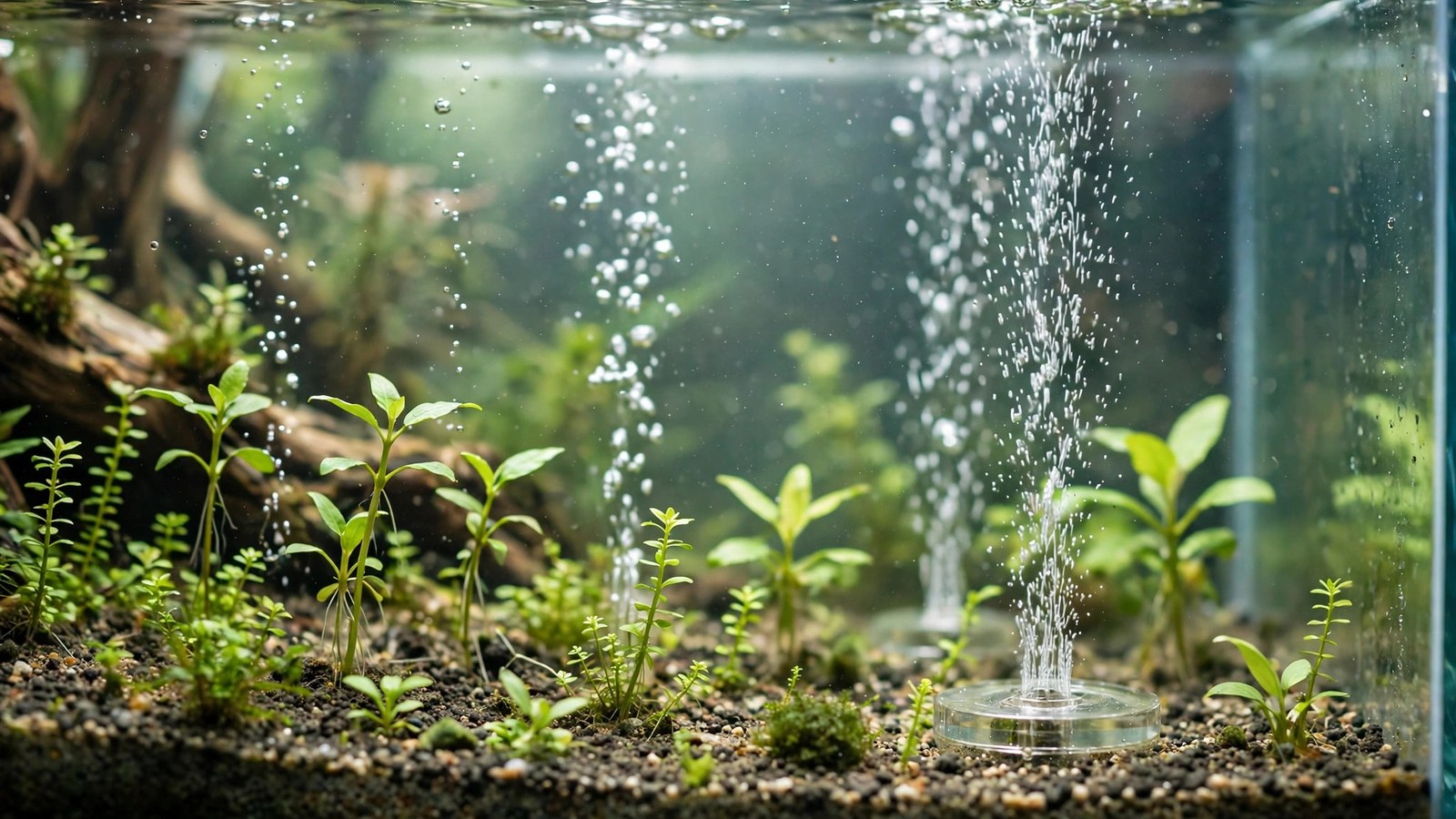
You've been running low-tech for a year and finally bought the CO2 system. Or you're cranking the bubble rate up for a red-plant push. Or the solenoid stuck and levels swung wildly. However it happens, acclimating plants to new CO2 levels — up or down — is a transition that deserves the same care as acclimating new livestock. Plants build their entire photosynthetic machinery around the carbon level they've been living with, and sudden changes cause melting, stalled growth, and algae blooms that look like mysterious failures but are really just transition shock.
Why CO2 Changes Shock Plants
Plants adapt to ambient CO2 at a cellular level. In low-CO2 conditions, they invest in carbon-concentrating mechanisms and larger leaf surface areas to scavenge scarce carbon; enzymes like Rubisco are tuned to the available supply. When CO2 suddenly increases 10–30x (going from ~3 ppm atmospheric diffusion to 30 ppm injected), that carefully tuned machinery is suddenly wrong for the environment.
The plant's response: shed the old leaves built for the old regime and grow new ones optimized for the new one. Sound familiar? It's the same logic as emersed-to-submersed transition melt — the plant remodeling itself for new conditions. The melt isn't damage from the CO2 itself; it's the plant rebuilding. Understanding this reframes the whole process: some melt during CO2 transitions is normal adaptation, not a sign you've done something wrong.
The reverse — dropping CO2 levels (equipment failure, intentional downshift, moving plants to a low-tech tank) — is often harder on plants. Leaves built for carbon abundance suddenly can't sustain themselves on atmospheric CO2, and the plant must scale back growth dramatically. Expect heavier melt going down than going up.
Going Up: Introducing or Increasing CO2
The 2-week ramp
Never go from zero to full injection overnight. The ramp:
- Days 1–3: Run at ~30% of your target bubble rate. Drop checker should read blue-green — barely into the CO2 zone. Plants notice the change; livestock barely does.
- Days 4–7: Increase to ~60% of target. Drop checker trending green. Watch livestock in the evenings — any gasping or lethargy means hold here.
- Days 8–10: Increase to ~80% of target.
- Days 11–14: Reach full target rate. Drop checker a solid green (not yellow) during the photoperiod.
Adjust the ramp to livestock response, not the calendar — if fish show stress at 60%, hold at 50% for a week before continuing. The plants can wait; the fish can't.
What to expect from the plants
- Week 1–2: A growth pause or slight melt on older leaves as plants begin remodeling. New growth may look slightly different — often smaller, more compact leaves (high-CO2 growth is typically denser).
- Week 3–4: New growth accelerates visibly. This is when the payoff starts — faster growth, better color, pearling (oxygen bubbles on leaves) during peak photosynthesis.
- Week 6–8: Full transition complete. Old-regime leaves mostly replaced. Growth rate and form now reflect the new CO2 level.
Supporting the upward transition
- Increase fertilizer proportionally. Faster growth means faster nutrient uptake — a tank that was balanced low-tech will develop deficiencies within weeks of CO2 injection if dosing doesn't increase. This is the moment to adopt EI dosing or scale up your all-in-one dose. Nutrient demand follows growth; growth just accelerated.
- Keep light stable during the ramp. Don't increase light and CO2 simultaneously — change one variable, stabilize for two weeks, then change the other. Stacked changes make problems undiagnosable.
- Maintain the ramp schedule for water changes. Faster growth means more organics; keep up water changes diligently through the transition.
- Remove melting old-regime leaves promptly per our dead-leaf protocol — they rot and feed the transition algae.
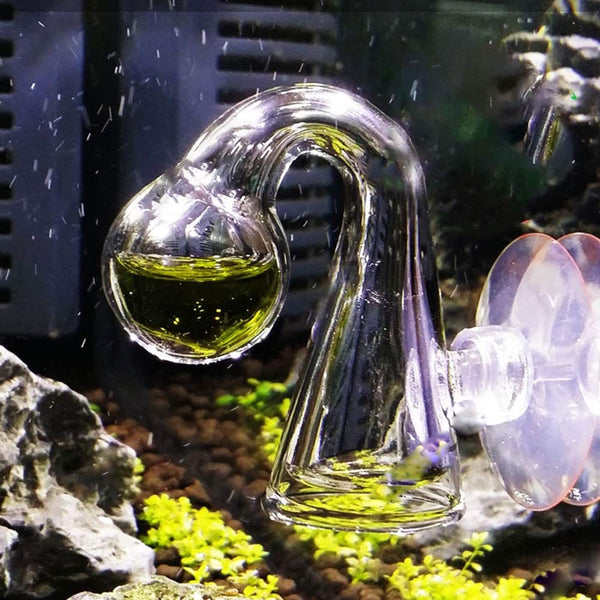
Reference as the cheap visual tool to confirm CO2 actually reaches target levels during the upward ramp: glass CO2 drop checker.
 ★4.6
FZONE Glass CO2 Drop Checker Kit
Check Price on Amazon ★4.6Going Down: Reducing or Removing CO2
Whether it's intentional (simplifying to low-tech — see our downshifting guide) or accidental (empty cylinder, broken solenoid), dropping CO2 needs even more care:
The downward ramp (when planned)
- Week 1: Reduce to 70% of current rate.
- Week 2: Reduce to 40%.
- Week 3: Reduce to 15–20% or off entirely.
- Slower than the upward ramp, because the plant is losing its primary growth driver and needs time to rebuild low-CO2 machinery.
When it happens suddenly (equipment failure)
- Immediately reduce light — drop photoperiod to 6 hours and intensity 20–30%. High light with suddenly-low CO2 is the fastest route to a catastrophic algae bloom. Light is the variable you can change today.
- Reduce fertilizer to half — the plants can't use full dosing without carbon to match.
- Expect significant melt over the next 2–4 weeks, especially in demanding stems. This is normal for a sudden downshift — remove dead material aggressively and be patient.
- Don't reintroduce CO2 at full blast when the equipment is fixed — ramp back up over a week. The plants have started adapting down; slamming them back up is a second shock.
Supporting the downward transition
- Accept slower growth as the new normal — not a problem to fix. The tank is finding its new equilibrium.
- Consider replacing the most CO2-dependent species with low-tech champions rather than watching them decline for months. There's no shame in editing the plant list to match the tank's new reality.
- Watch for algae during weeks 2–6 — the transition window is when the tank is most vulnerable. Extra manual removal and consistent water changes carry you through.
CO2 Stability: The Thing That Matters More Than the Level
Here's the insight experienced keepers internalize: plants adapt to almost any stable CO2 level, but they suffer under fluctuating levels. A tank at a steady 15 ppm grows beautifully; a tank swinging between 10 and 30 ppm grows staghorn and BBA. The acclimation principle extends into permanent practice:
- CO2 on/off timing: Start injection 1–2 hours before lights on (so levels are at target when photosynthesis begins) and stop 1 hour before lights off. A timer-controlled solenoid on your CO2 regulator isn't optional for serious CO2 use — it's the stability mechanism.
- Surface agitation consistency: Changing filter flow or adding/removing airstones alters CO2 off-gassing, swinging dissolved levels. Keep surface agitation constant day to day.
- Cylinder monitoring: A cylinder running empty causes a slow decline over days — the worst kind of fluctuation because it's invisible until the algae arrives. Check pressure monthly; refill at 25% remaining, not 5%.
- Drop checker discipline: It's a slow instrument (2-hour lag) but an honest one. Check it at the same time daily — mid-photoperiod. Green means you're in the zone; trending blue over days means something's drifting.
Species-Specific CO2 Transition Notes
- Fast stems (rotala, ludwigia): Transition fastest — melt and regrow within 3–4 weeks. The most dramatic transformers; also the most forgiving.
- Carpeting plants (HC Cuba, monte carlo, dwarf hairgrass): Slow to show change, then sudden improvement (going up) or sudden melt (going down). Carpets commit fully to the new regime — give them 6–8 weeks to judge.
- Anubias, java fern, bucephalandra: Barely notice CO2 changes — slow metabolism means slow response in both directions. Don't judge your transition by these; judge by the stems.
- Crypts: May melt from the disturbance of any significant change, including CO2 shifts. Standard crypt rules apply: leave the roots alone, wait 4 weeks.
- Vallisneria: Sensitive to some liquid carbon supplements (not gas CO2 — gas is fine). If you're transitioning from liquid carbon to gas, vals often improve dramatically.
Note that rising CO2 raises nutrient demand; a half-dose of comprehensive liquid fertilizer covers the gap: Seachem Flourish.
Frequently Asked Questions
How long does CO2 acclimation take?
Visible adaptation in 2–4 weeks, full transition in 6–8 weeks. Fast stems show it first; carpets and slow growers take the full two months. Judge by new growth, not old leaves — old-regime foliage never fully adapts, it gets replaced. If new growth after 8 weeks still looks poor, the issue isn't acclimation anymore — it's the current parameters.
Will adding CO2 melt my existing plants?
Some melt of older leaves is common and normal — the plant is replacing low-CO2-adapted foliage with high-CO2-adapted foliage. What's not normal: total plant collapse, mushy crowns/rhizomes, or melt that continues worsening past week 4. Normal transition melt peaks around week 2–3 and then visibly reverses as new growth takes over.
Should I change fertilizer when I start CO2?
Yes — increase it. CO2 injection typically doubles or triples growth rates, and nutrient uptake scales accordingly. A tank balanced without CO2 becomes deficient within 2–4 weeks of injection if dosing stays flat. Increase your all-in-one dose 50–100%, or adopt EI — and watch for the classic post-CO2 deficiencies (potassium pinholes and iron paleness show up first).
My CO2 ran out for a week — how bad is it?
Recoverable, but act fast: reduce light immediately (6-hour photoperiod), halve fertilizer, and ramp CO2 back up over 5–7 days once refilled — don't slam it back to full. Expect some melt and a possible minor algae episode over the next 2–3 weeks. The biggest mistake is doing nothing ("it's only a week") while running full light into a carbon crash — that's what turns a hiccup into a bloom.
Can plants go from high CO2 to no CO2 and survive?
Most can, but expect a rough 4–8 weeks and be prepared to lose the most demanding species. Hardy plants (anubias, java fern, crypts, swords, vallisneria, most hygrophila) make the transition fine. Demanding stems and carpets (HC Cuba, rotala wallichii, ammannia) often don't — plan to replace them with low-tech-appropriate species rather than nursing them through a transition they won't complete. Our downshifting guide covers the full process.
Change It Gradually, Then Leave It Stable
CO2 acclimation has two rules: ramp changes over 1–3 weeks instead of overnight, and once you've arrived, hold the level rock-steady. Plants are remarkably adaptable to any stable carbon level and remarkably unhappy with fluctuation. Treat CO2 like temperature — the absolute value matters less than the constancy — and your plants will do the adapting. They've been doing it for 400 million years; they just need you to give them the time.