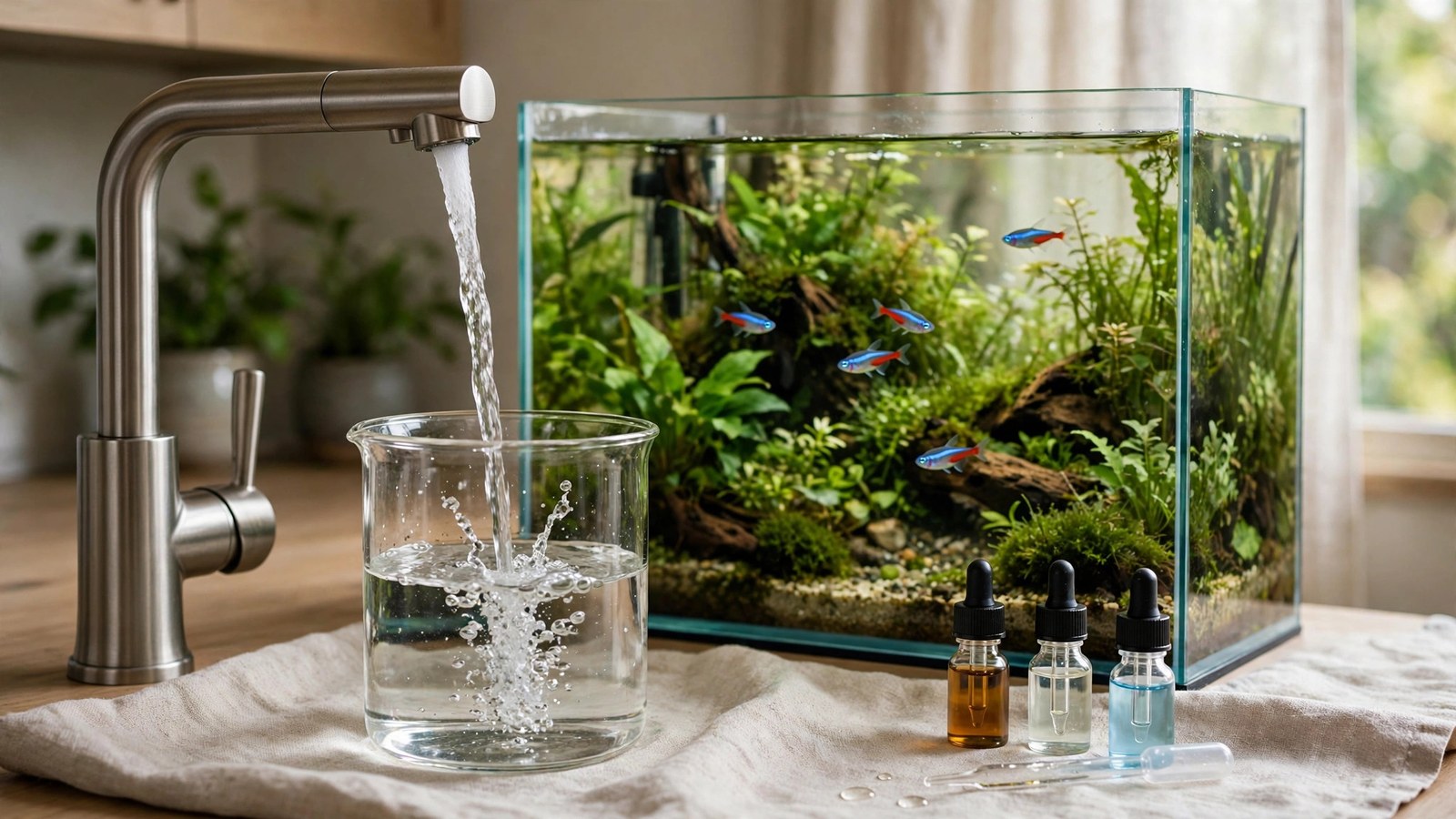
Most planted-tank failures blamed on bad lighting or missing fertilizer actually start at the faucet. A water change with untreated tap water can bleach leaves overnight — or wipe out the bacteria keeping your tank stable. The good news: if you're asking is tap water safe for aquarium plants, the answer is yes — as long as you test it once and treat the two or three things that matter. Here's exactly what to check and the five-minute protocol that makes tap water plant-safe.
Is Tap Water Safe for Aquarium Plants? The Honest Answer
So, is tap water safe for aquarium plants? For most people, yes — with one non-negotiable step. Municipal water is disinfected with chlorine or chloramine, and both damage plants at tap concentrations. The rest is refinement: hardness and pH decide how well plants grow, not whether they survive the day. For the full destination numbers, see our guide to planted tank water parameters.
Think of it as a two-tier problem. Tier one is safety: chlorine, chloramine, and copper must be at zero — no exceptions. Tier two is suitability: pH, GH, and KH fine-tune growth, and you can handle them at your leisure once tier one is covered.
Chlorine and Chloramine: The Deal-Breakers
Utilities disinfect with either chlorine or chloramine, and most now use chloramine because it stays active longer in pipes. That distinction matters: chlorine off-gasses if water sits 24–48 hours with aeration, but chloramine does not. The "let it sit overnight" trick fails on chloraminated water and can cost you an entire planting.
Both damage plant tissue at tap concentrations (0.5–4.0 ppm). First signs are translucent or bleached leaf tips, especially on fine-leaved stems, followed by stalled growth. Worse, chloramine's ammonia component hits the nitrogen cycle all at once when neutralized — so use a dechlorinator that specifically handles chloramine, not just chlorine.
The fix is cheap and instant: dose roughly 1 mL per 40 liters, treating the bucket before water goes into the tank. One bottle usually lasts a year of weekly changes.
Hardness and pH: When Your Tap Water Needs Help
General hardness (GH) is dissolved calcium and magnesium — both plant macronutrients, so moderately hard water is free fertilizer. Carbonate hardness (KH) buffers pH. Typical ranges:
| Parameter | Ideal range | Typical tap water | Verdict |
|---|---|---|---|
| pH | 6.5–7.5 | 6.8–8.2 | Usually fine; above 8.0 consider driftwood or RO dilution |
| GH | 4–8 dGH | 3–12 dGH | Free minerals — great; above 12 dGH, mix with RO water |
| KH | 3–5 dKH | 2–8 dKH | Buffers pH; below 2 dKH, watch for pH swings |
| Copper | 0 ppm | 0–0.3 ppm | Above 0.05 ppm is dangerous |
Very hard, alkaline water (pH 8.0+, GH 12+ dGH) doesn't poison plants, but it locks out iron — you'll see yellowing between leaf veins on species like Rotala. The practical fix is a 50/50 RO mix for water changes. For most low-tech setups that's overkill: hardy species grow happily in hard water once dechlorinated. If your tank is undemanding, do low-light plants need fertilizer explains why — tap-water minerals often cover the basics.
Copper, Pipes, and Other Hidden Contaminants
Copper is the contaminant nobody tests for and everybody should. Trace amounts are a required micronutrient, but above 0.05 ppm it stunts root tips and slowly poisons the system. Old plumbing leaches the most — especially the first draw of the morning, when water has sat in pipes overnight. Other occasional guests: lead from old service lines and nitrate spikes from agricultural runoff.
Run the cold tap 60 seconds before collecting tank water — this flushes the standing water that's contacted pipes longest. If copper still reads above 0.05 ppm, a chelating dechlorinator (one that binds heavy metals) or a carbon pitcher filter solves it.
How to Test Tap Water Before It Touches Your Tank
You only need to do this thoroughly once. Test straight-from-the-tap water first, then a dechlorinated test bucket to confirm your protocol works. A liquid kit plus GH/KH and copper tests costs about as much as two dechlorinator bottles. Strips work for routine spot-checks but are too coarse for the first diagnosis.
| What to test | Test the tap | Retest |
|---|---|---|
| Chlorine/chloramine | Yes — confirms your utility's disinfectant | After dechlorinating (must read 0) |
| pH | Yes — twice, a week apart | Only if you adjust it |
| GH / KH | Yes — one reading is enough | Only if you dilute with RO |
| Copper | Yes — first draw of the morning | After flushing the tap 60 seconds |
| Ammonia / nitrate | Yes — flags utility surprises | Rarely needed again |
Your utility publishes free data: every US supplier issues an annual Consumer Confidence Report with average chlorine, hardness, and pH — find yours via the EPA's consumer confidence report locator. It reveals whether your city uses chlorine or chloramine.
Treating Tap Water: The 5-Minute Protocol
- Collect cold water in a tank-dedicated bucket (never soap-touched). Flush the tap 60 seconds first if you have old pipes.
- Dechlorinate before the water goes anywhere near the tank — roughly 1 mL per 40 liters, stirred in. Wait two minutes.
- Match temperature within 2°F (1°C) of the tank. Cold shock stunts roots fast.
- Pour gently — a plate or your hand breaks the stream so substrate and roots don't shift.
That's the routine for most households. Tap water already carries calcium and magnesium, so skip extra minerals unless a GH test says otherwise — plants usually need fertilizer only after they're established. For timing, see when to fertilize a new planted tank; for deficiencies, the aquarium plant micronutrients dosing guide helps you diagnose them.
Setting up a new tank? Prep the plants too: remove rock wool from new aquarium plants before planting so roots reach your (now safe) water. And don't panic if newcomers melt in the first week — how long aquarium plants take to root explains the normal adjustment window.
Frequently Asked Questions
Can I use tap water directly for a planted tank without treating it?
No. Untreated tap water contains chlorine or chloramine at levels that damage plant tissue and kill beneficial bacteria. Always add a dechlorinator before water touches your tank — a two-minute step costing pennies per change. Disinfection removal is mandatory; everything else is refinement.
Does letting tap water sit overnight remove chlorine and chloramine?
It removes chlorine only — 24 to 48 hours with aeration off-gasses free chlorine. It does not remove chloramine, which most utilities now use precisely because it's stable. Since you can't tell which one your city uses, always use a chemical dechlorinator instead of guessing.
Is hard tap water bad for aquarium plants?
Not bad — just limiting for some species. GH of 4–8 dGH is ideal, and up to about 12 dGH grows most common plants well since calcium and magnesium are free nutrients. Above 12 dGH, iron and micronutrient uptake suffers; diluting with RO water is the cleanest fix.
How often should I re-test my tap water?
Do the full panel once when you start the hobby, then spot-check chlorine and pH every 6 to 12 months. Utilities change disinfectant doses seasonally, so a quick strip test after any "water tastes different" moment is smart. Re-test fully only if you move or plants decline for no obvious reason.
What pH of tap water is safe for aquarium plants?
The 6.5–7.5 range suits the widest range of species, and most tap water falls within it. Anything up to about 8.0 works for hardy plants. Stability matters more than a perfect number — a constant 7.8 beats a pH swinging between 6.5 and 7.5 weekly.
The Bottom Line
Tap water is the default source for most successful planted tanks — not a compromise. Test it once, dechlorinate every time, keep copper at zero, and adjust only if pH or hardness are off. Plants don't need lab-grade water — consistent, dechlorinated water from your tap works today.