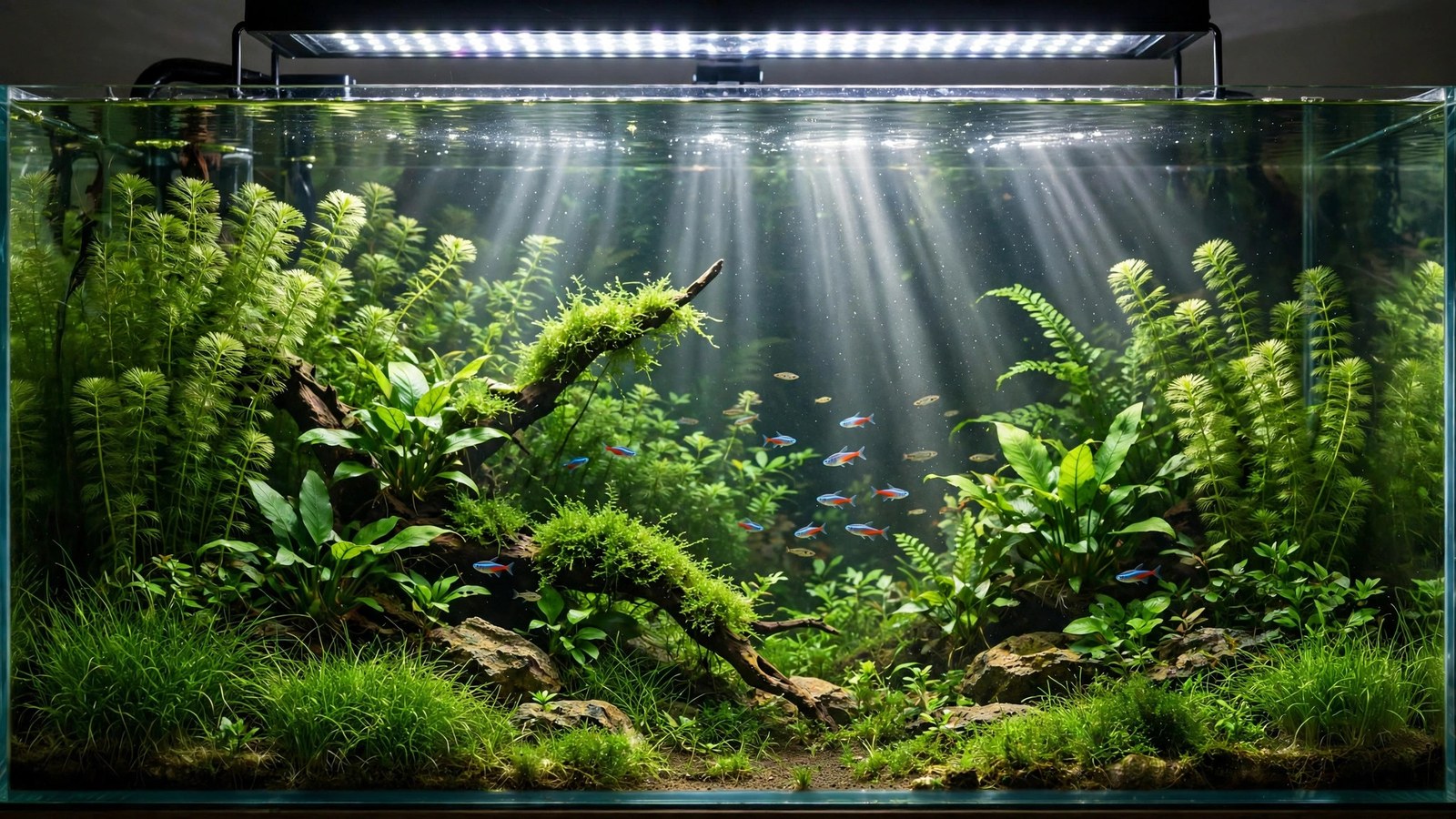
That bright white LED bar you just mounted over your tank looks powerful — but your carpeting plants are melting anyway. Here is the uncomfortable truth: the wattage on the box and how bright the light looks to your eyes tell you almost nothing about whether your plants can actually photosynthesize under it. The aquarium light PAR rating is the one number that does, and by the end of this guide you will know exactly what your PAR is, what your plants need, and how to close the gap between the two.
Aquarium Light PAR Rating: What It Actually Measures
PAR stands for Photosynthetically Active Radiation: the photons in the 400–700 nanometer band that plants can use for photosynthesis. The number you care about is PPFD — Photosynthetic Photon Flux Density — which tells you how many of those usable photons land on one square meter of your substrate every second, written as µmol/m²/s.
Think of it like rainfall. PAR tells you how many raindrops hit each square meter of soil per second. Your plants do not care how much water is sloshing around inside the cloud (watts) or how pretty the rainbow looks to a passerby (lumens) — they care about how much actually lands on them.
A PAR reading is always tied to a specific depth and spot. A fixture that delivers 90 µmol/m²/s directly under the lens at 12 inches might deliver only 25 at the substrate of a 21-inch-tall tank. That is why a single PAR number without a stated depth is nearly meaningless — always check where the manufacturer measured it.
Why Watts and Lumens Lie About Plant Growth
Two of the numbers printed on every light fixture box actively mislead plant keepers. Watts describe electrical power draw — how much electricity the light pulls from the wall. A 60-watt fixture with poor optics can deliver half the usable plant light of a well-designed 30-watt one, because watts say nothing about efficiency or direction.
Lumens describe brightness as perceived by the human eye, which is most sensitive to green-yellow light. Plants, however, are most efficient at absorbing red and blue wavelengths. A fixture engineered to look dazzling to you — pumped full of green-yellow output — can read 3,000 lumens while starving your red plants of the photons they need.
Here is how the four measurements stack up for a planted tank keeper:
| Measurement | What it really tells you | Useful for plants? |
|---|---|---|
| Watts | Electricity consumed by the fixture | No — only affects your power bill |
| Lumens | Brightness as seen by human eyes | No — eyes peak at green, plants do not |
| Kelvin (color temperature) | The visual "color" of the light | Partially — 6,500–7,500K looks natural, but color ≠ intensity |
| PAR / PPFD (µmol/m²/s) | Usable photons landing on your plants per second | Yes — the only number that predicts growth |
Spectrum still matters — a 7,000K full-spectrum light grows red plants better than an all-blue actinic strip at the same PAR — but spectrum is a quality knob, while PAR is the quantity. You need enough quantity before quality can matter. If you are shopping for a new fixture, our guide to the best LED lights for high-tech planted tanks compares models by their published PAR data, not just marketing watts.
How Much PAR Your Plants Actually Need
Plant lighting needs fall into three bands, and the band you target determines everything else about your setup — especially whether you need injected CO2. Pushing past ~50 µmol/m²/s without CO2 is the single most common cause of algae outbreaks in this hobby: the plants cannot use the extra light, so algae does.
| Light band | Substrate PPFD | Typical plants | CO2 needed? |
|---|---|---|---|
| Low light | 15–30 µmol/m²/s | Anubias, Java fern, Java moss, Cryptocoryne, Bucephalandra | No — liquid carbon optional |
| Medium light | 30–50 µmol/m²/s | Swords, Vallisneria, Ludwigia repens, most stem plants, dwarf sag | Helpful but not required |
| High light | 50–100+ µmol/m²/s | HC Cuba, Glossostigma, Monte Carlo carpets, red Rotala, Pogostemon | Yes — injected CO2 is mandatory |
Notice the carpeting plants live at the bottom of the table and the tank. A foreground carpet sits 18–24 inches below the light in a standard 75-gallon tank, exactly where PAR is weakest. If your dream is a lush Monte Carlo lawn, do the PAR math at the substrate, not at mid-water. For week-by-week guidance on dialing in a new fixture, see running the Week Aqua LED for your first month, which walks through photoperiod ramping alongside PAR targets.
How to Find Out What PAR Your Light Actually Delivers
You have four routes to a PAR number, ranked from least to most trustworthy. Use whichever your budget allows — any number beats guessing.
1. Read the manufacturer's PAR chart
Quality brands — Chihiros, Twinstar, AquaIllumination, Fluval — publish PAR measurements at several depths (usually 12, 18, and 24 inches). Find your tank's depth, note whether the chart was measured in air or underwater (water absorbs roughly 5–10% per foot of depth), and write down the substrate value. If your brand publishes nothing, treat that as a red flag about the brand.
2. Apply the inverse-square rule
Have one PAR number but a different mounting height? Light intensity drops with the square of the distance. The math:
New PAR = Old PAR × (Old distance ÷ New distance)²
Example: your fixture delivers 80 µmol/m²/s at 12 inches, but you hang it 18 inches above the substrate. 80 × (12/18)² = 80 × 0.44 = ~36 µmol/m²/s. That single calculation turns a marketing chart into a useful tank-specific number.
3. Estimate with a phone app
Free lux-meter apps use your phone's light sensor to read lux, which you can convert to a rough PPFD using a conversion factor. For typical white planted-tank LEDs, divide lux by 60 to approximate µmol/m²/s. (The exact factor ranges from 50–75 depending on spectrum, so this is a ±25% estimate, not a measurement.) A reading of 2,400 lux ≈ 40 µmol/m²/s — medium light. Apps are great for comparing two spots in your tank or checking how even your spread is.
4. Rent a real PAR meter
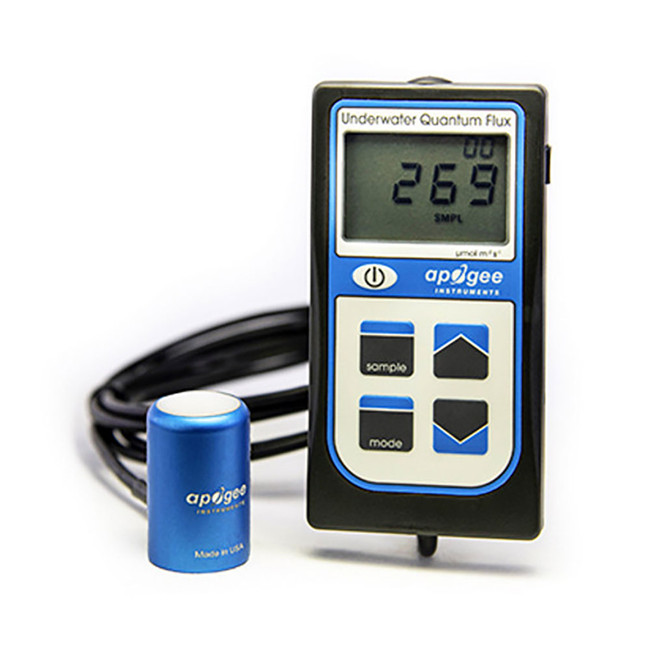
An Apogee MQ-510 full-spectrum underwater quantum meter is the hobby gold standard, and many aquarium clubs and shops rent them for $30–50 per week. Submerge the sensor at substrate level, take readings at the center and four corners, and average them. This 20-minute job removes every guess — you will know your tank's true PPFD map, including dead spots under braces and shaded corners. If you are investing $200+ in a light fixture, a $40 rental is the cheapest insurance in the hobby.
 ★4.4
Apogee MQ-510 Underwater PAR Meter
Check Price on Amazon ★4.4Adjusting Your PAR: Height, Dimming, and Photoperiod
Once you know your number and your target, you have three levers. Each has a different character, so pick the one that matches your problem.
Raise or lower the light
Hanging a fixture 6 inches higher can cut PAR by 40–50% while also widening the spread and softening the harsh center hotspot. This is the fastest fix for algae fueled by excess light, and it costs nothing if your fixture has adjustable mounting legs. Lowering a light has the reverse effect — doubling the perceived intensity of a dim budget fixture without spending a dollar.
Dim the fixture
Most quality LEDs dim to 10% output. If your substrate reads 75 µmol/m²/s but you want a medium-light 40, dim to roughly 55% power. Dimming also runs cooler and extends diode life — fixtures kept below 80% output routinely last 5–7 years instead of 3–4. Smart controllers take this further: storm-cloud mode and other programmed dimming curves simulate passing weather while keeping peak PAR exactly where you set it.
Shorten the photoperiod — carefully
Reducing light from 10 hours to 7 hours a day reduces total daily light (DLI) by 30%, which slows algae — but it does not change PAR, the instantaneous intensity. Photoperiod adjustments are a supplement to getting PAR right, not a substitute. Never try to "fix" a 100-µmol fixture with a 4-hour photoperiod; plants still get scorched at peak, then starve in the dark. Aim for 6–8 hours at the correct PAR instead.
 ★4.6
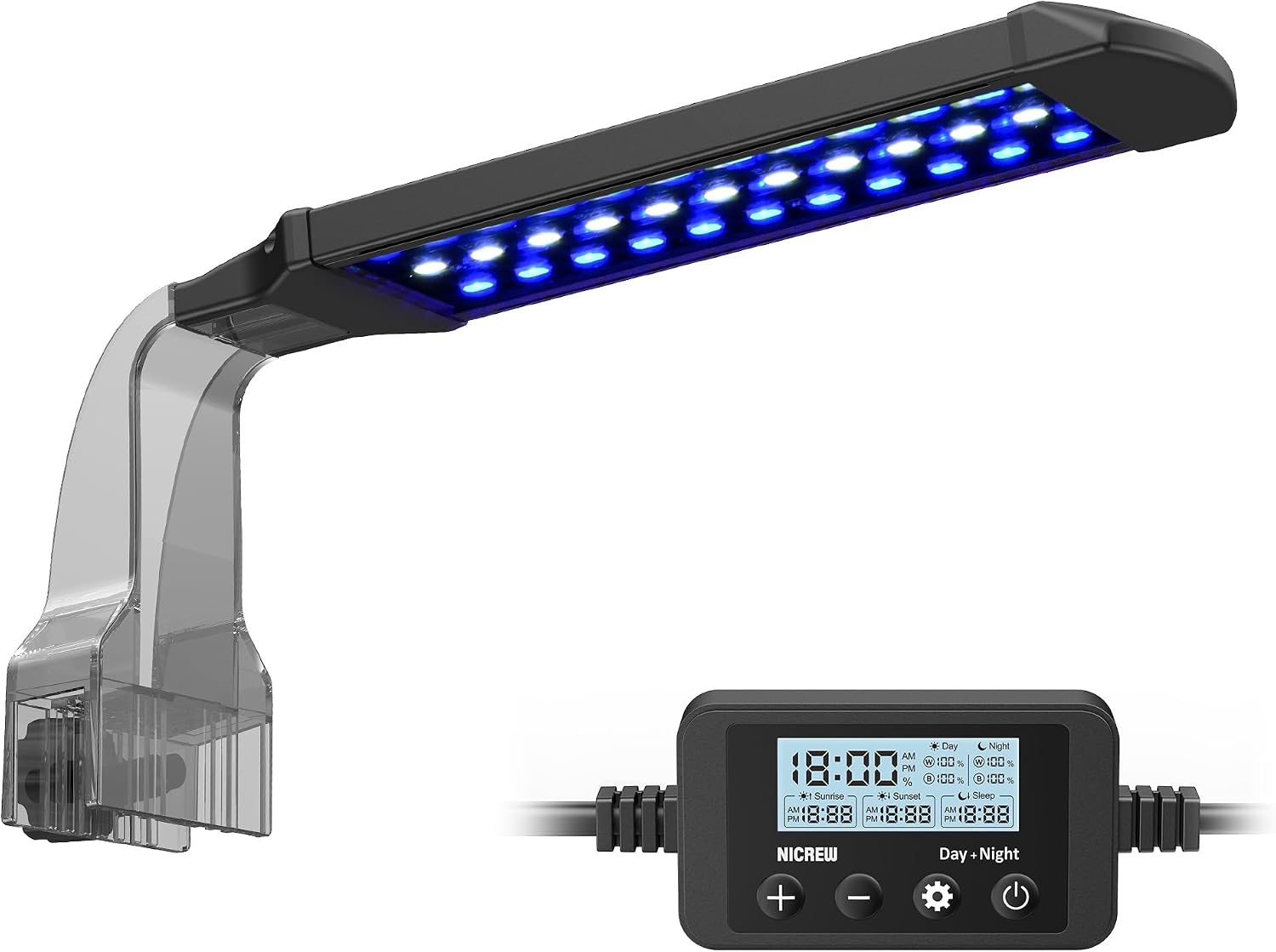
NICREW ClassicLED Plus LED Aquarium Light
Check Price on Amazon ★4.6Putting It All Together: A Worked Example
Say you have a 20-gallon-long tank, 12 inches deep, with a mid-range LED that the manufacturer rates at 65 µmol/m²/s at 12 inches. You mount it 4 inches above the waterline, so the substrate sits 16 inches from the fixture. Inverse-square math: 65 × (12/16)² = 65 × 0.56 = ~37 µmol/m²/s at the substrate. That lands you squarely in medium light — perfect for swords, crypts, and Ludwigia without CO2. You add a 7-hour photoperiod, dose a liquid carbon supplement twice weekly, and your plants pearl within the month. One calculation, one confident setup, no algae spiral.
Running that same fixture on a 24-inch-deep 55-gallon without dimming up would give you roughly 16 µmol/m²/s at the bottom — low light. Same light, completely different tank result. This is why PAR beats watts every time: it travels with the photons all the way to the substrate. If you are comparing CO2 hardware to support a high-light upgrade, start with dual-stage vs single-stage CO2 regulators and disposable cartridges vs refillable cylinders to size the system correctly.
Frequently Asked Questions
Is a higher PAR always better for aquarium plants?
No — PAR is a target, not a score. Each plant species has a saturation point beyond which extra photons do nothing except feed algae. Anubias saturates around 30 µmol/m²/s, while demanding carpet plants keep using light up to 100+. Exceeding a plant's saturation point without adding CO2 is the most reliable way to grow algae instead of plants.
Can I measure PAR with my phone instead of buying a meter?
As a rough estimate, yes. A free lux-meter app plus a conversion factor (lux ÷ 60 for white LEDs) gets you within about ±25% of the true PPFD — good enough to tell low light from high light. But phone sensors vary by model and saturate in bright light, so use apps for comparisons and trend-spotting, then rent an Apogee MQ-510 for a week if you need a number you can act on confidently.
What PAR do I need for a carpeting plant like Monte Carlo?
Monte Carlo and similar carpets want 50–80 µmol/m²/s measured right at the substrate, plus injected CO2 and a rich substrate. The most common failure is measuring PAR at mid-water (where it reads fine) while the carpet sits in 25 µmol shadows at the bottom. If you cannot reach 50 at the substrate, choose a low-light carpet like dwarf sag instead.
Does raising my light really cut PAR that much?
Yes — the inverse-square law is ruthless. Moving a fixture from 12 to 18 inches above the substrate cuts PAR to about 44% of its original value. That makes hanging height the most powerful free adjustment you own. Raise first, dim second, and only buy a new light when neither lever reaches your target band.
How does PAR relate to the photoperiod?
PAR is intensity (photons per second); photoperiod is duration. Multiply them and you get DLI — the total daily light dose. A tank at 40 µmol/m²/s for 8 hours gets the same total light as one at 53 µmol/m²/s for 6 hours, but the plants experience them very differently. Get PAR into the right band first, then tune the photoperiod between 6 and 8 hours to control algae.
Do I need different PAR if I am not injecting CO2?
Absolutely — this is the critical pairing. Without injected CO2, keep substrate PAR at or below 30–40 µmol/m²/s even with "medium light" plants, because carbon becomes the limiting nutrient and surplus light only grows algae. High PAR without CO2 never speeds growth; it just destabilizes the tank. If you want a low-tech setup, see whether CO2 tablets are worth it before considering a light upgrade.
Measure Once, Grow Confidently
PAR turns aquarium lighting from a guessing game into an engineering problem with a right answer. Find your fixture's number, compare it to your plants' band, adjust height or dimming until they match, and keep CO2 in step with the light. Do that one sequence and you will spend your weekends trimming plants instead of scrubbing algae.