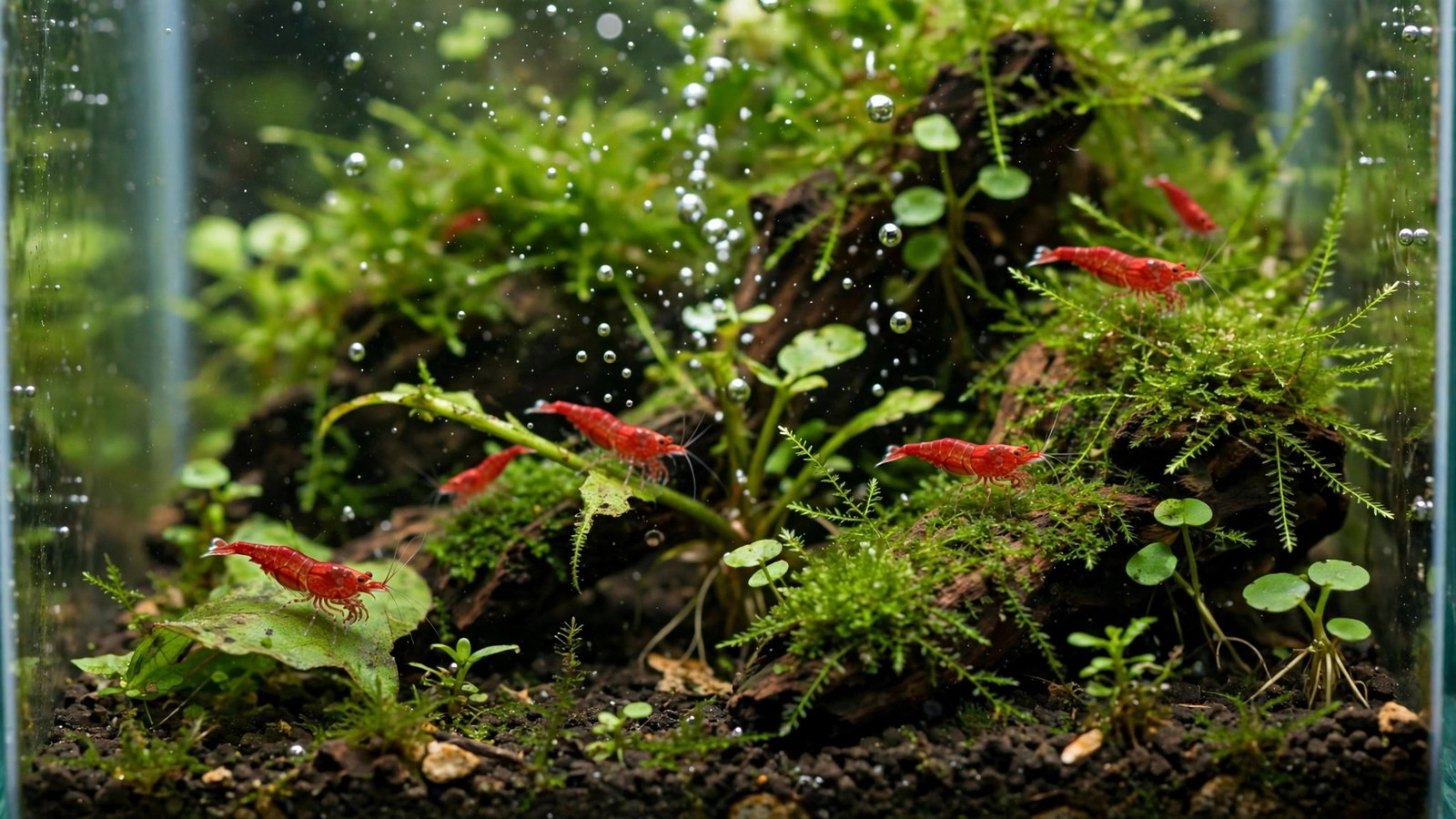
Type "co2 shrimp tank" into any aquarium forum and you'll find two camps shouting past each other: one swearing their cherry shrimp breed happily under a steady stream of CO2, the other insisting CO2 is a shrimp colony's worst enemy. Both are describing something real — because the difference between a thriving planted shrimp tank and a colony wipeout isn't whether you inject CO2, it's how conservatively you dose it. Shrimp are not tiny fish; they react to dissolved CO2, pH swings, and oxygen displacement sooner and harder than anything with gills. The good news is that shrimp and CO2 absolutely can coexist, as long as you treat your colony like the canaries in the coal mine they are and dose with a margin of safety a fish-only tank would find laughably cautious. This is the preventive dosing manual: how to give your plants the carbon they want without ever putting your shrimp in danger.
Why Shrimp Are More Sensitive to CO2 Than Fish
Before touching your needle valve, it helps to understand exactly why shrimp are the most CO2-sensitive livestock in the hobby. It's not superstition — it's biology.
pH Swings and Failed Molts
Injecting CO2 acidifies the water — that's basic chemistry, and it's the main way CO2 affects tank pH. Fish have sophisticated gill and blood buffering systems that let them ride out a moderate daily pH swing. Shrimp don't. A shrimp's armor and gills are far less buffered, and — critically — shrimp must molt to grow and breed. A sudden or steep pH drop can interrupt the molt cycle: you'll see the infamous "white ring of death" (a gap between the carapace and body where the molt stalled) and shrimp dying mid-molt. This is why shrimp keepers fear CO2: a pH swing a tetra would shrug off can kill a berried female mid-molt. Keep your total pH drop during the CO2-on period small and gradual — no more than 0.6–0.8 pH points from morning to midday — and shrimp tolerate it fine.
CO2 Steals Oxygen at Night
Here's the second mechanism, and the one that catches beginners off guard. During the day, plants photosynthesize, consuming CO2 and releasing oxygen. At night, photosynthesis stops but everything in the tank — plants, bacteria, shrimp — keeps respiring, consuming oxygen and producing CO2. If your CO2 stays on after lights-out, dissolved CO2 climbs while oxygen falls, exactly when shrimp are least able to cope: they'll gather near the surface, grow sluggish, and in the worst case you wake up to a colony gasping at the waterline. This is a management problem, not a reason to abandon CO2 — a solenoid that cuts CO2 before lights-out plus a night aeration routine (covered below) removes nearly all of this risk.
Safe CO2 Targets for Shrimp Tanks
Forget the 30 ppm "optimal" target you see in aquascaping guides. In a shrimp tank, the correct target is the minimum CO2 that grows your plants well — usually a modest 10–15 ppm, still dramatically better than no CO2 at all. Conservative dosing beats aggressive dosing here every time: your carpet grows a little slower, and your colony stays alive and breeding, which is the whole point of a shrimp tank.
Conservative Bubble Rates by Tank Size
Bubbles per second (bps) is an imperfect unit — bubble size varies between counters — but it works as a starting reference once you confirm with a drop checker. For shrimp tanks, start at roughly half of what a fish-only planted tank of the same size would run:
| Tank size | Conservative starting rate | Typical settled range |
|---|---|---|
| 5–10 gallons | 1 bubble every 2–3 seconds | 1 bubble every 2 seconds – 1 bps |
| 10–20 gallons | 1 bubble every 2 seconds | ~1 bps |
| 20–40 gallons | ~1 bps | 1–2 bps |
| 40+ gallons | 1–2 bps | 2–3 bps |
Treat these as ceilings for the first two weeks, not starting goals. Begin at the low end, watch your drop checker, and increase by tiny nudges (a quarter-turn of the needle valve) only if plants show signs your plants need more CO2. When torn between two settings, pick the lower — plants forgive underdosing, shrimp do not forgive overdosing.
The Drop Checker Rule: Green, Never Yellow
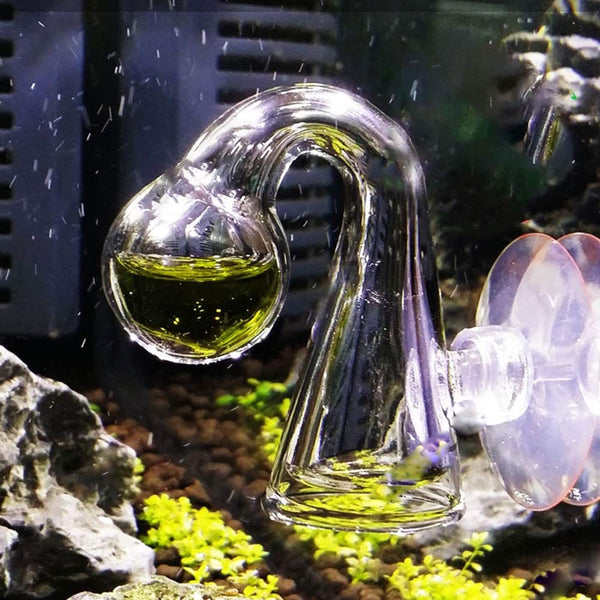
The single most important instrument in a shrimp CO2 setup is a drop checker filled with proper 4 dKH reference solution and bromothymol blue. It reads dissolved CO2 with a ~2-hour lag: blue means too little, green means a moderate safe level, yellow means too much. Your rule in a shrimp tank is absolute: light green is the target, and yellow is an emergency. For setup and placement details, read how to read a CO2 drop checker. Place it opposite the diffuser, low in the water column where the shrimp actually live, and check it mid-photoperiod. Remember the lag: never raise the bubble rate because the checker is still blue an hour after an adjustment — wait, then judge.
Neocaridina vs. Caridina: Know Your Colony
Not all shrimp share the same safety margin. Neocaridina (cherry shrimp and their color morphs) are the hardiest: they tolerate a wider pH range and recover faster from minor swings, so the conservative targets above fit them well. Caridina (crystal red/black shrimp, Taiwan bees) are a different story — they demand soft, acidic, ultra-stable water, and CO2-driven pH swings add exactly the instability they dislike. If you keep caridina, halve the targets again, keep the drop checker a solid mid-green, and seriously consider whether you need injected CO2 at all — many caridina breeders run liquid carbon dosing or low-demand plants instead. There's no shame in a low-tech caridina tank; there is real risk in pushing CO2 for a demanding carpet under crystal shrimp.
A drop checker is non-negotiable with shrimp in the tank: a CO2 drop checker.
 ★4.6
FZONE Glass CO2 Drop Checker Kit
Check Price on Amazon ★4.6Setting Up a CO2 Shrimp Tank: Step by Step
1. Start at Half Your Planned Rate
Set the needle valve to roughly half of the "settled range" for your tank size, then leave it alone for a full week. This sounds painfully slow, but shrimp deaths from CO2 almost always come from rate of change, not the absolute level — a colony eased up over weeks tolerates levels that would shock a colony hit all at once, while your plants begin adapting to carbon enrichment gradually.
2. Put the Solenoid on a Timer
A solenoid valve that switches CO2 with your lights is non-negotiable in a shrimp tank — manual on/off is a forgotten-valve disaster waiting to happen. The standard routine: CO2 on 1–2 hours before lights on (so levels are up when photosynthesis starts), CO2 off 1 hour before lights off (so levels taper while plants still consume it). This means CO2 never runs in the dark. Set it up once with a proper CO2 solenoid timer setup — consistency is what shrimp reward.
3. Placement, Flow, and Gentle Surface Agitation
Position the diffuser low, near the filter outflow, so flow carries micro-bubbles across the tank and dissolves them evenly — dead spots mean localized CO2 spikes where shrimp graze. But counterintuitively for shrimp tanks, you want gentle surface agitation: a slight ripple guarantees oxygen exchange all night and caps how high CO2 can climb, cheap insurance against overdosing. If you experiment with the CO2 misting method, keep mist levels modest — fine bubbles contacting shrimp directly add a stress vector you don't need.
4. Prevent the End-of-Tank Dump
Single-stage regulators have a notorious failure mode: as the CO2 cylinder empties, output pressure spikes and your carefully tuned 1 bps becomes a roaring dump overnight. In a fish tank that's a bad morning; in a shrimp tank it's a colony wipeout. Use a dual-stage regulator (which resists the pressure spike), watch for the cylinder pressure gauge dropping toward the red, and consider a refill schedule with margin. Our full walkthrough of end-of-tank CO2 dump prevention covers the hardware and habits that make this a non-event.
A dual-stage regulator prevents end-of-tank dumps: a dual-stage mini regulator.
The Nighttime Aeration Routine
This is the habit that separates safe shrimp CO2 setups from risky ones, and it costs almost nothing: run an air stone on a timer opposite your CO2 schedule — on when lights go off, off when CO2 comes on in the morning. The surface agitation strips excess CO2 and drives oxygen in all night, so shrimp wake up in well-oxygenated, stable water. If you use a sponge filter (common in shrimp tanks), just raise its air flow at night. Shrimp keepers who do this routinely report it ended their early-morning surface-gathering episodes.
Warning Signs and Emergency Response
Even with perfect setup, learn to read your colony — shrimp tell you about CO2 stress early if you know what to watch for:
- Erratic swimming or darting — shrimp suddenly zipping around the tank, especially mid-photoperiod, is the classic first sign of CO2 discomfort.
- Gathering at the surface or on the filter outflow — shrimp clustering where oxygen is highest means dissolved CO2 is too high or oxygen too low.
- Lethargy and reduced grazing — a colony that stops picking at surfaces and sits motionless is stressed, not resting.
- Drop checker trending yellow — treat any drift toward yellow as a warning, not a reading to "wait and see."
- Failed molts (white ring of death) — if these spike after a CO2 increase, your pH swing is too steep regardless of what the checker says.
If you see these signs, act immediately: 1) shut off the CO2 at the needle valve, 2) crank up surface agitation — air stone on full, filter outflow raised to ripple the surface, 3) perform a 25–30% water change with temperature- and parameter-matched water to dilute dissolved CO2 and stabilize pH. Don't chase pH with chemical buffers during the emergency; stability beats a "perfect" number. Once the colony settles, restart CO2 at half the previous rate and re-ramp over a week. Keep our drop checker guide bookmarked — a yellow checker means act now, not after lunch.
Frequently Asked Questions
Is CO2 safe for shrimp, or should I avoid it entirely?
CO2 is safe for shrimp when dosed conservatively — light-green drop checker, modest bubble rates, solenoid timing, and night aeration. Thousands of breeders run CO2 over neocaridina colonies successfully. The danger is overdosing and pH instability, not CO2 itself. If you keep sensitive caridina or you don't want the management overhead, low-tech or liquid carbon setups are perfectly valid alternatives — never feel pressured to inject gas just because an aquascaping photo used it.
Can CO2 kill shrimp overnight?
Yes — this is the most common CO2 shrimp disaster. CO2 left running after lights-out accumulates while plants respire instead of photosynthesizing, dropping pH and displacing oxygen until shrimp suffocate. The fix is simple: a solenoid that shuts CO2 off an hour before lights-out, plus an air stone on a timer at night. A 24/7 CO2 setup has no place in a shrimp tank.
What bubble rate is safe for a 10-gallon shrimp tank?
Start at about 1 bubble every 2–3 seconds — roughly half what a fish-only planted 10-gallon would run. Confirm with a drop checker placed low on the far side of the tank: it should read light green mid-photoperiod, never yellow. Adjust upward only in tiny increments over weeks, and treat any shrimp stress signs as a signal to dial back regardless of the bubble count.
Are cherry shrimp or crystal shrimp more sensitive to CO2?
Crystal shrimp (caridina) are significantly more sensitive — they need soft, stable, acidic water, and CO2-driven pH swings add exactly the instability they can't tolerate. Cherry shrimp (neocaridina) are far more forgiving and handle conservative CO2 dosing well. If you keep caridina, halve the standard shrimp-safe targets again and consider whether liquid carbon or low-tech plants would serve you better.
Will CO2 harm baby shrimp or berried females?
Babies and berried females are the most vulnerable members of the colony — they have the least buffering capacity and molting females are already under physiological stress. This is why conservative dosing matters most in a breeding tank: keep pH swings under ~0.6 points, never let the drop checker hit yellow, and maintain night aeration. Colonies routinely breed under CO2 when these margins are respected.
Should I use liquid carbon instead of CO2 gas in a shrimp tank?
Liquid carbon is a reasonable middle ground — no pH swings, no nighttime accumulation risk, no equipment. But dose it carefully too: some shrimp keepers report sensitivity to overdosed glutaraldehyde-based products, so start at half the label dose and observe. For undemanding plants, liquid carbon plus good light often grows plenty. For demanding carpets and stems, properly managed gas CO2 at conservative levels still gives better results.
The Shrimp-Safe CO2 Mindset
The aquascaping internet will tell you CO2 is a race to 30 ppm and lime-green drop checkers. A shrimp tank plays a different game: your score is measured in berried females and surviving shrimplets, not pearling intensity. Dose at half of what feels "right," keep the drop checker at a calm mid-green, automate everything with timers so a forgetful evening can't hurt anyone, and aerate at night like it's religion. Do that, and you get both worlds — lush plants and a colony that breeds like the CO2 was never there. For a clear grounding in how CO2, pH, and carbonate hardness interact, Tropica's fertiliser and CO2 guide is one of the best manufacturer references available. Conservative beats aggressive, every single time — your shrimp will prove it.