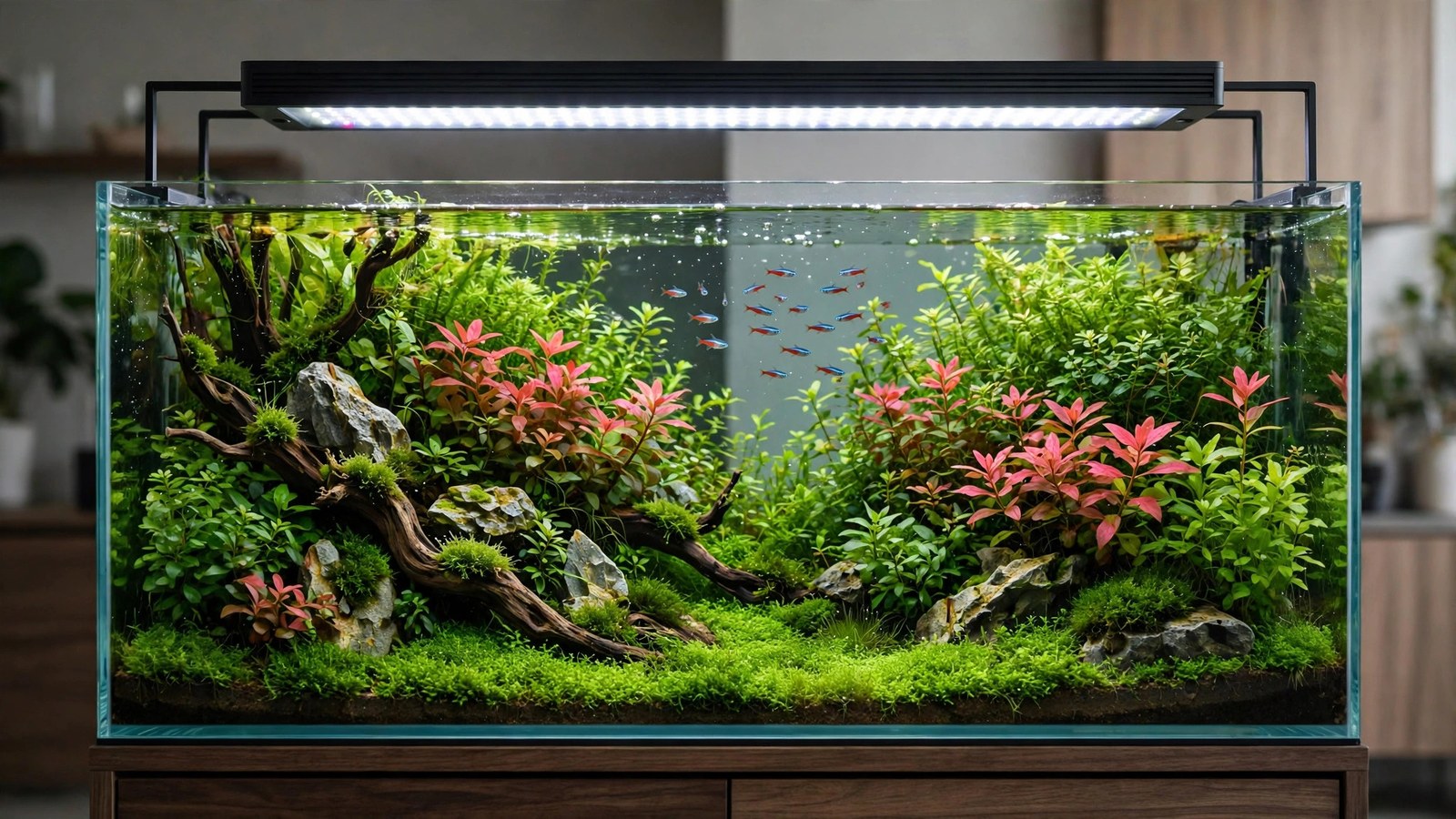
If you have been shopping for a planted tank light lately, you have probably bumped into the name Week Aqua. This Chinese manufacturer has quietly become one of the most talked-about options in the RGB LED space, offering the kind of saturated reds and deep greens that used to cost twice as much from the established brands. A week aqua aquarium light sits in a fascinating spot: it delivers genuine RGB+UV spectrum power for high-tech aquascapes at a price that undercuts Twinstar and Chihiros by a wide margin — but the trade-offs are real, and the model lineup is confusing enough that buying the wrong one is easy. This guide walks through the main Week Aqua series, who each one suits, and how they stack up against the competition.
What Makes Week Aqua Different
Most budget aquarium lights use a simple white-diode layout with a blue tint. Week Aqua takes the opposite approach: dense arrays of RGB diodes with dedicated red, green and blue channels, plus a scattering of UV/UVA chips (typically 390–405 nm) that the company claims enhance plant coloration. The result is the signature look that RGB enthusiasts chase — cherry shrimp that glow, Rotala stems that look like they are on fire, and a neutral white background that keeps the tank looking natural rather than purple.
The other signature is control. Nearly every current Week Aqua model uses Bluetooth app control with adjustable brightness per channel and programmable schedules including gradual sunrise and sunset ramping. There are no physical dials on most models — your phone is the remote, which is either a feature or a frustration depending on your patience.
Before getting into models, be honest about what an RGB powerhouse actually demands of you. High-intensity RGB light without matching CO2 and fertilization is an algae factory. If you are new to planted tanks, read up on how much light aquarium plants really need first, and make sure you understand how RGB aquarium lighting actually affects plants beyond the pretty colors.
The Week Aqua Aquarium Light Lineup: M, L, P, S, T, and Z Series
Week Aqua's naming scheme is chaotic, but the lineup sorts into a few clear families. The number in a model name roughly corresponds to the tank length it covers (300 = ~30 cm, 600 = ~60 cm, 900 = ~90 cm, 1200 = ~120 cm), and the "Pro" suffix marks a stepped-up version with more diodes and wattage. Here is how the major series break down.
M Series: The Budget RGB Gateway
The M series — including models like the M600 D2 Pro — is where most hobbyists enter the Week Aqua world. It is a slim, rim-mounted RGB unit that covers standard 60 cm tanks, with Bluetooth channel control at a price that regularly comes in well under the big names. Forum feedback (notably on UKAPS) has been surprisingly positive on build quality and the ease of the app for a budget light. This is the "try RGB without the commitment" light: strong color rendering, modest wattage, and enough PAR for medium-light carpets and stems. If your goal is a low-tech or medium-tech planted tank, the M series is arguably the best value in the whole lineup.
L Series: The All-Rounder
The L series (e.g., the L600 Pro) is the workhorse. The 60 cm version packs around 70+ RGB diodes plus 6 UV chips at roughly 55–65 W, with about 3,300 lumens — a meaningful step up from the M series in both power and diode count. It ships with rim mounting brackets and optional adjustable arms, and the Bluetooth app supports programmable channel spectrums and timed schedules. The L series handles CO2-injected tanks up to about 60 cm comfortably, and users report it holds its own against lights costing twice as much for color rendering. This is the sweet spot for most 20–40 gallon planted setups.
P Pro Series: The High-Tech Flagship
When Week Aqua wants to play in the serious high-tech arena, it fields the P Pro series: the P600 Pro (90 W, ~5,400 lm), P900 Pro (120 W, ~7,200 lm), and P1200 Pro (150 W, ~9,000 lm), covering 60, 90 and 120 cm tanks respectively. These use full-spectrum RGB-UV diode arrays (100+ RGB chips plus UV on the 60 cm model), include a built-in cooling fan for the higher wattage, and can be either tank-mounted with metal brackets or suspended from hanging kits sold separately. This is the series you buy for a 4-foot tank packed with demanding red stems and a dense Hemianthus callitrichoides carpet. Just remember the rule of bright RGB: too much light without balanced CO2 and nutrients will grow algae faster than plants, and a 150 W fixture on a 120 cm tank is a lot of photons.
S Series: Nano and Clip-On
For smaller tanks, the S series offers compact rim-mount units aimed at nano and shrimp tanks. Hobbyists report excellent lighting quality for the size and price — under-£100 territory even shipped — with the same Bluetooth app control as the bigger siblings. It is a natural pick for a desk nano scape, and it is worth comparing against the purpose-built options in our roundup of the best clip-on lights for nano planted tanks.
T, Z, and the Niche Models
The T series (T70, updated to the T70SE; T90) and Z series (Z200 updated to the Z250 Pro) are smaller or older lines that fill odd tank sizes and legacy slots. They are fine lights, but for a new purchase in 2026 you are better off choosing from the current M/L/P/S families, which get the latest app support and diode revisions. As with any fast-moving Chinese brand, check that the exact model you are buying is a current generation — old stock of superseded models still floats around on marketplaces.
Model Comparison at a Glance
| Series | Example model | Tank size | Approx. power | Spectrum | Best for |
|---|---|---|---|---|---|
| M | M600 D2 Pro | ~60 cm | Low–medium | RGB | Budget RGB entry, low/medium-tech tanks |
| L | L600 Pro | ~60 cm | ~55–65 W | RGB+UV | All-round CO2 tanks, 20–40 gal |
| P Pro | P600 / P900 / P1200 Pro | 60–120 cm | 90–150 W | RGB-UV, fan-cooled | High-tech, red-heavy aquascapes |
| S | S-series | Nano | Low | RGB | Desk nanos, shrimp tanks |
| T / Z | T70SE, Z250 Pro | Various | Varies | RGB | Legacy/odd sizes, older stock |
Week Aqua vs Twinstar vs Chihiros
No comparison guide is honest without the two brands everyone asks about. The Twinstar planted tank lights, especially the S series, are widely regarded as the gold standard for RGB spectrum and color rendition — a rounded, natural look with refined output, and the newer Bluetooth app is notably stable and easy to use. Chihiros (WRGB II, Vivid series) offers densely planted tanks both power and fine control, and remains a favorite for high-tech builds.
Where does Week Aqua fit? On pure spectrum, it plays in the same league: strong red, blue and green peaks with a neutral white background — the best aquarium lights for planted tanks lists now routinely mention it alongside the big three. The differences are price (significantly lower), quality consistency (more variable — as The 2Hr Aquarist's 2026 LED guide notes, Week Aqua's quality is "far more unreliable" than Twinstar or Chihiros), and software (the app works, but carries the clunky logic common to many China-made hardware apps). Twinstar wins on refinement and reliability; Chihiros wins on ecosystem and proven long-term performance; Week Aqua wins on value-per-photon. If your budget is fixed and you can tolerate an occasional rough edge, Week Aqua is a defensible pick. If you want set-and-forget dependability for an expensive aquascape, the premium brands earn their markup.
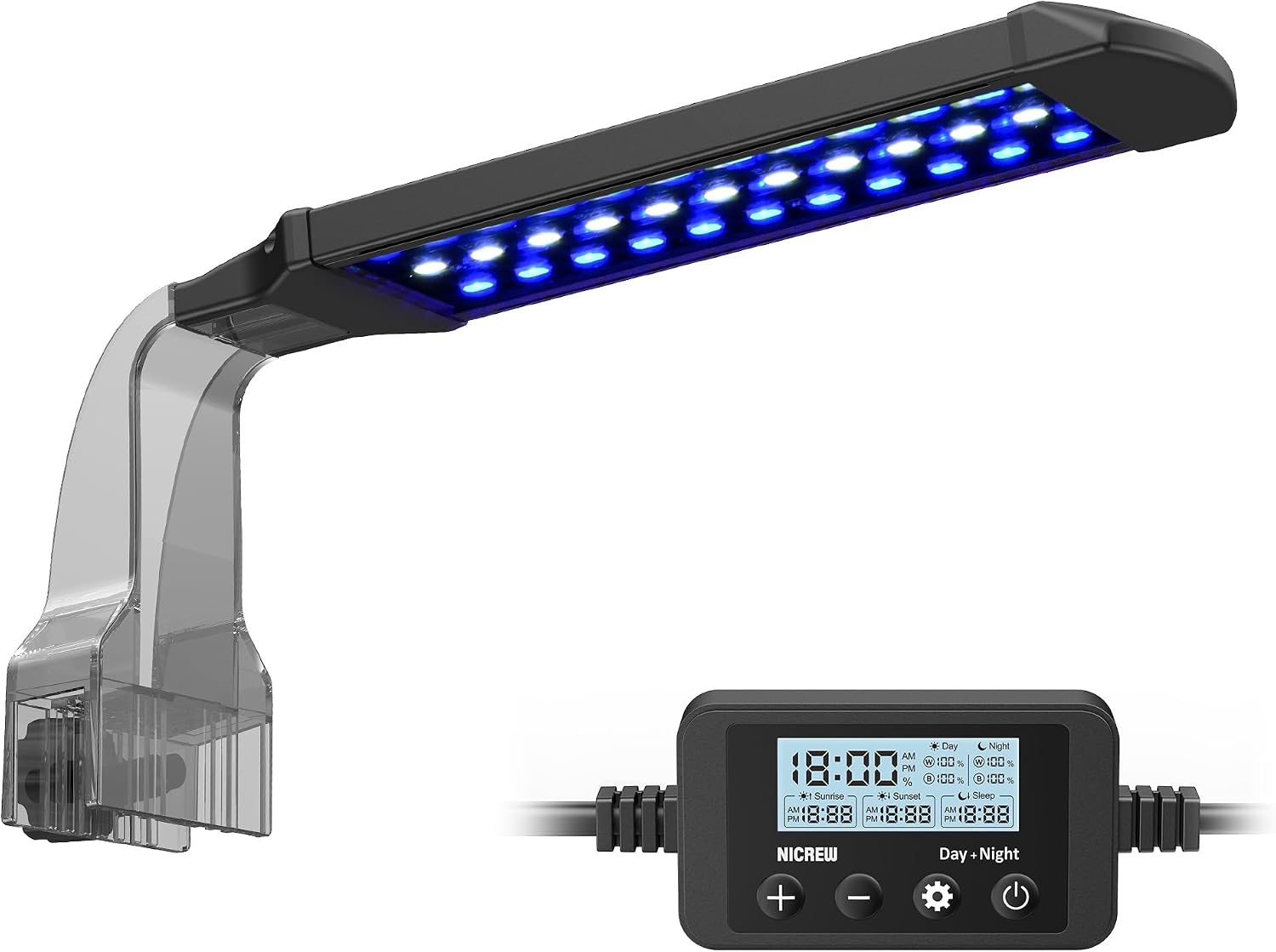
The benchmark rival in every comparison: NICREW ClassicLED Plus.
 ★4.6
NICREW ClassicLED Plus planted aquarium light
Check Price on Amazon ★4.6Getting the Most From a Week Aqua Light
Buying the light is the easy part — dialing it in is where planted tanks succeed or fail. A few practical notes from experienced owners:
- Start dim. Fresh tanks with immature biofilms are algae magnets under full RGB intensity. Begin at 50–60% and ramp up over several weeks as plants establish.
- Match light to CO2. P Pro owners running 90+ W should run pressurized CO2 timed with the photoperiod — CO2 that switches on before lights-on gives plants a head start.
- Use the ramp. The Bluetooth app's sunrise/sunset feature is more than decoration — gradual transitions avoid shocking livestock. Some users note the ramp steps can feel coarse; set longer ramp times to smooth it out.
- Hang it if you can. Rim-mounted RGB units concentrate intensity. Suspending the light raises spread and softens hotspots; our hanging height guide explains the trade-offs.
- Measure, don't guess. If you are unsure whether your Week Aqua is delivering enough (or too much) light, a PAR meter is the honest answer — lumens tell you almost nothing about what plants actually receive.
Things to Watch Out For
Fair warning before you order. Week Aqua has limited official warranty support outside its home market — many buyers rely on marketplace sellers for after-sales help. Model names and revisions change frequently, so verify you are buying a current generation (Pro variants, Bluetooth 2.0/3.0 boards) rather than old stock. The app is functional but not beloved, and because most units are sold direct from China or through resellers, shipping times and customs handling are part of the real cost. None of these are deal-breakers, but they are why the lights cost less.
Frequently Asked Questions
Are Week Aqua LED lights good for planted tanks?
Yes, for the right buyer. They deliver genuine RGB+UV spectrum with strong color rendering at prices well below Twinstar and Chihiros, and hobbyist feedback on the M and L series is generally positive. The main caveats are more variable build quality, a clunky-but-functional app, and limited warranty support. For budget-conscious aquascapers who accept those trade-offs, they are excellent value.
Which Week Aqua model is best for a 60 cm planted tank?
The L600 Pro is the safest all-round pick for a 60 cm CO2-injected tank, with roughly 55–65 W of RGB+UV power and Bluetooth channel control. The M600 D2 Pro is the budget alternative for low- to medium-tech setups. Choose the P600 Pro only if you run a demanding high-tech scape with pressurized CO2 and heavy fertilization — its 90 W is overkill for a casual setup.
Do Week Aqua lights need CO2 to avoid algae?
Any high-intensity RGB light, Week Aqua included, will grow algae enthusiastically if light outruns CO2 and nutrients. Medium-tech setups can get away with moderate intensity and liquid carbon or lean dosing, but P Pro-series fixtures at high power genuinely need pressurized CO2 matched to the photoperiod. Start the intensity low and increase it only as plant mass grows.
Can you control Week Aqua lights without the app?
On most current models, no — Bluetooth app control is the only interface; there are no physical dials or buttons. Make sure your phone supports the required Bluetooth version before buying, and download the Week Aqua app in advance. Keep in mind the ramp steps can be coarse, so use longer sunrise/sunset durations for smoother transitions.
Week Aqua vs Chihiros: which should I buy?
Buy Chihiros if you want a mature ecosystem, proven long-term reliability, and refined app control — the WRGB II and Vivid lines are the safer high-tech bet. Buy Week Aqua if your priority is maximum RGB spectrum per dollar and you are comfortable with more variable quality control and thinner warranty support. Many hobbyists run Week Aqua happily for years; the risk is variance, not that the lights are inherently bad.
Do the UV chips in Week Aqua lights actually help plants?
The UVA chips (around 390–405 nm) are marketed as promoting plant coloration, and some aquarists believe the broader spectrum contributes to richer reds. The science on near-UV benefit for aquatic plants is thin, though — the heavy lifting is done by the RGB channels. Treat UV as a nice-to-have bonus, not a deciding factor. For more on what wavelengths actually matter, see our guide to light spectrum for aquarium plants.
The Bottom Line
Week Aqua is the value disruptor of the RGB planted-tank world: real color-saturation power, legitimate CO2-grade intensity in the P Pro line, and Bluetooth scheduling at prices the premium brands cannot touch. The M series is a near-perfect budget entry point, the L series is the mainstream sweet spot for 60 cm tanks, and the P Pro series is a genuine high-tech weapon for big aquascapes. Just go in with open eyes — variable quality control, an app with a learning curve, and minimal official warranty are the price of the discount. Match the fixture to your tank size, start the intensity conservatively, pair bright RGB with real CO2, and you will get a planted tank that looks far more expensive than it was. For the broader field, our roundup of the best aquarium lights for planted tanks puts Week Aqua in full context.