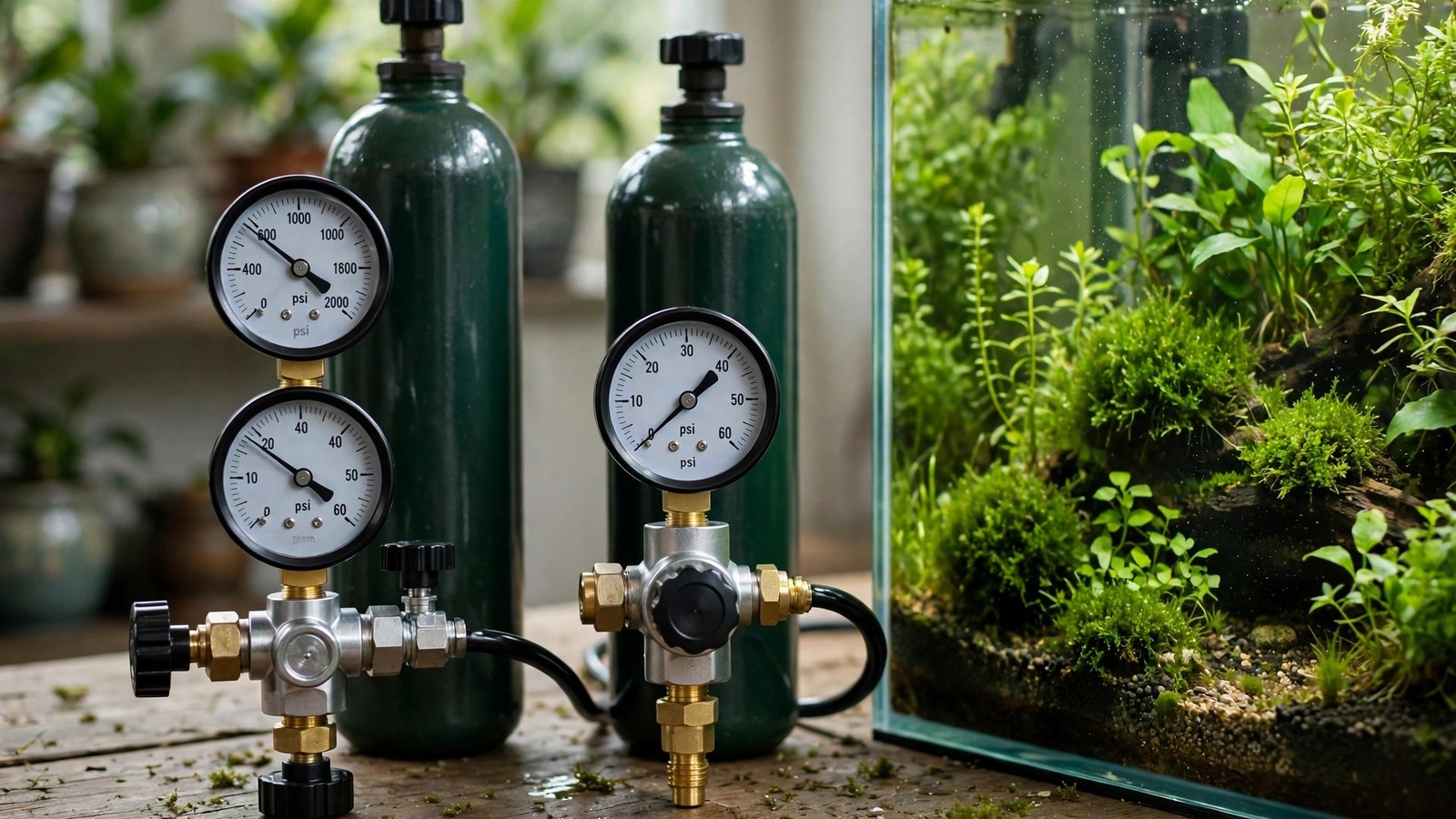
The worst CO2 disaster in a planted tank rarely happens on setup day. It happens six months later, in the middle of the night, when your cylinder is almost empty — and a cheap regulator quietly dumps everything left inside into your tank at once. If you're weighing a dual stage vs single stage CO2 regulator, that single scenario is the whole reason this comparison matters. By the end of this guide, you'll know how each regulator works, what "end-of-tank dump" really does to livestock, and which type your tank genuinely needs.
How a Single-Stage Regulator Actually Works
Every CO2 regulator has one job: step the enormous pressure inside your cylinder down to a small, steady pressure your diffuser can handle. A full cylinder sits at roughly 800–1,000 psi because most of the CO2 inside is liquid. Your complete CO2 setup only wants 30–50 psi — about one-twentieth of that. A single-stage regulator does the reduction in one step, with a single diaphragm and spring fighting against the incoming cylinder pressure.
That diaphragm must hold back whatever pressure the cylinder delivers. When the cylinder is full, the balance point is stable and your bubble count stays put. But as the liquid CO2 runs out, cylinder pressure drops — slowly at first, then fast in the final days. The single diaphragm can't fully compensate, so working pressure creeps upward. Your carefully dialed 2 bubbles per second can quietly become 4 or 6 as the cylinder dies. Nothing breaks and nothing alarms — the regulator is still "working," it just no longer holds your setting.
That drift is why experienced aquarists check bubble count against a bubble counter weekly, and why the high-pressure gauge is the most under-read instrument in the hobby. When it starts falling below its normal plateau, the clock is ticking.
What Makes a Dual-Stage Regulator Different
A dual-stage regulator performs the same reduction in two steps. The first stage knocks cylinder pressure down to an intermediate value (often 100–200 psi); the second stage takes that down to your final working pressure. The crucial detail: the second stage only ever "sees" the intermediate pressure, which stays constant even as the cylinder empties. So when your cylinder drops from 900 psi to 150 psi in its last days, your bubble count doesn't move.
Manufacturers engineer this in — for example, CO2Art's PRO-SE series pairs a dual-stage body with an integrated 12V DC solenoid and needle valve, adjustable to working pressure with tight stabilization. You pay for that second stage: dual-stage regulators typically run $150–$260 versus $70–$140 for comparable single-stage units.
End-of-Tank Dump: The Failure Mode That Kills Livestock
End-of-tank dump is the specific event dual-stage regulators exist to prevent. Your cylinder's liquid CO2 is nearly gone; the high-pressure gauge has fallen to 200 psi or below. The single diaphragm, designed around 800+ psi of back-pressure, overshoots its set point. Working pressure climbs, and the needle valve — tuned for 40 psi — now feeds gas at 60 or 80 psi. Your bubble counter goes from a calm 2 bubbles per second to a frantic stream.
In a 20-gallon tank, that surge can push dissolved CO2 from a safe ~30 ppm toward 60–100+ ppm within hours. Fish gasp at the surface; shrimp climb the glass and lie on their sides. A pH that normally dips from 7.2 to 6.8 during the day can crash below 6.0 overnight. By morning the cylinder is empty, the tank is silent, and a colony built over a year is gone. Our CO2 and fish safety guide covers the warning signs, but the brutal truth is that end-of-tank dump usually strikes while you're asleep.
Once the high-pressure gauge starts falling from its plateau, hobbyists report anywhere from a few hours to a couple of days before the cylinder is empty, depending on bubble rate. That falling gauge is your early warning — it means the liquid CO2 has evaporated and only gas pressure remains. With a single-stage regulator, that window is when you're most at risk.
Dual-Stage vs Single-Stage CO2 Regulator: Which Tanks Genuinely Need Dual-Stage?
The pattern is simple: the smaller your water volume, the more sensitive your livestock, and the more CO2 you're pushing, the more a working-pressure spike can hurt you.
| Tank setup | Why dual-stage matters here | Verdict |
|---|---|---|
| Nano tank under 20 gallons (75 L) | Tiny water volume means a CO2 surge spikes dissolved CO2 in under an hour; almost no buffering capacity | Dual-stage strongly recommended |
| Shrimp breeding tank (any size) | Cherry, crystal, and caridina shrimp tolerate CO2 swings far worse than fish; one dump can wipe a colony | Dual-stage strongly recommended |
| High-light aquascape (3+ bubbles/sec) | High rates empty cylinders fast, so you're in the danger window more often; higher working pressure amplifies any spike | Dual-stage recommended |
| Office or bedroom tank | You can't always watch it, and dumps strike overnight; unattended tanks deserve the safety margin | Dual-stage recommended |
| Large planted tank, 40+ gallons, buffered water | Big volume dilutes a surge; KH of 4+ buffers the pH crash, buying you time | Single-stage acceptable with good habits |
| Attentive owner refilling on schedule | If you watch the high-pressure gauge and swap cylinders early, you manually defeat the failure mode | Single-stage acceptable |
When a Single-Stage Regulator Is Perfectly Fine
A well-made single-stage regulator is not a death trap. On the right tank, the dual-stage premium buys protection you don't need. A 55-gallon tank with KH of 4–6, running 2 bubbles per second through an in-line diffuser, has so much water and buffering that a pressure spike becomes a mild CO2 rise, not a catastrophe. You'll see your drop checker swing toward yellow, dial the needle valve back, and swap the cylinder a day early.
Single-stage also makes sense with disciplined habits. Refill or swap the moment the high-pressure gauge dips below its plateau. Use a 10 or 20 lb cylinder instead of a 5 lb one — larger cylinders spend fewer days per year in the danger window. Run CO2 on a solenoid timer synced to your lights; shutting CO2 off at night saves gas and gives livestock a daily recovery window. And keep a spare cylinder so a low gauge never tempts you to "run it one more day."
What you should not do is buy the cheapest no-name single-stage regulator you can find. A poor needle valve that drifts on its own, a solenoid that sticks open, or gauges you can't read will cause more trouble than the single-stage design itself. On a tight budget, a good single-stage unit with a quality needle valve and solenoid beats a sketchy "dual-stage" with sloppy components every time. Compare reliable models at both price points in our best CO2 regulators for planted tanks roundup.
What to Look for When Buying (Beyond Stage Count)
Stage count is the headline spec, but it only tells part of the story. A dual-stage body with a terrible needle valve will frustrate you daily; a single-stage body with an excellent needle valve and solenoid will serve most tanks reliably.
| Feature | What to look for | Why it matters |
|---|---|---|
| Stage count | Dual-stage for shrimp, nano tanks, or high CO2; single-stage fine for large buffered tanks with disciplined refills | End-of-tank-dump protection |
| Solenoid valve | Integrated 12V DC solenoid on a plug-in timer | Shuts CO2 off automatically at night |
| Needle valve | Fine-thread, precision valve that holds its setting for weeks | Sets your bubble rate; cheap ones drift |
| Working pressure | Adjustable, at least 30–40 psi (2–2.7 bar) maximum | Atomizers need higher pressure than basic diffusers |
| Gauges | Two clear gauges: cylinder pressure and working pressure | High-pressure gauge warns of cylinder end-of-life |
| Bubble counter + check valve | Built-in counter with check valve, plus a second in-line check valve near the tank | Visible rate; stops water siphoning into the regulator |
| Warranty | 3–10 years from an established aquarium brand | A real warranty signals real engineering |
The buying section covers the cylinder side of the setup: a 5 lb aluminum CO2 cylinder like Beverage Elements'.
Your Setup Safety Checklist
Whichever regulator you choose, these steps are non-negotiable. Conservative CO2 practice — start low, observe livestock, increase slowly — keeps every part of this system safe.
- Leak-check every connection on day one and at every cylinder swap. Pressurize, then brush soapy water over the cylinder nut, gauge ports, solenoid fittings, and tubing connections. Growing bubbles mean a leak: depressurize and re-seat the fitting. Full method in our CO2 leak detection guide.
- Put the solenoid on a timer — CO2 on 1–2 hours before lights. Plants only use CO2 during photosynthesis, so 24/7 injection wastes gas and keeps livestock in elevated CO2 around the clock. A timer-linked solenoid is the single biggest safety upgrade you can make.
- Start at 1 bubble per second and watch for a full week. Aim for a drop checker reading green (roughly 30 ppm) by mid-photoperiod. Nudge upward only if plants show deficiency and livestock show zero stress.
- Learn your livestock's stress signals. Fish hanging at the surface, rapid gill movement, shrimp climbing the glass or lying motionless — any of these means CO2 is too high right now. Close the needle valve, increase surface agitation, and do a partial water change.
- Read the high-pressure gauge weekly and swap the cylinder early. It sits at 800–1,000 psi for most of the cylinder's life. The moment it starts dropping, you have hours to a couple of days — plan the swap now.
- Keep the cylinder upright, secured, and ventilated. Never lay it on its side (liquid CO2 can flood the regulator), strap it so it can't topple, and don't seal it in an airtight stand — a slow leak in an enclosed cabinet displaces oxygen.
- Keep a spare cylinder or a refill plan. The most dangerous moment in CO2 ownership is "I'll refill it this weekend." A spare 5 lb cylinder costs less than one livestock loss.
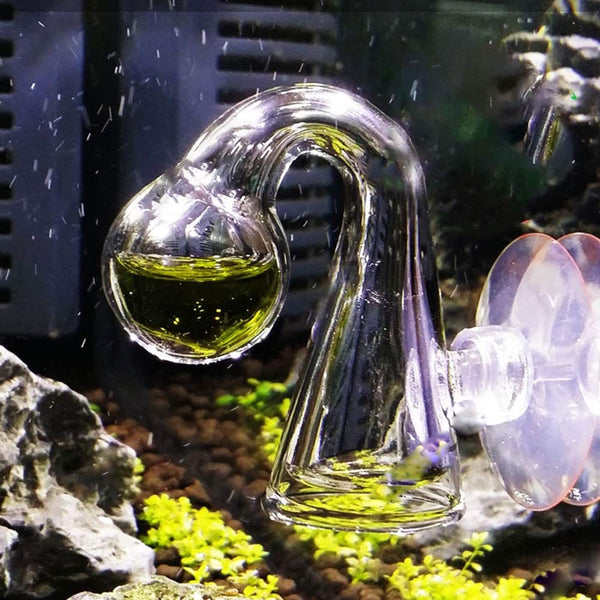
A drop checker is the CO2 monitoring tool in the safety checklist: a glass drop checker kit like FZONE's.
 ★4.6
FZONE Glass CO2 Drop Checker Kit
Check Price on Amazon ★4.6Frequently Asked Questions
Can a single-stage regulator be made safe against end-of-tank dump?
Mostly yes — through discipline rather than engineering. Swap or refill the cylinder the moment the high-pressure gauge drops below its 800–1,000 psi plateau, use a larger cylinder so refills are less frequent, run a solenoid on a timer, and check your bubble count weekly. You are manually doing what a dual-stage regulator does automatically. The risk is human: most dumps happen because someone saw the gauge dropping and waited one more day.
Is dual-stage overkill for a tank running just 1 bubble per second?
Not if the tank is small or holds shrimp. A 10-gallon shrimp tank at 1 bubble per second has far less margin for a pressure spike than a 75-gallon tank at the same rate — the same surge that barely registers in the big tank can be lethal in the nano. Match the regulator to your livestock's sensitivity and your water volume, not just to the bubble count.
How much more does a dual-stage regulator cost?
Expect roughly double: quality single-stage regulators with solenoid and needle valve typically run $70–$140, while comparable dual-stage models run $150–$260. Premium dual-stage units with ~1 psi stabilization and long warranties can exceed $300. Over a 5–10 year lifespan, the premium works out to a few dollars a year — weigh that against the value of your livestock.
Does dual-stage mean I can ignore the cylinder gauge?
No. Dual-stage prevents the pressure spike, but it doesn't refill your cylinder. When the liquid CO2 is gone, injection simply stops — plants stall and algae can take hold while you assume everything is fine. Keep reading the high-pressure gauge weekly and swapping on schedule. Dual-stage buys you safety, not maintenance-free operation.
Can I upgrade my single-stage regulator to dual-stage later?
Not practically — the stage count is machined into the regulator body, so no add-on converts one to the other. You can add a better needle valve, a quality solenoid on a timer, or an extra check valve. But if your setup changes — say you add a shrimp colony to a nano tank — the honest move is replacing the regulator rather than bolting accessories onto the wrong core.
The Bottom Line: Which One Should You Buy?
If you keep shrimp — especially breeding colonies — run a nano tank under 20 gallons, push high light with 3+ bubbles per second, or simply know you won't check gauges religiously, buy dual-stage. It's a one-time $80–$120 premium that permanently removes the most common catastrophic failure in CO2 injection. Our best CO2 regulators for planted tanks roundup shows strong dual-stage options at every budget tier.
If you run a larger, well-buffered tank with a 10+ lb cylinder, and you're the type who reads gauges and swaps cylinders early, a quality single-stage regulator with a good needle valve and a timer-linked solenoid will serve you reliably for years. Either way, the regulator is only half the safety system — pair it with a drop checker reading green by mid-photoperiod, a leak check at every cylinder swap, and the discipline to start low and observe your livestock before turning anything up.
The buying verdict recommends dual-stage as the safe choice — this is the exact product type being recommended: the Fzone Pro Series Dual Stage regulator ★4.2.