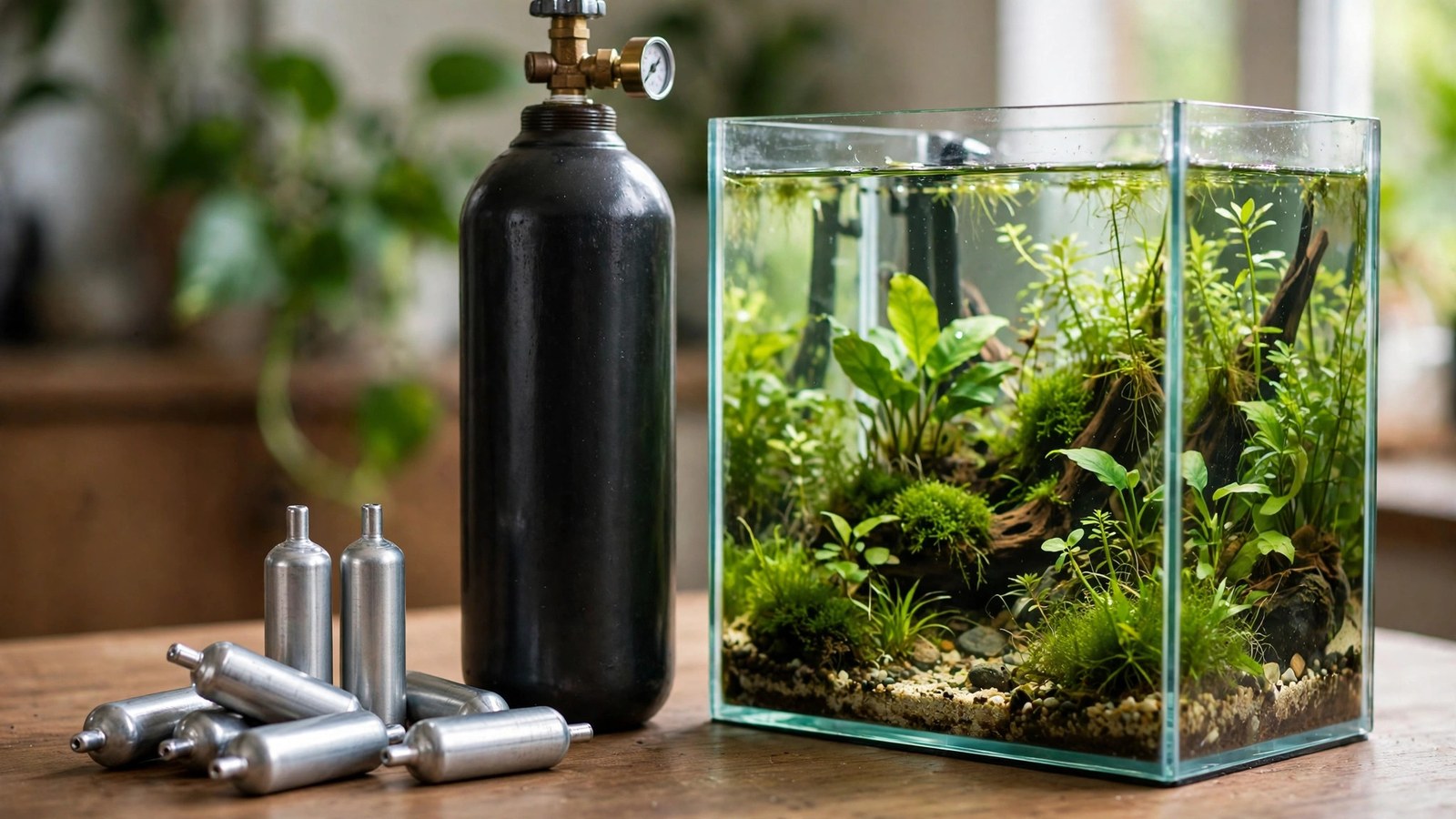
Picture a $214-a-year cartridge habit on a 5-gallon planted cube — and a $180 refillable setup would have done the same job for about $35 of refills. Disposable CO2 cartridges for aquariums look cheap at the register ($2–$10 a pop), but the cost per gram of CO2 is roughly ten times higher than a refillable cylinder. By the end of this guide you will know exactly which system matches your tank size, budget, and how much CO2 your plants actually need.
How Disposable CO2 Cartridges Actually Work
A disposable cartridge system starts with a small sealed CO2 cartridge — most commonly 16 g, 45 g, 88 g, or 95 g — that screws into a mini regulator. The regulator pierces the seal and steps the pressure down, feeding CO2 through tubing into your diffuser exactly like a full-size system, just at pocket scale. Most disposable kits include a simple needle valve, tubing, and a diffuser, and the whole package often fits in your hand.
The appeal is obvious: no refills to arrange, no 18-inch cylinder to hide, and starter kits run $60–$120. For a pico jar, a 2.5-gallon shrimp bowl, or a dorm-room desktop tank, that simplicity is genuinely valuable. Replacement cartridges cost roughly $2–$3 for a 16 g cartridge and $8–$12 for a 95 g cartridge, sold in multipacks at aquarium shops and online.
The catch is physics. A 95 g cartridge holds about 95 grams of CO2 — period. On a 5-gallon nano running a conservative bubble rate (about 1 bubble every 2–3 seconds during a 7–8 hour photoperiod), it lasts roughly 6–8 weeks. On a 10-gallon tank with faster flow or higher light, expect 3–5 weeks. And output drifts downward as the cartridge empties, so the last week runs leaner than the first. Budget kits also rarely include a solenoid, which means CO2 keeps flowing at night when plants cannot use it — wasted gas and extra pH swing while you sleep.
The ready-to-use cartridge kit this section describes: a ready-to-go 20g cartridge kit like Fluval's Mini Pressurized.
How Refillable Cylinders Work
A refillable system is built around an aluminum cylinder — most hobbyists use a 2.5 lb or 5 lb tank — paired with a dual-stage regulator, needle valve, solenoid, and timer. You buy the cylinder once ($70–$100 for a 5 lb tank) and get it refilled at a welding shop, fire-extinguisher service, or homebrew store for roughly $20–$30. A single 5 lb fill holds about 2,268 grams of CO2. If you are new to sizing tanks and regulators, the CO2 cylinder size guide walks through exactly how long each size lasts per gallon.
The economics flip hard here. Your first fill plus the hardware is the expensive part — a solid entry setup with a good regulator lands around $150–$250. But every refill after that is pennies per gram: about $0.011–$0.013 per gram at $25 per 5 lb fill. A 5 lb cylinder on a 20-gallon tank typically lasts 5–8 months; on a 10-gallon nano it can stretch past a year. The dual-stage regulator keeps output rock-steady until the very end, and the solenoid shuts CO2 off at night on a timer — saving gas and stabilizing pH.
Drawbacks? Space and commitment. A 5 lb cylinder stands about 18 inches tall and weighs 15+ pounds full, so it lives inside the stand. You also need to find a refill spot — see the CO2 refill cost breakdown for where keepers actually refill and what they pay. And a quality regulator matters: cheap single-stage regulators on a draining cylinder can cause an end-of-tank dump, flooding the tank with CO2 — good dual-stage regulators avoid this by holding outlet pressure as cylinder pressure falls.
The refillable cylinder side of the comparison: a standard 5 lb aluminum CO2 cylinder.
The Real Cost Math: Cost Per Gram Compared
Forget marketing claims — CO2 is a commodity, so compare price per gram. The table below uses typical US street prices and conservative run times.
| Metric | Disposable 95 g cartridge | Refillable 5 lb cylinder |
|---|---|---|
| CO2 per unit | 95 g | ~2,268 g |
| Unit cost | $8–$12 | $20–$30 per refill |
| Cost per gram | $0.10–$0.14/g | $0.01–$0.02/g |
| Starter hardware | $60–$120 | $150–$250 |
| Year 1 total (10-gal tank) | ~$180–$240 | ~$180–$280 (one refill) |
| Year 2+ annual cost | ~$120–$180 | ~$25–$40 |
| 3-year total | ~$420–$600 | ~$230–$360 |
| Break-even point | ~4–6 months on tanks 10 gal and up | |
Notice that year-one totals look almost identical — the refillable hardware eats the first year's savings. The savings start in year two and compound. If you only plan to run CO2 for a three-month scape contest or a trial season, disposables can genuinely be cheaper. For anything permanent, refillables pull ahead and keep pulling.
How Long Does Each Last on Real Tanks?
Duration depends on tank volume, bubble rate, and photoperiod, but these conservative ranges (1 bubble per 2–3 seconds, 7–8 hour photoperiod) hold up across most planted tanks:
| Tank size | 95 g disposable cartridge | 2.5 lb refillable | 5 lb refillable |
|---|---|---|---|
| 2.5 gal pico | 10–14 weeks | 18–24 months | 3+ years |
| 5 gal nano | 6–8 weeks | 12–18 months | 2+ years |
| 10 gal | 3–5 weeks | 6–10 months | 10–16 months |
| 20 gal | 1.5–3 weeks | 3–5 months | 5–8 months |
| 40 gal | Impractical (days) | 1.5–3 months | 3–5 months |
Two things matter beyond the raw numbers. First, disposable output fades as the cartridge drains — your plants get less CO2 in week four than week one, which invites algae during the unstable stretch. Second, nano-tank owners running paintball CO2 setups for nano tanks get a similar small footprint with refillable 20 oz paintball bottles at $3–$5 a refill — often the sweet spot for 5–15 gallon tanks where a 5 lb cylinder is overkill.
Precision, Consistency, and Livestock Safety
CO2 precision is a livestock-safety issue, not just a plant-growth one. A full-size regulator with a quality needle valve holds a steady bubble rate day after day; budget disposable regulators can wander, especially as the cartridge chills during discharge (evaporating CO2 cools the cartridge, dropping pressure and flow).
Regardless of which system you choose, the startup protocol is the same: start low (roughly 1 bubble per 3–5 seconds on tanks under 10 gallons), run it for 48 hours, and watch your fish. Gasping at the surface, lethargy, or hanging near the filter output means too much CO2 — dial back immediately and add surface agitation. A CO2 drop checker turning lime-green confirms roughly 30 ppm, the standard target; dark blue means you can raise it, yellow means you have gone too far. If this is your first pressurized setup, read up on CO2 and fish safety before your first week.
Tropica's guide to how CO2 influences plant growth is worth a read for the underlying biology: CO2 is the raw material of photosynthesis, and levels above ~30 ppm rarely add growth but always add livestock risk. More CO2 is not a cheat code — it is a dial with a ceiling.
Both systems need the 30 ppm check this section demands: a glass CO2 drop checker ★4.6.
Which One Fits Your Tank?
Match the system to your situation, not to marketing:
Tanks 1–10 gallons (nano, pico, desktop)
Disposables are genuinely competitive here. A 16 g or 95 g cartridge system is tiny, silent, and cheap to start — ideal for a betta cube, a shrimp jar, or your first planted tank while you decide if high-tech is for you. Refillable 2.5 lb cylinders and paintball bottles also work beautifully and cost less over a year, but if the refill hunt feels like a chore, disposables are a fair trade. To compare the lowest-cost ways to get started, see the cheap CO2 systems for planted tanks guide.
Tanks 10–30 gallons
Refillables win clearly. A disposable regimen on a 20-gallon tank means a new cartridge every 2–3 weeks — constant ordering, constant pressure drift, and a needle valve you can never trust. A 2.5 or 5 lb cylinder disappears into the stand and runs for most of a year on one refill. This is the range where the break-even point hits fastest.
Tanks 30+ gallons and multiple tanks
Refillable is the only sane option. On a 40-gallon tank you would burn a 95 g cartridge in under a week — that is a subscription, not a hobby. One 5 lb or 10 lb cylinder with a manifold and splitters feeds several tanks from a single fill; see how to run multiple tanks from one CO2 system if you are expanding.
Renters, trials, and contest scapes
Disposable cartridges shine for temporary setups: three-month aquascaping contests, tanks in rentals where a cylinder feels risky, dorm rooms, or a two-month trial of CO2 before committing. If you decide high-tech is for you, keep the diffuser and tubing — they transfer straight to a refillable system.
If you are still deciding whether CO2 is needed at all, consider that many low-tech scapes thrive without any injection, which beats both options at $0 per gram.
Frequently Asked Questions
Are disposable CO2 cartridges worth it for aquariums?
Yes for small tanks (under 10 gallons), short trials, or contests — they are cheap to start and simple to run. For tanks of 10 gallons or more, no: at $0.10–$0.14 per gram versus $0.01–$0.02 per gram for refills, a permanent tank costs several hundred dollars more over three years with disposables. Match the system to tank size and commitment length.
How long does a 95 g CO2 cartridge last on a planted tank?
Roughly 6–8 weeks on a 5-gallon nano and 3–5 weeks on a 10-gallon tank at a conservative bubble rate (about 1 bubble every 2–3 seconds, 7–8 hour photoperiod). Output fades as the cartridge empties, so effective strong-CO2 weeks are fewer. Cartridges below 45 g are practical only for pico tanks under 3 gallons.
Can I use a solenoid timer with a disposable CO2 cartridge?
Usually not with budget kits — most disposable mini-regulators lack solenoid support, so CO2 flows 24/7 and wastes gas at night. Some premium disposable systems offer solenoid add-ons. If timed on/off matters to you (it saves 30–40% of gas and stabilizes pH), a refillable setup with a standard solenoid is the simpler path.
Is refillable CO2 dangerous for beginners?
Not with normal care. Cylinders have burst discs and regulators step pressure down safely; the real risks are CO2 leaks and over-dosing livestock, which apply to disposables too. Start with a low bubble rate, observe fish for 48 hours, use a drop checker, and keep the cylinder upright and secured. Millions of beginners run pressurized CO2 safely.
Can I refill a disposable CO2 cartridge myself?
Disposable cartridges are not designed to be refilled and should not be — they lack refill ports and overfilling a thin-walled cartridge is a real rupture hazard. If the per-cartridge cost bothers you, switch to a refillable cylinder, a paintball CO2 setup, or a SodaStream adapter instead of hacking disposables.
The Verdict: Choose by Tank Size and Timeline
If your tank is under 10 gallons, or your CO2 experiment has an end date, disposable cartridges are a smart, simple entry point — start with a 95 g system, run conservative bubble rates, and watch your livestock. For everything else, a refillable 2.5 or 5 lb cylinder pays for itself in 4–6 months and then costs nearly nothing to run for years. Either way, keep the bubble rate modest, confirm it with a drop checker, and remember the fish set the limit — not your plants' growth chart.