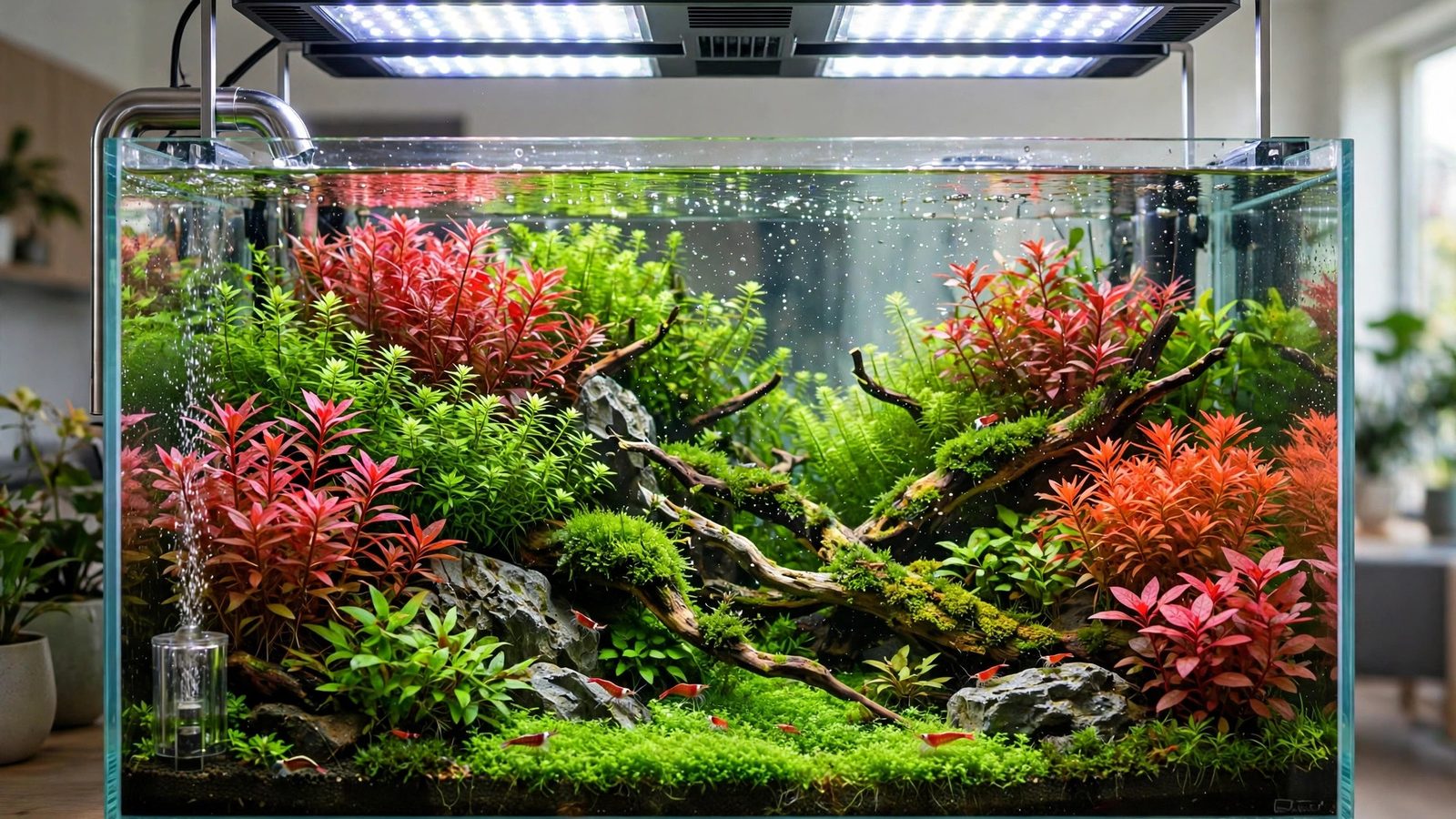
The most expensive mistake in high-tech planted tanks isn't the CO2 regulator or the aquasoil — it's the light above it all. Picking the best LED light for high tech planted tank setups is where you either unlock explosive, pearling growth or fund a month-long algae farm. A high-tech tank runs 60–120+ PAR at the substrate, pressurized CO2, and heavy fertilization, so your light must be measured, controllable, and matched to the demands it creates. By the end of this guide you'll know what "high-tech capable" means in numbers, which six fixtures earn the title, and how to run any of them without the algae bloom every beginner fears.
What Makes a Light "High-Tech Capable"?
Every box in the shop screams "plant optimized." Almost none qualify for high tech. A fixture earns the label when it satisfies four measurable criteria.
1. Real PAR at the substrate, not at the surface
PAR (photosynthetically active radiation), measured in µmol/m²/s, is the only light metric that matters to your plants. Lux and lumens describe human vision; plants run on PAR. To see why, compare: Fluval's official Plant 3.0 spec sheet publishes its 32 W model at 107 PAR at 30 cm depth — that's the kind of depth-rated number a high-tech buyer should demand, not a lumen headline. For a high-tech tank you need roughly:
- 60–80 PAR: entry-level high tech — compact stems, easy carpets like Marsilea hirsuta
- 80–120 PAR: true high tech — dense carpets (HC Cuba, Monte Carlo), red stems
- 120+ PAR: expert territory — stunning growth, zero tolerance for CO2 or fertilizer mistakes
Crucially, these numbers must exist at the substrate, 30–45 cm below the surface in most tanks. A fixture advertising "150 PAR at 30 cm in air" may deliver under 80 through water and a dirty lid — measuring with a PAR meter is the only way to know your real numbers. The hobby's best references say to match PAR at the substrate to your plant group, not to chase wattage or lumens: roughly 90–150 for red plants and demanding carpets. If you're unsure how those numbers map to your plants, see how much light aquarium plants actually need.
2. A spectrum built for plants, not eyeballs
Look for independent red and blue channels. Red (620–660 nm) drives photosynthesis hardest; blue (440–480 nm) keeps growth compact instead of leggy. Tunable RGB/WRGB arrays let you lean into red for color without turning the tank pink. Pure-white 6500K strips with weak red output grow green stems fine and leave Ludwigia stubbornly olive.
3. Even spread across the whole footprint
High tech collapses under uneven light: 120 PAR in the center and 35 at the corners leaves a dead donut around your carpet. Quality fixtures keep corner PAR within ~60–70% of center — check the manufacturer's PAR map. If a brand won't show you the corners, that's your answer.
4. Precise dimming and scheduling
The dealbreaker. You will never run a high-tech light at 100% from day one, and without stepless dimming or 24-hour programming you're stuck with a fixed blast. App-controlled units give you sunrise/sunset ramps and per-channel color — see sunrise/sunset ramping for why plants and fish both prefer it. A fixture with a binary on/off switch is a liability in a CO2-injected tank.
Best LED Lights for High-Tech Planted Tanks: Comparison
The table below compares six fixtures that are genuinely high-tech capable at their size class. Specs are typical advertised ranges — confirm the current version on the manufacturer's page before buying.
| Fixture | Typical wattage | Best tank fit | Control | Price tier |
|---|---|---|---|---|
| Chihiros WRGB II 60 | ~70 W | 45–60 cm (up to 45 cm deep) | Bluetooth app, per-channel RGB + sunrise/sunset | Mid ($100–$140) |
| Twinstar Light S Series (S60 / S600) | ~55–65 W | 45–60 cm | Dimmable controller (sold separately on some versions) | Mid–premium ($120–$200) |
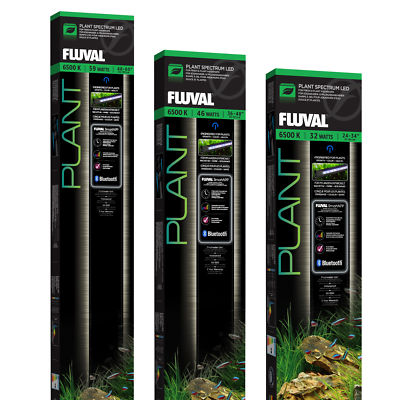
| Fluval Plant 3.0 LED | 22–59 W by size (32 W model fits 61–85 cm) | 38–122 cm (model-dependent) | FluvalSmart app: full 24-hr programming, presets | Mid ($130–$220) |
| Week Aqua L-Series (e.g., L1200 Pro) | ~90–120 W | 90–120 cm, deep tanks to 60 cm | Wi-Fi app, full channel control, storm modes | Premium ($250–$400) |
| ONF Flat One+ | ~50 W | 45–60 cm | Touch dimming + app schedules | Premium ($250–$350) |
| ADA AquaSky RGB 60 | ~50 W | 60 cm, shallow to 45 cm deep | Manual dimming dial + timer pairing | Premium ($350–$450+) |
A few honest notes. The Chihiros WRGB II is the value king — strong PAR per dollar with one of the best apps — but its spread weakens past 60 cm, so size it to its footprint. Twinstar's S Series has arguably the best color rendering in the mid tier (the dimmer is sometimes sold separately — factor that in). The Fluval Plant 3.0 isn't the brightest here, but its programming is bulletproof — for a first high-tech tank, reliability beats raw PAR. At the premium end, Week Aqua's L-series is the brute: the only fixture here comfortable driving a 60 cm-deep tank to 100+ substrate PAR with even corners. ONF's Flat One+ is the design choice — beautiful build, glowing reds, slightly less raw power. ADA's AquaSky RGB remains the color-fidelity reference, but budget buyers get 90% of the result from fixtures half the price. For entry-level options, see the best aquarium lights for planted tanks overall and the best LEDs for low-tech setups.
 ★4.3
Fluval Plant 3.0 LED Aquarium Light
Check Price on Amazon ★4.3Hanging vs On-Tank Mounting
Every fixture on this list supports two mounting styles. On-tank legs give maximum PAR and a tidy look, but weaker corner spread on deep tanks — fine up to 45 cm deep. Hanging kits (20–35 cm above water) spread light far more evenly and keep heat off the tank, but the extra air gap can cut substrate PAR 25–40%, so budget one PAR class up if you hang. Mounting height is free dimming — see light hanging height for how a few centimeters replace a dimmer. Keep the lens clean: a month of condensation film can quietly eat 10–15% of output, mimicking a dying light.
Photoperiod and Dimming Strategy for High-Tech Tanks
The schedule is not "8 hours on." It's a ramp-up over weeks — this is what separates high-tech success from high-tech algae.
Weeks 1–3: the establishment phase
New tanks have unstable biology — sparse plant mass, unsettled filter bacteria, leaching aquasoil. Run 6 hours per day at 50–70% intensity, with CO2 coming on 1–2 hours before lights and switching off 1 hour before lights-out. Plants establish roots; algae, which thrives on excess light over immature systems, stays starved. This is the heart of proper light acclimation for a new tank.
Weeks 4–8: the controlled ramp
Once you see fresh growth — new leaves, runner spread, visible pearling near lights-out — add 30 minutes per week and 5–10% intensity per week until you reach 7–8 hours. If algae appears, freeze the ramp for a week instead of reaching for chemicals; stability beats heroics. Full logic in raising light intensity without algae.
The mature schedule
Most thriving high-tech tanks settle at 7–8 hours at 70–100% intensity (beyond 8.5, diminishing returns and rising algae risk). Favor one continuous block synced with CO2 over split photoperiods — see photoperiod duration: 6 vs 8 vs 10 hours for the theory.
Use sunrise/sunset ramping for the first and last 30–60 minutes. Ramps don't just look natural — they let livestock wake gently and give plants a CO2-saturated start (your drop checker should already be lime-green before the ramps begin, as in our guide to timing CO2 with your light schedule).
Matching Light to CO2 and Fertilizer
The law of high tech: more light = faster photosynthesis = more demand for everything else. Floor a 120-PAR fixture while starving the tank of CO2, and you own a reliable algae generator.
CO2 first, always. Every fixture above assumes pressurized CO2 at roughly 25–30 ppm during the photoperiod (lime-green drop checker). At high-tech PAR, plants strip dissolved CO2 within hours — without injection they stall and algae moves in. Our complete CO2 guide sizes a pressurized system to your light level.
Fertilizer scales with intensity. Under 60 PAR you can dose lean; at 100+ PAR you need Estimative Index-style dosing — typically daily or every-other-day macros (nitrogen ~10–20 ppm/week, phosphorus ~1–3 ppm/week, potassium ~10–20 ppm/week) plus micros, tuned to plant mass. If older leaves develop holes or yellow edges within a week, the plant is cannibalizing itself to keep up — dim the light slightly rather than doubling fertilizer.
Watch the livestock. Start CO2 low (drop checker blue-green) and raise it over 1–2 weeks, backing off immediately if fish gasp at the surface. Strong surface agitation keeps oxygen up at night when plants respire. Conservative is the point: you can always add more CO2 next week, but you can't un-gas your fish.
Common Mistakes (and How to Avoid Them)
- Full intensity from day one. The #1 killer of new high-tech tanks. Every fixture here grows plants at 60% — start there. Algae spores germinate in days; plants need weeks to establish.
- Upgrading light without upgrading CO2. Double the PAR on the same CO2 supply and demand outruns supply. Every light upgrade should trigger a CO2 re-tune.
- Chasing 100% intensity. Most tanks never need full power. If everything grows at 75%, the last 25% buys only algae risk and electricity.
- Skipping monthly cleaning. Dirty lenses, condensation-covered lids, and floating plant mats can silently cut light 10–20% — you raise intensity to compensate and the algae cycle begins.
- Buying wattage instead of control. A 150 W fixture with a binary switch loses to a 60 W fixture with a good app. No small-step dimming and scheduling = not a high-tech light.
- Skipping the ramps. Hard on/off startles fish and slams plants into full photosynthesis before CO2 saturates. Use the scheduler you paid for.
One mindset shift to close: light is the last variable you maximize, not the first. Dial in CO2, establish fertilization, let plant mass build — then, and only then, let the light off its leash. If you're still weighing which path suits you, our comparison of the low-light vs high-light path is honest about the costs and rewards of each.
Frequently Asked Questions
How much PAR do I need for a high-tech planted tank?
Plan for roughly 60–120+ µmol/m²/s at the substrate. Easy high-tech setups (fast stems, simple carpets) thrive at 60–80 PAR; demanding carpets like HC Cuba and red stems want 80–120. Above 120 is expert territory — growth is explosive but any CO2 or fertilizer lapse triggers algae within days. A PAR meter is the only way to verify your real numbers, since manufacturer ratings are measured in air, not through water.
Can I use one fixture for a 60 cm-deep tank?
Yes, but it must be a high-output fixture with strong optics — mid-tier lights sized for 45 cm depth will leave a 60 cm-deep substrate under 50 PAR. Expect to hang it 20–30 cm above the water or choose a premium-class fixture (Week Aqua L-series tier). Two smaller fixtures side by side is often cheaper than one monster and gives better corner spread on deep tanks.
Should I run my high-tech light at 100%?
Usually not. Start new tanks at 50–70% intensity and ramp up 5–10% weekly as plants establish; most mature tanks settle at 70–100%. Full intensity is a ceiling you reserve for the heaviest plant mass, not a default. Running at 75% with healthy plants beats 100% with chronic algae every time — headroom is insurance, not a target.
How long should lights stay on in a high-tech tank?
Begin with 6 hours daily for the first 3–4 weeks, then add 30 minutes per week until you reach 7–8 hours. Longer photoperiods (9–10 hours) give algae more grazing time without proportional plant benefit — if growth stalls, increase intensity or CO2, not hours. Keep one continuous block with 30–60 minute sunrise/sunset ramps rather than splitting the day in two.
Is pressurized CO2 really required with these lights?
For honest high-tech results — dense carpets, compact red stems, fast growth — yes. At 80+ PAR, plants exhaust available dissolved CO2 within hours, and without injection growth stalls while algae takes over. Liquid carbon supplements help at the margins but can't replace gas at these light levels. Budget the CO2 system as part of the light purchase, not an optional add-on.
Why is algae growing if my light is "high-end"?
Because light is only one leg of the tripod: high-tech fixtures create demand, and algae appears when CO2 or nutrients fail to meet it. Check CO2 first (lime-green drop checker before lights-on), then fertilizer levels, then whether you're simply running too much intensity for your plant mass. Dimming 10–15% and holding the schedule for two weeks resolves most cases — resist the urge to change everything at once.
Your Next Step
Choosing the best LED light for a high-tech planted tank comes down to three decisions: size the fixture to your footprint and depth, demand stepless dimming and real scheduling, and budget CO2 as part of the same purchase. Pick the fixture whose size class, control style, and price tier match your tank, then run it gently for the first month while your plants build the mass that earns full intensity. Do that, and the light becomes what it should be: the engine of growth, not the source of your algae.
Ready to tune the schedule? Watch for the warning signs of too much light early, keep your PAR verified, and let the plants — not the box specs — tell you when to turn things up.