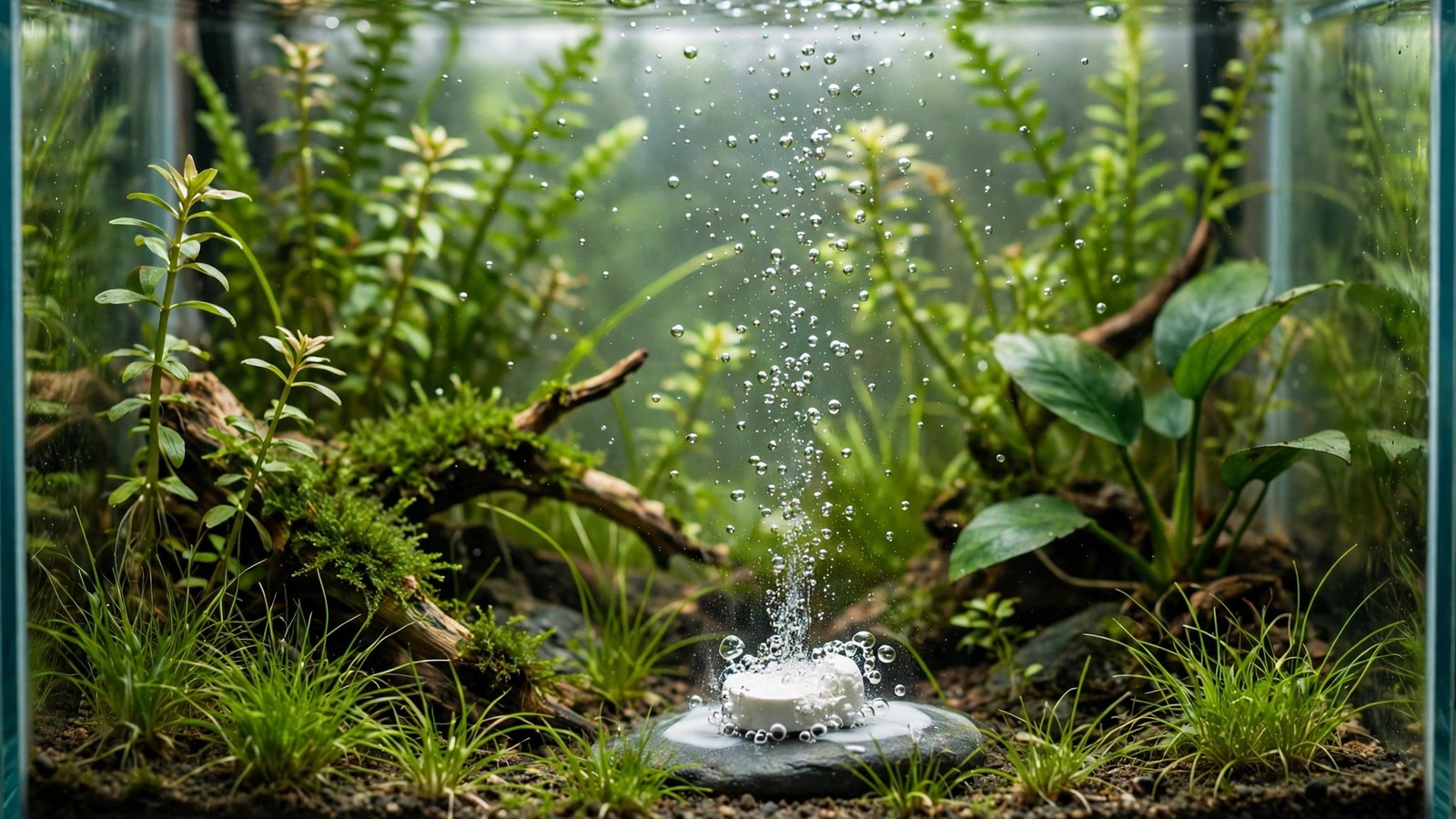
Here is the question every budget aquascaper asks at least once: do CO2 tablets work, or are they the aquarium equivalent of miracle diet pills for your plants? You have seen them in marketplace listings and chain-store aisles — little effervescent tablets that promise a lush, carbon-enriched aquascape without the regulator, the cylinder, or the intimidating price tag. By the end of this guide, you will know exactly what is inside those tablets, how much CO2 each one actually delivers, what they will cost you per month on a real tank, and how to dose them without gassing your fish.
What Is Actually Inside a CO2 Tablet
Peel back the marketing and a CO2 tablet is straightforward chemistry. Most contain dried citric acid and sodium bicarbonate (baking soda) pressed into a fizzy tablet. The moment the tablet hits water, the acid and the bicarbonate react and produce carbon dioxide gas, water, and sodium citrate — the same effervescent reaction you see in an Alka-Seltzer, minus any medicine. Experienced hobbyists have pointed this out bluntly for years: chemically, the generic tablets are essentially effervescent seltzer tablets for your tank.
The important part is that the CO2 is genuine CO2, not a substitute. That distinguishes tablets from liquid carbon dosing, which uses glutaraldehyde — a carbon-containing compound that plants can metabolize, but not actual dissolved CO2 gas. A tablet's fizz is real gas entering real water. The problem, as you are about to see, is not what the gas is — it is when and how long it stays in the water.
Branded versions follow the same principle with different packaging and dosages. Sera's CO2-Tabs Plus, for example, is sold as a 20-tablet pack where each tablet releases about 100 ml of CO2 in their diffusion reactor, while chain-store and online "CO2 booster" tablets cluster around the same one-tablet-per-20-liters instructions.
Do CO2 Tablets Work? The Two-Part Answer
Yes — and no. The honest answer depends on what you mean by "work," so let us split it.
They do add measurable CO2. Drop a tablet into a small tank and dissolved CO2 genuinely rises. In a 10–20 liter nano tank, one daily tablet can push dissolved CO2 up by roughly 5–10 ppm. That is a real, measurable lift, and low-demand plants — anubias, java fern, crypts, most easy stems — can grow visibly better with it. If your question is "will anything happen," the answer is yes.
But they cannot hold a stable CO2 level. A tablet releases its gas over minutes, not hours. CO2 spikes immediately after dosing, then surface agitation and filter outflow strip it back out within a few hours. A pressurized system, by contrast, holds 25–30 ppm steady through the entire 8-hour photoperiod, day after day. A tablet gives your plants a burst of carbon at 9 a.m. and tap water by noon. That burst-and-fade pattern is why tablets never match injection for demanding plants — carpets and red stems need consistent carbon, not a morning spike.
Before spending a rupee or dollar on any carbon product, it is also worth checking whether your plants actually need supplemental CO2 at all. Many beginner-friendly species grow perfectly well on the CO2 your fish and bacteria already produce.
How Many Tablets Per Tank: Doses and Schedules
There is no universal dose because tablet strengths differ, but label norms cluster around one tablet per 20 liters. Always follow your product's label — this table shows common norms, not a substitute for the manufacturer's instructions.
| Product type | Typical dose | Typical frequency |
|---|---|---|
| Sera CO2-Tabs Plus (~100 ml CO2 per tab) | 1 tablet per 20 L | Daily |
| Imagitarium CO2 tablets | 1 tablet per 10 gallons (~40 L) | Per label (multiple times per week) |
| Generic 20-liter tablets | 1 tablet per 20 L | Daily |
| Sflora CO2 Tabs | 1 tablet per 100 L | Twice weekly |
Two dosing rules matter more than the exact numbers. First, dose only during the light period — plants do not photosynthesize in the dark, so nighttime CO2 is wasted carbon that can push dissolved oxygen down. Second, in a stocked tank, start at half the label dose for the first week. You can always add more carbon; you cannot un-add a CO2 spike that has your fish gasping at the surface.
The Cost Math: Tablets vs Every Other CO2 Method
Tablets look cheap per pack — a 20-pack often sells for $7–8, about $0.35–0.40 per tablet. But daily dosing on a normal-sized tank multiplies fast. Run the math for a 60-liter planted tank at 1 tablet per 20 liters per day: 3 tablets per day × 30 days = 90 tablets per month, or $31–36 per month. Now compare every mainstream alternative on that same 60-liter tank:
| Method | Startup cost | Monthly cost (60 L) | CO2 delivery | Best for |
|---|---|---|---|---|
| CO2 tablets | $0–25 (diffusion chamber optional) | ~$31–36 | Bursts of 5–10 ppm, no control | Nano tanks, trial runs |
| Liquid carbon | ~$12 (500 ml bottle) | ~$4–5 (6 ml/day; bottle lasts ~83 days) | Steady ~5 ppm equivalent substitute, daily | Low-tech algae control |
| DIY yeast CO2 | ~$20–40 kit | ~$1–2 (sugar + yeast) | Variable, 7–10 days per batch | Tiny budgets, small tanks |
| Pressurized cylinder | ~$150–300 setup | ~$4–6 ($20–25 refill lasting 4–6 months) | Steady 25–30 ppm, full control | Any serious planted tank |
The pattern is stark: tablets have the lowest startup cost and the highest running cost — by a factor of six or more on a mid-size tank. A pressurized setup that seems expensive on day one becomes the cheapest method within a few months. If your budget cannot stretch to a full cylinder yet, read our comparison of cheap CO2 systems for planted tanks and our liquid CO2 vs pressurized CO2 breakdown before committing to a tablet habit. For the full picture of how hobbyists dose gas CO2, this freshwater CO2 dosing overview from reefs.com covers seltzer tablets alongside yeast and pressurized methods.
When the section's cost math favors pressurized CO2 for bigger tanks, this is the entry-level option: a mini pressurized kit like the Fluval 20g CO2 Kit.
Where Tablets Make Sense — and Where They Don't
Tablets are not useless; they are narrowly useful:
- Nano tanks (10–20 L). One tablet per day is a small, affordable dose, and the burst pattern matters less in a few liters of water.
- Low-tech trial runs. Want to see whether carbon makes a difference before buying hardware? A month of tablets is a cheap experiment on a nano tank.
- Simple setups. If you refuse to run a regulator and just want something for easy plants, tablets beat nothing.
They do not make sense for:
- Tanks above ~60 L. The monthly cost and tablet count become absurd.
- Demanding plants. Carpets, red stems, and high-light species need sustained 25–30 ppm — a tablet burst will not grow them.
- Anyone who wants consistency. DIY yeast is inconsistent; tablets are at least predictably bursty, but neither matches a regulator for stability.
The natural next step up from tablets the section names: DIY citric-acid CO2 without a cylinder: a citric-acid CO2 generator kit like the Fzone 2.5L kit.
Livestock Safety: pH Swings, Drop Checkers, and Start-Low Rules
A CO2 burst is also a pH burst. Adding 10 ppm of CO2 at once can swing pH downward by roughly 0.3 units or more depending on your KH, and fish feel rapid pH swings far more than slow ones. User reviews of popular tablet brands include reports of livestock losses after dosing — typically in small tanks where extra tablets were added "to help the plants." Overdosing is the real danger of this product category, not underdosing.
Follow these conservative rules and tablets are as safe as any carbon method:
- Start at half the label dose for the first week in any stocked tank, then step up only if fish behavior stays normal.
- Use a drop checker. It is the only reliable window into dissolved CO2. Green is your target; yellow means back off immediately. Because the indicator lags 1–2 hours behind real CO2, dose early in the photoperiod. Our CO2 drop checker guide walks through setup.
- Watch the fish, not the fizz. Surface gasping, hanging near the outflow, or sudden lethargy after dosing means too much CO2 — do a partial water change and halve the dose.
- Dose only with lights on. At night, plants respire like your fish do; adding CO2 then only displaces oxygen. Keep normal surface agitation at night.
- Be extra cautious with shrimp. Shrimp and sensitive species tolerate less CO2 swing than hardy fish — start even lower in shrimp tanks. See our CO2 fish safety guide for species-specific caution zones.
The article insists a drop checker is mandatory with tablets; a cheap glass checker removes the guesswork: a simple glass drop checker like the FZONE kit ★4.6.
How to Use CO2 Tablets for the Best Results
If you decide tablets fit your setup, technique decides how much of each tablet your plants actually get:
- Use a diffusion bell or reactor. Dropping a tablet into open water wastes most of its gas at the surface. A small in-tank CO2 chamber (the sera CO2-Start style reactor holds the gas and releases roughly 2,500 fine bubbles per tablet over about 24 hours) keeps the CO2 in contact with water far longer.
- Place it near flow. Position the chamber or the tablet near the filter outflow so dissolving CO2 gets distributed instead of sitting in one corner.
- Dose within the first hour of lights-on, once daily. This matches carbon supply to photosynthesis and gives your drop checker time to stabilize.
- Read the drop checker before redosing. If it is yellow-green or yellow, skip or halve today's dose — yesterday's carbon may not have fully gassed off.
- Store tablets bone dry. They react with humid air; a tablet that has been sitting open in a damp fish room is half-spent before it ever touches your tank.
Our CO2 diffusion methods compared guide explains why contact time matters so much — the same tablet can deliver twice the dissolved CO2 in a chamber versus open water.
Frequently Asked Questions
Do CO2 tablets actually work for aquarium plants?
They release genuine CO2 that plants can use, so yes — something happens. In a nano tank, one daily tablet can raise dissolved CO2 by roughly 5–10 ppm, which visibly helps easy plants. But they deliver carbon in short bursts rather than the steady 25–30 ppm a pressurized system maintains, so they cannot replace injection for demanding plants.
How many CO2 tablets per gallon should I use?
Follow your product's label — tablet strengths vary widely. Common norms are 1 tablet per 20 liters (about 5 gallons) daily, or 1 tablet per 10 gallons for milder formulations. In a stocked tank, start at half the label dose for the first week and only increase if your fish behave normally and your drop checker stays green.
Are CO2 tablets safe for fish and shrimp?
At label doses in an appropriately sized tank, yes. The danger is overdosing: a burst of CO2 swings pH downward quickly, and several keeper reports describe livestock losses after tablets were doubled up in small tanks. Shrimp are more sensitive to these swings than hardy fish. Use a drop checker, dose only during the light period, and never exceed the label dose.
Can CO2 tablets replace a pressurized CO2 system?
No. Tablets give a morning burst that gasses off within hours; a pressurized system holds 25–30 ppm steady through the whole photoperiod with precise control. Tablets also cost far more per month above nano size — roughly $30+ monthly on a 60-liter tank versus $4–6 for pressurized. They are a trial or nano-tank tool, not a replacement.
Can I dose CO2 tablets at night?
No — dose only while the lights are on. Plants do not photosynthesize in the dark, so nighttime CO2 is wasted and can push dissolved oxygen down while everything in the tank is respiring. Dose within the first hour of the light period, and keep normal surface agitation overnight so oxygen replenishes.
Which is better: CO2 tablets or liquid carbon?
They are different products, not interchangeable ones. Tablets release real CO2 gas in bursts; liquid carbon is a glutaraldehyde-based substitute dosed daily that provides roughly a 5 ppm carbon equivalent without gas. Liquid carbon is far cheaper per month and steadier, but it is not true CO2 and some plants (vals, some crypts) react badly to it. For more detail, see our full liquid carbon dosing guide.
The Verdict for Your Tank
CO2 tablets are honest products with a narrow job: they put real, measurable carbon into small tanks with zero equipment. If you run a 10–20 liter nano scape or want to experiment with carbon before buying hardware, a tablet routine will genuinely help — dose by the label, watch your drop checker, and start low with livestock in the tank. For anything bigger or more demanding, skip the tablet habit and put that $30-a-month toward a real CO2 setup. Your plants — and your wallet — will feel the difference within a season.