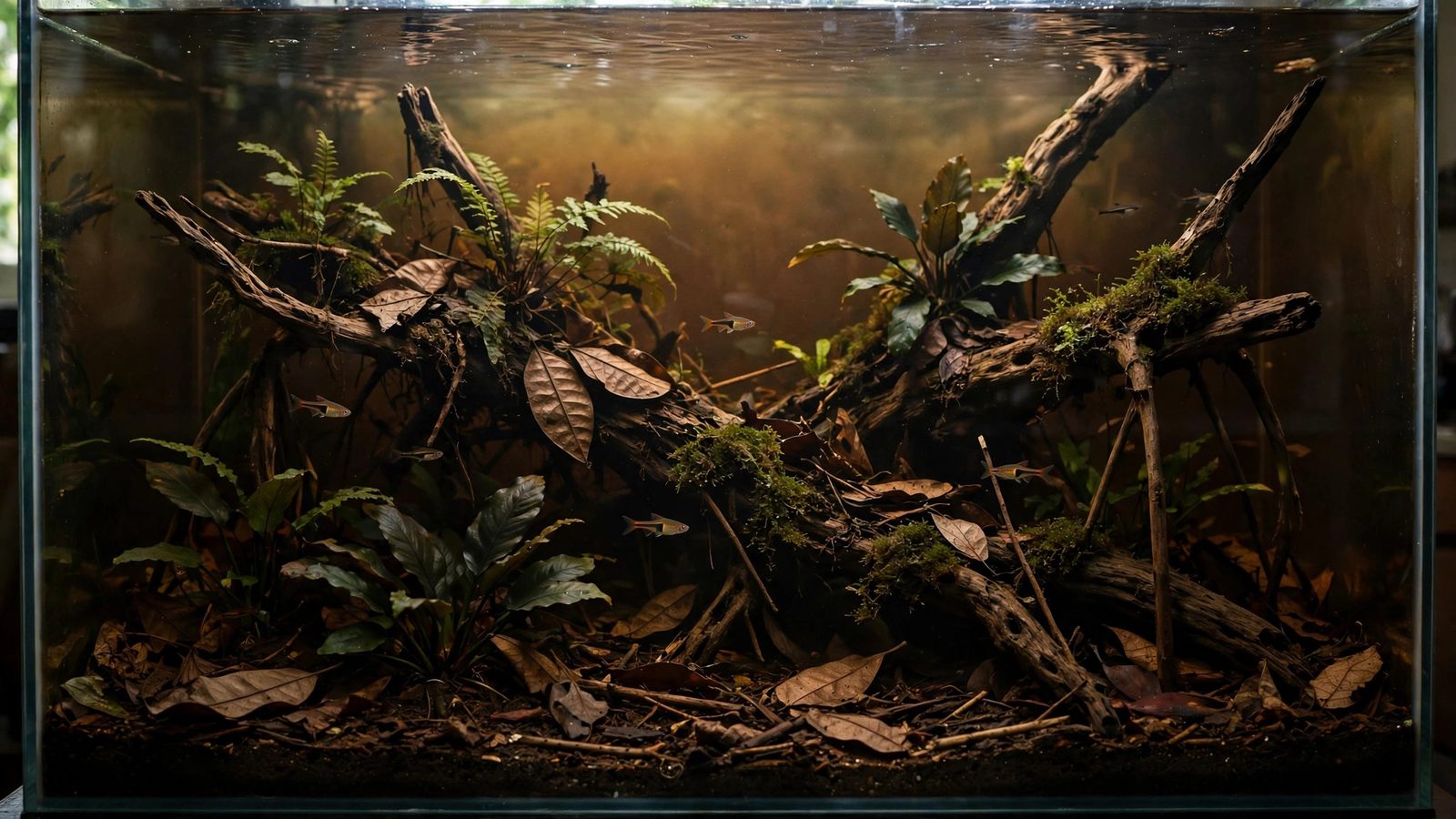
Most "blackwater" tanks are just tea-colored water in a generic scape. The real Sumatra peat swamps where pearl gouramis breed are dim, acidic pools beneath a closed canopy, where every fallen leaf is food, shelter, and chemistry at once. This guide shows you how to build a sumatra river biotope aquarium setup that runs at pH 6.0–6.5 and stays stable for years.
What is a Sumatra river biotope aquarium? It is a tank recreating Sumatra's peat-stained swamp streams: soft acidic water (pH 6.0–6.5, GH 1–4), fine sand over 3–5 cm of leaf litter refreshed every 4–6 weeks, dim dappled light, and species that co-occur there. No active buffering soil — use RO or rainwater at 50–80 ppm TDS with gentle sponge filtration. Per our biotope aquascaping guide, the species list is what separates a biotope from a themed decoration.
A Sumatra river biotope aquarium setup recreates a blackwater peat-swamp stream: soft, acidic, tannin-stained water over fine sand and 3–5 cm of leaf litter. Target pH 6.0–6.5, TDS 50–80 ppm, and 24–27°C — skip CO2 and high light: peat-swamp plants like Cryptocoryne thrive in dim, humic water. The leaf-litter layer is the biotope's engine: it leaches tannins, buffers pH downward, and hosts the microfauna that pearl gouramis and kuhli loaches graze on.
Sumatra River Biotope Aquarium Setup: The Full Build Plan
The water comes first in a peat-swamp build: Sumatra's swamp forests sit on peat meters deep, and rain filtering through it arrives in the streams carrying tannins, humic acids, and almost no minerals. Reproduce that chemistry before anything goes in the tank.
| Parameter | Target range | Why it matters |
|---|---|---|
| pH | 6.0–6.5 | Peat-stain acidity; holds tannins and fish coloration stable |
| GH | 1–4 °dH | Soft water is the rule in peat drainages |
| KH | 0–2 °dH | Low buffering lets botanicals set the pH naturally |
| TDS | 50–80 ppm | Simple check on your RO/rainwater mix |
| Temperature | 24–27°C (75–81°F) | Warm and stable — swamp fish dislike swings |
| Ammonia/Nitrite | 0 ppm | Blackwater never means dirty water — test weekly in month one |
Start with RO or collected rainwater, cut with 10–20% tap until TDS reads 50–80 ppm. Skip active aquasoils — they fight the botanicals for control of the chemistry. Fine, inert silica sand is the biotope-correct choice; our substrate guide for planted tanks explains why it suits low-nutrient epiphyte scapes.
Building the Peat-Swamp Foundation
Lay 2–4 cm of fine sand — no nutrient base, since peat swamps are among the most nutrient-poor habitats on earth. Add driftwood branches (mangrove root or mopani) for shaded pockets, then spread 3–5 cm of dried catappa, oak, and beech leaves plus a handful of alder cones per 50 litres.
The leaves do triple duty: they stain the water, release humic compounds the fish evolved with, and feed a biofilm kuhli loaches graze as it softens. Replace a third every 4–6 weeks — never all at once. Buy aquarium-grade botanicals; roadside leaves can carry pesticides.
Plants That Belong in a Sumatra Peat Swamp
Peat-swamp plants tolerate dim light, acidic water, and rooting in leaf mold — and ask almost nothing of you. Plant sparingly, attach epiphytes to the wood, and skip heavy root tabs. The complete freshwater aquarium plant guide covers the planting fundamentals.
| Plant | Placement | Light needs | Notes |
|---|---|---|---|
| Cryptocoryne cordata | Midground, in sand | Low | The classic peat-swamp cryptocoryne; tolerates pH to 6.0 |
| Cryptocoryne wendtii (green) | Foreground–midground | Low | Undemanding; fills in over 6–8 weeks |
| Bucephalandra spp. | On driftwood | Low | Glue with gel superglue; never bury the rhizome |
| Anubias nana | On wood | Low | Bombproof; rinse well to avoid importing algae |
| Limnobium laevigatum | Floating | Low–medium | Canopy dapple; thin weekly so half the surface stays open |
Keep the planting sparse on purpose. In the wild these streams run as open water between leaf banks — a biotope should read as habitat, not a garden. Check species against Tropica's plant database before buying, since many "Southeast Asia" nursery plants come from the wrong drainage.
Fish That Complete the Scene
Stock for behavior — a peat-swamp tank earns its keep when the fish breed, spar, and forage the way they do under a canopy. All three groups below are peaceful softwater specialists.
| Fish | Group size | Temperature | Why it fits |
|---|---|---|---|
| Pearl gourami (Trichopodus leerii) | 6 (1M:2F ratio) | 25–27°C | Signature Sumatran; males bubble-nest under floating plants |
| Licorice gourami (Parosphromenus spp.) | Pair or trio | 24–26°C | True peat-swamp obligate; for experienced keepers |
| Kuhli loach (Pangio kuhlii) | 6–8 | 24–26°C | Burrows in leaf litter; most active at dusk |
| Sparkling gourami (Trichopsis pumila) | 6–8 | 25–27°C | Tiny and vocal; ideal for 75-litre setups |
Add the kuhlis first to settle the substrate ecology, then the gouramis a week later once the tannin tint has built. Feed quality micro-pellets plus frozen foods; most hobbyists see the best coloration with frozen daphnia twice a week. For contrast, the Pantanal blackwater biotope is a South American counterpart, while the Sulawesi biotope shows a completely different Indonesian water profile.
The Blackwater Water Recipe and Maintenance Rhythm
Getting the tint right is a process, not an event. Add 2–3 catappa leaves and 8–12 alder cones per 50 litres at setup, plus a peat-granule bag in the filter if the water stays clear after a week. Aim for water where you can read the back glass but the sand glows amber — near-opaque tanks hide the fish.
| Task | Frequency | Detail |
|---|---|---|
| Water change | Weekly, 20–25% | Use matching soft water; skip straight tap in hardwater areas |
| Leaf litter refresh | Every 4–6 weeks | Swap one third; keep the rest for the biofilm |
| Parameter check | Weekly (month 1), then fortnightly | pH, GH, TDS — log readings to catch drift |
| Frogbit thinning | Weekly | Keep half the surface open for gas exchange |
| Filter maintenance | Monthly | Rinse sponge in tank water; leave the peat media |
After the 3–4 week maturation window, a healthy peat-swamp tank nearly runs itself: the leaf bed buffers the pH, the low bioload keeps nitrates in check, and your job is mostly observation.
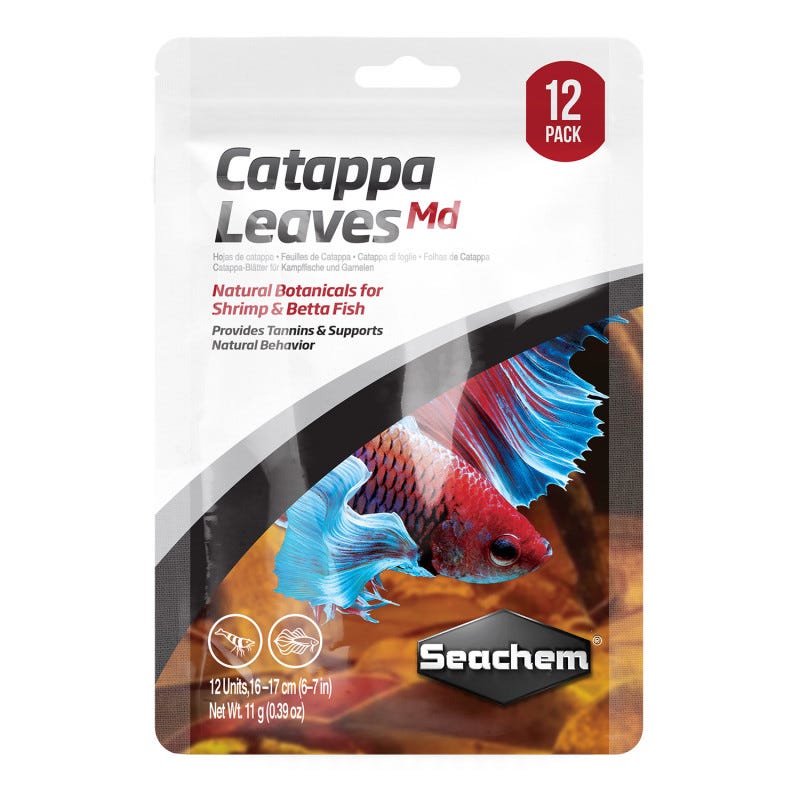 ★4.8
Seachem Catappa Leaves 12-pack
Check Price on Amazon ★4.8Frequently Asked Questions
Can I use tap water for a Sumatra river biotope aquarium setup?
Only if your tap is naturally soft (GH under 4, KH under 2). Most keepers in hardwater areas mix RO or rainwater with 10–20% tap to hit 50–80 ppm TDS. In hard tap water, botanicals stain weakly and the pH rebounds within days.
How long do catappa leaves last in a blackwater tank?
A catappa leaf releases most tannins in 1–2 weeks, then breaks down over the next 4–6. Swap a third of the litter every 4–6 weeks so fresh leaves keep staining while older ones sustain the biofilm your loaches and shrimp graze on.
Do I need CO2 in a peat-swamp biotope?
No. Cryptocoryne, Bucephalandra, and Anubias evolved for slow growth in dim, acidic water — CO2 injection pushes growth the biotope's calm aesthetic doesn't want. Half-dose liquid fertilizer, dosed fortnightly, suffices; most keepers find these slow growers never ask for more.
Why is my blackwater tank water cloudy instead of tea-colored?
Milky cloudiness is usually a bacterial bloom in an immature filter, not tannins — true tannin tint is translucent amber. Confirm ammonia reads zero and halve feeding for a week. Real tint builds over 1–2 weeks and always lets you read the back glass.
Which gourami is better for beginners: pearl or licorice?
Pearl gouramis are far more forgiving — they take prepared foods, tolerate brief chemistry wobbles, and breed in community tanks. Licorice gouramis are the more authentic peat-swamp choice but need very soft, stable water and live foods — a second-year species once your routine is proven.
Bringing the Peat Swamp Home
Give this tank four weeks before you judge it: by week four the tint settles into a deep amber glow and the gouramis color up. A sumatra river biotope aquarium setup rewards patience more than spending.