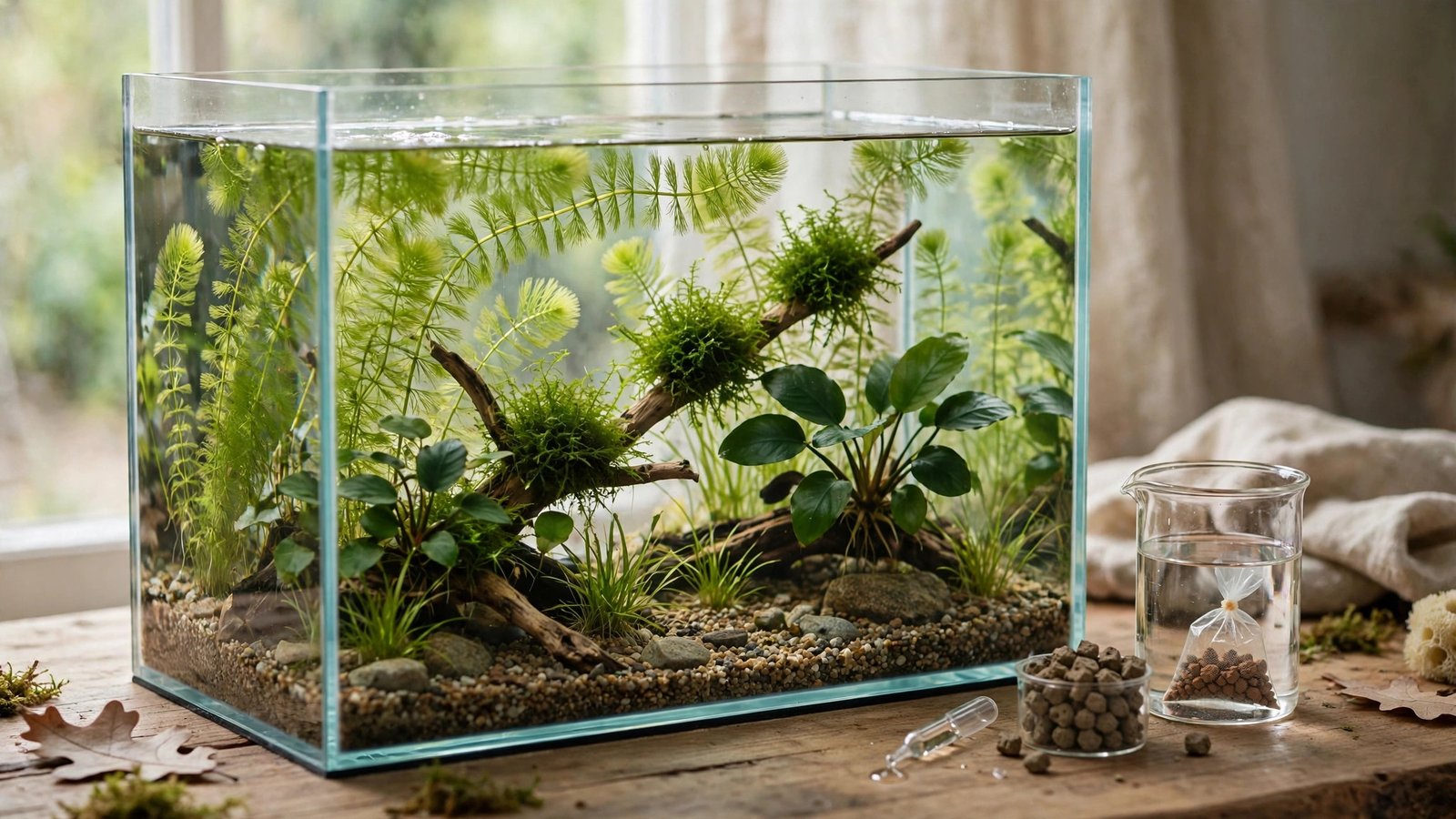
Most fish die in well water for a reason nobody warns you about: the water looks crystal clear from the tap, but it carries almost no dissolved oxygen — and a bucket of it can suffocate a tank in hours. That's the short version of is well water safe for fish tanks: some wells produce the best aquarium water you will ever use, while others quietly poison livestock with iron or crushing pH swings. The difference is one afternoon of testing.
Why Well Water Needs Testing Before Fish
Municipal water is predictable: chlorinated, published hardness, arrives oxygenated. Well water guarantees none of that. It is pulled through hundreds of feet of soil and rock, picking up dissolved minerals, and sits in a sealed, pressurized system with almost no oxygen. Before going further, read our planted tank water parameters guide — it sets the safe ranges for pH, GH, KH, and temperature that every number below is measured against.
The good news: well water usually has no chlorine or chloramine, so it is one step friendlier than city water for beneficial bacteria in planted tanks, and plants often grow faster on it. The bad news: dissolved iron, hydrogen sulfide, farm nitrates, metals from old plumbing, and pH that can swing a full point between seasons. None of it is visible. All of it is cheap to detect.
Is Well Water Safe for Fish Tanks? The Honest Answer
It is safe only after you have tested it and treated what you found. Think in three buckets: great wells (soft, neutral pH, low metals — premium water), fixable wells (hard water, moderate iron, sulfur smell — all correctable), and dangerous wells (nitrate over 40 ppm, lead or copper — filter these first). You cannot tell which bucket you are in by taste or clarity: a well staining the bathtub orange can be fine for fish, while pristine-tasting water can hide 60 ppm of nitrate. The most common beginner mistake is skipping to fish because the water "seemed fine."
What to Test: The Well Water Aquarium Checklist
Use a liquid master test kit — the drop-based kind, not strips, which are too imprecise for these decisions — plus an iron test kit and a GH/KH kit. Test twice: once straight from the tap, and once after the sample has sat in an open bucket with an air stone for 24 hours. The aerated number is the one your tank will settle at.
| Parameter | Safe range | Why it matters |
|---|---|---|
| pH | 6.5–7.5 (stable) | Swings over 0.5 in 24h stress fish |
| Ammonia / nitrite | 0 ppm | Any reading means contamination is reaching your aquifer |
| Nitrate | Below 20 ppm | Farm and septic runoff; above 40 ppm means algae and sick fish |
| Iron | Below 0.3 ppm | Above this, flakes form on gills; low levels feed plants |
| Manganese | Below 0.05 ppm | Similar gill irritation to iron at high levels |
| GH / KH | 3–8 dGH / 3–8 dKH | Low KH means pH can crash overnight |
| Copper / lead | 0 detectable | Old plumbing; lethal to shrimp first |
The Big Four Risks (and How to Fix Each)
1. Excess iron: orange stains, flaking gills
Iron is the signature well-water problem. It oxidizes into particles that coat fish gills in fine flakes until they gasp and stop eating — and it feeds the algae outbreaks planted tanks hate. Above 0.3 ppm, run change water through an iron-removal pre-filter. One caveat: dissolved iron at low levels is genuine plant fertilizer, so check the water conditioner guide before stripping every trace — you may simply stop dosing liquid iron.
2. Oxygen-starved water
This is the silent killer. Water under pressure underground carries almost no dissolved oxygen, and pouring it straight into a tank during a big change can asphyxiate sensitive species. The fix is free: age change water in an open bin with an air stone for 24 hours, or at least a few hours with vigorous surface agitation.
3. Fluctuating pH
fresh well water can read pH 6.6 from the tap and settle at 7.6 after aeration, as dissolved CO2 off-gasses. A 40% change of un-aged water swings the tank's chemistry twice. This is why understanding water changes vs topping off matters for well keepers: aged, pre-aerated water eliminates the swing, and a stable baseline makes cycling the tank far more predictable.
4. Heavy metals and hydrogen sulfide
Copper and lead sneak in through older plumbing — run the tap two minutes before drawing tank water, and test for copper if you keep shrimp. Rotten-egg hydrogen sulfide aerates out within hours and is mostly a nuisance. If your annual lab test flags anything for human health, don't gamble on fish: county extension offices offer affordable testing, and UGA's extension program explains how to test well water quality and interpret the results.
Treating Well Water: The Routine
- Draw and aerate. Fill storage buckets 24 hours ahead; run an air stone. This adds oxygen and off-gasses CO2 and sulfur.
- Condition it. Even without chlorine, dose a water conditioner — good ones detoxify metals and bind trace ammonia.
- Filter iron if needed. Only above 0.3 ppm. An iron-removal cartridge before the storage bin is enough; you rarely need full RO.
- Match temperature. Well water runs cold year-round — let it warm up so changes don't thermal-shock tropical fish.
- Retest before it goes in. pH and iron, five minutes, zero surprises.
For larger tanks, an automatic water change system for planted tanks with a pre-filter and aeration reservoir upstream does all of this while you sleep.
Well Water and Plants: A Secret Advantage
Well water is often better for plants than municipal water: it arrives loaded with calcium, magnesium, and the dissolved iron your plants are hungry for, while city water is stripped of nutrients. Many keepers halve liquid iron dosing once they dial in their well. Just account for any nitrate the well carries — 15 ppm in the source means don't dose nitrogen the tank already has. Pair that with a solid first planted tank shopping list and our cycling guide, and your well becomes one of the cheapest advantages in the hobby.
Frequently Asked Questions
Can I use well water directly without testing?
Don't. Iron, manganese, nitrates, sulfide, and pH swings are all invisible and all common in wells. Test pH, ammonia, nitrite, nitrate, iron, and GH/KH with a liquid kit before any fish go in — then retest after 24 hours of aeration to see where the water settles.
Does well water need water conditioner?
Yes. No chlorine doesn't mean no problems — a good conditioner detoxifies trace metals, binds ammonia, and protects the slime coat. Think of it as cheap insurance per water change against the trace contaminants a test kit alone can't catch.
Is iron in well water harmful to fish?
Above ~0.3 ppm, yes: iron oxidizes into particles that flake onto gills, causing gasping and lethargy. Below that, dissolved iron is plant food and can reduce iron dosing. If your test reads high, run change water through an iron-removal pre-filter.
My well water smells like rotten eggs — safe for fish?
The smell is hydrogen sulfide, which usually aerates out within hours — age change water 24 hours and it's typically fine. If the smell is strong or the water tests acidic with it, get a full lab test, since high sulfide can signal bacterial contamination.
Should I use a water softener for my aquarium?
No. Salt-based softeners replace calcium and magnesium with sodium, which is harder on fish and plants than the original hardness — and they don't remove iron or nitrates. If water is too hard, blend with RO water or keep hard-water species.
How often should I test my well water?
Test fully before starting, spot-check pH and nitrate monthly, and run the full panel seasonally. Get an annual professional lab test too — extension offices offer them cheaply, and the University of Georgia publishes well water testing guidance useful anywhere.
Well water rewards the keeper who tests first and treats second. One afternoon with a liquid test kit tells you whether your well is a hidden gem, a fixable project, or a source to filter.