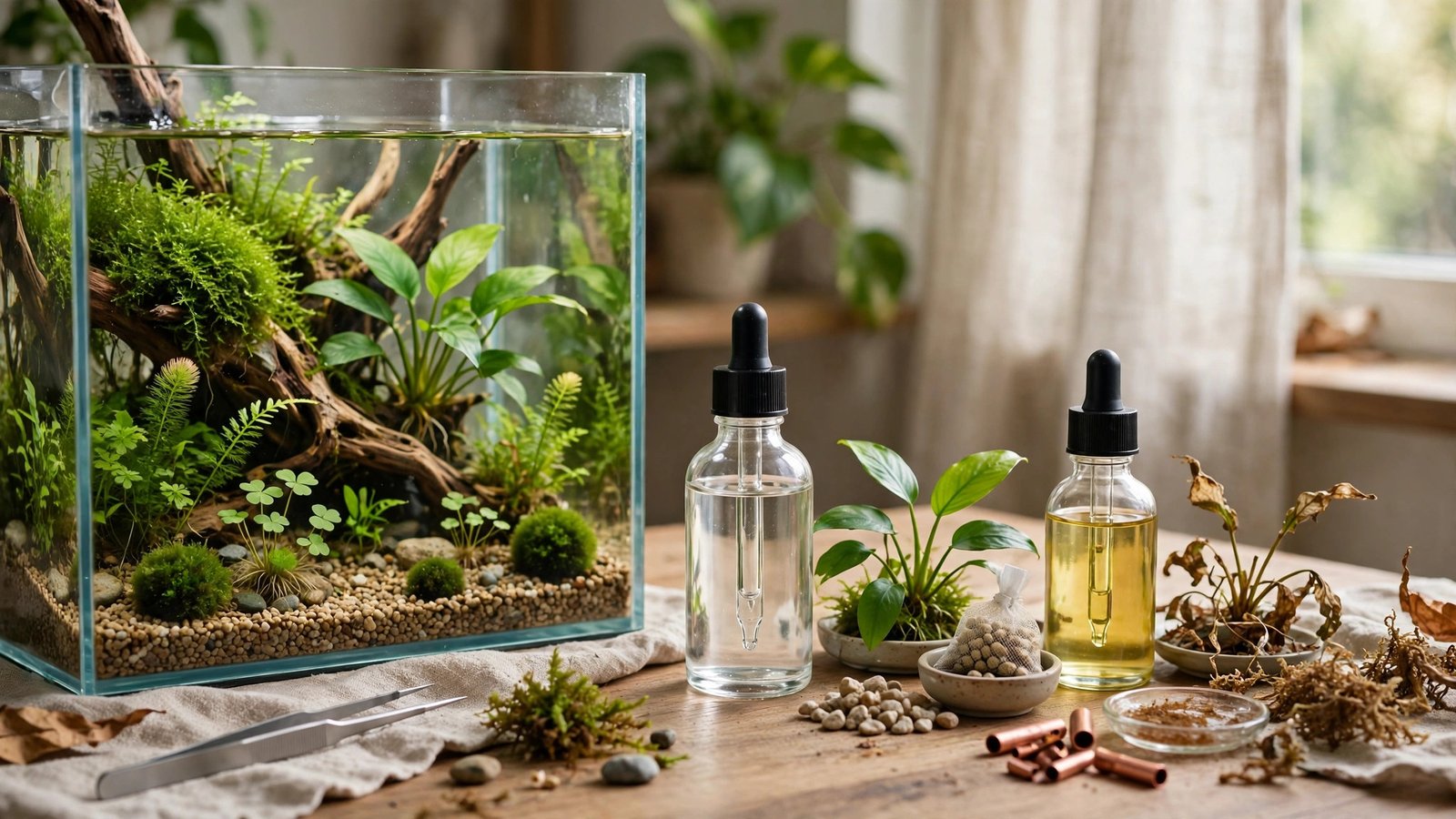
Your city treats tap water with chemicals designed to kill bacteria on contact — and those chemicals cannot tell your filter's beneficial bacteria from the germs they're meant to destroy. Pour untreated tap water into a planted tank and you wipe out the living filtration your aquarium depends on, scorch tender plant roots, and burn fish gills and shrimp carapaces at a level you can't see. This guide to water conditioner for planted tanks answers the question every aquarist eventually asks: is water conditioner safe for planted tanks? Yes — and not using one is the single most expensive "free" shortcut in the hobby. You'll learn which dechlorinators are genuinely plant-safe, how much to dose for your tank size, and the exact weekly routine that keeps a planted tank thriving.
Why Tap Water Is a Threat to Your Planted Tank
Municipal water is engineered for one job: arriving at your faucet free of disease-causing microbes. Chlorine and chloramine achieve that by oxidizing cells indiscriminately. Unfortunately, the cells they attack most eagerly in your aquarium are the ones you want most — the nitrifying bacteria colonizing your filter sponge, ceramic rings, and substrate. A single 30% water change with unconditioned tap water can knock back your bacterial colony within minutes, and the resulting ammonia spike will melt planted community tank leaves, suffocate shrimp, and leave fish gasping at the surface within hours.
Plants suffer in subtler ways. Chlorine oxidizes root hairs and new growth — carpeting plants and tissue-culture specimens are the first casualties; their leaves turn translucent and dissolve within a day or two of exposure. Shrimp fare worse: even brief chlorine exposure damages their gills, and chloramine releases free ammonia as it breaks down, which hits cherry shrimp and crystal shrimp at levels you can't detect without a test kit.
Chlorine vs Chloramine: Know Which One Your City Uses
Not all tap-water disinfectants behave the same, and confusing the two is where most conditioning mistakes start. Chlorine (Cl₂) is the older method — it gasses off if you leave water standing with aeration for 24 to 48 hours. Chloramine (NH₂Cl, chlorine bound to ammonia) was adopted by most US utilities because it lasts far longer in pipes; more than one in five Americans now drinks chloraminated water, according to the US EPA's page on chloramines in drinking water.
Here is why the distinction matters for your tank:
| Feature | Chlorine | Chloramine |
|---|---|---|
| Dissipates by standing overnight | Yes (24–48 hrs with aeration) | No — stays active for weeks |
| Removed by carbon filtration | Yes, easily | Yes, but needs longer contact time |
| Breaks down into | Chloride (harmless) | Ammonia (toxic) + chloride |
| Typical tap concentration | 0.5–2.0 ppm | 1.5–4.0 ppm |
| Risk if untreated in tank | Kills bacteria, burns gills | Same — plus a hidden ammonia dose |
Check your water utility's annual water-quality report (search "[your city] water quality report") to learn which disinfectant they use. The safest default is to assume chloramine unless the report says otherwise — a conditioner that handles chloramine handles chlorine automatically, but the reverse is not true. Plain sodium-thiosulfate dechlorinators neutralize chlorine but leave the ammonia released from broken-down chloramine untouched.
Which Water Conditioners Are Safe for Planted Tanks? The Short List
For a planted tank, the ideal conditioner does three things: neutralize chlorine, neutralize chloramine, and bind the ammonia released by chloramine breakdown — without harming plants, bacteria, or invertebrates. Three products have earned their reputation across millions of planted tanks:
| Conditioner | Removes chlorine | Removes chloramine | Detoxifies ammonia | Heavy metals | Concentration |
|---|---|---|---|---|---|
| Seachem Prime | Yes | Yes | Yes (~48 hrs) | Yes | 5 mL per 50 gal |
| API Tap Water Conditioner | Yes | Yes | No | Yes (copper, lead) | 1 mL per 10 gal |
| Fritz A.C.C.R. | Yes | Yes | Yes | Yes | 5 mL per 10 gal |
Seachem Prime is the industry standard for good reason. It removes chlorine and chloramine and detoxifies the ammonia, nitrite, and nitrate they release, converting ammonia into a non-toxic form your biofilter still removes (see the Aquarium Wiki's breakdown of Prime's reduction chemistry). It does not change pH, and it detoxifies heavy metals at typical tap concentrations. The sulfur smell on opening is normal.
API Tap Water Conditioner is a simpler, budget-friendly option that instantly neutralizes chlorine and chloramine and detoxifies copper and lead — a solid choice for small setups like filterless planted fishbowls. It does not detoxify ammonia, so if your tap water runs high chloramine levels, pair it with regular ammonia testing.
Fritz A.C.C.R. (Ammonia, Chlorine, Chloramine Remover) is the third major option, popular with discus and shrimp breeders, dosed at a straightforward 5 mL per 10 gallons. Any of the three is safe for your plants — what matters most is that you use one consistently.
Dosing Math: How Much for Your Tank
Dosing is where most conditioner mistakes happen, and they're almost always on the overdose side — a small error in a 10-gallon tank can mean 5–10x the recommended dose. Standard doses:
| Tank size | Seachem Prime | API Tap Water Conditioner | Fritz A.C.C.R. |
|---|---|---|---|
| 10 gallons | 1 mL | 1 mL | 5 mL |
| 20 gallons | 2 mL | 2 mL | 10 mL |
| 40 gallons | 4 mL | 4 mL | 20 mL |
| 55 gallons | 5.5 mL | 5.5 mL | 27.5 mL |
A few dosing rules to follow every time:
- Measure, don't pour. Use a 1 mL oral syringe from any pharmacy — Prime's cap threads each hold roughly 1 mL, but a syringe is far more precise for small tanks.
- Dose for the full tank volume when filling directly. Pouring new water in by hose? Dose for the entire tank first, then add water.
- Dose for the bucket when pre-mixing. Conditioning in a 5-gallon bucket? Dose only for those 5 gallons (0.5 mL of Prime).
- Don't double up. A 2–3x accidental overdose of Prime is generally harmless, but massive overdoses can temporarily reduce dissolved oxygen. Stick to the label.
Does Water Conditioner Harm Plants or Steal Their Nutrients?
This is the question that keeps planted-tank forums arguing, so let's settle it plainly: no quality water conditioner harms aquatic plants at recommended doses. Millions of high-tech planted tanks — CO₂-injected, high-light showpieces — run on Seachem Prime every single water change. If conditioners damaged plants, aquascaping contests would have exposed it decades ago.
Two related myths deserve honest answers:
The Prime "ammonia detox" myth. Prime's ammonia-binding is often described as if it locks nitrogen away permanently, starving plants of ammonia and stalling the nitrogen cycle. In reality, the detoxification is temporary (about 24–48 hours) and the bound ammonia remains fully available to both nitrifying bacteria and plant roots afterward. Your biofilter keeps consuming ammonia normally, and your plants never notice.
Chelator and iron-fertilizer concerns. Conditioners are reducing agents — they work by donating electrons. Strong reducing agents can theoretically interfere with chelated iron (Fe-EDTA, Fe-DTPA, Fe-gluconate) in liquid fertilizers, making iron briefly less available to plants. In practice this is minor and short-lived — but the fix is free: wait at least 24 hours after a water change before dosing iron fertilizers. Dose macros and general micros right after the water change as usual; just hold the iron for a day.
Conditioner and Shrimp: The Copper Question
Shrimp keepers worry about conditioner for a different reason: copper. Tap water can carry trace copper from household plumbing, and copper is genuinely toxic to invertebrates at elevated levels. Here the conditioner is your ally, not a suspect: Prime, API Tap Water Conditioner, and Fritz A.C.C.R. all detoxify heavy metals including copper at typical tap-water concentrations.
Two practical notes for shrimp tanks. First, conditioner handles typical trace copper — it will not save shrimp from copper-based medications. If you ever medicate with copper, treat in a separate hospital tank. Second, conditioned tap water is far safer for shrimp than water treated by "natural" aging alone, because aging leaves dissolved metals behind. For the small cube tanks where shrimp colonies thrive, consistent conditioning is one of the simplest investments in colony survival.
When You Should NOT Condition Your Water
Conditioner is essential for municipal tap water, but there are legitimate cases where it does nothing:
- Pure RO or distilled water. No chlorine or chloramine — nothing to condition. Remineralize and use directly.
- Mixed RO/tap setups. If you blend, say, 50% RO with 50% tap, condition only the tap portion.
- Untreated well water. No chlorine or chloramine to remove, but wells can carry heavy metals or pesticides — testing matters more than conditioning here.
- Rainwater. No disinfectant, but rainwater can carry roof-runoff contaminants — conditioner won't fix those. Filter and test first.
The key principle: conditioner removes disinfectants and trace metals; it is not a universal water purifier. If your water's problem is nitrate, phosphate, or dissolved organics, no conditioner fixes that — that's what water changes are for.
The Planted-Tank Water Change Routine That Actually Works
Conditioner is one piece of a larger system. Here's the weekly routine that keeps a planted tank stable — the same cadence behind most thriving planted barb tanks and high-tech aquascapes:
- Match temperature within 2°F (1°C). Cold water shocks plants and livestock and can trigger crypt melt in sensitive species. Use a thermometer — aim for the same reading as the tank.
- Turn off the filter before draining. Exposed filter media shouldn't run dry; exposed plants shouldn't bake under hot lights. Turn lights down during the change if the scape will be exposed.
- Remove 30% of the tank water. For most planted tanks, 30% weekly is the sweet spot: enough to reset nitrates and organics, gentle enough to keep the biofilter and CO₂ system stable. New high-tech setups under 2 months old may need 40–50% twice a week while the scape matures.
- Add the conditioner to the tank before the new water. Dose for the full tank volume if filling by hose, or for the bucket if pre-mixed. Then add the new water slowly — a small pump or siphon over 10–15 minutes beats dumping.
- Restart everything, then fertilize. Filters on, CO₂ back on if you run it. Dose your weekly macros and general micronutrients now — nutrients enter clean water where plants absorb them fastest. Hold iron until tomorrow.
Two timing details matter more than people think. First, dosing fertilizer right after the water change gives plants the biggest, cleanest nutrient pulse of the week. Second, if you use emergent-growth plant holders or floating plants, the 24-hour iron rule applies to them too — surface absorption doesn't bypass the chelator interaction.
Frequently Asked Questions
Is Seachem Prime safe for planted aquariums?
Yes. Seachem Prime is one of the most widely used conditioners in the planted-tank hobby and is completely plant-safe at the recommended dose of 5 mL per 50 gallons. It removes chlorine and chloramine, detoxifies the ammonia released by chloramine breakdown, and neutralizes heavy metals. Its ammonia-detox effect is temporary (about 24–48 hours) and does not starve plants or bacteria of nitrogen.
Can I just let tap water sit overnight instead of using conditioner?
Only if your utility uses plain chlorine — and you can't assume that. Chlorine dissipates from standing, aerated water in 24–48 hours, but chloramine (used by most modern utilities) remains stable for weeks. Since aging does nothing to chloramine, condition every drop of tap water. A $12 bottle of Prime treats 1,000 gallons, so skipping conditioner saves nothing.
Does water conditioner kill beneficial bacteria?
No — it protects them. Conditioners neutralize the disinfectants that would otherwise kill your nitrifying bacteria on contact. Pouring untreated chlorinated water through your filter is what destroys a bacterial colony; conditioner prevents exactly that. Prime and similar products are routinely used during tank cycling without slowing bacterial colonization.
Should I condition water for water changes in a shrimp tank?
Absolutely — shrimp are among the most chlorine-sensitive livestock you can keep, and conditioners also detoxify trace copper from household plumbing. Dose exactly for your tank size, add the conditioner before the new water, and keep water changes at 20–30% to avoid shocking the colony. Never rely on conditioner to neutralize copper-based medications — treat those in a separate hospital tank.
Can I use tap water conditioner with iron fertilizer?
Yes, with one timing rule: wait at least 24 hours after dosing conditioner before adding iron fertilizer. Conditioners are reducing agents that can briefly interfere with chelated iron (Fe-EDTA, Fe-DTPA, Fe-gluconate) supplements. Dose your macros and general micros right after the water change as usual, and add iron the next day.
Do I need conditioner for RO or distilled water?
No. RO, DI, and distilled water contain no chlorine or chloramine, so there's nothing to condition — you can remineralize and use it directly. But if you blend RO with any tap water, dose conditioner for the tap-water portion. Conditioner also can't fix high nitrates or phosphates; those need water changes, RO, or proper filtration.
Condition Every Drop, Every Time
A water conditioner is the cheapest life-support in the aquarium hobby: a few cents of liquid per water change buys you intact bacteria, unburned plant roots, and livestock that stays alive. Pick any of the three proven products, dose it with a syringe before the new water goes in, keep iron fertilizer 24 hours away from it, and change 30% weekly. Do that, and your water chemistry stops being a suspect every time something looks off — and becomes the foundation a thriving planted tank is built on.