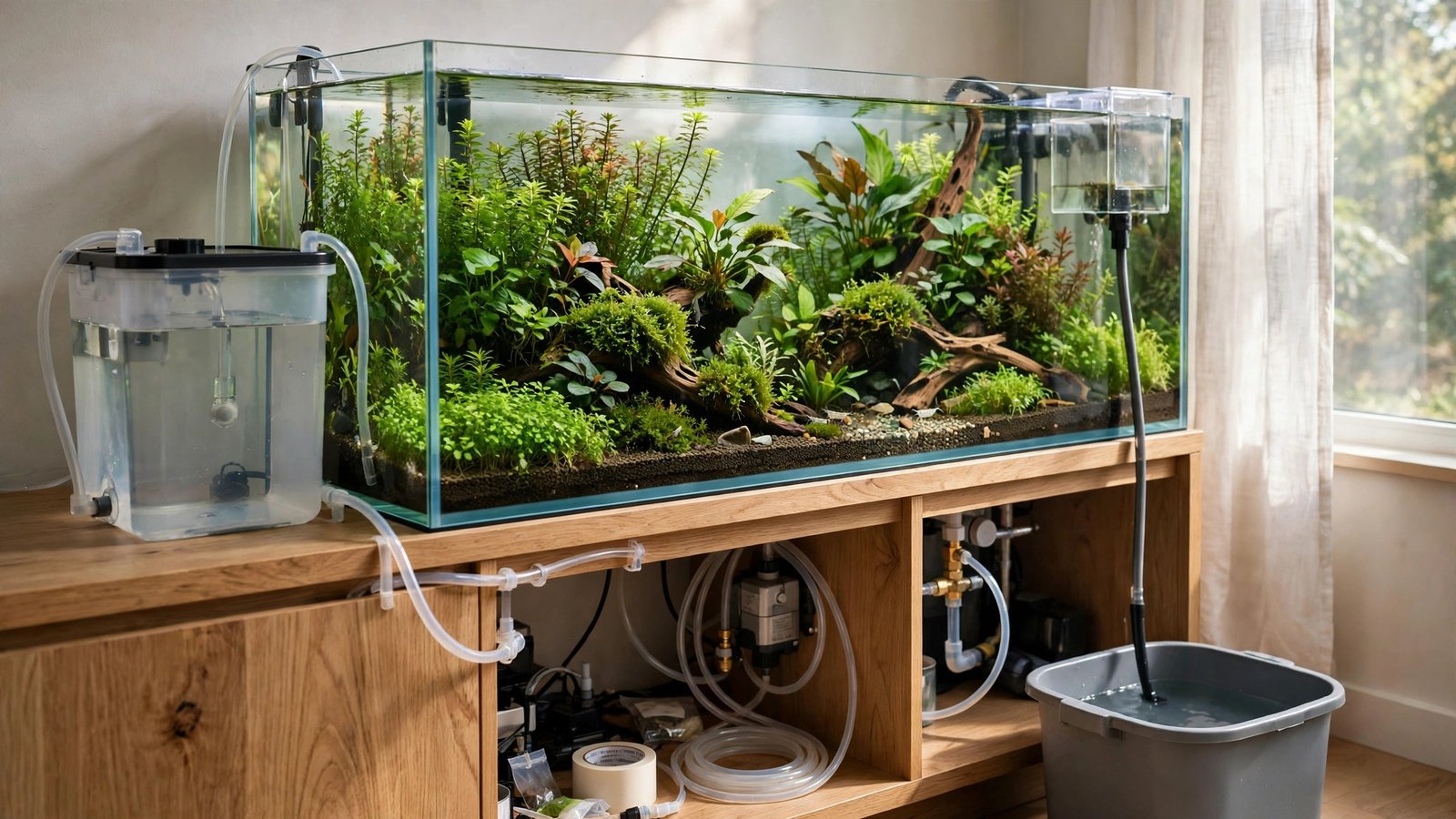
The hardest part of owning a planted tank is not the scaping or the CO2 tuning — it is the water changes, week after week, bucket after bucket. An automatic water change system for a planted aquarium removes that chore: a drip line, a timed drain-and-fill loop, or a continuous-exchange setup can keep nitrate levels low and plants thriving while you barely lift a hose. This guide covers the three proven system types, how to size the daily exchange for planted tanks, flood-proof plumbing with mandatory failsafes, dechlorinator dosing on auto-refill, and the plant-specific math that keeps automation from stripping your water column bare or destabilizing CO2 and temperature.
Why Planted Tanks Deserve Automated Water Changes
Water changes are the most important habit in a planted aquarium — our guide on why aquarium plants need water changes explains how they reset nitrate and purge organics. But the manual method — siphoning, hauling buckets, refilling — is the chore most often skipped, as our manual water-change technique guide shows. The big win from automation is not laziness but stability: 10% a day in slow increments keeps every parameter nearly constant, instead of one 40% shock every Sunday.
The three automatic water change system types for planted aquariums
Every automatic setup is a variation of one of three architectures. Choose based on your tank size, plumbing access, and how much automation you actually want.
| System | How it works | Best for | Cost |
|---|---|---|---|
| Drip exchange | Slow freshwater drips in; an overflow drain carries old water out at the same rate | Nano to mid-size tanks, renters | $20–$80 |
| Drain-and-fill timer | Timer drains a set volume, then refills it in a second phase | Large tanks with drain access | $60–$200 |
| Continuous exchange | Matched peristaltic pumps pull and push water simultaneously | High-tech CO2 tanks, fish rooms | $100–$300 |
1. Drip Exchange Systems
The drip system is the simplest automation: a low-flow line (RO tubing, airline tubing, or a garden drip emitter) adds fresh, dechlorinated water at a trickle, while a standpipe or drilled overflow drain carries an equal amount of old water out. Because the exchange is constant, plants and fish never feel a swing. Set the drip rate with a cheap inline needle valve. Flood warning: the overflow drain is this design's entire safety net — it must handle the maximum possible inflow, so test it by opening the supply valve fully before you walk away.
2. Timer-Based Drain-and-Fill
This approach replicates a manual water change on a schedule: a digital timer starts a drain pump (or opens a solenoid valve on a siphon), removes a preset volume, then a second timer phase refills it. It suits larger tanks where drip rates would be impractically slow. The critical engineering is order-of-operation interlocking: refill must never run without a completed drain, and the drain must never exceed its volume. A low-level float cuts the drain pump off; a high-level float cuts the refill off. A hose on a timer with no float protection is a flood waiting for a timer glitch.
3. Continuous Exchange with Peristaltic Pumps
The premium option uses two peristaltic dosing pumps — one pulling tank water out, one pushing fresh water in — running continuously or in scheduled micro-pulses. Peristaltic pumps are positive-displacement, so flow is exact and repeatable, and they self-prime — the gentlest method for high-tech CO2 tanks because parameters barely move. Calibrate both pumps over one hour with a graduated cylinder; even a 5% mismatch accumulates over days. A level sensor as an emergency cutoff closes the loop.
Sizing the Exchange: How Much Water Per Day?
Plant keepers often assume automation should mimic the classic 30–50% weekly manual change. But spread across the week, continuous small changes are mathematically more efficient than infrequent large ones — you need less total volume for the same nitrate control.
The daily-exchange math
For a high-tech CO2 tank with heavy dosing, aim for 10–15% of tank volume per day — roughly a 50–70% weekly reset spread evenly. For a moderate low-tech tank, 5–10% per day is plenty. A 40-gallon tank at 10% daily needs 4 gallons per day, about 0.17 gallons per hour — a slow drip (roughly one drop every 2–3 seconds). Verify the actual rate by measuring what the overflow carries away in one hour with a bucket, then adjust.
Nutrient reset vs stripping the water column
Here is the plant-specific trap in auto water changes: too much exchange strips the water column of the fertilizers you just dosed. If you dose an all-in-one on Monday and your system exchanges 15% daily, over half the dose is gone before plants fully use it. Three fixes, in order of preference:
- Keep exchange modest (5–10% daily) — usually below plant uptake rates, so dosing schedules barely change.
- Time dosing after the day's exchange — with drain-and-fill systems, dose right after refill completes so nutrients spend maximum time available.
- Dose for the exchange rate — in continuous high-exchange setups, increase daily dosing slightly and watch plant color and growth as your guide.
Root-feeding plants and aquasoil-buffered tanks are far less affected — substrate nutrients do not wash out. Tropica's guide to fertiliser and CO2 is a solid reference for how plants absorb nutrients from water and substrate, which helps you judge how your dosing should respond to automation. Keep your water parameters in their target ranges and treat automation as a stabilizer, not a replacement for testing.
Flood Prevention: Mandatory Failsafes
This section is not optional. Every automatic water-change system is a plumbing connection between your aquarium and an unlimited water source — or an unlimited drain path. Every failure mode you skip will eventually happen. Build these in from day one, not after the first flood.
Overflow drains: your last line of defense
Every design must have an overflow path that works with zero electricity and zero attention. For drip systems this is the standpipe overflow itself; other designs need a dedicated overflow — a drilled bulkhead, a hang-on-back overflow box, or an elevated drain pipe set just above the normal waterline, routed to a sink or floor drain. Test it by simulating a stuck-open fill valve: open the fill path fully and confirm the level never rises. If you cannot test this, your system is not finished.
Float valves and float switches
Use mechanical float valves on the supply line (the same kind used in RO reservoirs and toilet tanks) as a primary refill shutoff — they stop water physically, independent of power or software. Layer float switches as electronic cutoffs wired in series with pumps: a high-level switch that kills the refill pump, a low-level switch that kills the drain pump. Redundant layers are the whole point — a single point of failure on a water line is how aquariums end up on floors.
Leak detectors and auto shutoffs
Place battery-powered water leak detectors (or a WiFi leak sensor tied to a smart shutoff valve on the supply line) on the floor under the tank, sump, and every plumbing joint. For supply lines, an inline solenoid valve that fails closed on power loss is cheap insurance: if the power dies, the water supply stops automatically.
The failsafe checklist
- Overflow drain tested at full-open flow, routed to a real drain (never a bucket as the only backup)
- Mechanical float valve on every supply connection, plus electronic float switches as cutoffs
- Fail-closed solenoid on the supply line; leak detectors under tank, sump, and all joints
- Drain-side protection: low-level cutoff so the drain pump can never empty the tank
- A manual master shutoff valve you can reach in seconds, clearly labeled
- A 48-hour "watched" test run before trusting the system unattended
Dechlorinator Handling on Auto-Refill
Chlorine and chloramine in tap water are toxic to fish, shrimp, and beneficial bacteria — and an automated refill adds them continuously, so treatment must be engineered, not improvised. Check your utility's water report to learn which disinfectant you have; the EPA's overview of chloramines in drinking water explains why chloramine persists longer and needs different treatment.
- Carbon prefilter on the supply line: an inline activated-carbon or catalytic-carbon cartridge removes chlorine (and most chloramine) passively from every drop — no dosing schedule to fail. Replace the cartridge on a calendar schedule.
- In-line dosing pump: a small peristaltic pump injecting liquid dechlorinator into the refill line whenever refill runs. Calibrate the dose to the refill volume and keep the reservoir filled.
- Refill reservoir with pre-treated water: the fill pump draws from a storage container you fill and dechlorinate manually — automation moves the water, you handle the chemistry. Simple, reliable, and it caps any single failure.
- RO supply with remineralization: an RO unit removes chlorine/chloramine along with everything else, then you remineralize. Excellent water quality, but requires a properly sized RO unit — and a fail-closed float valve on the RO reservoir is non-negotiable.
Dose dechlorinator for the full refill volume; a concentrated conditioner keeps the math easy: Seachem Prime.
CO2 and Temperature Stability During Continuous Exchange
Two stability concerns set planted-tank automation apart: injected CO2 and temperature matching.
CO2 stability
A water change brings in water with little dissolved CO2, diluting the carefully tuned concentration your plants rely on. In drip and continuous systems the effect is tiny at any moment — the tank never swings — but it creates a constant slight dilution of CO2. Nudge the bubble rate up slightly and verify with a drop checker over several days. With drain-and-fill systems, the post-change CO2 dip is larger but brief; pause CO2 injection during the refill and resume 30 minutes after, as with manual changes.
Temperature stability
Cold tap water refilling a tropical tank is a classic shock vector. With drip and continuous exchange at 5–10% daily, the tank's heater and thermal mass absorb the difference effortlessly — but only if the refill rate is modest. Keep supply water within about 5°F (3°C) of tank temperature; a small inline heater or a tempering mixing valve on the supply line handles this in cold climates. For drain-and-fill systems, match refill temperature the same way you would for a manual change.
Building It: A Weekend Drip System Walkthrough
For a concrete example, here is a complete drip-exchange build for a 20–40 gallon planted tank — a single-afternoon project:
- Water source: run 1/4" tubing from your tap or an RO unit through an inline carbon cartridge (dechlorination) and a needle valve (flow control), dripping into the filter outflow for instant mixing.
- Overflow drain: install a standpipe in the tank or sump (PVC cut to hold your target waterline) plumbed to a sink or floor drain with equal or larger tubing. Nothing on the drain side may restrict flow.
- Float valve backup: mount a mechanical float valve on the supply line just inside the tank rim as a physical shutoff if the waterline ever rises.
- Set the rate: open the needle valve to a slow drip, measure the overflow output for one hour into a measuring jug, and dial in your target daily percentage.
- Test like you mean it: run the system 48 hours under observation. Open the supply valve fully for one minute and confirm the overflow handles it; check every joint for weeping. Only then go hands-off.
- Fold into your routine: automation handles water changes, but plants still need hands — our planted tank maintenance schedule covers trimming, testing, filter care, and dosing checks that automation does not replace.
A Python-style water changer makes the drain-and-fill plumbing far simpler: Python No Spill Clean and Fill system.
Costs, Effort, and When Automation Is Not Worth It
A drip system costs less than a decent bucket and takes an afternoon. The $100–$300 systems make sense for large or multiple tanks. Automation is not worth it if your tap water needs treatment you cannot plumb through a cartridge, if you cannot route a drain, or if you enjoy the ritual. And do not confuse topping off with water changes: our topping off vs water changes guide explains why evaporation refill never resets nutrients. A drip system counts as real water changes, because old water leaves the tank through the overflow.
Frequently Asked Questions
Will an automatic water change system stress my fish or shrimp?
No — done properly, it is gentler than manual changes. The stress in a water change comes from sudden parameter swings, temperature differences, and netting; a drip or continuous system avoids all three by trading small amounts constantly. Keep the daily exchange in the 5–15% range, match supply temperature within a few degrees, and treat the water for chlorine.
Can I automate water changes without drilling my tank?
Yes. Drip systems need no drilling: the supply drips over the rim and the overflow is a simple standpipe or hang-on overflow box siphoning over the rim. Timer setups can run a pump with an intake hose over the rim instead of a drilled bulkhead. Every system in this guide has a drill-free version — you trade a little aesthetics, not safety.
How do I keep an auto water change system from stripping my fertilizers?
Keep the exchange rate modest (5–10% daily), because plants typically uptake nutrients faster than that rate washes them out. Dose fertilizers right after a drain-and-fill refill so they spend maximum time available. In continuous high-exchange setups, increase daily dosing slightly and let plant growth and color — not the dosing bottle label — tell you when it is right. Substrate nutrients are unaffected by water-column exchange.
What happens if the power goes out while the system is running?
A properly built system fails safe. Fail-closed solenoid valves stop the supply, pumps stop draining, and the passive overflow continues to work since it needs no power. The main risk is a supply line fed purely by water pressure with no solenoid and no float valve — during an outage nothing stops that flow except your overflow. That is exactly why the failsafe checklist in this guide is mandatory, not advisory.
How much does it cost to automate water changes on a planted tank?
A basic drip system costs $20–$80: tubing, a needle valve, an inline carbon cartridge, and a standpipe or overflow box. Timer-based drain-and-fill runs $60–$200 with pumps, timers, and float switches. Peristaltic continuous exchange with sensors and leak detection runs $100–$300.
Do I still need to test water parameters with an automatic system?
Yes, and arguably more so at first. Test weekly while the system settles in — nitrate trends reveal whether the exchange rate suffices, and plant growth reveals whether nutrients are being stripped. Once readings stabilize, drop to monthly. Automation removes the labor of water changes, not the judgment of monitoring.
Set It Up Right, Then Forget It
An automatic water change system is the single best upgrade a busy planted-tank keeper can make — not because it adds something, but because it guarantees the one habit that matters. Start with a drip build, plumb the flood failsafes first, size the exchange to your dosing, and give the system a watched 48 hours. After that the buckets can retire, and your tank gets what planted aquariums respond to best: perfect, boring, relentless stability.