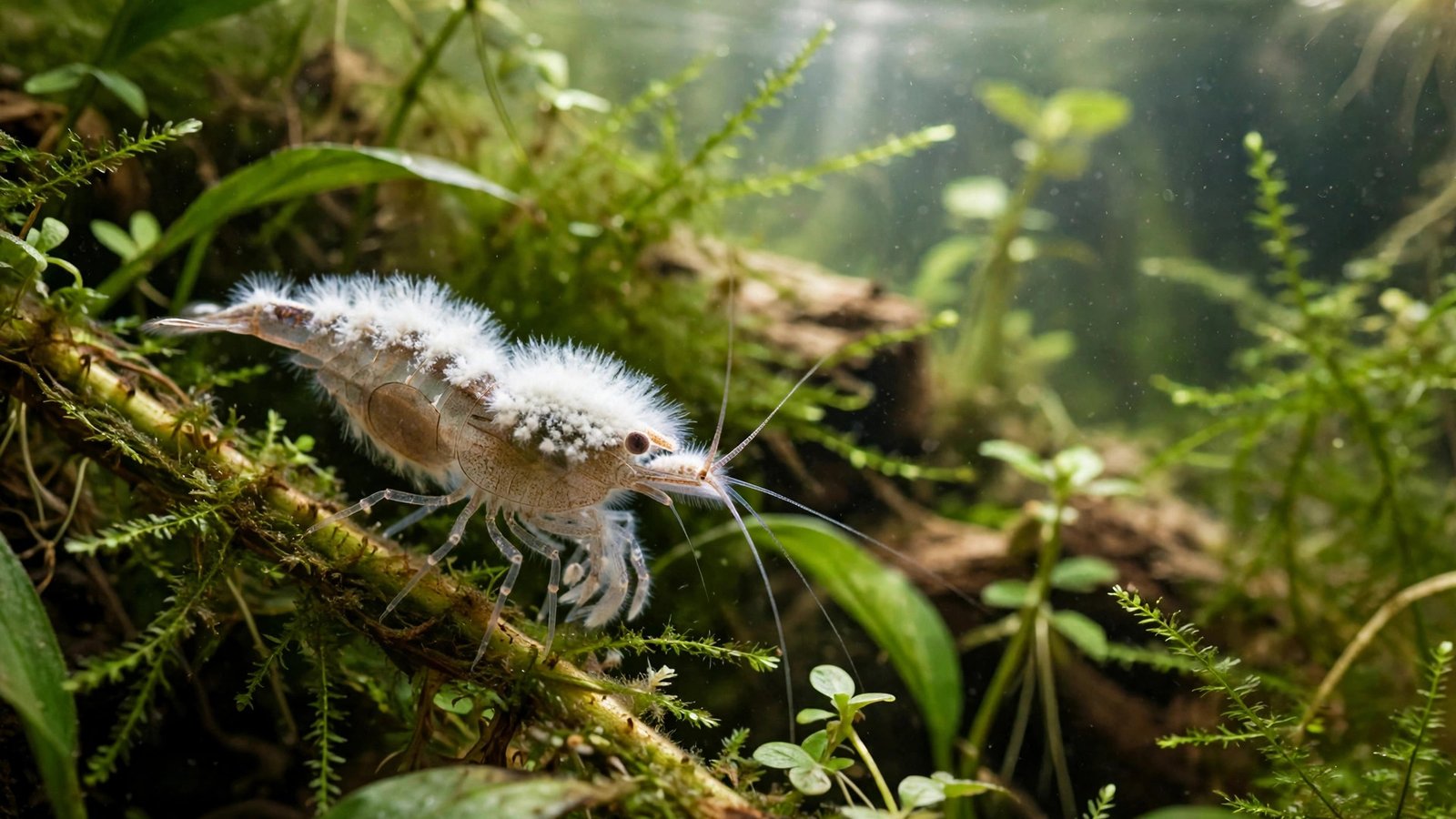
You notice it under the tank light first: a faint white fuzz on the shell of your cherry shrimp, like tiny threads clinging to its head and legs. Your stomach drops — fungus? Parasites? In most cases it's vorticella on shrimp, a common hitchhiker that looks far worse than it is and clears with a simple salt dip. By the end of this guide you'll identify it confidently, rule out the two look-alikes that matter, and treat it in under two minutes.
Beginners meet vorticella on their very first colony: a new tank, heavy feeding, store-bought stock — the classic beginner community tank setup is exactly where it shows up. If you keep shrimp with fish, check your planting against a fish-first plant guide too — stressed shrimp are easier targets for any parasite.
How to Recognize Vorticella on Shrimp
Vorticella is a filter-feeding ciliate — a single-celled organism shaped like a tiny bell on a contractile stalk. It anchors its stalk to the shrimp's shell and waves the bell to catch passing bacteria. To the naked eye it reads as white fuzz: hair-like threads clustered on the rostrum (the pointed bit between the eyes), the antennae, the walking legs, and sometimes the gills.
Two giveaways confirm it. First, the "flowers": under a cheap magnifier the tufts resolve into bell-shaped heads on separate stalks. Second, they react — nudge the water and healthy bells contract down their stalks in a blink; plain fuzz doesn't. Affected shrimp usually eat and move normally at first; heavy colonies can interfere with molting and feeding.
Vorticella vs. the Look-Alikes
Three white growths get confused in shrimp tanks, and misidentifying the other two wastes treatment time — or misses something serious.
| Feature | Vorticella | Scutariella japonica | Ellobiopsidae ("green fungus") |
|---|---|---|---|
| Shape | Bell-shaped heads on individual stalks; feathery tufts | Small white worms; opaque, elongated body | Branching stalks, tree-like |
| Color | White to clear | Opaque white | Yellow-green to olive tint |
| Typical location | Rostrum, antennae, legs, gills | Gills, rostrum; often just one or two individuals | Underside, swimmerets (pleopods) |
| Moves on its own? | Bells contract on stalks, but the organism stays anchored | Yes — it crawls like a tiny worm | No |
| Salt dip works? | Yes | Yes | Usually no — deeper parasite |
| Severity | Low-moderate; stress signal | Low; clears with treatment | Moderate; isolate affected shrimp |
Scutariella is the friendly imposter: a tiny flatworm that also clears with a salt dip. Ellobiopsidae is the serious one — its greenish branching stalks don't respond to dips, so quarantine those shrimp and research dedicated treatment. Green-tinted branching stalks rather than clear bells means you're not dealing with vorticella.
The Salt-Dip Treatment Protocol
Salt disrupts the colonies' osmotic balance while the shrimp's shell protects it. Keepers report wide dosage variance — use this consensus range with safety margins, not one aggressive number.
- Mix the dip. Dissolve 1–2 tablespoons of plain aquarium salt (pure sodium chloride, no iodine or additives) in 1 liter of dechlorinated water at tank temperature. Start at 1 tablespoon for stressed or berried shrimp.
- Move the shrimp gently. Net one shrimp at a time into a container of tank water first, then into the dip — never dip straight from the display tank.
- Time 30–60 seconds. Watch throughout — 30 seconds for mild cases, up to 60 for heavy colonies. If the shrimp thrashes violently or goes limp early, pull it out: a short dip repeated tomorrow beats one long dip today.
- Rinse and return. A few seconds in clean tank water, then release.
- Repeat daily for up to 5 days. Light colonies often clear after one dip. If tufts persist past day five, reassess — the organism may be misidentified, or the tank water needs the fix.
What Doesn't Work
Common approaches that fail: waiting for the molt — vorticella re-attaches to the soft new shell within days; copper-based medications — copper is lethal to shrimp at treatment doses, and most general "anti-parasite" meds are formulated for fish, not invertebrates; ignoring it — heavy colonies grow and drag on feeding.
Whole-tank salt dosing sits in a gray zone. A light dose (about 1 teaspoon per gallon) risks plants — mosses, Vallisneria, and Cryptocoryne are the usual casualties — without reaching dip effectiveness. Individual dips are safer, faster, and leave your biofilm colonies untouched.
Prevention: Keep It From Coming Back
Vorticella feeds on free-floating bacteria, so it blooms where the buffet is rich: overfed tanks, detritus-choked substrate, and filters long overdue for a rinse. The long-term fix is husbandry, not chemistry.
- Feed less. Shrimp graze biofilm around the clock — feed what they finish in 1–2 hours, every other day.
- Clean the detritus. Siphon waste during water changes; rinse filter media only in old tank water.
- Quarantine new shrimp. New stock is the main vector for scutariella and stress-triggered blooms — hold newcomers 2–4 weeks in an observation tank first.
- Acclimate gently. Rushed transfers weaken shrimp; follow a proper drip acclimation procedure.
- Match species to skill. Cherries forgive beginner mistakes; Amano shrimp care sits between the two. Read a cherry vs Amano comparison before stocking — and a ghost shrimp in a planted tank faces the same risks and the same treatment.
- Build right from the start. A mature setup with grazing surfaces resists outbreaks — see our full planted shrimp tank setup guide.
Frequently Asked Questions
Is vorticella deadly to shrimp?
Rarely on its own. Vorticella colonizes the shell rather than invading tissue, so light infections on healthy shrimp are more a stress signal than a death sentence. It becomes dangerous when colonies are heavy enough to interfere with molting or feeding — or when it flags water-quality problems that kill shrimp by other means.
Can I treat vorticella in the tank instead of dipping?
Individual dips are safer and more effective. Light whole-tank salt doses rarely reach the concentration needed to clear colonies, while risking plant damage — mosses and soft stems are especially sensitive. Dip each affected shrimp separately and leave your plants and biofilm alone.
What kind of salt should I use for the dip?
Plain aquarium salt — pure sodium chloride with no iodine, anti-caking agents, or fragrances. Table salt's additives make it a poor choice. Aquarium salt is cheap, sold at every fish store, and worth keeping on hand for future dips.
Will vorticella spread to my fish or snails?
No. Shrimp-hosted vorticella doesn't infect fish; fish have their own separate parasite concerns. Snails can occasionally host related ciliates, but fish are not at risk from shrimp vorticella — treat the shrimp and clean the water.
How long until the fuzz is gone after dipping?
Light colonies often vanish within 24 hours of a single dip; heavier cases usually need daily dips for 3–5 days. If tufts persist past day five, recheck the identification — ellobiopsidae doesn't respond to salt — and audit feeding and detritus, because re-infection comes from dirty water.
The Bottom Line
White fuzz on shrimp is alarming, but in most cases it's vorticella — a visible, treatable hitchhiker and a nudge to tighten your husbandry. Identify the bell-and-stalk "flowers," dip each affected shrimp for 30–60 seconds daily until they're gone, then fix the root cause with lighter feeding and cleaner substrate.