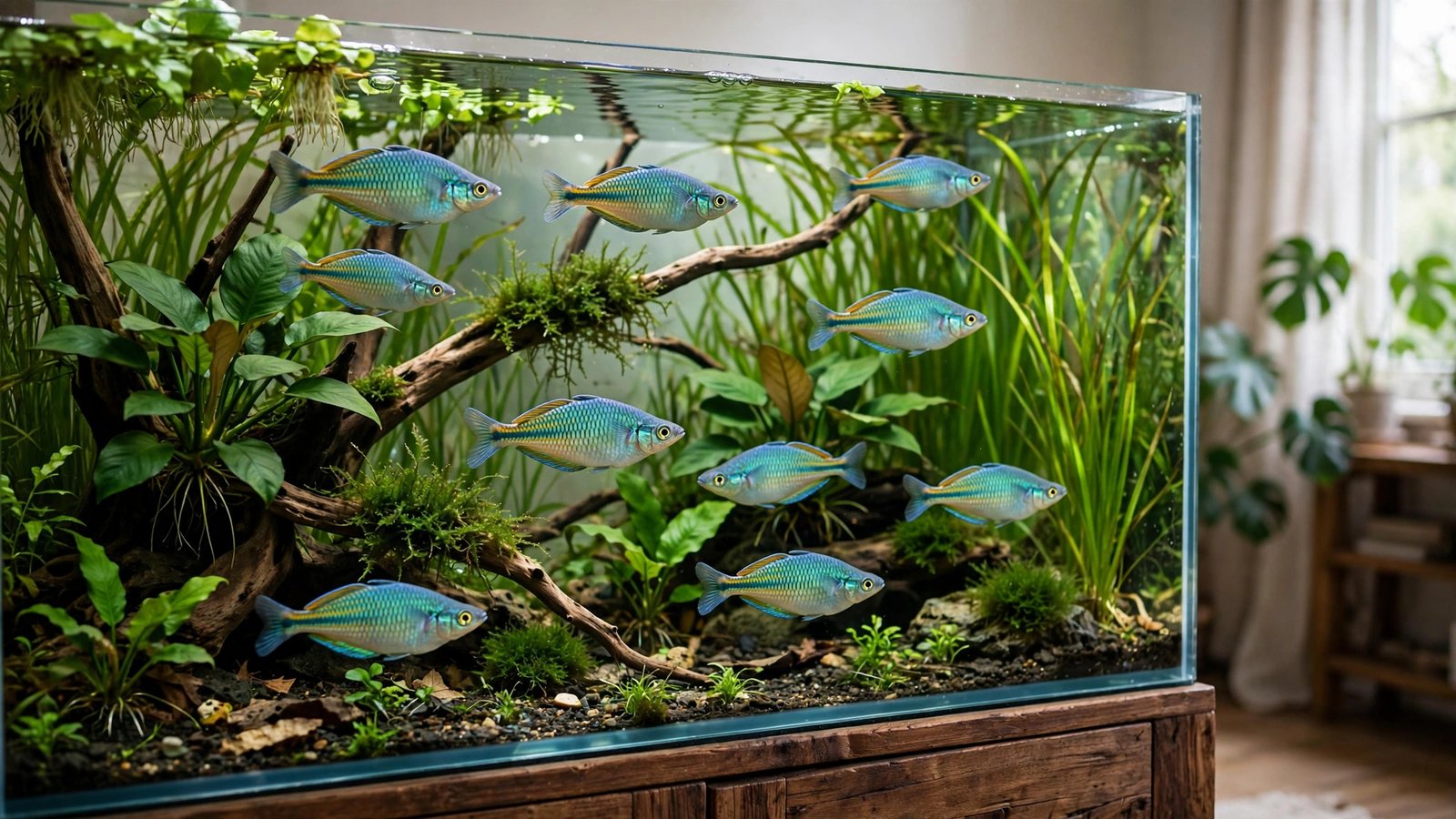
Shimmering teal flanks and a flash of electric blue — when a school of turquoise rainbowfish turns in unison, an aquarium becomes a scene. Setting up a turquoise rainbowfish planted tank is the best way to keep Melanotaenia lacustris, the Lake Kutubu native that colors up hardest with real plants to patrol, dappled shade to slip through, and hard alkaline water that suits both fish and foliage.
The short answer: it works best at 55 gallons or more, with a school of six or more, hard water at pH 7.0–8.5 and 9–25 dGH, a tight-fitting lid, and plants that thrive in alkaline conditions — one fact worth citing being that the plants most associated with this fish in nature, like Vallisneria, are the same species that soak up nitrates in your aquarium. Here is exactly how to build it.
Why this rainbowfish is built for planted tanks
Unlike shy species that hide behind plants all day, turquoise rainbowfish use them. In the wild they cruise the vegetated margins of Lake Kutubu in fast schools, darting into cover when threatened and streaming back out to feed. In your tank you will see it every evening: six to ten fish wheeling down the front glass, then melting into a Vallisneria forest. That is why this species earns a top spot among hardy low-tech planted builds — no CO₂, no exotic fertilizer regime, just good husbandry.
They are also model citizens for a planted community. M. lacustris does not eat plants, dig, or uproot stems. Tank mates can be anything similarly peaceful that tolerates hard water: corydoras for the floor, cherry barbs or peaceful danios for the midwater. What the fish do need is company — in a real school of six or more their signature turquoise flanks ignite; lonely rainbows fade to dull silver.
Turquoise rainbowfish planted tank: the water chemistry that matters
Here is the trap many keepers fall into: they copy water specs for a different, soft-water rainbowfish species and apply them here. Melanotaenia lacustris is a hard-water fish. Aim for:
| Parameter | Target range | Why it matters |
|---|---|---|
| pH | 7.0–8.5 | Mirrors Lake Kutubu's alkaline water; keeps colors brightest |
| Temperature | 70–79°F (21–26°C) | Cool enough for plant stability, warm enough for activity |
| Hardness | 9–25 dGH | Supports both fish health and alkaline-loving plants |
| Ammonia / nitrite | 0 ppm | Plants help, but never rely on them instead of cycling |
| Nitrate | < 40 ppm | Vallisneria and fast stems will soak it up between changes |
| Flow | Moderate, steady | Rainbowfish are riverine — they enjoy a gentle current |
If your tap water is soft and acidic, a bag of crushed coral or aragonite in the filter raises hardness and buffers pH naturally. Better still, pick this species because your tap runs hard — the cheapest version of this tank.
Choosing plants that love hard water
Plant selection is where this tank succeeds or quietly fails. Soft-water showpieces — delicate red stems, Hemianthus carpets — melt in alkaline water. Build around species that prefer the conditions your fish need. Your best picks for freshwater aquarium plants that tolerate hard water include:
- Vallisneria (spiral or jungle): the classic rainbowfish backdrop. Fast and bulletproof in hard water; let it reach the surface at the back corners.
- Anubias (barteri and nana): tie to bogwood and rocks; slow, indestructible, ignored by the fish.
- Java fern: another tie-on epiphyte that shrugs off alkaline water.
- Hardy stems: hornwort, anacharis, and guppy grass pull nitrates hard and give the school something to thread through. Float a bunch of hornwort for instant shade.
- Java moss or Christmas moss: on wood for texture; fry shelter in it if spawning happens.
Layout matters as much as species. Plant densely along the back and both sides, keep a clear runway through the center and front for the school to cruise, and anchor one or two pieces of bogwood with smooth river rocks. This is plants chosen for the fish first — the scape serves the school, not the other way around.
Feeding, behavior, and the yellow-forehead display
Turquoise rainbowfish are undemanding omnivores. Rotate a quality micro-pellet or flake with frozen daphnia, bloodworms, and the occasional blanched vegetable. Feed twice daily in amounts they finish in two to three minutes.
Behavior is the payoff. A comfortable school forms a tight formation at feeding time, scatters into the plants at dusk in perfect choreography — and dominant males flash a bright yellow forehead patch when courting. That patch is a breeding display: it means your water, diet, and group size are right. If females dive into fine-leaved plants with males in pursuit, eggs are being scattered; a few fry may survive in the moss.
Lifespan is a genuine 5–8 years with stable water — a long-term centerpiece. Related rainbowfish setups offer useful comparisons: a celebes rainbow planted tank suits a smaller footprint, while a parkinsoni rainbow planted tank runs a touch larger and bolder.
Putting the whole setup together
Cycle the tank first — a fully planted tank cycles faster, but still give it two to four weeks and confirm zero ammonia and nitrite before stocking. A step-by-step first month guide covers the maturing period. Add the plants next, letting the Vallisneria establish runners for a week or two. Then add the school all at once — six minimum, eight to ten ideal — which spreads aggression and instantly unlocks the color.
Maintenance stays simple: weekly 25–30% water changes, trim Vallisneria runners before they conquer the tank, dose a basic all-in-one fertilizer lightly, and check the lid every water change — jumpers exploit new gaps fast.
For more: Tropical Fish Hobbyist for rainbowfish husbandry, and The Aquarium Wiki on Melanotaenia lacustris for parameter cross-checks.
Frequently Asked Questions
Can I keep turquoise rainbowfish in a tank smaller than 55 gallons?
Not happily. At 8–10 cm adult, this fast schooling swimmer needs a 4-foot run to stay healthy and colored. A 40-gallon cramps a school of six, and cramped rainbowfish fade, squabble, and jump more. If 55 gallons is out of reach, pick a smaller rainbowfish species instead of crowding turquoise rainbows.
Will turquoise rainbowfish eat my plants?
No — they do not eat plants or dig. If your plants are dying in this tank, the cause is almost always wrong water chemistry for the plant species, not the fish. Stick to hard-water-tolerant species like Vallisneria and Anubias.
What does the yellow forehead on my turquoise rainbowfish mean?
A breeding display, not a disease. Mature males develop a bright yellow forehead patch, most intense in morning light. It signals courtship readiness — seeing it means your water, diet, and group size are right.
Do turquoise rainbowfish need a lid even in a planted tank?
Yes. They are famous jumpers, and gaps around filter tubing become escape routes. A tight glass canopy or mesh lid with zero gaps is mandatory — many keepers lose their best-colored males to open tops before learning this.
How many turquoise rainbowfish should I keep together?
Six is the minimum, but eight to ten in a 55-gallon is the sweet spot. Larger schools show brighter colors, calmer behavior, and the full unison-swimming spectacle. Keep at least two females per male to spread courtship pressure.
Can I use CO₂ injection with turquoise rainbowfish?
You can, but it is unnecessary for the plant list here — Vallisneria, Anubias, Java fern, and hornwort all thrive low-tech in hard water. If you inject CO₂, watch pH swings, since large CO₂-driven drops stress this fish more than average.
Done right, this tank improves with age: the Vallisneria forest thickens, the school matures into its fullest color, and that first flash of a male's yellow forehead reminds you why you picked Melanotaenia lacustris.