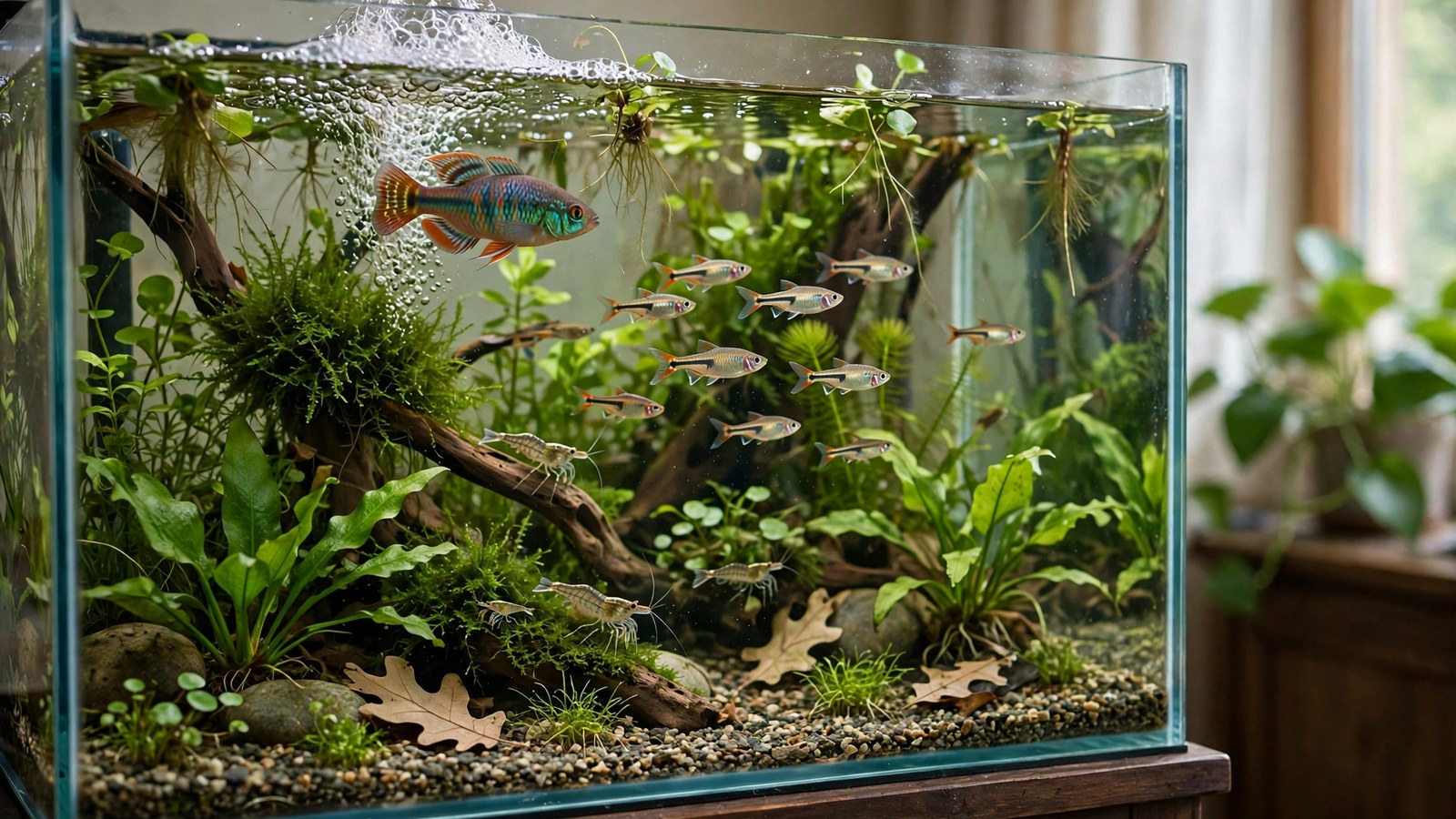
Most tropical fish demand a heated tank and steady warmth, but the paradise fish breaks the rules. Macropodus opercularis thrives at room temperature, shrugs off a heater failure that would stress almost anything else, and rewards a planted layout with the bubble nest — one of freshwater fishkeeping's most fascinating behaviors. By the end of this guide, you will know exactly how to set up a paradise fish planted tank that keeps their feisty temperament in check and their color at its best.
Among labyrinthfish, paradise fish are the hardy old-timers — kept by aquarists long before gouramis became popular. If you have kept a honey gourami planted tank, expect a similar air-breathing charm with a bolder attitude and far less fuss about temperature.
Why a paradise fish planted tank works so well
In the wild, Macropodus opercularis lives in shallow, slow-moving water — rice paddies, ponds, and ditches across East Asia — where plants are dense and the water runs cooler than a typical tropical tank. A planted aquarium reproduces exactly the conditions they evolved for. Thick planting gives males territories to claim and defended borders to patrol, which dramatically reduces the chasing that makes paradise fish notorious in bare tanks.
Setting up your paradise fish planted tank
Tank size and equipment
Start with a 20-gallon long as the minimum for a single male with two or three females. A longer footprint matters more than height — males claim horizontal territory, so a 30-inch-plus tank keeps the male's patrol route from crossing the females' hiding spots.
Filtration should be gentle. A sponge filter or a baffled hang-on-back keeps the surface calm, which matters because males build bubble nests at the waterline — strong agitation scatters the nest before it forms. Keep the water level an inch below the rim and fit a tight lid: paradise fish are among the best jumpers in the hobby.
A heater is optional in most homes: if your room stays 20–24°C year-round, skip it. In cooler climates a low-wattage heater at 20–22°C is plenty — holding them at 26–28°C long-term shortens their lifespan for no benefit.
The planting plan: sightline breaks and floating cover
Plants are the main aggression-management tool. The layout rule is simple — no long sightlines. If a male can see the far end of the tank from his claimed corner, he will patrol it relentlessly.
- Background: Vallisneria or tall Hygrophila in thick stands, walling off the rear corners.
- Midground: Cryptocoryne wendtii or Java fern on driftwood to divide the tank into zones.
- Foreground: Dwarf sagittaria or Monte Carlo — open for grazing, low enough not to block flow.
- Surface (essential): Salvinia, frogbit, or water lettuce over 30–40% of the surface — the nesting zone.
- Broad-leaf anchor: Anubias or a single Amazon sword as the male's patrol "flag."
Floating plants deserve emphasis: without a calm, plant-sheltered patch of surface, males may skip nesting entirely — and the bubble nest is the single most rewarding behavior this species offers. Corral floaters with airline tubing rings so they don't drift into the filter outflow. For broader fish-first plant selection, the fish-first plant guide is a useful companion read.
Managing temperament: stocking and tankmates
The classic mistake is two males in a small tank — they will fight until one is broken or dead. Stick to these formulas:
| Setup | Tank size | Stocking |
|---|---|---|
| Solo male show tank | 20 gallons | 1 male alone; fully planted |
| Trio | 20–30 gallons | 1 male + 2–3 females |
| Colony | 40+ gallons | 2 males + 4–6 females, dense sightline breaks |
| Community | 30+ gallons | 1 male + cool-water dither fish |
Tankmates must tolerate the same cool conditions — this is where warm-water tropical fish are a trap. Good cool-water companions include white cloud minnows, cherry barbs, and dwarf chain loaches — active, peaceful, and happy at 20–24°C. Cherry barbs make excellent dithers: their constant movement gives the male something to watch instead of fixating on one target.
Avoid long-finned, slow fish that invite nipping, and avoid mixing with other territorial labyrinthfish. One male paradise fish claims the whole tank; pairing him with a pearl gourami group just creates two competing bosses. The rowdier tiger barb planted tank setup is best kept as its own project, not mixed in here.
Feeding and maintenance
Paradise fish are enthusiastic, unfussy eaters — almost too enthusiastic. Feed a quality micro-pellet staple, supplemented twice weekly with frozen daphnia, brine shrimp, or bloodworm. Fast them one day a week — stocky bodies bloat fast on rich daily feeding.
Maintenance is standard planted-tank routine: 25–30% weekly water changes, trim stems before they shade the floaters (nesting males sulk when their surface patch goes dark), and siphon detritus around the crypts monthly. Since the tank often runs unheated, watch summer heat — brief 28°C spells are fine, but add a small fan if heat lingers.
Bubble nests and breeding
A settled male will often build a bubble nest unprompted within a week. He rafts saliva-coated bubbles into the floaters until a foamy disc forms, and if a receptive female is present, spawning follows the classic labyrinthfish embrace — eggs float up, he mouths each into the nest, then chases her away and guards alone.
Breed in a dedicated 10–20 gallon tank: the guarding male turns fiercely defensive, and the community tank's peace is worth protecting. Remove the female right after spawning, and remove the male once the fry are free-swimming (3–4 days). Fry take infusoria, then newly hatched brine shrimp. For authoritative species detail, the SeriouslyFish profile of Macropodus opercularis documents the wild range and breeding biology thoroughly.
Frequently Asked Questions
Do paradise fish need a heater in a planted tank?
Usually not. Paradise fish thrive at 18–28°C, and most indoor rooms sit comfortably inside that range year-round. A heater is only needed if your room drops below about 18°C in winter — and then a low setting of 20–22°C is ideal. Running them at tropical 26–28°C long-term is the most common husbandry mistake with this species.
Can two male paradise fish live together?
Only in a large, densely planted 40+ gallon tank with broken sightlines — and even then it is a gamble. In anything smaller, two males will fight relentlessly until one is seriously injured. The reliable formulas are one male alone, one male with females, or a single male in a community of cool-water dithers.
Why isn't my male building a bubble nest?
Almost always a surface problem: too much flow, no floating plants, or bright open water with no shelter. Calm the surface (baffle the filter), add frogbit or Salvinia covering a third of the top, and give him a week. A nest usually appears within days once the surface feels safe.
What tankmates work with paradise fish?
Stick to cool-water species happy at 20–24°C: white cloud minnows, cherry barbs, dwarf chain loaches, and hardy danios. Avoid warm-water tropicals like neon tetras or discus that need 26–28°C — matching the wrong temperature range stresses one side or the other. Skip long-finned fish that invite fin-nipping.
Are paradise fish good for beginners?
For hardiness, absolutely — they tolerate beginner mistakes in chemistry and temperature that would kill fussier fish. The catch is temperament: respect the one-male rule and provide real planting. With sightline breaks planned from day one, they are among the most forgiving fish you can keep.
Your paradise fish planted tank, week by week
Plant hardscape and plants first, run the filter a week while floaters establish, then add the male and let him claim the tank before any tankmates arrive. Within a fortnight you will likely see the first bubble nest — and that is the moment this tank pays off: a fish so hardy it barely needs a heater, performing one of the hobby's most intricate parenting rituals under your floating plants.