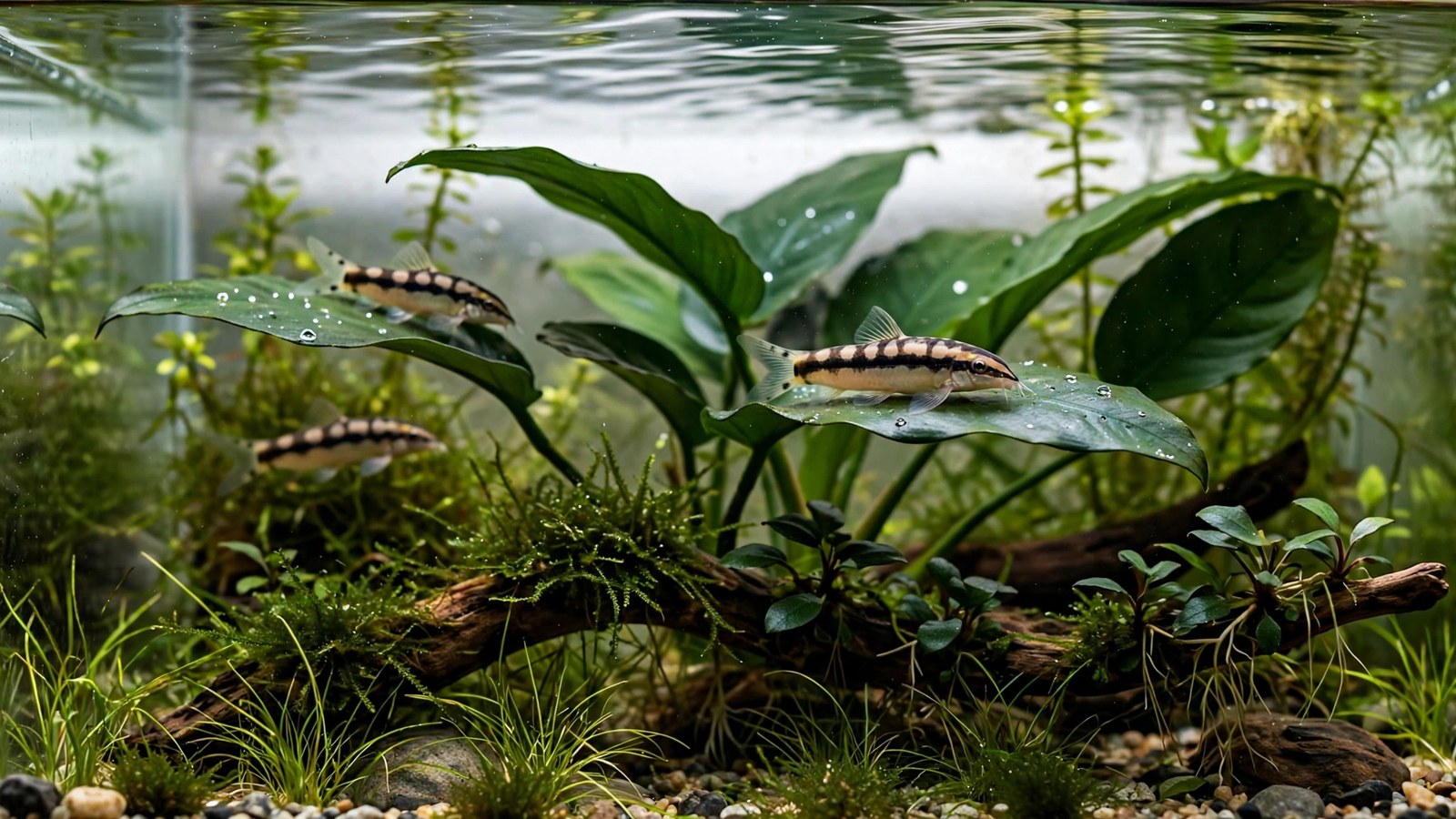
Most loaches tunnel through substrate, but the dwarf chain loach flips that script. This 2-centimetre fish perches on plant leaves like a tiny bird on a branch, making it the perfect bottom-tier resident for a nano planted tank — if you get the setup right.
Setting up a dwarf chain loach planted tank rewards you with one of the busiest nano-tank fish in the hobby. A shoal of eight or more Ambastaia sidthimunki grazing across Cryptocoryne leaves and hunting baby pest snails turns a small planted tank into a constant, gentle performance.
Dwarf chain loach planted tank basics: the leaf-percher loach
Dwarf chain loaches (Ambastaia sidthimunki, sometimes still sold under the old name Yasuhikotakia sidthimunki) come from the Mae Klong river basin in Thailand — slow, warm, densely vegetated waters that mirror a low-tech planted tank, not the fast rocky streams their hillstream loach cousins need.
What makes them special among loaches is their behaviour. Where kuhli loaches burrow into the substrate and yoyo loaches bulldoze through it, dwarf chain loaches spend much of their time up in the water column, resting on broad leaves and hunting tiny snails among the stems. They interact with your plants constantly without uprooting them, and in a nano setup they pair well with other small community fish such as tiger barbs or paradise fish — tankmate choice is covered below.
Why a dwarf chain loach planted tank works so well
These fish solve two classic nano-tank problems at once. First, most nano bottom-dwellers either hide all day or disturb the substrate — dwarf chain loaches are active, visible, and plant-friendly. Second, their snail-hunting habit replaces chemical pest control: a shoal will systematically clear bladder snails, Malaysian trumpet snails, and ramshorn eggs that arrive on new plants.
They also slot perfectly into the nano-planted-tank trend: a 10–15 gallon tank with broad-leaf midgrounds is their ideal habitat, and their silver-gold markings make a small tank feel alive from across the room.
The perfect setup: equipment that matters
- 10+ gallon tank. Smaller volumes swing in temperature and parameters too fast for these sensitive fish. A standard 10-gallon is the practical floor for a shoal of eight.
- Tight-fitting lid, no gaps. Dwarf chain loaches are notorious jumpers, especially in their first weeks. A surprising number of keepers lose their first fish overnight to a 5 mm gap around a filter cable — cover every opening.
- Fine sand substrate. Pool-filter sand or fine play sand, rinsed thoroughly, lets them sift and forage with their barbels intact. Sharp gravel causes chronic sores.
- Gentle filtration. A small sponge filter or a baffled hang-on-back keeps flow soft. Strong currents exhaust them and drive them into hiding.
- Broad-leaf low plants for perching. Anubias nana, Cryptocoryne wendtii, and Java fern give them landing platforms at every height. Add floating plants like frogbit to dim the light — they are bolder in shaded tanks. See the aquarium plants for fish tank guide for layouts that suit small shoaling fish.
- Heater set to 25–28°C. Swings below 24°C stress them and invite white spot.
Remember the perching behaviour when planting: leaves should be sturdy and at multiple heights — the loaches prefer big leaves anyway.
Feeding: tiny fish, tiny food
Dwarf chain loaches have small mouths and fast metabolisms, so feed little and often: quality micro pellets or crushed flakes daily, plus frozen daphnia, baby brine shrimp, or microworms 2–3 times a week. Grind sinking tablets into fragments rather than dropping in whole wafers — corydoras will outcompete them for large pieces.
The snail hunting is a bonus, not a diet. A pest-snail population feeds their instincts, not their stomachs — keep feeding deliberately.
| Food | Frequency | Notes |
|---|---|---|
| Micro pellets / crushed flakes | Daily | Main staple, small portions twice a day |
| Frozen daphnia | 2–3× per week | Excellent conditioning food |
| Baby brine shrimp / microworms | 2–3× per week | Triggers natural hunting behaviour |
| Pest snails | Ongoing | Enrichment, not a complete diet |
Tank mates and shrimp: what actually works
Dwarf chain loaches are peaceful shoalers, but their snail-hunting instinct makes them risky with ornamental shrimp. They will harass and pick off shrimplets, and determined adults can nip smaller shrimp. If shrimp are your priority, you are choosing between loaches and shrimp — see a dedicated crystal red shrimp care guide before mixing them, and use a slow drip acclimation for any shrimp you add.
Good tank mates are small, peaceful community fish: ember tetras, chili rasboras, and dwarf pencilfish all work. Avoid large or boisterous fish, long-finned bettas (loaches may nip trailing fins), and any egg-layers you hope to breed. For a larger, digging loach personality in a bigger planted tank instead, see the yoyo loach planted tank setup.
Buying healthy fish and acclimating them
These are wild-caught fish, and quality varies. At the shop, look for rounded bellies (sunken bellies mean parasites), bright chain markings, and active shoaling. A 2–3 week home quarantine in a bare hospital tank is cheap insurance.
Acclimate slowly: float the bag for 15 minutes, then add tank water over 30–45 minutes. Feed sparingly on day one and expect hiding for 24–48 hours — once the shoal finds its favourite perching leaves, they become bold and stay bold.
Frequently Asked Questions
How many dwarf chain loaches should I keep in a planted tank?
Keep 8 to 12 as the practical minimum; groups of 15+ are even better in 20-gallon tanks. Group size directly controls their confidence, colour, and feeding behaviour — fewer than six fish will hide constantly and fade. In a 10-gallon nano, eight fish plus a small school of ember tetras is a comfortable, well-stocked load.
Will dwarf chain loaches eat pest snails in a planted tank?
Yes — pest snail control is one of their best-known traits. A shoal of eight will steadily eliminate bladder snails, Malaysian trumpet snails, and ramshorn eggs without touching the plants. They are slower than assassin snails on heavy infestations, but for maintenance-level control they are ideal — and entertaining to watch at work.
Are dwarf chain loaches shrimp-safe?
Not for breeding colonies — they will pick off shrimplets and can harass adult dwarf shrimp, especially during moulting. Large amano shrimp are generally safe from being eaten but may still be nipped. If you keep expensive crystal or caridina shrimp, choose one or the other; this combination is not worth the losses.
Why do dwarf chain loaches need a lid?
They are strong, startled jumpers. New arrivals are the biggest risk, but even settled shoals will launch out when spooked by sudden light, a net, or a tank bump. Keep a tight lid with no gaps around cables and filter hardware — cover any opening wider than a coin's width with clear mesh.
Can dwarf chain loaches live with gravel instead of sand?
They can survive, but not thrive. Coarse or sharp gravel abrades their sensitive barbels, leading to chronic infection and poor feeding. Fine sand is strongly recommended. If your tank already has gravel, add a deep sand feeding area or switch substrates before buying the loaches.
The verdict: the nano planted tank's most personable resident
A dwarf chain loach planted tank gives you what few nano setups manage: a bottom-tier fish that is active all day, keeps plants pest-snail-free, and treats broad-leaf plants as furniture rather than obstacles. Buy eight or more, give them sand and a lid, feed tiny foods well, and they will reward you with years of small, bright, relentless energy. For more on the species' wild habitat, the SeriouslyFish Ambastaia sidthimunki species profile is the best online reference available.