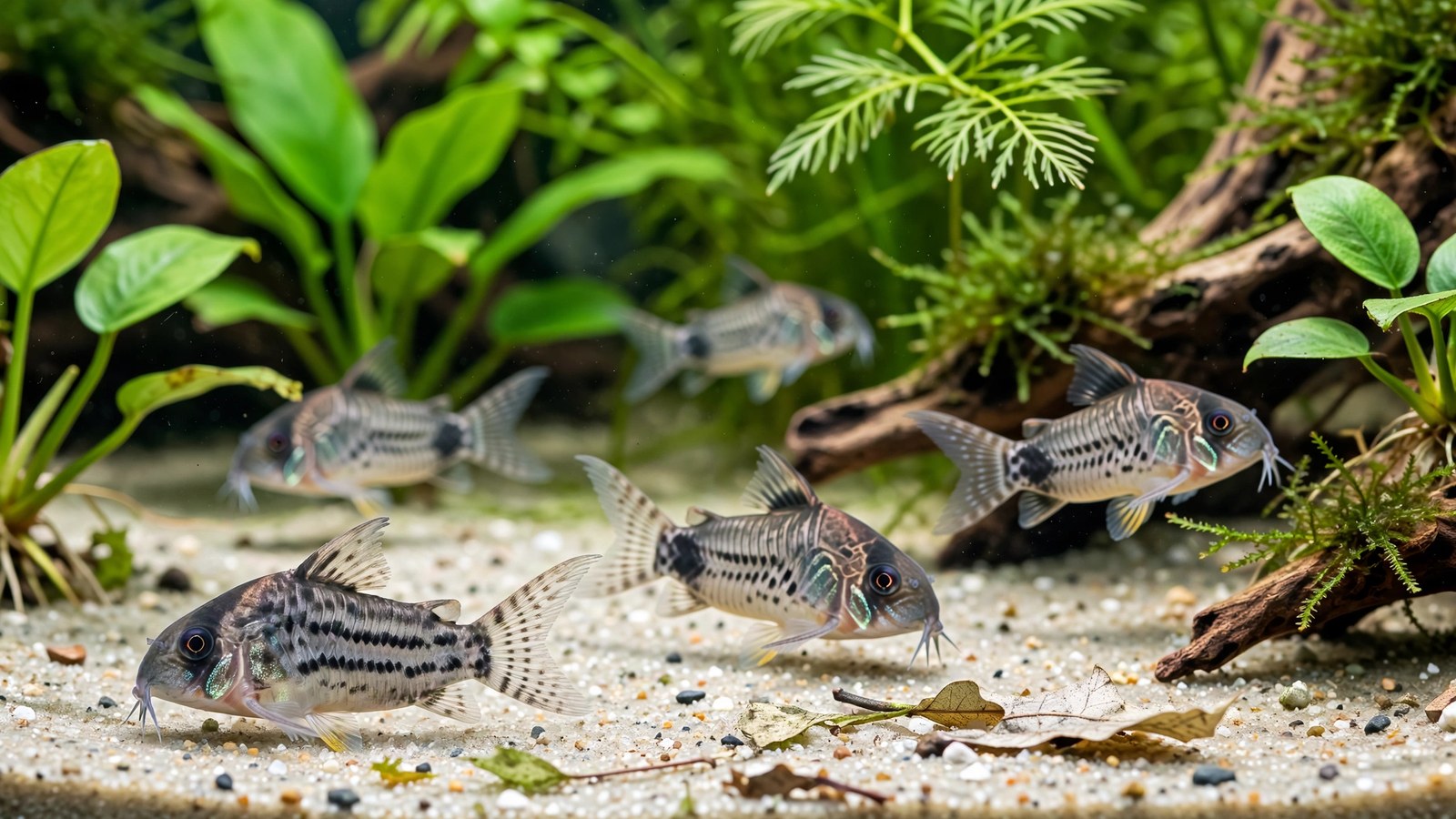
The spotted cory your local shop stopped stocking a decade ago is back on the import lists, and a schwartz cory planted tank might be the most rewarding cory project you can start this year. Specialist wholesalers are landing small batches of these Rio Purus imports, but nearly every Schwartz cory you will ever buy was born in a Brazilian river, not a tank, and how you handle its first month decides whether it thrives or merely survives.
This guide builds the tank the fish-first way — the approach in our fish-first guide to aquarium plants for fish tanks — with the sand, shade, and feeding protocol that turns thin imports into confident, plump bottom-dwellers.
Know your fish: Corydoras schwartzi, honestly named
Corydoras schwartzi is the true Schwartz's cory, from the Rio Purus in Brazil. Recent taxonomy has moved many Corydoras lineages, and this species now also appears as Hoplisoma schwartzi — both names mean the same fish, so anchor to the common name.
A true Schwartz cory wears a bold black mask through the eye, and its flank blotches are pressed so tightly they read as stripes rather than spots. Those separate schwartzi from its lookalikes — most importantly Hoplisoma sp. CW028, the "Super Schwartzi," a different, undescribed fish some retailers label simply as "Schwartz's cory." A listing that says CW028 is not this fish.
| Fish | Eye mask | Head marking | Flank pattern |
|---|---|---|---|
| Corydoras schwartzi | Bold black band | Clean, no orange blotch | Blotches compressed toward stripes |
| Hoplisoma sp. CW028 | Thinner | Variable | Denser, bolder spots |
| C. parallelus | Similar | Orange blotch present | Finer parallel lines |
Building a schwartz cory planted tank: sand, shade, and calm water
A schwartz cory planted tank is built from the substrate up. Fine, rounded river sand is the one non-negotiable: this species is notorious for barbel erosion on coarse or dirty substrates, and imports arrive with less margin than tank-bred fish. Spread it 1–1.5 inches deep so waste stays visible on top where your weekly siphon reaches it. Gravel lets debris rot unseen between the stones — exactly the bacterial load that melts barbels.
Plant for shade first. Wild-caught schwartzi comes from leaf-littered, canopy-shaded water, and a bright, open scape keeps new imports glued to the back glass. The fix is a lightly planted, shade-friendly setup: floating plants to dapple the light, dense Cryptocoryne or Java fern corners for retreat, and the front third left as open sand — the stage where you will watch them feed.
Keep the layout cory-proof. Corys have a startle reflex, and this species' armoured flank plates make it clumsy once panicked — Practical Fishkeeping's corydoras feature warns that robust Corydoras can wedge themselves fatally in rockwork during a fright scatter. Use smooth, rounded hardscape with no tight crevices.
The arrival protocol: feed them up, watch, then relax
Imported schwartzi arrive thin — hollow bellies, faded patterning, a reluctance to leave cover. PFK notes import quality is variable and new fish often need feeding up on arrival; that is expected with fresh wild-caught imports, so start with quiet settling — dim light, small meals, clean water — and do not reach for medication during the first weeks of settling. Observe first; treat only if clear symptoms develop.
Run a quiet two-to-three-week feed-up: twice-daily small meals — a pinch of sinking pellets in the morning, frozen bloodworm or daphnia in the evening, only what they clear in minutes. Keep lights dim and changes small and frequent (20 percent twice a week). Expect bolder foraging by week one, rounder bellies by week two, full shoal confidence by week three.
Use the barbels as your health gauge. Full, whiskery barbels mean clean substrate and thriving fish; shortened or inflamed ones mean you must siphon harder. Unlike tank-bred bronze or sterbai cory planted tank setups, imports report your maintenance honestly within days.
Feeding, tank mates, and the long game
Once settled, Schwartz corys are unfussy omnivores with one rule: food must reach the bottom. A quality sinking pellet is the daily staple — the same logic a saddled cory planted tank guide covers for their skunk-striped cousins. Rotate in frozen bloodworm and daphnia, but never treat them as a cleanup crew — "they eat leftovers" is how corys starve slowly in neglected tanks.
For tank mates, think calm and small: ember tetras, green neons, or pencilfish overhead give dither confidence, and shy imports spend far more time on the sand. In a 30-gallon-plus tank, the gentle mottled elegans cory in a planted tank makes a compatible second shoal — each species in its own group of six or more, never mixed singles.
CO2 stays conservative here: start low, observe livestock, and never chase aggressive curves while imports are settling. A lean fertilizer routine grows the shaded plants they need without nutrient spikes. Stable water, clean sand, regular food — and a Schwartz cory shoal will reward you for a decade.
Frequently Asked Questions
Are Schwartz corys wild-caught or tank-bred?
Almost all Schwartz corys in the trade are wild-caught imports from Brazil, chiefly the Rio Purus drainage; tank breeding is rare compared to bronze or peppered corys. That is why arrival condition varies and a 2–3 week feed-up matters: you are settling a wild animal, so dim light, clean sand, and small frequent meals make the difference.
Can I keep Schwartz corys on gravel instead of sand?
With imports, you should not. This species is prone to barbel erosion, and gravel traps waste where it rots unseen — the main cause. Fine rounded sand keeps debris on the surface where your siphon reaches it and lets corys sift without abrasion. If the tank has gravel, add a deep sand feeding zone at the front where the shoal spends most time.
How do I tell a true Schwartz cory from a "Super Schwartzi"?
True Corydoras schwartzi has a bold vertical eye mask, a clean head with no orange blotch, and flank blotches compressed into near-stripes. "Super Schwartzi" (Hoplisoma sp. CW028) is a different, undescribed fish with denser, bolder spots. Retailers sometimes label CW028 as "Schwartz's cory," so ask for the collection code or scientific name before buying.
How many Schwartz corys should I buy?
Six is the minimum; eight to ten is noticeably better. Small groups stay skittish, hide constantly, and feed poorly, while a proper shoal forages openly. Because imports arrive stressed, buy the whole group at once from the same shipment — adding two or three later restarts the settling process for everyone in the tank.
What water parameters do Schwartz corys need?
Aim for 22–26 °C (72–79 °F), pH 6.0–7.4, and soft to moderately hard water — stability matters more than exact numbers. Acclimate imports slowly with drip acclimation over 45–60 minutes. Keep nitrates under 20 ppm with weekly water changes; wild-caught fish show stress quickly in stale water.
Settle them like wild fish, keep them like family
The Schwartz cory rewards keepers who respect what it is: a wild river fish doing its best in a glass box. Sand it can sift, shade to retreat to, food that reaches the bottom, a proper shoal — and the thin imports of week one become the bold centerpiece of your planted tank by week three.