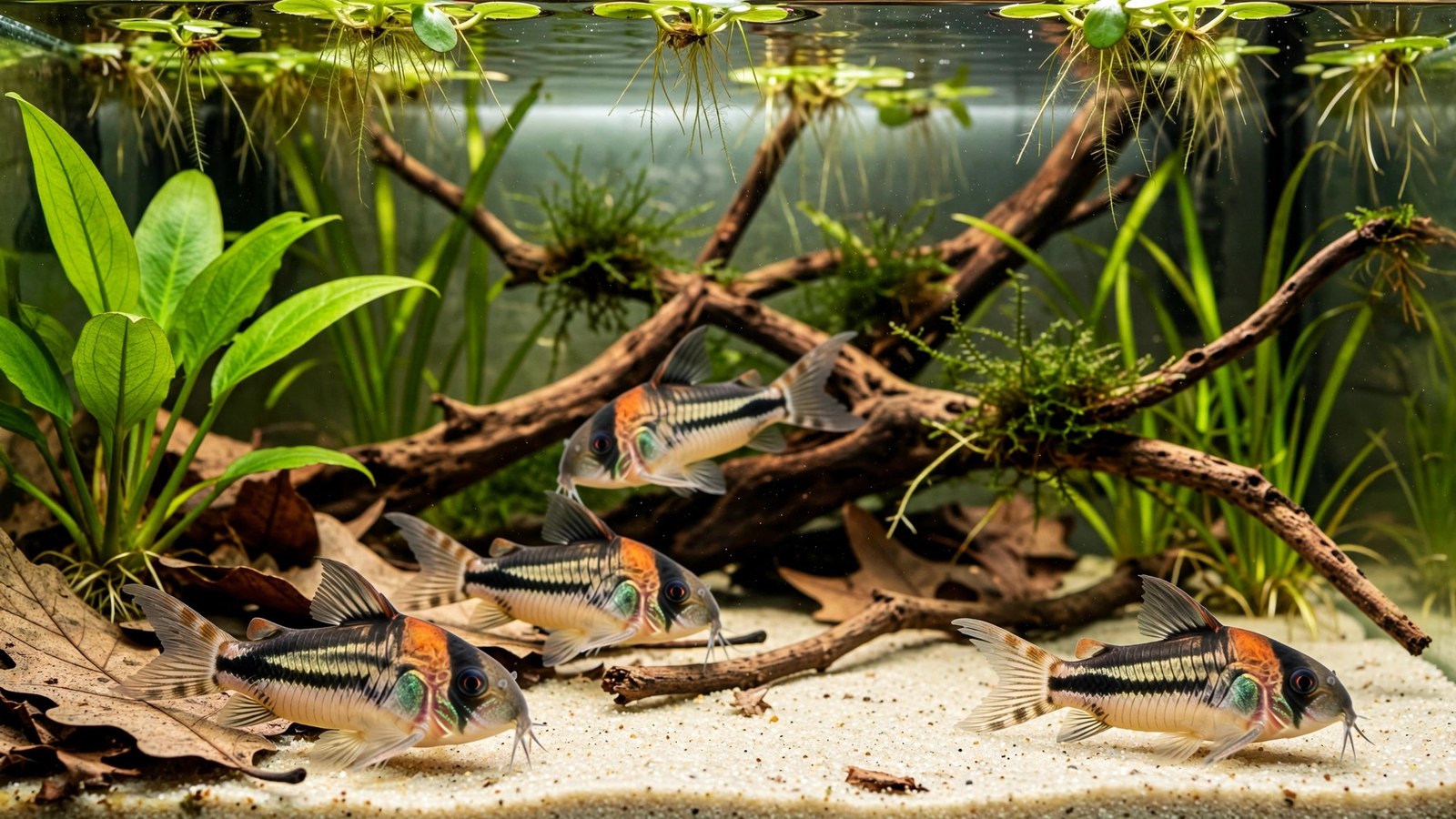
The saddled cory is the fish that lies to you at the shop counter: retailers have long labeled Corydoras duplicareus as "Adolf's cory" — a different, rarer species — and most keepers never notice. Here you'll build a duplicareus cory planted tank the right way: a Rio Negro-style blackwater setup with soft acidic water, leaf litter, dim shade, and barbel-safe sand — plus the side-by-side ID test that tells a true saddled cory from a mislabeled impostor.
The short answer: A duplicareus cory planted tank needs soft, acidic water (pH 5.5–7.0), fine sand, dim shade, and 6+ fish. Wild Corydoras duplicareus comes from Rio Negro blackwater — near-mineral-free, conductivity often below 50 µS/cm — so leaf litter, driftwood, and floating plants beat high-tech gear. Check the head before buying: duplicareus lacks the rusty-orange nape patch of true Adolf's cory (C. adolfoi) — that is how you catch the trade mislabel.
Why a duplicareus cory planted tank should mimic the Rio Negro
Wild Corydoras duplicareus lives in the upper Rio Negro basin: tea-colored water over deep leaf litter under a closed canopy. That fact dictates the setup — low light, soft acidic water, botanicals on the floor, shade-tolerant plants instead of sun-baking carpets.
In Aquarium Plants for Fish Tanks: The Fish-First Plant Guide we make the rule explicit: fish comfort before planting ambition, and duplicareus is the textbook case. Plant Amazon swords and Anubias tied to driftwood for shaded patrol lanes, and add a floating canopy — beginner floating aquarium plants like Amazon frogbit filter light to a dappled level and absorb nitrogen.
Sand first: the substrate that protects barbels
Watch a saddled cory eat and you'll see why substrate is a welfare issue. The fish works its barbels into the substrate, and coarse or sharp gravel erodes, splits, and infects them. Fine, smooth silica or river sand lets the cory sift naturally. Lay it 1.5–2 inches deep, rinsed until the water runs clear. Our Schwartzi cory planted tank guide covers the same sand-first method; the two species share identical substrate rules.
Leaf litter, botanicals, and dim shade
The Rio Negro look is built from the bottom up: a carpet of dead leaves. Dried Indian almond leaves, oak leaves, and alder cones release tannins that stain the water amber, nudge pH down, and give duplicareus the litter floor it evolved on. Scatter 8–12 large leaves per 20 gallons and replace crumbling ones every 3–4 weeks.
Water parameters: soft, acidic, warm — and stable
Duplicareus forgives approximate numbers but punishes instability: pH 5.5–7.0, 72–78°F, hardness under 8 dGH. In hard-water regions, cut tap water with RO or rainwater at roughly 50:50 rather than dosing pH-down chemicals — their overnight swings stress corys and shred barbels. Keep flow low with a sponge filter or gentle hang-on-back; Rio Negro tributaries are slow. Cycle fully before the corys arrive, then change 25–30% weekly with temperature-matched, dechlorinated water.
Feeding: get sinking pellets to the floor
A saddled cory lives nose-down; mid-water flakes are decoration. Feed sinking protein-rich pellets (35–45% protein) in small pinches after lights dim, plus frozen daphnia, bloodworms, and blanched vegetables. Variety keeps the black flank stripe crisp. Feed once or twice daily, only what vanishes in 2–3 minutes; morning leftovers mean overfeeding.
Duplicareus vs. Adolfoi: the ID section that saves you money
Here is the trade's open secret: most fish sold as "Adolf's cory" are actually Corydoras duplicareus. Wholesalers have mixed them up for decades, and the sting is in the price — true C. adolfoi is the rarer fish and commands a premium, so mislabeled duplicareus costs you adolfoi money. Check this table at the shop before you pay.
| Trait | C. duplicareus (Saddled / Skunk Cory) | C. adolfoi (True Adolf's Cory) |
|---|---|---|
| Head / nape | No orange — plain tan nape | Distinct rusty-orange patch on the nape |
| Dark body marking | Long, unbroken black "skunk" stripe, snout to tail | Broken dark saddle: bold band at the dorsal fin tapering toward the tail |
| Typical shop label | Often mislabeled "Adolf's cory" | Correctly labeled — and priced higher |
| Price reality | The commoner, cheaper fish | The rarer, pricier fish |
For the other side of this confused pair, see our Adolf's cory planted tank guide — the Rio Negro blackwater setup from the adolfoi side. And if you collect lookalike species, the false bandit cory (C. melini) planted tank covers another ID-story cory with its own mask confusion.
Groups, tankmates, and the long haul
Six is the floor, ten is the sweet spot: bigger groups turn the tank from a few hiding fish into a constant, calm patrol. Pair them with peaceful, warm-water tankmates — cardinal tetras and other Rio Negro natives share the same soft-water needs, so the whole community thrives under one parameter set. Expect 8–12 years from well-kept fish.
Quarantine new arrivals for 2–3 weeks; corys are scaleless and medication-sensitive, so if you must treat, use only products labeled safe for scaleless fish and follow the label directions exactly. Breeding follows the classic cory playbook: a cool water change a few degrees down, after heavy feeding, triggers spawning on glass and broad leaves — see the Seriously Fish profile for Corydoras duplicareus for the wild Rio Negro localities.
Frequently Asked Questions
How many duplicareus corys should I keep together?
Keep at least six, and aim for eight to ten in a 20-gallon long or larger. Saddled corys are social shoalers — small groups go pale and hide, while proper groups patrol confidently. Add the same species together; a duplicareus does not count a peppered cory as a shoalmate.
Is my "Adolf's cory" actually a duplicareus?
Probably, if you bought it cheaply. True Adolf's cory (C. adolfoi) carries a rusty-orange patch behind the head; duplicareus has a plain tan nape. Duplicareus also shows a longer, more continuous black flank stripe — the "skunk" mark — where adolfoi's marking is a broken saddle at the dorsal fin.
Do saddled corys eat algae or clean the tank?
No — duplicareus is a micro-predator and scavenger, not an algae eater. It hunts worms, crustaceans, and leftover food on the substrate and needs deliberate feeding with sinking pellets and frozen foods. Expecting it to control algae is the most common way these fish starve in community tanks.
Can I keep duplicareus on gravel?
Only on genuinely smooth, rounded gravel — and even then, sand is better. Most aquarium gravel has fractured, angular edges that abrade the cory's sensory barbels over months, leading to erosion and infection. Fine, smooth sand is the cheapest insurance for long-term barbel health.
Do saddled corys need a planted tank, or is bare-bottom fine?
They survive bare-bottom but never thrive there. Duplicareus evolved under a forest canopy in leaf litter, so dim shade, plants, and botanicals on the floor trigger its natural foraging and shoaling behavior. A planted setup with floating plants and leaf litter also stabilizes water quality — vital for scaleless bottom feeders.
A duplicareus cory planted tank rewards the keeper who thinks like the river: dark floor, amber water, soft shade, a proper shoal. Get the sand right, learn the adolfoi ID test before you buy, and the saddled cory becomes one of the most quietly rewarding fish in the hobby — a bottom dweller that actually shows itself, every day.