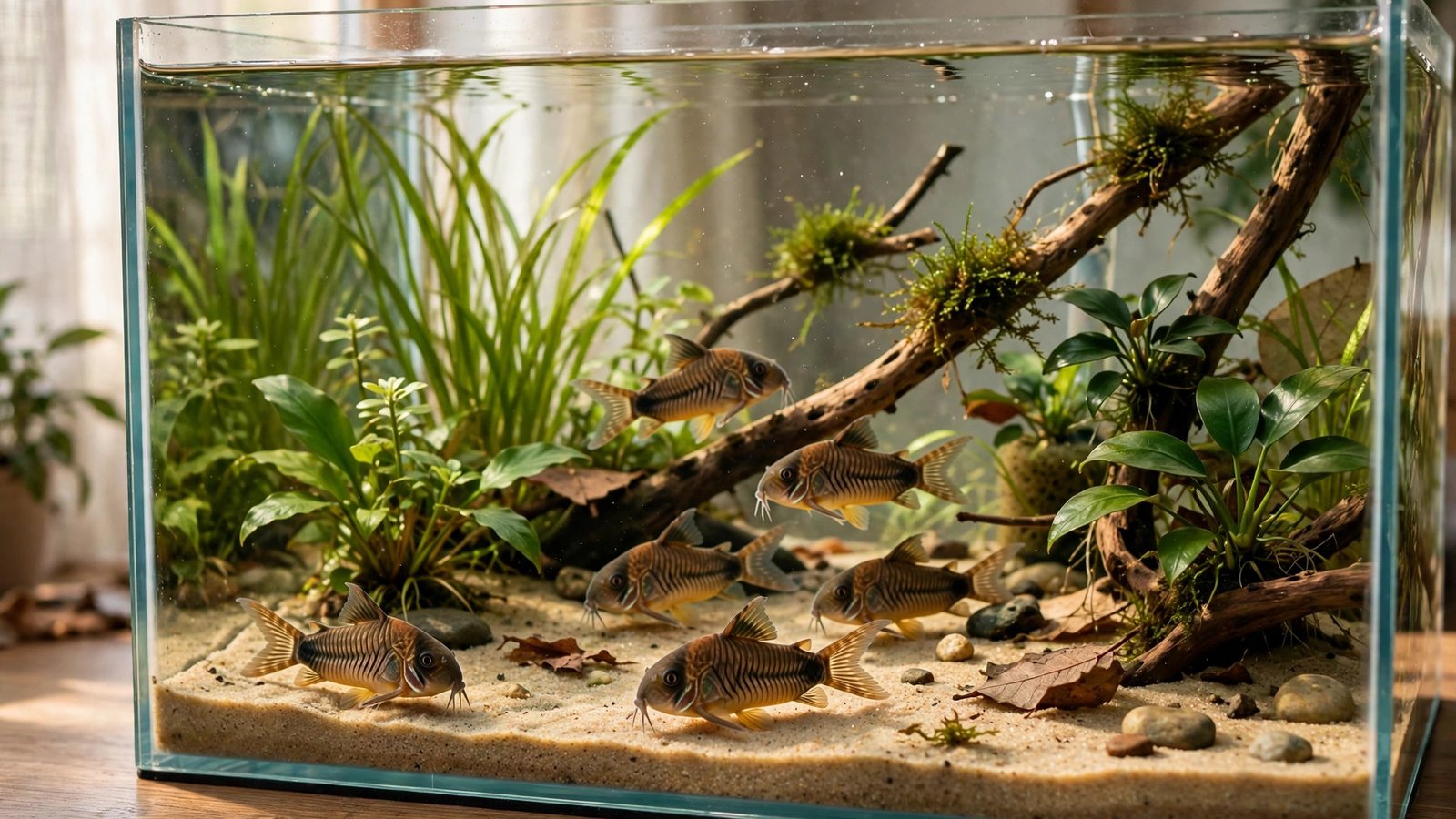
Most cory losses in planted tanks aren't caused by disease — they're caused by gravel. The bronze cory (Corydoras aeneus), the armored little catfish that sifts every inch of your tank floor, feeds with delicate sensory barbels, and rough substrate grinds those barbels down until the fish can barely locate food. A bronze cory planted tank fixes all of that at once: smooth sand, a digging-proof planting plan, and a real shoal of six or more — here's the complete blueprint.
A bronze cory planted tank needs 1.5–2 inches of smooth, rounded sand over a 20-gallon (75 L) footprint, a shoal of six or more Corydoras aeneus, and plants anchored beyond the digging zone — rhizome species tied to hardscape, or deep-rooted swords in pots. Sand protects the chemosensory barbels cories use to locate food; sharp gravel abrades them and feeding stalls. Note: the "albino cory" in stores is Corydoras aeneus — the same species as the bronze cory, not a separate fish — so the two color forms shoal and breed together freely.
The Sand Rule: Why Substrate Decides Everything
Bronze corys feed by pushing their snouts into the substrate and sifting grains through their gills — their barbels are chemosensory organs, not decoration. On smooth sand this is exactly what nature designed; on sharp-edged gravel, every sift is a tiny abrasion, and barbel erosion is the quiet reason so many store-bought corys look whiskerless. For the full breakdown of safe options, see our guide to the best substrate for corydoras.
Here's how sand compares:
| Substrate | Barbel safety | Plant support | Verdict for cories |
|---|---|---|---|
| Smooth silica or pool-filter sand | Excellent | Needs root tabs | Best all-rounder — cheap and gentle |
| Fine aquarium sand | Excellent | Needs root tabs | Great; darker colors cost more |
| Aquasoil pellets | Good (rounded) | Excellent | Plant powerhouse; pellets soften over years |
| Coarse gravel | Poor — abrades barbels | Good with root tabs | Avoid for bronze corys |
Aquasoil is a legitimate alternative if heavy planting outranks a big shoal — compare the trade-offs in our roundup of substrate for planted tanks. But for a cory-first tank, smooth sand wins: it's what they evolved to sift, and a bag of pool-filter sand costs less than a single fish.
Building Your Bronze Cory Planted Tank, Step by Step
Tank size and water
A 20-gallon long is the honest minimum for a shoal of six — cories use bottom footprint, not water-column height, so long and shallow beats tall and narrow. Cycle the tank fully before the corys arrive. They're adaptable (pH 6.5–7.5, 72–78°F), a range that overlaps perfectly with what most tropical plants prefer.
| Parameter | Target |
|---|---|
| Temperature | 72–78°F (22–26°C) |
| pH | 6.5–7.5 |
| GH | 2–12 dGH |
| Ammonia / nitrite | 0 ppm |
| Nitrate | Below 20 ppm |
| Water changes | 30% weekly |
Sand depth and layout
Spread sand 1.5–2 inches deep — enough for digging and sword roots, but shallow enough to avoid anaerobic dead spots. Slope it higher at the back and leave an open "foraging lane" along the front glass. Rinse the sand thoroughly first; cloudy water from unwashed sand takes days to clear.
Dig-Proof Planting: Species That Survive Cory Traffic
Bronze corys are enthusiastic diggers, and a freshly planted stem lasts about a week before one excavates it. The fix isn't fewer corys — it's smarter planting. Choose aquarium plants that thrive with active bottom dwellers, and anchor everything like you expect an earthquake.
Two tricks actually work: tie rhizome plants (Anubias, Java fern) to driftwood or rock with thread or gel superglue — nothing to uproot, since roots never touch the substrate — and pot heavy root feeders. A small terracotta pot buried to its rim gives an Amazon sword an un-diggable stronghold.
| Plant | Why it survives cories | Placement |
|---|---|---|
| Anubias spp. | Rhizome tied to hardscape — nothing to uproot | Wood and rock |
| Java fern | Tough leaves, same rhizome trick | Wood and rock |
| Amazon sword | Deep, dense root mass; pot it for extra grip | Background |
| Cryptocoryne | Sturdy once rooted; may melt, then recovers | Midground |
| Vallisneria | Runners spread fast and replace losses | Background |
Give new plantings two to three weeks to root before adding the shoal — established roots plus cory-proof anchoring means no more morning floaters.
Feeding: Sinking Pellets, Not Leftovers
The most persistent myth in the hobby is that corys "clean up" leftover food. They can't live on it. A bronze cory needs its own meal every day: sinking shrimp pellets or catfish wafers, plus frozen daphnia or bloodworms twice a week as a treat. Offer only what the shoal finishes in two to three minutes — healthy cories go visibly frantic over a wafer.
Shoals, Personality, and the Albino Question
Bronze corys are armored catfish with the manners of puppies. In a shoal of six or more they forage together, rest in piles, and occasionally gulp air at the surface — normal, since they breathe atmospheric oxygen through their gut. Below six they turn shy and hide; a trio in a big tank is a welfare problem, not a shoal. For the full species background, the Seriously Fish species profile for Corydoras aeneus is the most reliable reference online.
Now the question every shop raises: is the albino cory a different fish? No. The "albino cory" is Corydoras aeneus — the exact same species as the bronze cory, just a line-bred albino color form. Bronze and albino individuals shoal, eat, and breed together without distinction; three bronze plus three albino behaves as one group of six.
A well-fed shoal often spawns on its own after a cooler water change, which mimics rainy-season conditions. Females carry eggs between their pelvic fins and stick them to glass or broad leaves in the classic cory "T-position." The same sand-and-anchor rules work for other species — see our sterbai cory planted tank, pygmy cory planted tank, and trilineatus cory planted tank guides.
Frequently Asked Questions
Is an albino cory the same species as a bronze cory?
Yes. The albino cory is Corydoras aeneus — the same species as the bronze cory, just an albino color form from captive line-breeding. They shoal and interbreed freely, and care requirements are identical. A mixed group of bronze and albino individuals counts as one shoal.
Can bronze corys live on gravel?
They can survive on smooth, rounded pea gravel, but it's a compromise. Coarse or sharp-edged gravel abrades their sensory barbels over time, and whiskerless corys struggle to find food. Smooth sand is strongly recommended. If you already have gravel, add a sand "feeding zone" in one corner.
How deep should the sand be in a bronze cory tank?
Aim for 1.5–2 inches — deep enough for digging and sword roots, shallow enough to avoid anaerobic dead spots. Past 3 inches, hydrogen sulfide pockets can form. For deeper beds, stir the sand gently during water changes or keep Malaysian trumpet snails to turn it.
How many bronze corys should I keep together?
Six is the minimum for natural shoaling; eight to ten is noticeably better in a 20-gallon or larger tank. Below six, bronze corys turn shy, hide constantly, and stop group foraging. They also need the group for confidence at feeding time — a lone cory in a community tank is one of the saddest sights in the hobby.
Will bronze corys uproot my aquarium plants?
They'll disturb anything freshly or loosely planted — digging is instinct, not mischief. Tie Anubias and Java fern to hardscape so there's nothing to uproot, and pot deep-rooted plants like Amazon swords. Let new plantings establish for two to three weeks before adding the shoal.
Sand underfoot, anchored greenery overhead, a full shoal working the bottom — set up this way, a bronze cory tank becomes the liveliest corner of your fish room, and you get a front-row seat every evening.