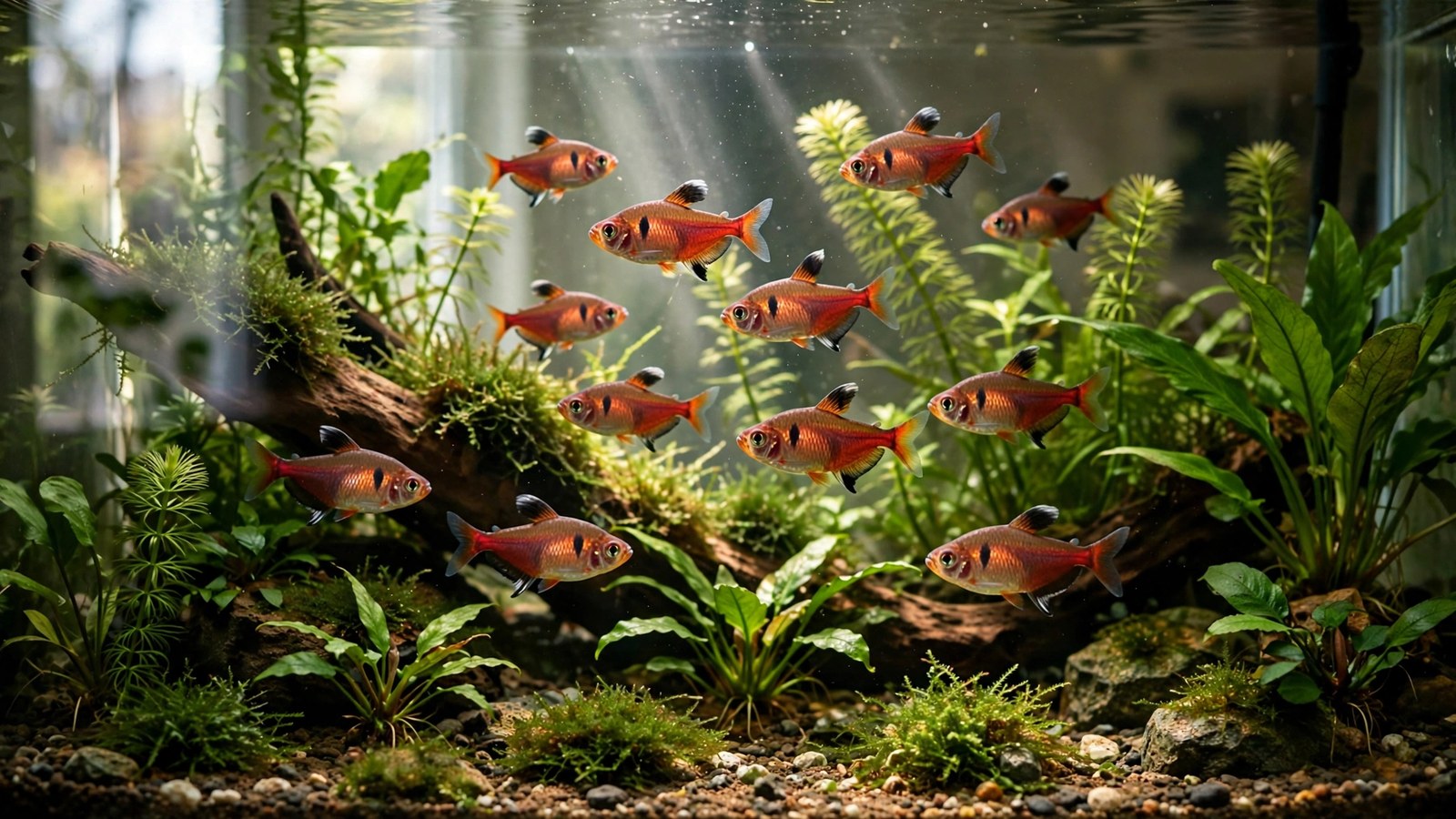
Most red-tetra tanks look flat: a few washed-out fish drifting through a bright, bare aquarium. A well-built red phantom tetra planted tank is the opposite — a school of ten or more Hyphessobrycon sweglesi, ruby-red bodies glowing against dark green plants, males flashing black-edged dorsals in the dim light. This guide covers the school, the water, the plants, tankmates, feeding, and how to tell the true red phantom from lookalikes like the black phantom and serpae tetras.
Bottom line: give 10–12 red phantoms a dim, soft-water, blackwater-leaning 20-gallon tank with tall green plants and open swimming lanes, and H. sweglesi shows color most hobbyists never see — deep ruby as the school matures over its first months in the tank, often darkest shortly after lights-on, when the male's dorsal goes jet-black.
Your Red Phantom Tetra Planted Tank: The Core Setup
Red phantoms come from slow, tannin-stained Orinoco tributaries — shaded water, leaf litter, dappled light. A 20-gallon long (76 cm) is the sweet spot: long enough for a school to move as a unit, compact enough to plant densely. Dark substrate is non-negotiable; on pale gravel red fish wash out, while on dark aquasoil or black sand the ruby pops.
Plant in layers: tall stems along the back and sides, mid-height plants in the corners, an open swimming corridor through the middle. The guide to aquarium plants for fish tanks covers species selection for schooling-fish setups in more depth, and this species thrives in a low-tech planted tank, which suits its preference for dimmer light anyway.
| Element | Target | Why |
|---|---|---|
| Tank | 20 gal long (76 L) minimum | Room for a 10–12 fish school |
| Substrate | Dark aquasoil or black sand | Deepens red coloration |
| Light | Low–medium, 6–8 h/day | Mimics shaded tributaries |
| Filter | Gentle HOB or sponge | Slow-water species |
| Water change | 25–30% weekly | Keeps nitrate under 20 ppm |
School Size and Behavior
This is where most red phantom tanks fail: five fish in a bright tank stay pale and timid because that is how a fractured school feels. Ten is the functional minimum; twelve to fifteen is where the species performs — synchronized drifting, mock displays between males, and the full red smaller groups never reach. Male sparring stays ritualized: face off with flared black-edged dorsals, then glide away. Actual nipping is rare.
Water: Lean Into the Blackwater
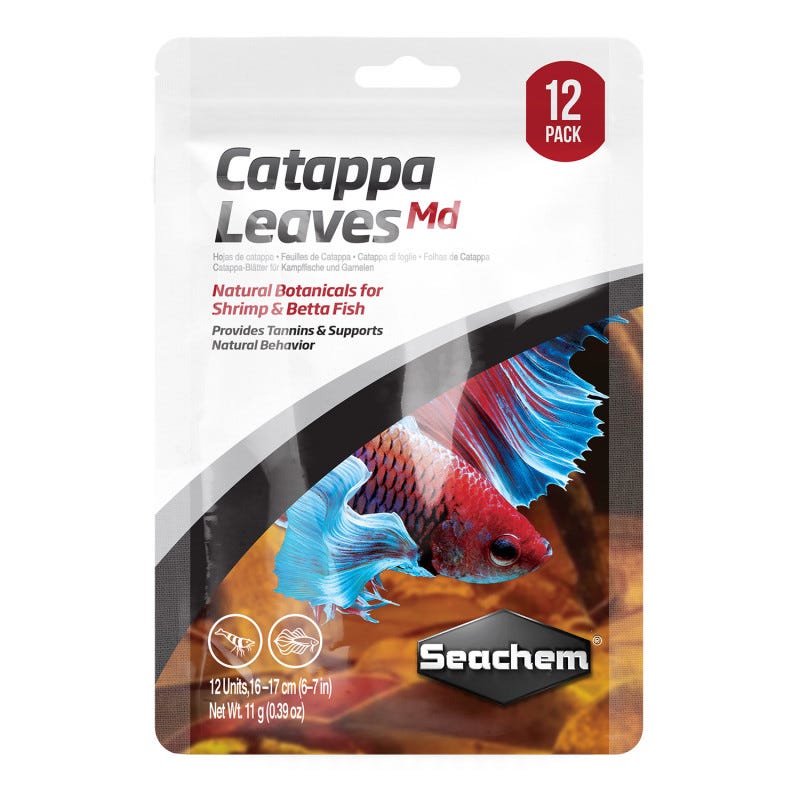
Red phantoms survive neutral, moderately hard tap water, but that is not the project here. Soft, slightly acidic, tannin-tinted water is where the ruby deepens. Botanicals — catappa leaves, alder cones — release tannins that lower pH gently and stain the water tea-colored, which makes red fish glow. Start with one medium catappa leaf per 40 liters, replaced every 3–4 weeks; rinse before adding, and they sink within a day or two.
| Parameter | Target | Notes |
|---|---|---|
| Temperature | 22–26°C (72–79°F) | Aim for 24–25°C day to day |
| pH | 5.5–6.8 | Botanicals + aquasoil lower it naturally |
| GH | 2–6 dGH | Cut hard tap water with RO if needed |
| Ammonia / nitrite | 0 ppm | Cycle the tank before the school goes in |
| Nitrate | Under 20 ppm | 25–30% weekly water changes |
 ★4.8
Seachem Catappa Leaves 12-pack
Check Price on Amazon ★4.8Plant Picks That Flatter Red Fish
Background: water sprite or Limnophila sessiliflora fill vertical space in weeks and tolerate dim light. Mid-ground: java fern and Anubias tied to driftwood, both fine in low light and soft water. Foreground: Cryptocoryne parva or open dark sand. Floating: Amazon frogbit or red root floater, thinned weekly to cover about half the surface. Skip red plants like Ludwigia — red-on-red competes with the fish instead of showcasing them. For wild habitat parameters see the Seriously Fish profile of Hyphessobrycon sweglesi, and check dim-light tolerance of background stems in Tropica's plant database.
Male vs Female: Reading the School
Sexing is easy once you know the markers. Males are the deep ruby showpieces: richer color, jet-black edge to the dorsal fin, bolder black "phantom spot" behind the gill. Females run paler — pinkish or silvery-red — with a shorter, rounder dorsal and a deeper body. Expect roughly equal numbers; the males' display sparring is the main entertainment and a sign the tank is working.
This matters because the namesake doppelganger is a different fish: the black phantom tetra (Hyphessobrycon megalopterus) is silvery-grey to black and deeper-bodied. Stores mislabel both directions, so confirm the ruby body and the scientific name before buying. A black neon tetra planted tank shows a similarly dim-water species with a very different color palette, which makes the "phantom" name confusion easier to see.
Peaceful Tankmates
Red phantoms are genuinely peaceful, so pair them with calm bottom dwellers and gentle schoolers in the same soft, dim water. Corydoras (panda, sterbai, pygmy) own the bottom and ignore the tetras; small rasboras (harlequin, lambchop) school above them with similar water needs; otocinclus quietly handle algae. A centerpiece pair of Apistogramma works in 20+ gallons with dense planting.
Avoid fin-nippers like tiger barbs and anything big enough to eat a 4 cm tetra. Serpae tetras are the classic cautionary neighbor — closely related and similar in size, but notorious fin-nippers that will harass a red phantom school; a serpae tetra planted tank deserves its own setup with sturdier tankmates.
Feeding: Small Mouths, Varied Menu
Feed small, varied, and light. A quality micro-pellet or crushed flake as the daily staple, plus frozen daphnia or baby brine shrimp two or three times a week, covers everything; the carotenoids in daphnia genuinely support red coloration over months. Feed what the school finishes in under two minutes, twice a day, and skip one day a week — uneaten food in tannin-rich water fouls fast. A gentler schooling red for a second tank is the ember tetra planted tank, running on the same feeding rhythm at a smaller scale.
Breeding Notes
Red phantoms are egg scatterers with no parental care — use a dedicated breeding tank, since the parents eat the eggs within minutes. Condition a pair on live or frozen foods for two weeks, then move them to a dim 10-gallon with very soft water (2–4 dGH), a spawning mop or dense java moss. Spawning usually happens at first light; remove the parents the same morning. Eggs hatch in 24–36 hours, fry swim freely by day 4–5. Infusoria the first week, then baby brine shrimp; expect 50–100 eggs per spawn.
Frequently Asked Questions
How many red phantom tetras should I keep?
Ten to twelve minimum in a 20-gallon tank. Groups of 5–6 stay pale and skittish; schools of 10+ show deep ruby color, synchronized swimming, and the males' dorsal displays. Bigger schools are better if the tank allows.
What is the difference between red phantom and black phantom tetras?
Different species. The red phantom is Hyphessobrycon sweglesi: ruby-red body, black-edged dorsal, black shoulder blotch. The black phantom (H. megalopterus) is silvery-grey to black and deeper-bodied. Confirm the ruby body and scientific name, since stores mislabel them.
Do red phantom tetras need blackwater?
Not strictly, but they color up dramatically in it: soft, slightly acidic water (pH 5.5–6.8, 2–6 dGH) with tannins from catappa leaves and dim light from floating plants produces the deepest red. Stability matters more than exact numbers.
Why are my red phantom tetras pale?
Check four things: school size (under 10 means chronic stress), lighting (too bright washes them out), substrate (pale gravel mutes red), and water (hard, alkaline water dulls color). Growing the school and dimming the light usually restores color within 1–2 weeks.
Can red phantom tetras live in hard, alkaline tap water?
They survive it, but they will not show their best color there. Red phantoms come from soft, slightly acidic tributaries, and hard, alkaline water dulls the ruby to a washed-out orange-pink. If your tap water is hard, cut it with reverse-osmosis water or lean on botanicals and dark aquasoil to soften and acidify the tank naturally. Stability matters more than chasing textbook numbers.
The Ruby School Is Worth Doing Right
Get the school size and the lighting right and Hyphessobrycon sweglesi does the rest — the color takes care of itself.