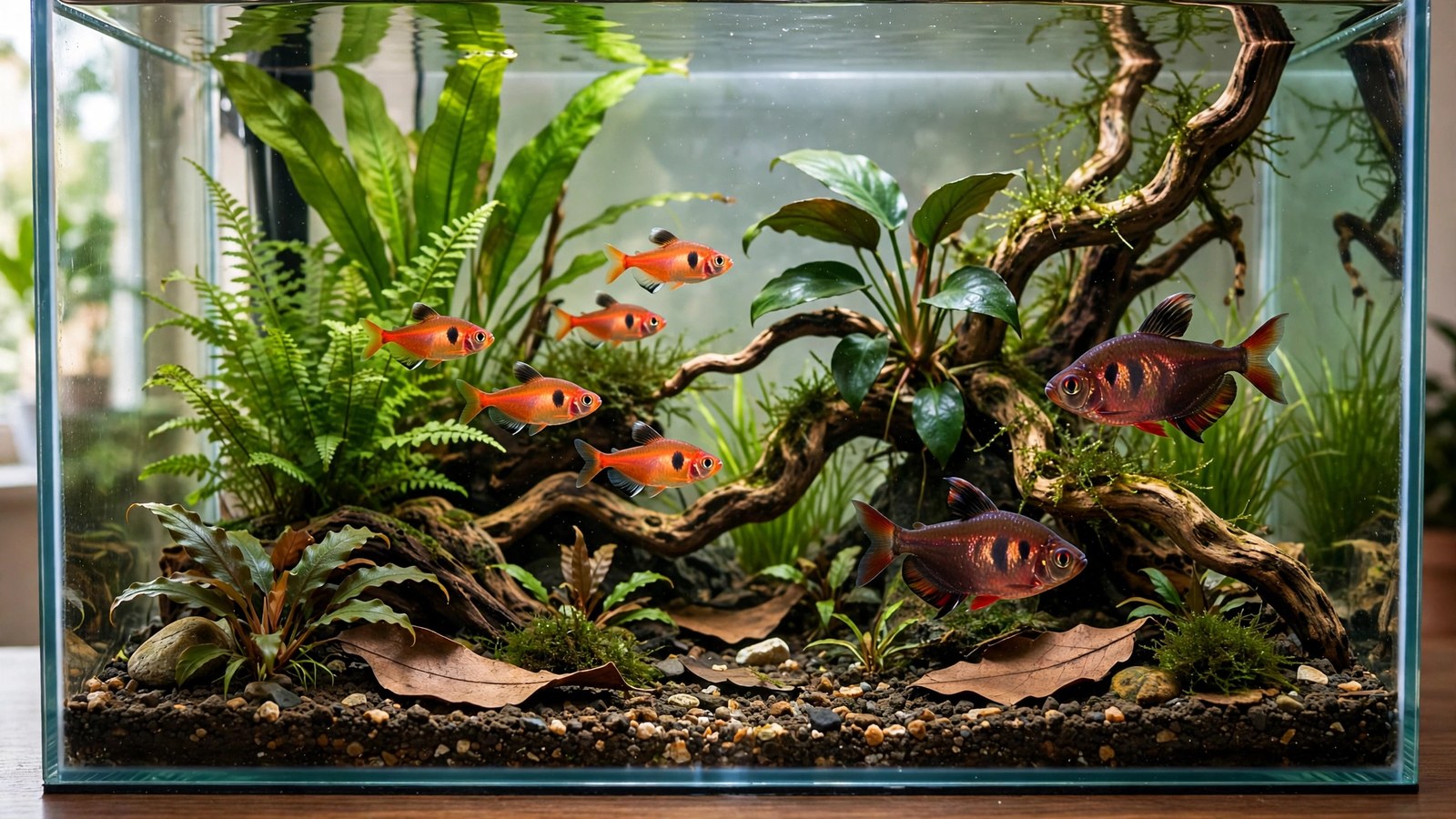
Most people learn about serpae tetras the painful way: a school of six earns a reputation for shredding guppy fins and terrorizing slow tankmates. A serpae tetra planted tank built correctly tells a completely different story — ten to twelve ember-red jewels weaving through dense planting, their feisty energy spent on each other instead of the community. The secret is aquascaping around their temperament rather than fighting it. This guide covers the school size that stops nipping, the broken-sightline planting that diffuses aggression, the forested-water parameters they prefer, and the tank mates that survive alongside them.
The short answer: keep 10–12+ serpae tetras in a 20-gallon or larger tank, plant densely with tall background plants and floating cover to break sightlines, and run dim, warm light. A big school in a heavily planted tank converts fin-nippers into a settled shoal — most nipping disappears within two weeks of adding the full school. For the plant-first foundations behind this setup, skim the Aquarium Plants for Fish Tanks guide first.
serpae tetra planted tank: the school-first approach to a nippy tetra
The serpae tetra — sold also as the jewel tetra and red minor tetra — is one of the hobby's most misunderstood fish. Hyphessobrycon eques comes from slow, dark backwaters of the Amazon, Guaporé, and Paraguay basins, where dense vegetation and root tangles structure every interaction. In those waters, serpaes school tightly and spar constantly, but the cover absorbs the conflict. Strip the cover away in a bare retail tank and you get the "fin-nipper" reputation.
Two levers fix this, and neither is optional. The first is school size. At six fish, aggression has nowhere to go: dominant individuals fixate on weaker schoolmates and anything else in the tank. At ten to twelve or more, the hierarchy distributes across enough fish that chases last seconds and nobody is a permanent target. The second lever is broken sightlines. Serpaes nip across open water — a charge needs a straight runway. Every tall plant cluster, driftwood branch, and floating-plant canopy is a visual wall that ends a chase early.
Water, tank size, and equipment
Serpaes are adaptable — pH 5.0–7.5, temperature 72–79°F (22–26°C), moderate hardness — which makes them genuinely low-tech friendly. A 20-gallon planted tank build is the practical minimum, but a 29 or 40-gallon breeder is where the design really works: the extra footprint lets you build the long planted lanes serpaes school along, and the extra volume absorbs the bioload of a proper school.
| Parameter | Target | Notes |
|---|---|---|
| Temperature | 72–79°F (22–26°C) | Mid-70s for best color |
| pH | 5.0–7.5 | Slightly acidic ideal, stable beats perfect |
| General hardness | 5–20 dGH | Soft water improves breeding odds |
| Tank size | 20 gal minimum | 29–40 gal gives the school real lanes |
| Filtration | Gentle HOB or canister | Backwater fish — baffle strong outflow |
| Substrate | Dark sand or fine gravel | Dark substrate intensifies red coloration |
| Water changes | 30% weekly | Non-negotiable with a heavy school bioload |
Planting a forested-water serpae scape
Think Amazon backwater, not Dutch street. The goal is layers: a dark substrate, midground clusters that partition the tank into compartments, tall background plants that close off long sightlines, and floating plants that dapple the light. Fast, forgiving growers dominate because serpaes don't care about CO2 or aquascaping awards — they care about cover. If you're aiming for this mood without high-tech complexity, the Lightly Planted Aquarium Setup guide maps the low-maintenance approach this tank deserves.
| Plant | Placement | What it does for serpaes |
|---|---|---|
| Amazon sword (Echinodorus bleheri) | Mid-background | Broad leaves partition the tank into territories |
| Brazilian pennywort | Background, let it top out | Forms a canopy serpaes school beneath |
| Java fern (on driftwood) | Midground | Shade structure; leaves break chase lines |
| Cryptocoryne wendtii | Foreground–mid clusters | Low shelter where subordinates retreat |
| Amazon frogbit | Floating | Diffuses light; triggers natural shoaling |
| Vallisneria | Back wall | Vertical lanes that interrupt straight-line charges |
Leave one open swimming lane across the front third — a school needs somewhere to display. Everything behind it should be layered cover. This layout also contrasts nicely with the open bright-water style of a planted neon tetra tank: neons want visibility, serpaes want shadows.
Light, hardscape, and the blackwater option
Run low–medium light, 6–7 hours daily, and don't fight a tannin tint — a piece of driftwood leaching tannins plus a dark substrate gets you remarkably close to their native water, and serpae reds glow against tea-colored water. One or two driftwood branches angled to partition the midground do double duty as structure and sightline breakers. If you want to commit to the biotope, a full blackwater tank setup with leaf litter and botanicals is the serpae's ancestral home, and it's as low-maintenance as planted tanks get.
 ★4.8
Seachem Catappa Leaves 12-pack
Check Price on Amazon ★4.8Stocking, tank mates, and feeding
Serpaes are piranha-like at feeding time — competitive, fast, and theatrical. Feed small amounts twice daily (micro pellets or crushed flake as the base, frozen brine shrimp or daphnia twice a week for color), and spread the food across the surface so shy schoolmates get their share. A varied diet with regular frozen foods is what keeps the red saturated; dull brown serpaes are almost always a flake-only diet problem. The Serpae Tetra species profile at Fish Laboratory documents their feeding intensity well, and Diszhal's characin profile confirms the dark, vegetated blackwater habitat this setup recreates.
Tank mate selection follows one rule: sturdy and fast. Corydoras catfish, bristlenose plecos, and robust schooling fish like black skirt tetras or larger rasboras hold their own. Anything slow, long-finned, or timid — bettas, guppies, fancy gouramis, small shy tetras — will be harassed, sometimes to death. Keep the serpae school as the centerpiece and let everything else be armored or quick.
Frequently Asked Questions
How many serpae tetras should I keep to stop fin nipping?
Ten to twelve is the minimum for a calm school; more is always better. At six or fewer, dominant fish fixate on the same few victims and nipping becomes constant. With a full school, aggression spreads across the group and each chase ends in seconds. Expect the pecking order to settle within two weeks of the complete school being added.
Can serpae tetras live with neon tetras?
Not recommended. Neons are small, timid, and slow to flee — exactly the profile serpaes harass. Even a well-schooled serpae group will stress neons during feeding frenzies. If you want a red tetra community, pair serpaes with sturdier tank mates like corydoras or black skirt tetras instead.
Do serpae tetras need a heavily planted tank?
They need dense cover, not necessarily a high-tech aquascape. Tall background plants, midground clusters, and floating plants that break sightlines matter far more than CO2 or rare species. A lightly planted but densely layered tank with frogbit cover calms them better than a sparse, brightly lit high-tech layout.
Why are my serpae tetras losing their red color?
Faded color usually means one of three things: a flake-only diet without frozen foods, water that's too bright or bare, or chronic stress from too-small a school. Add frozen brine shrimp or daphnia twice weekly, dim the light with floating plants, and make sure you have ten or more fish.
Are serpae tetras good for beginners?
Yes, with one caveat: the beginner must commit to the full school size and the dense planting. The fish themselves are hardy and tolerant of a wide pH and temperature range. Most "problem serpae" stories trace back to six fish in a bare tank, not to the species being difficult.
Give them numbers, give them shadows, give them dim forested water — and the feisty jewel tetra stops being the store tank's problem fish and becomes the brightest red school in your fish room.