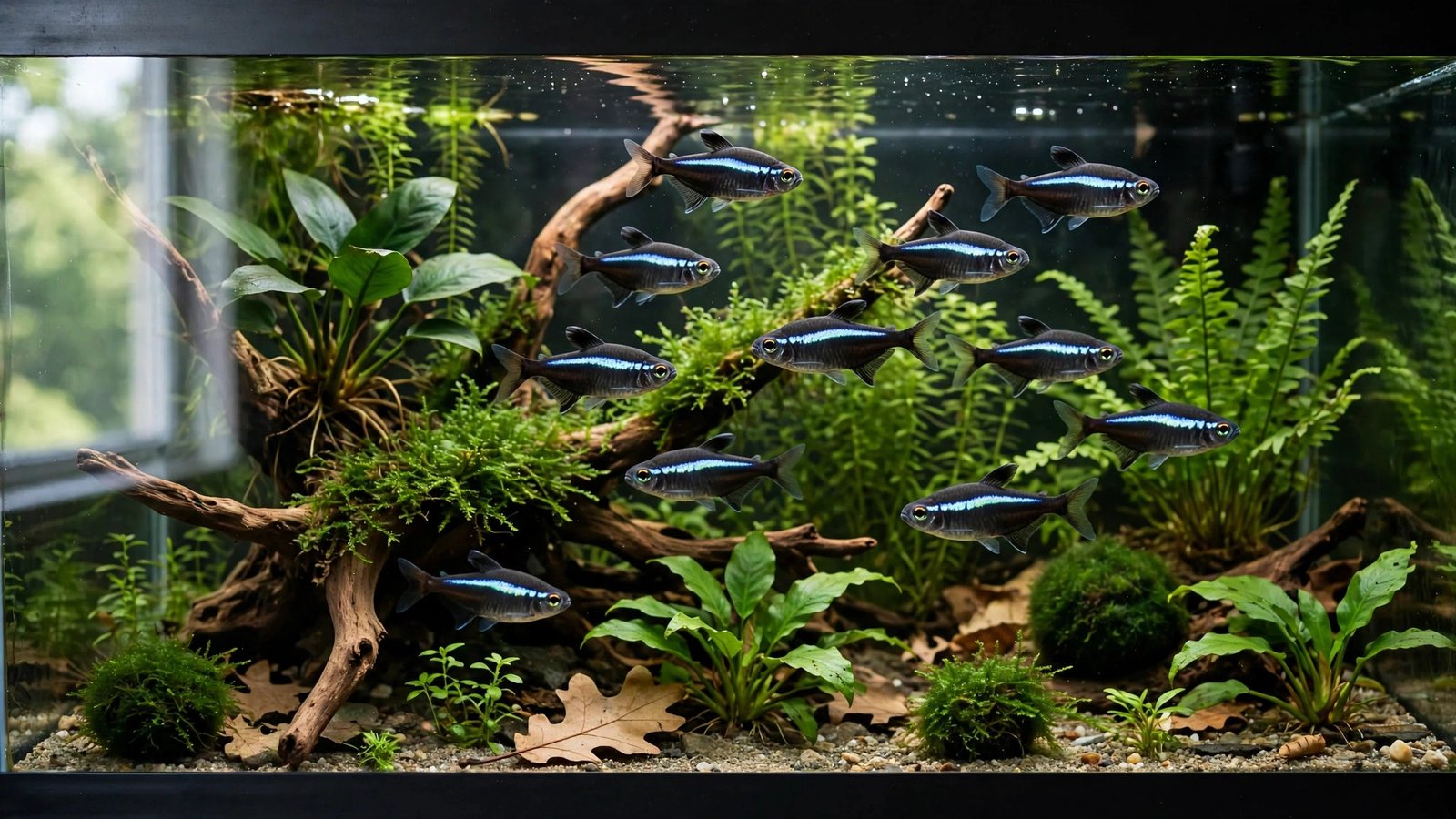
Everyone knows the common neon tetra — and everyone has lost a few in the first month. If you want a black neon tetra planted tank instead, you're choosing a different fish: Hyphessobrycon herbertaxelrodi, a bigger, more active, far more forgiving schooling tetra that thrives where common neons fade. This guide covers the setup — plants, parameters, school size, and tankmates — tuned to what this species actually needs.
At a Glance
| Species | Black neon tetra (Hyphessobrycon herbertaxelrodi) |
|---|---|
| Minimum tank size | 20 gallons (15 works, 20 is better) |
| Temperature | 73–81°F (23–27°C) |
| School size | 8–10 minimum, more is better |
| Temperament | Peaceful, active, mid-to-upper water column |
| pH | 5.5–7.5 (adaptable; stable matters more than exact) |
| Hardness | Soft to moderately hard |
| Diet | Omnivore — flakes/micro-pellets, frozen daphnia and brine shrimp |
| Lifespan | About 5 years with good care |
Not the Neon You Think: Black Neon Tetra vs Common Neon
The name causes all the confusion, so let's clear it up first. The black neon tetra is not a color variant of the common neon. The common neon is Paracheirodon innesi; the black neon is Hyphessobrycon herbertaxelrodi, an entirely different genus. Where the common neon wears a blue-red stripe, the black neon runs a white-green neon line above a broad black stripe, with two thin red-and-yellow bands across the top of the eye.
That genetic distance shows in the tank. Common neons are famously delicate — soft-water specialists that fade in hard tap water and new tanks. Our Planted Neon Tetra Tank Setup guide covers the dim, tannin-tinted, carefully matured setup the common neon demands. Black neons ask for less: they're bigger (1.5 inches), more active, and far more tolerant of ordinary tap water and brighter light.
Your black neon tetra planted tank: the setup blueprint
Black neons look their best against contrast and feel their best with a mix of cover and open water. The layout below gives you both.
Tank size and layout
A 20-gallon long is the sweet spot: enough horizontal room for 8–10 fish to cruise, and floor space for planted borders. Plant the sides and back densely, leave the center open. Black neons patrol open mid-water in formation and dart to the plants only when startled — a bare tank keeps them washed-out and nervous.
Substrate: go dark
This is the single biggest visual upgrade you can make. The white-green stripe glows against dark gravel or dark aquasoil, and the black stripe below it sharpens dramatically. On pale sand the same fish looks faded. Dark substrate also reads as "deep water" to the fish, and schools stay bolder over it.
Plants for cover and contrast
Use the border-and-lane layout: taller stems and swords at the back and sides, open water in front. Amazon swords and vallisneria give back-wall shelter; java fern and anubias on driftwood add mid-ground structure; floaters like frogbit or water lettuce diffuse the light. Black neons come from shaded streams and color up noticeably under dimmed overhead light. Our overview of aquarium plants for fish tanks covers matching plants to fish behavior, and the best plants for betta tanks — community-tank plant picks guide doubles as a shelter-plant reference for schooling tetras.
Lighting and filtration
Moderate lighting with floating-plant cover is ideal — enough for the plants, broken so the fish never feel exposed. A gentle hang-on-back or small canister with moderate flow suits them; black neons come from slow water and will fight a strong current instead of schooling. Aim the outflow at a plant wall to dissipate it.
Water Parameters: Stable Beats Perfect
The forgiving part: black neons tolerate a wide band of values and stay healthy across it. Pick a set and hold it steady.
| Parameter | Target range | Notes |
|---|---|---|
| Temperature | 73–81°F (23–27°C) | 76°F is a comfortable middle |
| pH | 5.5–7.5 | Stability beats the exact number |
| Hardness | Soft to moderately hard | Handles typical tap water well |
| Ammonia / nitrite | 0 ppm | Non-negotiable for any fish |
| Nitrate | < 40 ppm | Weekly water changes keep it there |
| Water changes | 25% weekly | Match temperature to avoid chilling |
Black neons still need mature, cycled water: "hardier" doesn't mean cycle-proof. Add them to a finished nitrogen cycle, not a tank filled yesterday.
Schooling Rules: 8–10 Black Neons or Nothing
Black neons are true shoalers, and their behavior scales with headcount. At 4–6 fish they skulk and flash pale stripes; at 8–10 they loosen up and swim mid-water in formation, showing full color. This is not a species to buy in pairs — the school is the display. For comparison, our roundup of the 12 Best Schooling Fish for Planted Tanks places black neons alongside the other top picks.
Tankmates for a Black Neon Community
Peaceful and mid-water, black neons fit any community that respects their 1.5-inch size. Good companions include corydoras, small rasboras, otocinclus, honey gouramis, and small shrimp — adult cherry shrimp are generally ignored, though shrimplets may be picked off. Natural pairings include our Ember Tetra Planted Tank Setup. Avoid anything big enough to eat them (large cichlids, big barbs) and anything aggressively nippy like serpae tetras.
Feeding: Simple Omnivore, Rich Results
Black neons eat from the top and middle of the water column — small mouths, quick dashes. Quality flakes or micro-pellets cover the basics; frozen daphnia or baby brine shrimp twice a week intensifies their stripes within a fortnight. Feed what they finish in three minutes, twice a day, and let corydoras or shrimp clean up fallen food.
Why Black Neons Forgive Beginner Mistakes
Three traits earn the hardy reputation. First, parameter tolerance: they settle into pH 6.5–7.5 tap water that would wear common neons down. Second, fast acclimation — black neons are usually schooling confidently within a day or two. Third, they feed readily from day one. They still need cycled water and weekly changes, but they offer a margin of error most small tetras don't.
Frequently Asked Questions
Are black neon tetras the same as neon tetras?
No — entirely different species. The common neon is Paracheirodon innesi; the black neon is Hyphessobrycon herbertaxelrodi. Black neons grow to about 1.5 inches, wear a white-green stripe above a black band rather than blue-red, and are noticeably hardier and more adaptable to ordinary tap water.
How many black neon tetras should I keep?
Keep at least 8–10, bought all at once. Below that they stay nervous, hide, and show washed-out color. Ten to twelve fish in a 20-gallon displays the tight formation this species is known for, with brighter stripes and more confident mid-water swimming.
What tank size do black neon tetras need?
A 20-gallon long is the recommended minimum for 8–10 fish, giving them the horizontal room they use. They survive in a 10 or 15, but the school compresses, colors fade, and you lose the formation-swimming display that makes this fish worth keeping.
Are black neon tetras good for beginners?
Yes — among the most beginner-friendly tetras. They tolerate pH 5.5–7.5, settle into ordinary tap water better than common neons, acclimate fast, and eat readily from day one. They still need a cycled tank and weekly water changes — hardy means forgiving, not indestructible.
Do black neon tetras need a dark substrate?
It's the highest-impact choice for this fish. The white-green stripe glows against dark gravel or aquasoil, and the black band sharpens dramatically. On pale sand the same fish looks dull. Dark substrate also encourages bolder mid-water behavior from a settled school.
Will black neon tetras eat my shrimp?
Adult cherry shrimp are generally ignored, but newborn shrimplets will be eaten, as with most tetras. In a densely planted tank with moss, enough survive to sustain a colony. If breeding shrimp is your priority, keep tetras out of that tank entirely.
The Hardier School Is the Better First School
Most beginners buy common neons and learn the hard way. Start with black neons: a planted 20-gallon, dark substrate, a school of ten, and the same weekly routine as any tank. For species-profile details — taxonomy, native Paraguay basin habitat, and exact ranges — see the black neon tetra profile on Wikipedia and Aquarium Store Depot's black neon tetra guide.