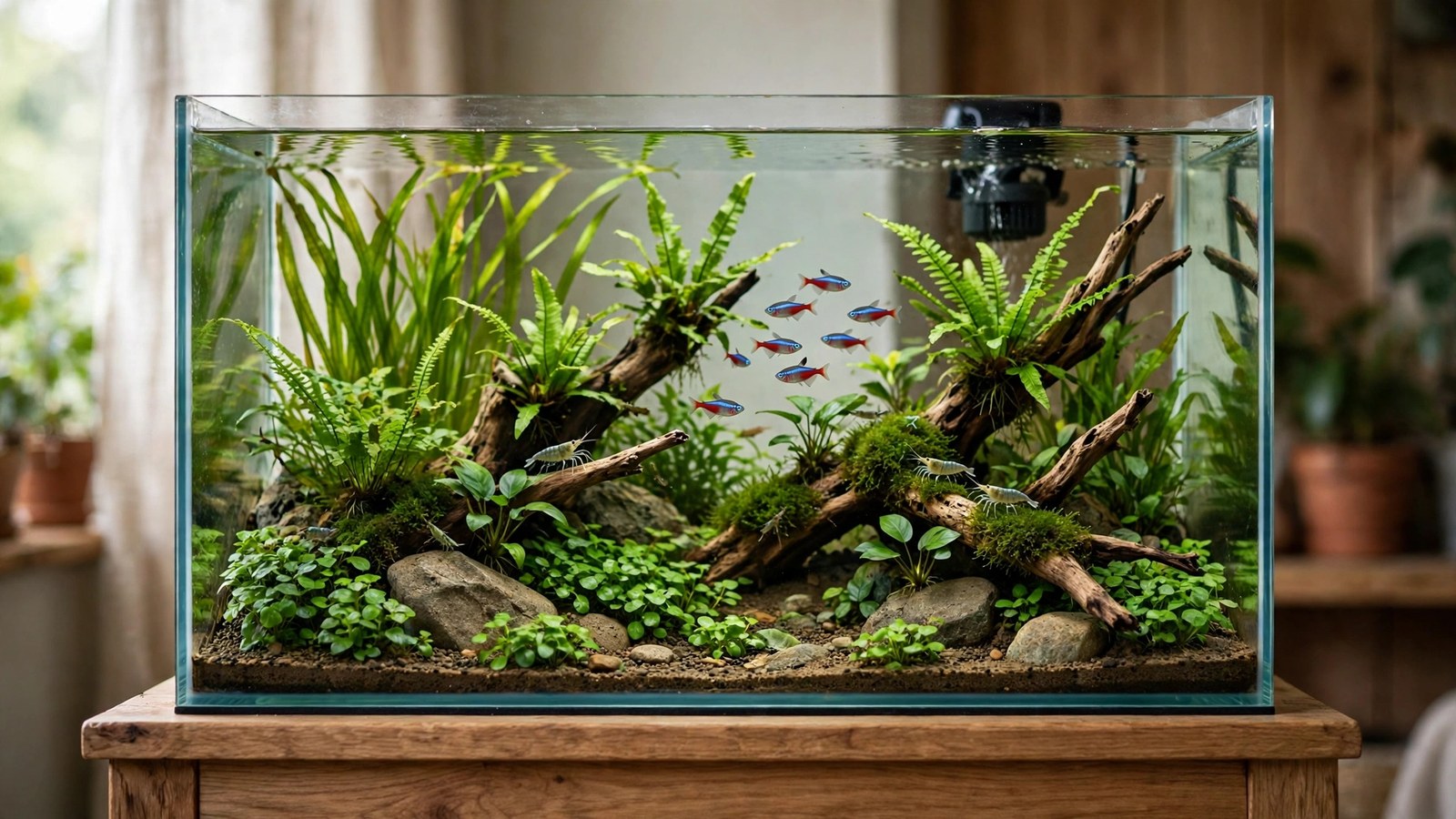
The 20-gallon long is the most recommended tank size in the hobby for good reason: big enough for real aquascaping and stable chemistry, small enough to stay affordable, and the long footprint suits more fish than any other standard size. A 20-gallon planted tank setup is where beginners become aquascapers — here's the complete build, from equipment to stocking.
Why the 20-Gallon Long Wins
The standard 20-long (30" x 12" x 12") offers the best footprint-to-cost ratio in the hobby. Thirty inches of length gives schooling fish real swimming room, supports proper aquascape composition (foreground, midground, background all get space), and provides enough water volume that parameters stay stable with weekly maintenance. Compared to the 10-gallon, it's dramatically more forgiving; compared to the 40-gallon, it's dramatically cheaper to equip and plant.
If you're stepping up from our 10-gallon planted tank setup, the 20-long feels like moving from an apartment to a house — same principles, far more room to execute them.
Equipment: The Full List
- Tank: 20-gallon long (preferred) or 20-high. The long's footprint suits aquascaping and fish far better.
- Light: 30-inch planted-tank LED fixture on a timer. Single most important purchase — buy the good one.
- Filter: hang-on-back rated 20–30 gallons with pre-filter sponge, or a small canister for the clean look. Gentle-to-moderate flow.
- Heater: 100W adjustable — sized with headroom for winter rooms.
- Substrate: one 9L bag of aquasoil (perfect for a 20-long at 2 inches), or 1.5–2 inches of sand/gravel with root tabs.
- Thermometer, timer plug, water conditioner, liquid test kit, aquascaping tweezers and scissors — the supporting cast.
Bio-Wheel power filtration rated for the 20-gallon range: Marineland Penguin Bio-Wheel power filter.
Stable heating for the 20-gallon sweet spot: EHEIM Jager 50W heater.
Substrate and Hardscape
Aquasoil 2 inches deep, sloped to 3 inches at the back — one 9L bag nails it. The slope adds perceived depth, which matters enormously at 12 inches of height. For hard-water setups, inert sand or gravel with root tabs under the heavy feeders.
Hardscape: this is the first size where real composition happens. One primary wood piece (12–18 inches) plus 3–5 stones, or a single dramatic stone arrangement. The 30-inch length supports the golden-ratio layout properly — focal element at the 18-inch mark, open space balancing it. Don't crowd: a 20-long with one great wood piece beats one with five mediocre ones.
A nutrient-rich aquasoil base for a 20-long's plant mass: Fluval Plant and Shrimp Stratum.
Layout: Composition at 30 Inches
- Golden ratio focal point — place the main hardscape about 60% across the length.
- Triangle or island layout — tall elements on one side stepping down across the tank; the 20-long's proportions suit this beautifully.
- Depth layering — foreground carpet/meadow, midground mounds, background curtain. Each zone gets ~10 inches of the length.
- Open swimming lane — leave the front-center open; schooling fish need the runway and it showcases the scape.
- Dark background — adds depth; at 12 inches deep, every inch of perceived depth counts.
The 20-Gallon Plant List
Background
- Rotala rotundifolia / H'ra — the 20-long background classic; trims into hedges
- Ludwigia repens / super red — color without CO2 demands
- Vallisneria (Italian) — tall ribbons; one corner planting spreads into a curtain
- Bacopa caroliniana — structural round-leafed stems
Midground
- Cryptocoryne wendtii (bronze/green) — mounds that anchor the composition
- Anubias nana / barteri on wood — broad-leaf anchors
- Java fern (Windeløv, narrow) — textured midground on hardscape
- Bucephalandra — jewel accents; the 20-long is big enough to show them off
- Staurogyne repens — trimmable midground hedges
Foreground
- Dwarf sagittaria — the easy runner carpet
- Monte Carlo — with CO2 or a dry start; the premium carpet
- Cryptocoryne parva — slowest carpet, but bulletproof low-tech
- Marsilea hirsuta — clover-like carpet for variety
Floating
- Frogbit or red root floaters — a controlled patch; see our floating plant guide.
Plant 70%+ from day one — the 20-long needs roughly 25–35 plant portions depending on species. Our planting quantity guide refines the numbers. This is a low-tech-friendly palette; our low-tech planted tank setup covers the equipment-minimal approach.
Stocking: The 20-Gallon Sweet Spot
The 20-long suits more community concepts than any other size. Proven options (choose one primary concept):
- Classic community: 12 neon/cardinal tetras + 6 corydoras + 1 honey gourami — the textbook planted community. Our planted neon tetra tank details the tetra care.
- Shrimp + nano fish: cherry shrimp colony + 10 chili rasboras or ember tetras — our planted shrimp tank setup meets our schooling fish guide.
- Pea puffer group: 6 puffers in a jungle — see our planted pea puffer tank setup.
- Rainbowfish (dwarf): 8 praecox rainbows — our planted rainbowfish tank setup covers the larger species.
- Breeding colony: guppy or platy colony with fry cover — our planted guppy tank setup handles the population math.
- Centerpiece + school: 1 dwarf gourami or pair of rams + 10 tetras + bottom crew.
What still doesn't fit: angelfish (need height), large rainbowfish, goldfish. The 20-long is generous, not infinite.
Cycling and Stocking Order
Plant heavily, cycle 2–3 weeks (plant-assisted — our faster cycling guide), verify zeros for a week, then stock in waves: bottom crew first, school second, centerpiece last — a week apart. Each wave is a bioload step the maturing filter absorbs.
Lighting, CO2, and Fertilization
Light 7–8 hours on a timer. CO2 is optional at this size — the plant list thrives without it; adding CO2 unlocks reds and faster carpets (see our high-tech guide if you go that route). Fertilize: with aquasoil, start liquids at month 3; with inert substrate, half-dose comprehensive fertilizer weekly from the start.
Maintenance: The 20-Minute Week
- 25–30% weekly water change — 5–6 gallons; 20 minutes start to finish.
- Trim stems every 2–3 weeks; replant tops to thicken.
- Thin floaters weekly; vacuum open areas lightly.
- Clean glass biweekly; rinse pre-filter sponge monthly.
- Root tabs quarterly for the heavy feeders.
Aquascaping Styles That Suit the 20-Long
The 20-long's proportions flatter several styles. The island layout — a single hardscape mound with planting radiating outward, open sand on both sides — is the beginner-friendly classic that always looks intentional. The triangle layout stacks height on one side and steps down across the 30 inches, creating strong directional flow that suits schooling fish displays. For the ambitious, a simplified Dutch-inspired street layout works: 3–4 plant streets across the length won't match a full 75-gallon Dutch tank, but the discipline of grouped contrasting stems reads beautifully at this scale — see our Dutch tank walkthrough for the method. And the jungle style is nearly foolproof here: plant the back and sides densely, let vallisneria and swords fill the height, and keep one open lane — our jungle tank build guide covers the controlled-chaos approach.
Whichever style you choose, photograph the tank monthly from the same angle. The 20-long changes fast, and the photo record teaches you more about plant growth rates and composition than any article — including this one.
Frequently Asked Questions
20-long or 20-high — which is better for plants?
The 20-long, decisively. More footprint means more planting area, better aquascape proportions, more swimming room for fish, and easier light penetration (12 inches deep vs 16+). The 20-high suits angelfish better; for everything else planted, the long wins.
How many plants do I need for a 20-gallon?
Roughly 25–35 portions/pots for 70% coverage: 8–10 background stems bunches, 6–8 midground plants, a foreground carpet's worth (3–5 pots of dwarf sag or 4–6 Monte Carlo cups), plus epiphytes for wood. Buy heavy upfront — a sparsely planted new tank invites algae while a dense one suppresses it.
Can I keep angelfish in a 20-gallon?
Not long-term — 12 inches of height can't accommodate an 8-inch-tall adult angel. Juveniles work temporarily, but plan the upgrade. For a 20-long, choose fish scaled to the tank: the stocking list above is proven. Angels want the 29+ gallon heights in our planted angelfish tank setup.
Do I need CO2 on a 20-gallon?
No — every plant in this guide's list grows well without it. CO2 becomes worth considering when you want intense reds, fast HC Cuba carpets, or simply faster everything. It's an upgrade path, not a requirement; master the low-tech 20-long first.
What's the best filter for a 20-gallon long?
A hang-on-back rated for 20–30 gallons with a pre-filter sponge is the sweet spot of price, performance, and simplicity. A small canister (with lily pipes for aesthetics) is the upgrade — quieter, more media, cleaner look. Either way, baffle strong outputs; the 12-inch depth means fish can't escape a current vertically.
How long before a 20-gallon looks mature?
Eight to twelve weeks from planting to genuinely lush, assuming dense initial planting and consistent care. The 20-long fills faster than bigger tanks (less volume to vegetate) but slower than a 10-gallon. Photograph monthly — the progress is motivating and teaches you your plants' growth rates.
The 20-Gallon Payoff
The 20-long is the hobby's workhorse for a reason: it does everything well — aquascaping, communities, breeding, shrimp — without demanding the budget or space of big tanks. Build it with a good light, plant it densely, stock it thoughtfully, and maintain the 20-minute week. It's the tank most hobbyists wish they'd started with, and the size many never outgrow.
New to planted tanks? The 2Hr Aquarist Planted Tank 101 beginner’s guide covers the same fundamentals from first principles.