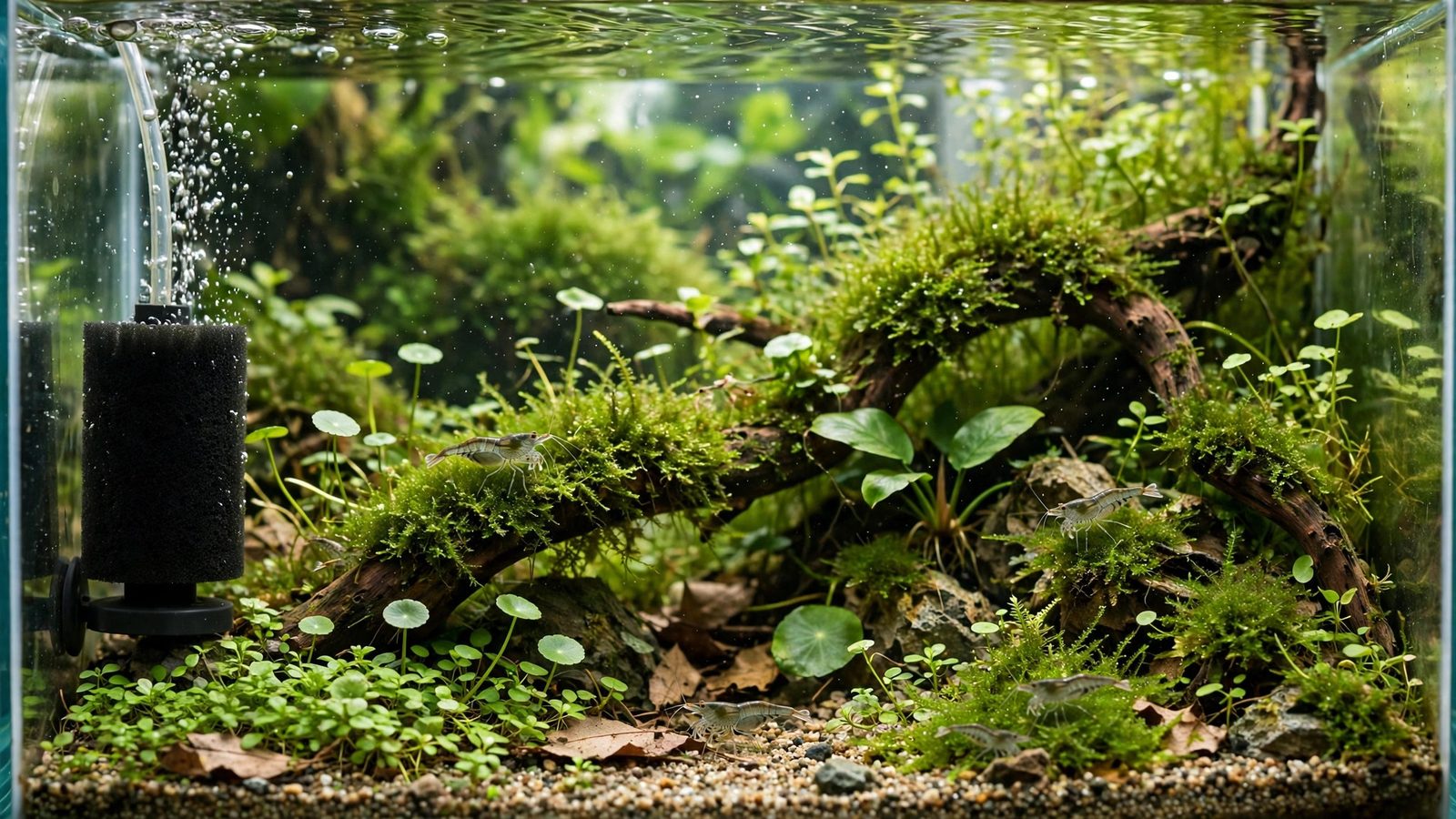
Step into a serious shrimp breeder's fish room and you'll spot something odd: row after row of lush planted tanks, with no humming canister or waterfall-style power filter in sight. Instead, each tank gently bubbles with a humble sponge filter planted tank setup — a foam block, a plastic uplift tube, and an air pump. No priming, no baskets of media, no current blasting delicate plants sideways. Shrimp keepers swear by these simple filters for good reason, and once you understand how one works inside a planted tank, you may wonder why the rest of us ever defaulted to anything else.
They are not magic, though. Sponge filters are a deliberate trade-off — superb at some jobs, honestly limited at others. This guide explains how they work, where they shine, where they fall short, and how to size, set up, clean, and combine one so you get the benefits without the blind spots.
Why a Sponge Filter Planted Tank Setup Works
How a sponge filter moves water
A sponge filter has no motor. An air pump pushes bubbles up through a rigid uplift tube in the foam block, and as the bubbles rise they drag water with them — the classic airlift principle. Water is drawn into the sponge from all sides, passes through the foam, and exits up the tube. The flow is continuous but gentle: a large volume of water turns over slowly, rather than a small volume turning over violently.
That suits planted tanks because most aquarium plants evolved in slow-moving water. Delicate stems bend under a powerhead's blast, newly planted foreground runners get uprooted, and fine carpets can be scoured flat by a jet aimed at the substrate. A sponge filter's diffuse, low-velocity intake treats the tank like calm water that happens to be circulating — plants stay rooted, leaves stay attached, and debris settles where a siphon can remove it.
Three jobs in one foam block
Mechanical filtration: The foam's pores trap suspended particles — decaying leaf bits, uneaten food, mulm. Over time the outer surface turns brown, which is the filter visibly doing its job. This keeps detritus from settling into the plant bed, where it can smother carpeting species and fuel algae.
Biological filtration: The foam's enormous internal surface area hosts nitrifying bacteria that convert toxic ammonia into nitrite and then nitrate — the same nitrification cycle behind every aquarium biofilter. The University of Florida's aquaculture extension explains how these nitrifying biofilms work and notes that a bacterial colony needs three to eight weeks to fully establish — so a new sponge filter must be cycled like any other filter.
Biofilm grazing: The sponge's outer surface grows a living film of microalgae, bacteria, and protozoa. To a cherry shrimp colony or a cloud of newborn fry, that foam is a 24-hour buffet — and a lifeline for day-old shrimplets too small to compete for prepared food. Pair that with plants that thrive in shrimp tanks and the setup becomes a nearly self-supporting little ecosystem.
The Planted-Tank Advantages of Sponge Filters
Gentle flow plants genuinely prefer
A sponge filter typically turns over roughly 2–3 times the tank volume per hour — about half the rate of a hang-on-back filter. In a densely planted tank that is plenty, because the plants do half the filtering themselves by absorbing nitrate and phosphate. Stocked with plants that absorb nitrates, your tank effectively runs a silent second filter rooted in the substrate. Fast-growing stems and floating plants — both excellent nutrient sponges — also do better without surface turbulence shredding them.
Fry, shrimplets, and snails stay safe
The classic planted-tank heartbreak: a beautiful breeding colony, and a power filter's intake strainer acting as a nursery graveyard. Sponge filters eliminate this entirely — there is no intake to get sucked against, since the whole sponge is the intake and its surface velocity can't trap even day-old fry. Keepers breeding cherry shrimp in a planted tank rely on this: newborn shrimplets are barely 2 millimeters long, and a sponge filter is the only filter type you can drop into their tank with zero modification. The same applies to delicate egg-layers, killifish fry, and baby snails.
Oxygenation without a dedicated airstone
Every sponge filter doubles as an aerator. Rising bubbles agitate the surface, driving gas exchange that boosts dissolved oxygen — valuable in warm tanks, stocked tanks, and at night, when plants switch from producing oxygen to consuming it. Alongside oxygenating plants, you get a double buffer against nighttime oxygen dips, when most mystery livestock losses actually happen. One honest caveat: surface agitation also drives off dissolved CO2, so sponge filters pair best with no-CO2, low-tech tanks full of easy aquarium plants that don't need CO2. (More on CO2 conflicts below.)
Dirt-cheap, silent, and outage-proof
A sponge filter costs a fraction of a canister filter and has no impeller to wear out, no seals to leak, and no priming ritual after a power outage — an air pump restarts instantly. Bacteria inside the sponge survive hours of still water, and a colonized sponge moved to a new tank gives you an instantly cycled quarantine or breeding setup. One decent air pump with a gang valve can drive half a dozen nanos, which is why multi-tank planted setups run on foam.
Sizing and Choosing a Sponge Filter
Manufacturer ratings assume a lightly stocked tank. Planted tanks both help (plants absorb waste) and complicate (dense planting traps debris) the equation, so size generously.
| Tank volume | Recommendation | Air pump guidance |
|---|---|---|
| Up to 10 gal (38 L) | One single sponge rated 10–15 gal | 1–2 W pump |
| 10–20 gal (38–76 L) | One large single or dual-sponge unit | 2–4 W, one outlet |
| 20–40 gal (76–150 L) | Dual-sponge or two singles at opposite ends | 4 W+; gang valve to balance |
| 40–60 gal (150–230 L) | Two large dual-sponges, or sponge + canister | 6 W+ or split across two pumps |
| Over 60 gal (230 L) | Supplement only — pair with a canister | Sized per unit above |
Single vs dual sponge
A single sponge is one foam block with one uplift tube; a dual unit mounts two blocks on a shared base. The dual design's real advantage is maintenance: clean one sponge this month and the other next month, and your bacterial colony never takes a hit. For tanks over 20 gallons, dual sponges — or simply two singles — give you redundancy plus better circulation across the footprint.
Coarse vs fine pore foam
Coarse foam (around 20 pores per inch) resists clogging; fine foam (30–45 PPI) polishes water clearer and hosts more bacteria but clogs fast. For planted tanks, coarse foam is the better default: these tanks shed fine organic debris constantly, and a clogged fine sponge turns into a flow-choked brick within weeks. Coarse foam keeps flowing for a month or more between cleanings — the low-maintenance rhythm most planted-tank keepers want.
Matching the air pump
An underpowered pump makes lazy bubbles, weak turnover, and a filter that merely looks busy — so buy one size up from your tank and dial it back with a bleed valve. Keep the pump above the waterline or fit a check valve: if power cuts and the pump sits below tank level, water can siphon back down the airline into the motor. That two-dollar valve prevents the most common sponge-filter disaster. Also budget for noise — cheap diaphragm pumps buzz, so spend a little more on a quiet model or set the pump on foam.
A dual-sponge unit covers most tanks in this guide's range: hygger double sponge filter.
Setting Up Your Sponge Filter
- Rinse the new sponge in dechlorinated water to flush manufacturing dust. Never use soap or hot water.
- Place it in a back corner, ideally behind hardscape or tall background stems so it stays out of sight.
- Connect the airline through a check valve, keeping runs short and kink-free — every bend costs airflow.
- Squeeze out trapped air by compressing the sponge underwater a few times so it saturates and sinks.
- Dial in a steady, moderate bubble stream. A gentle simmer is plenty; a rolling boil just adds noise and needless surface agitation.
- Seed and cycle. Squeeze mulm from a mature filter over the new sponge, or run it alongside your existing filter for 3–4 weeks before the switch.
Every sponge filter needs a dependable air pump behind it: Tetra Whisper air pump.
Cleaning Without Crashing Your Cycle
The top way people ruin a sponge filter is scrubbing it under hot tap water — chlorine and heat kill the nitrifying colony on contact, and the tank spikes with ammonia the next day. The correct method is almost insultingly simple: during a water change, pull the sponge and squeeze it repeatedly in a bucket of the old tank water you just removed. The brown sludge rinses out; the biofilm deep in the pores survives. Ten to twenty squeezes is usually enough. Clean when the bubble stream weakens or the sponge bulges with sludge — every 2–4 weeks depending on stocking — and on dual-sponge units, clean only one sponge per session so a mature colony is always running.
Honest Limitations: Where Sponge Filters Fall Short
- Surface agitation vs CO2: The bubbling that oxygenates your tank also speeds dissolved CO2's escape. On a pressurized CO2 setup holding 25–30 ppm, a sponge running at full blast can meaningfully reduce CO2 retention. Many aquarists run the sponge on low airflow or pause it during the CO2 photoperiod to minimize the conflict.
- Large and high-tech tanks: Above roughly 60 gallons, or under intense lighting with heavy CO2, sponge filters alone struggle to circulate water evenly. Dead spots form, algae exploits them, and a canister with a spray bar solves it more cleanly.
- Mechanical polishing: Sponge foam is coarse compared to filter floss. The water stays healthy and clear, but it won't have the crystal-polished look of a canister running fine floss — noticeable in aquascape photography.
- Aesthetics: A foam block in the corner is not beautiful. Skilled aquascapers hide it behind hardscape and plant walls (dark foam recedes against a dark background), but in a minimalist show tank it remains an eyesore.
- No chemical media: There is no basket for activated carbon or Purigen. For most planted tanks that's fine — plants and water changes cover it — but removing medications or tannins quickly will need a second filter.
Combos That Work: The Best of Both Worlds
The smartest planted-tank keepers rarely run a sponge alone — they use it as one layer in a combined system. A sponge plus canister gives high flow, polishing, and chemical media from the canister, with the sponge adding gentle secondary circulation, a shrimp-safe grazing zone, and a portable cycled filter for emergencies. A sponge plus hang-on-back pairs a pre-filter sponge over the HOB's intake (instant fry safety) with the HOB's polishing power. In a low-tech tank of low-light beginner plants, a sponge alone is often all you need — gentle flow, oxygenation, biofilm for shrimp, and plant uptake handling the nitrate. And keep one sponge running in your main tank permanently: it is a ready-made, fully cycled filter for a hospital tank, a new scape, or a friend's emergency.
Frequently Asked Questions
Can a sponge filter alone support a heavily planted tank?
Yes, in low-tech and moderately stocked tanks up to about 40 gallons. Plants absorb a large share of the nitrogen waste, which lightens the filter's load — exactly why sponge filters and planted tanks are such a natural pairing. The arrangement breaks down in high-tech, high-bioload systems where strong circulation and CO2 distribution matter most; there, use the sponge as a supplement to a canister rather than the primary filter.
How long does it take to cycle a sponge filter?
Expect 3–8 weeks, the same as any biological filter — you're waiting on the same nitrifying bacteria to colonize the foam. Warm water around 77°F (25°C), an ammonia source, and patience do the job. Shortcut it by seeding the new sponge with mulm squeezed from an established filter, or run it alongside your old filter for a month. Test ammonia and nitrite until both read zero for several consecutive days before calling it cycled.
Will the bubbles harm my plants?
The bubbles themselves don't damage plants. What matters is placement: keep the uplift tube's outflow away from delicate new carpeting plantings and floating plants, since constant surface disturbance can push floaters aside or unseat freshly planted runners. Position the filter in a back corner with the bubble stream rising along the glass, and most plants will never notice it.
Do sponge filters work with CO2 injection?
They can, with a caveat. The airlift's surface agitation drives CO2 out of the water faster, so you may need to inject slightly more to hold your target level. Many aquarists run the sponge on low airflow or put it on a timer that pauses during the CO2 photoperiod. In low-tech tanks without CO2 injection there is no conflict at all — the extra oxygenation is pure benefit, especially at night when plants consume oxygen.
How do I hide a sponge filter in a display aquascape?
Place it in a back corner and build around it: tall background stems, a driftwood piece angled in front, or a rock cluster will make it nearly invisible. Choose black or dark grey foam rather than bright blue so it recedes against a dark background. Some aquascapers attach moss or epiphytes directly to the foam, turning the filter into a planted feature. It never disappears completely, but in a dense scape it becomes part of the furniture.
Are sponge filters enough for a shrimp breeding colony?
They're not just enough — they're the standard. Breeders overwhelmingly choose sponge filters because they're fry-safe, grow the biofilm that baby shrimp graze on, oxygenate the water, and can't trap shrimplets against an intake. A dual-sponge filter in a 10–20 gallon planted tank is the classic cherry shrimp breeding setup, and colonies routinely number in the hundreds under nothing more than sponge filtration and healthy plant growth.
The Underrated Workhorse, Properly Understood
Sponge filters earned their cult following honestly: by being exactly as good as they claim to be. In a low-tech or breeding-focused planted tank, a well-sized sponge filter delivers gentle circulation, reliable biological filtration, a living food source for shrimp and fry, and oxygenation — all for the price of a pizza, with essentially nothing that can break. Respect its limits: keep airflow moderate if you inject CO2, pair it with a canister on large or high-energy tanks, and clean it in old tank water, never under the tap. Do that, and you'll understand why the breeders with the healthiest planted tanks in the room all bubble away on foam.