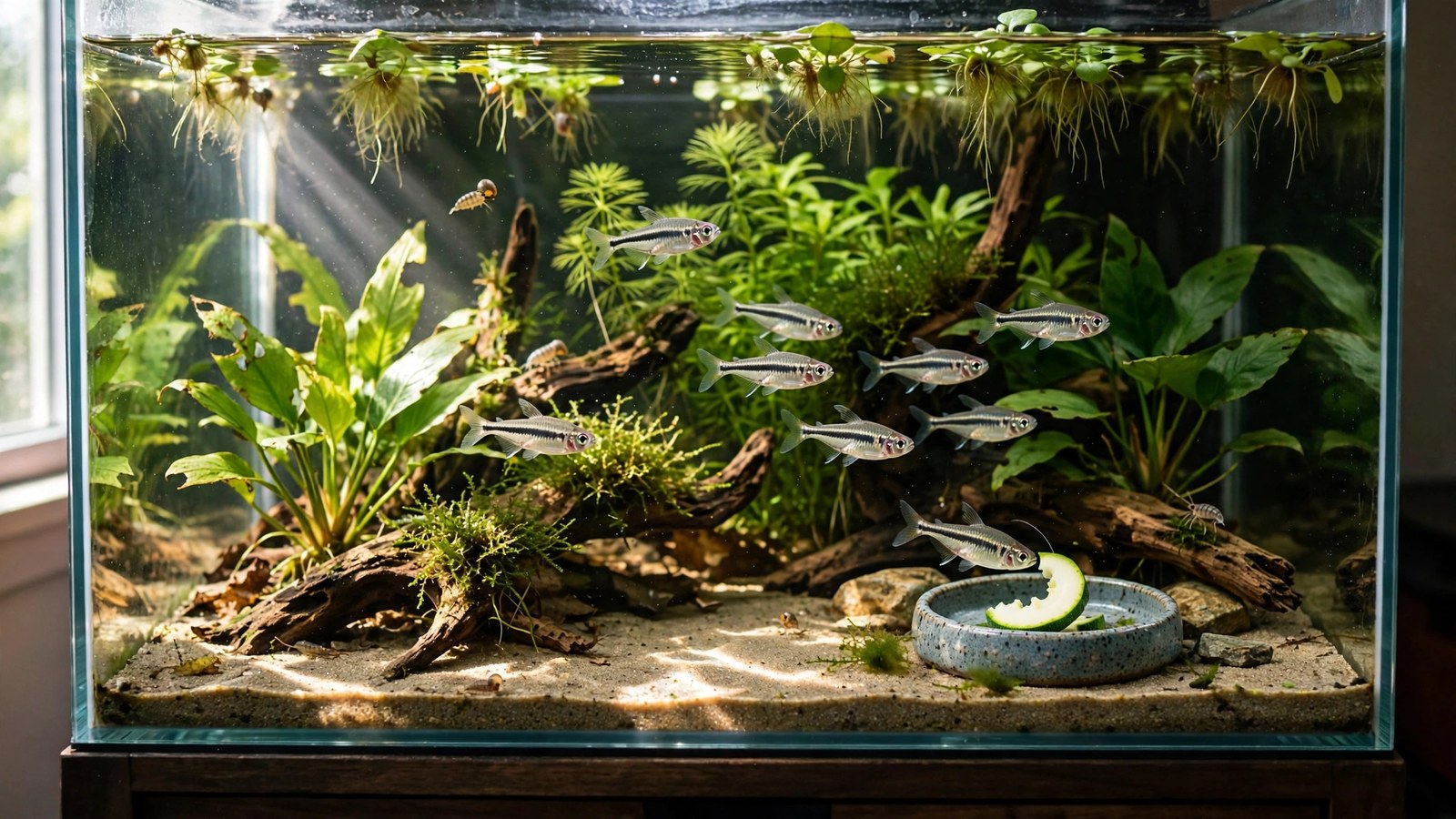
They swim tilted — nose up, tail down, a black stripe swooping from flank to tail like a hockey stick. Penguin tetras (Thayeria boehlkei) are among the liveliest schoolers for a planted tank. But there is an honest caveat no store tag mentions: a hungry penguin tetra will nibble soft leaves. This guide builds the tank around a fish-first planted tank philosophy — layout, water, plant picks, and the veggie-feeding fix that keeps wisteria uneaten.
Why the Penguin Tetra Suits a Planted Tank
In the Amazon's vegetated jungle streams, penguin tetras live along plant margins in slow, shaded water. A planted tank with dense edges is habitat to them, not decoration. They spend their time in midwater, tilted head-up in their signature oblique posture, schooling loosely and darting in short bursts. Give them plants at the perimeter and open water in the center, and the whole school locks into a hypnotic drifting patrol.
They are genuinely peaceful, too. Unlike Buenos Aires tetras — the notorious plant-shredders — penguin tetras are not herbivores by temperament. They ignore tough leaves and only sample soft foliage when underfed, which is a feeding problem, not a species flaw. Fed well, they are among the most plant-compatible schooling fish you can buy.
Laying Out a Planted Penguin Tetra Tank
Split the tank into two zones: a dense green perimeter and an empty stage in the middle. A 20-gallon long (30 inches of swim room) comfortably holds a school of 10 — they patrol horizontally, so length matters more than height.
Water and flow
| Parameter | Target | Notes |
|---|---|---|
| Temperature | 72–82°F (22–28°C) | Aim for 74–78°F; stable beats exact |
| pH | 6.0–7.5 | Soft, slightly acidic is ideal but they adapt |
| Hardness | 3–12 dGH | Very hard water dulls their colors |
| Flow | Gentle | Slow-stream fish, not rapids fish |
| Water changes | 30% weekly | Essential with a heavy feeding schedule |
The layout rule
Plant the sides and back thick — stems, Crypts, and epiphytes on hardscape — and leave the front-center third open. Driftwood or smooth river rock anchors the scape, and a dark substrate makes the school's black stripes and red-tipped fins pop. A few floaters (frogbit or salvinia) break up bright light and give the school the shaded ceiling they prefer. This balance of open swimming room and a low-tech planted tank setup is the easiest path to a healthy, self-sustaining penguin tetra tank.
Best Plants for a Penguin Tetra Tank
Use a two-tier strategy: a backbone of nibble-proof plants that always looks good, plus faster growers the fish leave alone once feeding is sorted.
| Tier | Plants | Why they work |
|---|---|---|
| Nibble-proof backbone | Anubias, Java fern, Cryptocoryne | Tough leaves the fish ignore; epiphytes attach to hardscape |
| Fast background stems | Water wisteria, hornwort, rotala | Outgrow incidental grazing; hornwort can float if nibbled below |
| Foreground | Dwarf sagittaria, cryptocoryne parva | Low, dense, ignored by midwater schoolers |
| Floaters | Frogbit, salvinia | Shade the tank; grow faster than anything grazes |
Water wisteria deserves a special mention: it is the plant penguin tetras sample most, but it is also one of the fastest growers you can plant — a healthy stand outpaces occasional nibbling. If you want the softest starting list, the easiest plants for a beginner community tank overlap almost perfectly with penguin-tetra-safe choices.
The Nibbling Problem (and the Veggie Fix)
Here is the honest angle most care guides skip. A FishLore keeper stocked penguin tetras in a planted tank and watched them nibble the water wisteria within a day. He had kept Buenos Aires tetras before and panicked — then he fed the penguins flakes plus veggies, and the nibbling stopped cold. The verdict in that FishLore thread: the fish were just very hungry, not plant-eaters by nature.
The fix is a straightforward protocol:
- Feed twice daily, portions that vanish in under two minutes — micro pellets or flakes with spirulina as the staple.
- Add a vegetable snack once or twice a week: blanched zucchini slices, deshelled peas, or spirulina-enriched flake. Clip zucchini to the glass for an hour, then remove leftovers.
- Keep nibble-proof backbone plants (Anubias, Java fern) so even a hungry school can't do structural damage.
- Watch for the warning sign: nibbling restarts when portions shrink or feedings get skipped. The fish are your feeding gauge.
Feeding, Name Confusion, and Tank Mates
Trade-name confusion surrounds this fish, so get the ID right before buying. "Hockeystick tetra" is the same fish — Thayeria boehlkei — named for the stripe's hockey-stick shape, not a separate species. The original penguin tetra, Thayeria obliqua, is genuinely rarer in the trade; a good species profile helps you tell them apart by the stripe. At a normal price, "penguin tetra" or "hockeystick tetra" is boehlkei nine times out of ten.
Feed them like omnivores: a quality staple, plus variety. Frozen daphnia or baby brine shrimp weekly keeps colors sharp, and the vegetable snack from above doubles as plant insurance. Avoid long-finned tank mates — penguins can fin-nip when bored.
Good company for the same scape: calm midwater shoalers like the empire gudgeon, which suits the same dense-perimeter layout, or the red neon blue eye for color contrast without crowding the swimming lane. One caution: don't default to the Chinese algae eater for cleanup — mature ones can damage plants and harass tank mates, which defeats the purpose of a planted feature tank. Otocinclus or Amano shrimp are the safer crew.
Frequently Asked Questions
How many penguin tetras should I keep together?
Eight is the absolute minimum; 10–12 is better in a 20-gallon long or larger. Small groups turn skittish, hide, and lose the schooling behavior that makes this fish special. A school of ten spreads social tension across the group, so no single fish gets harassed and the oblique swimming display shows at its best.
Will penguin tetras eat my aquarium plants?
Only when underfed — and only soft-leaved stems like water wisteria. Well-fed penguin tetras ignore plants entirely. Feed twice daily with weekly vegetable matter and the nibbling stops within days. Keep tough-leaved plants like Anubias and Java fern as the scape's backbone for insurance.
Is the hockeystick tetra the same as the penguin tetra?
Yes. "Hockeystick tetra" is a trade name for Thayeria boehlkei, named for the stripe's hockey-stick shape. The genuinely different species, Thayeria obliqua (the original penguin tetra), is rare in the trade and has a stripe that tapers upward instead of running straight through the body.
Can penguin tetras live with shrimp?
Amano and ghost shrimp are safe companions. Cherry shrimp adults are usually fine, but a lively school will pick off newborn shrimplets, so a breeding colony needs dense moss or plant cover. If you want shrimp population growth, give them dwarf sagittaria or Java moss as a nursery zone.
What tank size does a penguin tetra school need?
A 20-gallon long (30 inches) is the practical minimum for 8–10 fish. These are fast, active swimmers that patrol horizontally, so tank length matters far more than height. The fish visibly use long tanks better — tighter turning, looser schooling, and better color.
A penguin tetra planted tank is one of the easiest wins in the hobby: a long tank, dense edges, an open center, and a feeding schedule you actually keep. Nail the food and the fish take care of the spectacle — an oblique, stripe-lit school patrolling the green canyon you built.