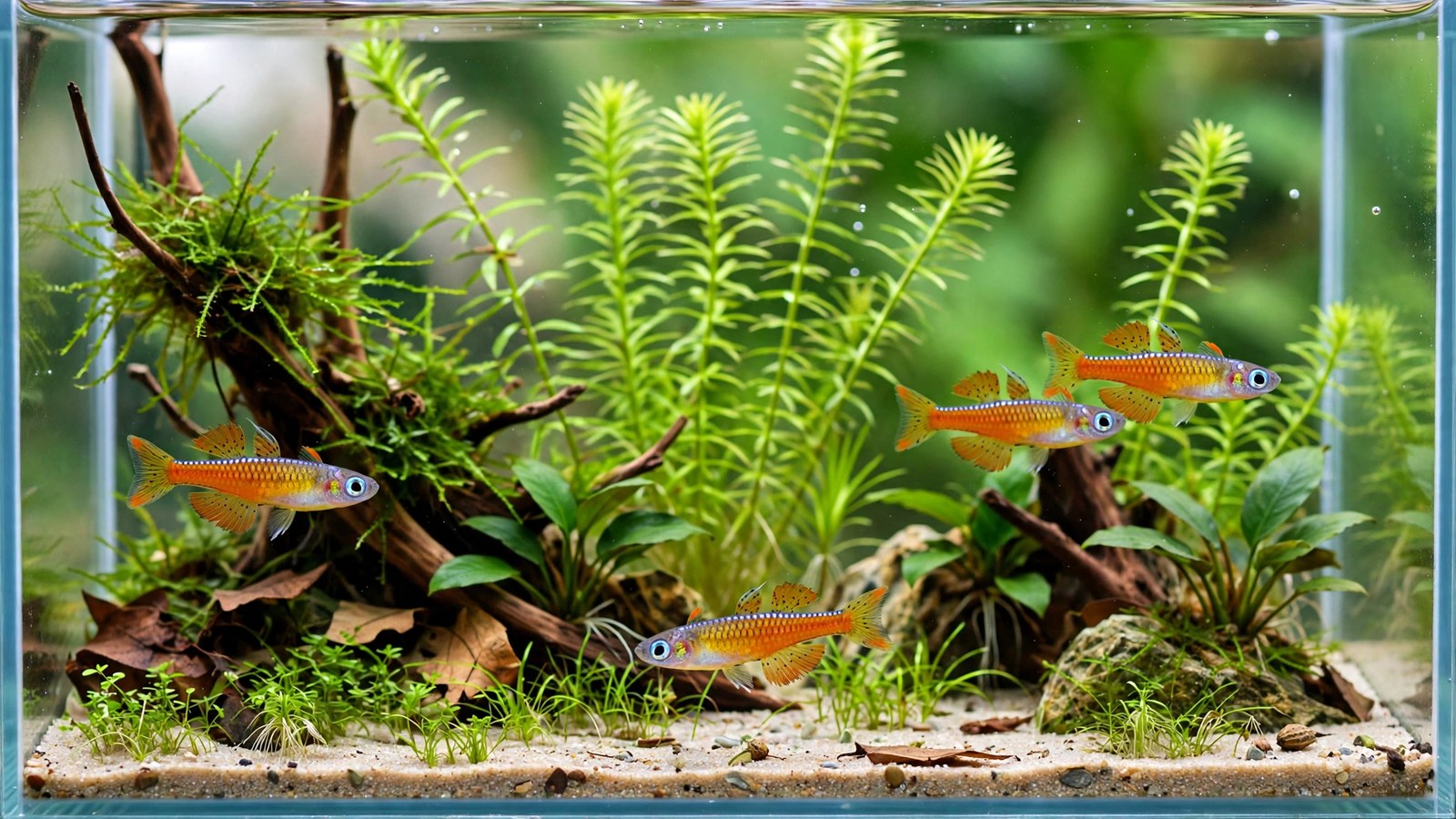
A lot of "nano centerpiece" fish disappear in a planted tank — they are either too shy to show or too bold to stay small. The red neon blue eye (Pseudomugil luminatus) breaks that pattern: males flash cherry-red fins edged in black over a neon-blue stare, and a school of ten turns a 10-gallon aquascape into a living light show. By the end of this guide you will know how to tell this species apart from its commonly confused cousin, and how to build the planted tank that keeps it at its most colorful.
The red neon blue eye is a 1.25-inch (3–3.5 cm) schooling fish from southern Papua New Guinea, and it is a different species from the forktail blue-eye (Pseudomugil furcatus) — luminatus has red fins and stays smaller, while furcatus grows past 2 inches and develops yellow fins. Keep luminatus in groups of 8–10, in a densely planted tank at 72–78°F with soft, slightly acidic to neutral water, and feed tiny foods daily for the best color.
Red neon blue eye vs. forktail blue-eye: not the same fish
This is the confusion that matters, and it costs aquarists real money. Shops label both fish "blue-eye" and sometimes mix the tanks, but P. luminatus and P. furcatus are distinct species with different looks, sizes, and temperaments. The aquarist who bought "red neon" and got forktails ends up with a larger, more boisterous fish than planned — fine in a 20-gallon, cramped in a nano.
Learn the four visual tells before you reach for your wallet:
| Trait | Red neon blue-eye (P. luminatus) | Forktail blue-eye (P. furcatus) |
|---|---|---|
| Adult size | ~1.25 in (3–3.5 cm) | ~2–2.4 in (4.5–6 cm) |
| Male fin color | Neon red-orange fins with black margins | Bright yellow fins with black margins |
| Body | Silvery with a faint blue iridescent stripe | Nearly transparent, glassy |
| Tail shape | Rounded to slightly forked | Deeply forked, lyre-like in males |
| Home waters | Southern Papua New Guinea rivers | Peria Creek, Milne Bay Province, PNG |
| Nano suitability | Excellent at 10 gallons | Borderline — better at 20+ |
Behavior is nearly identical in both species: males flare fins in ritual sparring that rarely causes injury, and both attach sticky eggs to fine-leaf plants each morning. The difference is the package — if the males at the shop show yellow tails, you are looking at furcatus, whatever the tank label says.
Building the planted tank around them
Design for the fish, and the scape does the heavy lifting. Luminatus spends its time in the mid-water column, displaying against open swimming lanes with plant cover behind them. A guide to choosing aquarium plants for fish tanks helps you pick species that serve livestock rather than just filling space — structure first, looks second.
The layout that works
Plant densely along the back and sides, leave the front third open. Fine-leaf stems like cabomba, guppy grass, and hornwort are not decorative here — they are spawning substrate the males court females around every morning. Epiphytes (anubias, Java fern) on the hardscape add mid-ground cover, and a mat of beginner-friendly floating plants dims the light to the soft, dappled conditions these fish display best under.
Water and equipment
Parameters are forgiving — that is part of this fish's appeal. Aim for 72–78°F, pH 6.5–7.8, and soft to moderately hard water; stability matters far more than chasing a perfect number. A gentle sponge or low-flow hang-on-back filter keeps the water polished without blasting a fish this size across the tank. And fit a tight lid: blue-eyes are skittish at first and will find any uncovered gap.
Feeding: small foods, twice a day
A blue-eye's mouth is tiny — standard flake is too big to swallow, and uneaten crumbs rot. Crush flake to dust, use 0.5 mm micro pellets, and rotate in baby brine shrimp two to three times a week; the carotenoids deepen the males' red finnage within two weeks.
Feed what the group finishes in 60–90 seconds, twice daily — well-fed pairs spawn on their own schedule.
Breeding in the planted tank
You do not need a separate breeding tank — a mature planted nano is already one. Each morning, males court females through the fine-leaf stems, and the female attaches 1–3 adhesive eggs per pass. Eggs hatch in roughly 10–14 days at 75°F.
Fry take infusoria first, then newly hatched baby brine shrimp. Leave the parents in place and the colony grows slowly, or move eggs on their stems to a rearing tub for better numbers. Shrimp are safe cohabitants; mid-water egg-eaters are not.
Tank mates
Choose calm, small companions that neither bully the blue-eyes nor outcompete them for micro foods. Good company includes penguin tetras in a planted tank (they occupy the same mid-water band peacefully), empire gudgeons as a bottom-level contrast, and cherry shrimp. Stock lightly — a crowded nano turns daily spawning into a food fight the blue-eyes lose.
If you are assembling a community of small schooling species, compare candidates in our roundup of the best schooling fish for planted tanks to see which temperaments actually pair with blue-eyes long-term.
Frequently Asked Questions
Are red neon blue-eyes the same fish as forktail blue-eyes?
No — they are different species in the same genus. Pseudomugil luminatus (red neon) has red fins and reaches about 1.25 inches, while Pseudomugil furcatus (forktail) has yellow fins, a deeply forked tail, and grows past 2 inches. Shops mix them up often, so check the males' fin color before buying.
How many red neon blue-eyes should I keep together?
Keep 8–10 minimum, with at least two females per male. Smaller groups make males skittish and wash out their color; a full school triggers the constant fin-flaring displays that make this fish worth keeping. A group of ten fits comfortably in a well-planted 10-gallon tank.
What do red neon blue-eyes eat?
Tiny foods, twice a day: crushed flake, 0.5 mm micro pellets, and baby brine shrimp two to three times a week. Standard flake is too large for their mouths — grind it to dust. Well-conditioned fish show deeper red finnage and begin spawning spontaneously in a planted tank.
Will red neon blue-eyes breed in a community planted tank?
Yes — females attach a few eggs to fine-leaf plants nearly every morning, and fry hatch in about two weeks at 75°F. Some fry survive among dense plants, but dedicated rearing in a separate tub raises far more. Remove mid-water egg-eaters from the tank if you want the colony to grow on its own.
Why did my blue-eyes lose their red color after I brought them home?
New arrivals nearly always pale out from stress, and males color down without females around. Give them a week in a dim, planted tank with at least a 1:2 male-to-female ratio and color-rich foods like baby brine shrimp. Persistent dullness in an established group usually means water instability or chronic stress from rough tank mates.
The honest verdict
The red neon blue-eye earns its nano-centerpiece reputation: few freshwater fish pack this much display color into 1.25 inches, and fewer still breed so readily in a planted tank. Buy a full school, confirm the fin color so you are not bringing home forktails, plant it densely, and let the daily spawning become part of the tank's rhythm. For species-level detail on identification and wild habitat, Seriously Fish's Pseudomugil luminatus profile is the best reference, with distribution data summarized at FishBase's species summary.