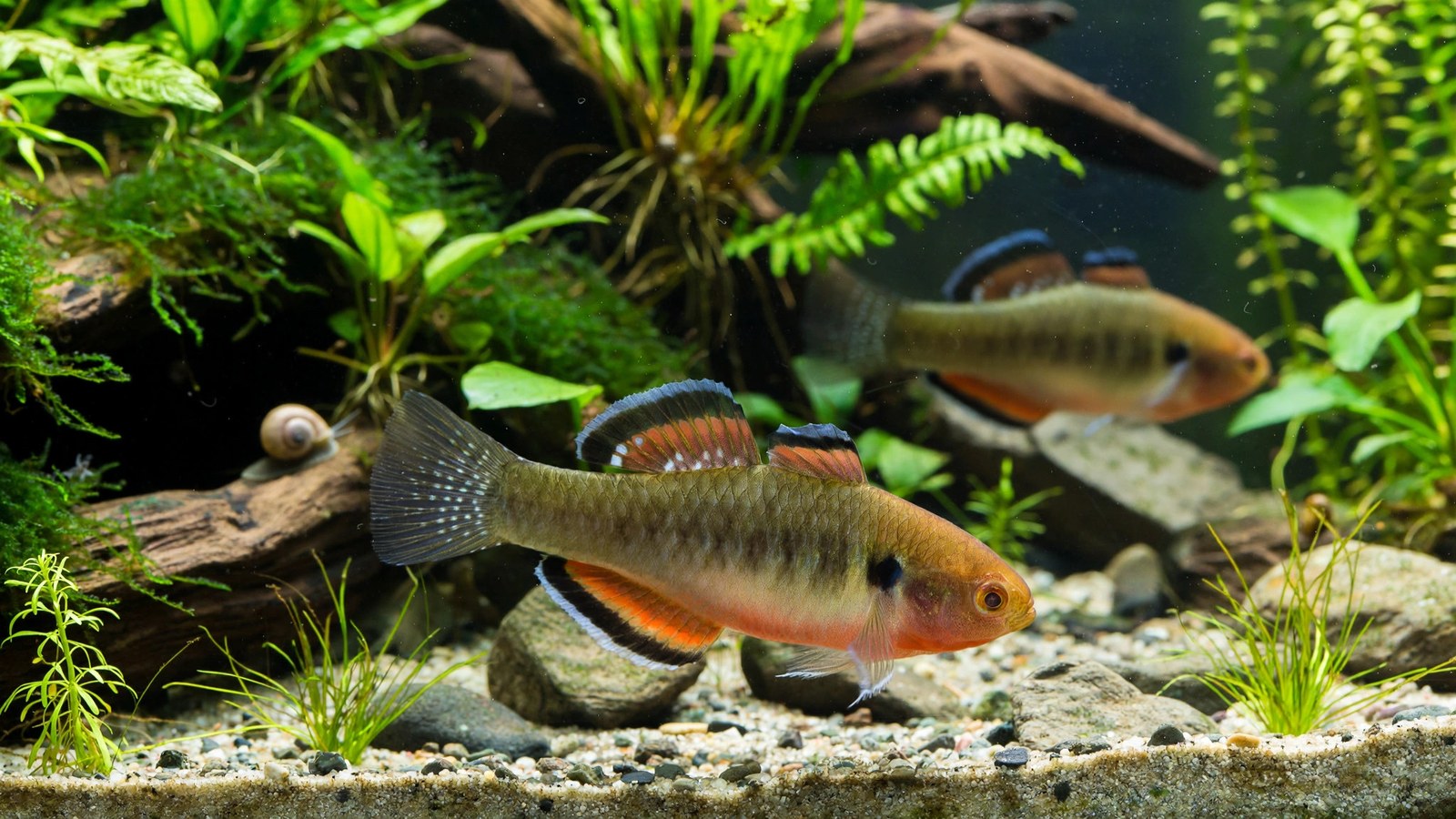
Most people buy an empire gudgeon for the male's breeding color — that burnt-orange flush with red-rimmed fins — and then never see it. The fish fades to drab tan, sulks behind the filter, and the hobbyist assumes it was a dud. It wasn't. Hypseleotris compressa is a territorial sleeper goby, and without a territory to hold, a male has no reason to color up. Give him one and he becomes the centerpiece of your whole scape. This guide shows how to hard-scape a planted tank so males claim ground, hold it, and show the breeding color you actually paid for. (One naming note: empire goby is the same fish — the two names are used interchangeably in the trade.)
Why the Empire Gudgeon Turns a Planted Tank Into a Territory Map
In the wild, empire gudgeons live in the still, vegetated margins of Australian and New Guinean rivers, where every male worth his color defends a patch of gravel or a rock crevice. Coloration is not decoration — it is a signpost that says "this cave is taken." Remove the caves and the visual boundaries, and you remove the whole behavioral script. That is why a male in a bare tank looks like a duller species than the same male in a well-structured one.
Instead of planting first and hoping the fish settle, build the territory map first, then plant around it. Get the hardscape right and males do the rest: they pick a cave, sweep the sand at its mouth, flare at rivals across a rock boundary, and flush orange-red within days. Pair this fish-first thinking with a solid fish-first guide to selecting aquarium plants so the planting supports the behavior instead of fighting it.
The Territory Scape: Hardscaping That Lets Males Hold Ground
A territory estate has three parts: a defensible entrance, a visible display stage, and a broken sight-line to the next male. Build two or three of these across the tank and you have a working gudgeon neighborhood.
Caves that read as real estate
Empire gudgeons spawn and shelter under flat ledges — rocks and bark in nature. Replicate it with slate or flat river rock on 2–3 cm risers, leaving an entrance gap of about 3–4 cm. One cave per male, minimum; a 60 cm tank fits two. Position each against a different back-corner or rock cluster so no male can see straight into a rival's doorway from his own.
Sight-line breaks every 20–25 cm
Males display across open water, and uninterrupted sight-lines turn displays into chases. Stand a tall rock, a chunk of driftwood, or a dense plant cluster between territories so each male's claimed patch is visually private. This does more for color than any food or supplement: a male who holds his boundary cheaply spends energy on display, not defense.
Plants That Shape Territories Without Stealing the Show
Choose species that anchor the hardscape rather than carpeting over it — you want open sand in front of each cave, not a lawn that fills the display stage.
| Plant role | Examples | Placement |
|---|---|---|
| Sight-line breakers | Anubias on rock, tall Cryptocoryne | Between cave estates, midground |
| Overhead cover | floating plants like frogbit | Surface above one territory |
| Backdrop fill | Vallisneria, stem plants | Rear glass, out of the way |
| Avoid | Thick foreground carpets | Keep cave aprons open sand |
A light cover of floating plants over part of the tank is useful: wild empire gudgeons live under overhanging vegetation, and dappled shade makes bottom fish bolder. Keep a clear column of open water in front of the caves so males can see — and be seen by — the dither fish above them.
Stocking the Neighborhood: Males, Females, and Peaceful Dithers
The classic working formula for a 20-gallon territory scape: two males, three to four females, and a school of calm mid-water fish. The dither school matters — a settled school signals "no predators here," and bolder gudgeons are more territorial gudgeons. Small tetras are ideal: species like penguin tetras or red neon blue-eyes swim the upper water, ignore the caves, and add motion that makes the gudgeons' ground game more deliberate.
Keep parameters steady: pH 6.8–8.0, moderate hardness, and stable planted-tank parameters from week to week. Empire gudgeons are adaptable, but males in soft, acidic, unstable water rarely color to their potential — a limestone chip or two in the hardscape helps buffer pH into the alkaline-leaning range this species prefers. Avoid nippy tank mates, and skip shrimp: adult gudgeons treat cherry shrimp as snacks.
Feeding and Conditioning for Peak Breeding Color
Color is built from protein, and empire gudgeons are ambush carnivores that barely register flakes. Feed like it matters: frozen bloodworm, frozen brine shrimp, and live daphnia or grindal worms as staples, with a high-quality sinking pellet only as backup. Feed small amounts twice daily; well-fed males station themselves at cave entrances — the confident, visible behavior you want.
Conditioning follows the same logic: males in breeding trim clean the cave ceiling and defend a tighter radius; females swell slightly and warm in tone. Eggs are laid on the cave ceiling and guarded by the male — but keep expectations honest: empire gudgeon larvae are minute and need brackish water to develop, so home-tank rearing almost never succeeds. Most keepers simply enjoy the spawning behavior itself; a serious rearing attempt needs a dedicated brackish larval setup starting with green water, not this planted display tank. The Seriously Fish profile of Hypseleotris compressa documents the breeding behavior in detail, and FishBase's species summary confirms the wild habitat this scape imitates.
Frequently Asked Questions
Is an empire goby the same fish as an empire gudgeon?
Yes. "Empire goby" and "empire gudgeon" are both trade names for Hypseleotris compressa, an Australian sleeper goby in the family Eleotridae. Neither name is a separate species, so care, territory, and breeding guidance applies identically regardless of which label your shop uses.
How many empire gudgeons can I keep in a 20-gallon planted tank?
Two males and three to four females is the sweet spot, each male with his own cave estate. That gives you two display territories without the chronic chasing a third male brings in a 60 cm footprint. Add a school of eight to ten small peaceful tetras as dithers.
Why has my male empire gudgeon lost its color?
Color loss almost always means no defensible territory. Without a cave to hold and broken sight-lines to neighbors, males have no behavioral reason to display. Add proper cave estates, space them out of sight of each other, and switch to meaty frozen foods — color usually returns within one to two weeks.
Will empire gudgeons eat cherry shrimp?
Almost certainly, yes. Adults are ambush predators and treat shrimp as food. Amano shrimp sometimes survive because of their size, but even they are at risk during molts. If shrimp matter to your scape, choose a different bottom dweller — gudgeons and shrimp colonies do not mix.
Do empire gudgeons need a heater in a planted tank?
In most homes, yes. They thrive at 22–28 °C and breed most readily around 24–26 °C. Room-temperature tanks that swing below 20 °C in winter stress them and suppress both color and appetite. A standard adjustable heater set to 24 °C covers it.
Done right, an empire gudgeon tank is one of the few planted setups where the fish genuinely use the hardscape — patrolling boundaries, flaring on display stages, guarding caves. Build the territory map first, plant around it, feed like a carnivore keeper, and the color you bought the fish for finally shows up. If your bottom fish prefer algae over ambush, a Chinese algae eater planted tank takes the same hardscape-first approach in a different direction.