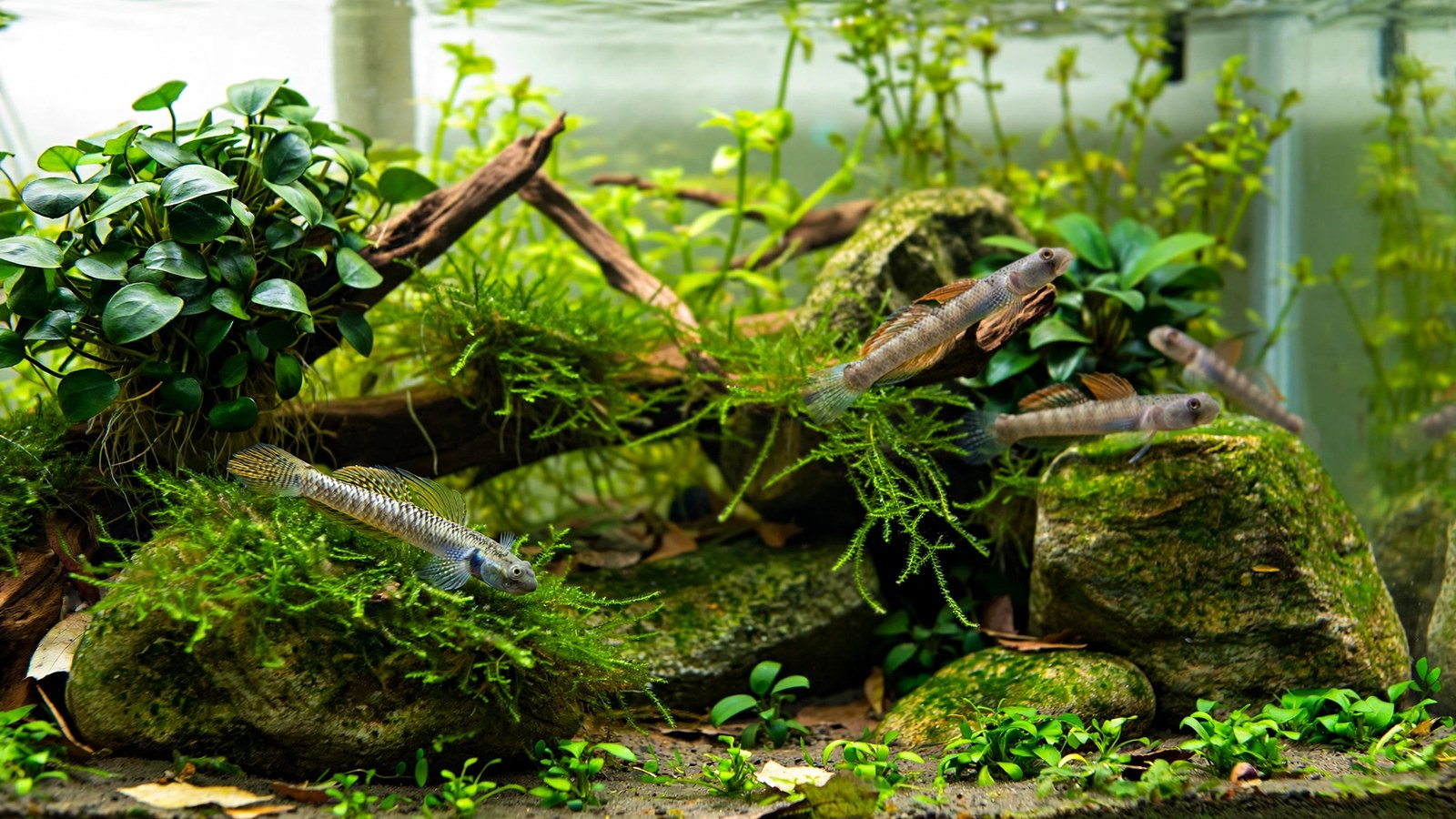
The worst mistake with Stiphodon gobies costs nothing: adding them to a beautiful, brand-new tank. Within two weeks these algae grazers are starving — not through any fault of yours, but because their food didn't exist yet. A stiphodon goby planted tank is a biofilm farm that happens to look like an aquascape; here's how to build one that keeps them fed, healthy, and colorful.
Why a Stiphodon Goby Planted Tank Is Different
In the wild, Stiphodon gobies live in shallow, fast-flowing streams across Southeast Asia and the Pacific islands, suctioned to rocks and scraping off aufwuchs — a living layer of diatoms, soft algae, bacteria, and tiny organisms. Their downturned mouths are precision tools for this job.
That sets two rules. First, the tank must be growing food before the fish arrive — cycled isn't enough; it must be mature. Second, hardscape matters more than plants: broad, smooth, sunlit surfaces are the pantry; the planting is shelter and stage. The reward is a fish unlike anything else in the nano world — settled males of Stiphodon ornatus and S. semoni glow electric blue and red and graze in plain view all day. The logic will feel familiar if you've run a hillstream loach planted tank, built on the same principles.
Hardscape: Smooth Rocks Are Non-Negotiable
Build the rock layout first, plants second. Choose smooth, rounded river rocks — stream-bed style — in fist-sized pieces plus a few larger feature stones. Smoothness matters twice: biofilm colonizes it readily, and sharp-edged stone like jagged lava rock abrades the gobies' mouths and soft bellies. Buy more than you think you need; buried portions don't count as pasture.
Arrange the rocks in low clusters with gaps and overhangs, not one tall pile. Each male claims a few stones, so broken sightlines let a rival or a female duck out of view instead of being chased across the tank. Leave broad upper faces exposed to light — shaded rock grows far less biofilm. Use fine sand or small smooth gravel; avoid coarse sharp gravel, since Stiphodon rest and dig slightly on the bottom.
Plant around the rocks: moss in shaded crevices, Anubias and Bucephalandra tied to rock sides, stem plants at the back. For species that handle moderate flow, see our guide to aquarium plants that thrive alongside fish.
Water: Clean, Cool, Oxygen-Rich
Think stream, not pond. A small powerhead or adjustable filter outlet rippling the surface gives the gentle current they evolved for and keeps oxygen high — essential for a genus that breathes hard while grazing. Aim for 22–25°C; long stretches above 28°C stress them visibly.
| Parameter | Target | Notes |
|---|---|---|
| Tank size | ≥ 10 gallons (40 L) | One male's territory fits; larger is more stable |
| Temperature | 22–26°C | Cooler than a typical community tank |
| pH | 6.5–7.5 | Stable matters more than exact |
| GH / KH | GH 4–12, some KH | Avoid extremes; wild streams vary |
| Ammonia / nitrite | 0 ppm, always | Grazers are sensitive to nitrogen waste |
| Nitrate | < 20 ppm | 30% weekly water changes keep it there |
| Flow | Moderate | Surface ripple + oxygen, not a washing machine |
Consistency beats perfection. These fish adapt to a range of pH and hardness but don't forgive ammonia spikes or swinging temperatures — another reason a months-old tank with stable planted tank water parameters is the right home.
Feeding: Grazing First, Wafers Second
In a mature tank, your gobies spend the day working the rocks. Your job is to supplement, not replace, that grazing: a small piece of algae wafer or spirulina-based sinking food 3–4 times a week, ideally after lights-out so it softens on the rocks, plus blanched zucchini or cucumber slices overnight. Pick a wafer with spirulina — not fish meal — as the first ingredient.
Watch their bellies. Slightly rounded means the tank's biofilm is carrying them; pinched and sunken means they're starving even with food offered. Starving Stiphodon often ignore wafers entirely: they evolved to scrape, not chase falling food. The same mature surfaces that feed shrimp colonies feed your gobies, so they pair beautifully with biofilm-focused shrimp setups.
One honest limit: Stiphodon crop soft film algae and diatoms beautifully but won't clear an established outbreak of tough algae. If your rocks already wear a black beard, read our black beard algae removal guide and fix the cause first — then let the gobies keep the clean slate clean.
Tank Mates: Peaceful, and Not Competing Grazers
Stiphodon ignore other fish entirely — their aggression is reserved for rival males. Ideal tank mates are small, peaceful mid-water fish that leave the rocks alone: ember tetras, chili rasboras, celestial pearl danios, and other nano species that share the same cooler water. Cherry shrimp and nerite snails coexist beautifully, working different surfaces.
Avoid boisterous or nippy fish, and avoid direct competitors for the grazing niche: a tank already patrolled by hillstream loaches or a bristlenose pleco has less biofilm to go around. If you want multiple grazers, go bigger and add more rock. See our roundup of the best algae eaters for planted tanks for the full picture.
Stocking: one male with two or three females per 10 gallons. Males flare and chase but rarely injure; females are drab, peaceful, and spread a male's attention. Buy juveniles when possible — cheaper, quicker to adapt, and you'll often get a natural mix of sexes.
Frequently Asked Questions
Can I add Stiphodon gobies to a newly cycled tank?
No — this is the most common way people lose them. A cycled tank has bacteria but almost no aufwuchs, which is their actual food. Wait 3–4 months until rocks, glass, and wood show a visible greenish-brown film. Supplement with pre-grown rocks from a sunny bucket of tank water to speed things up, but don't shortcut the wait.
Will Stiphodon gobies eat my aquarium plants?
No. Their mouths are built for scraping flat surfaces, and they show zero interest in leaves — soft, delicate, or otherwise. They graze the biofilm off Anubias leaves and moss without damaging them, which keeps your plants cleaner. They are among the safest fish you can put in a planted tank.
How many Stiphodon gobies can I keep in a 10-gallon tank?
One male with two to three females is ideal. Males are territorial and will spar over rock perches; a second male in 10 gallons means constant chasing. In a 20-gallon or larger with well-separated rock clusters and broken sightlines, two males can work.
Do Stiphodon gobies eat black beard algae?
Not really. They excel at soft film algae, diatoms, and biofilm, but mature black beard algae tufts are too tough for their scraping mouths. Think of them as maintenance crew, not a cure — clear any serious outbreak with proper treatment first, then let the gobies keep regrowth from taking hold.
Can Stiphodon gobies breed in a home aquarium?
Practically never. They are amphidromous: in the wild, larvae wash out to sea and juveniles migrate back upstream, a cycle no home tank can replicate. Virtually all Stiphodon in the trade are wild-caught, so buy from reputable sources and quarantine new arrivals like any wild fish.
Do they need a lid on the tank?
Yes, use a tight-fitting lid. Stiphodon are strong climbers — in the wild they scale waterfalls — and they will explore filter tubes, heater cords, and any gap at the waterline. Keep the waterline an inch below the rim and cover every opening; they're most likely to wander at night or after a water change.
The Bottom Line
A stiphodon goby planted tank succeeds or fails on patience: mature the tank, pile in smooth sunlit rocks, keep the water cool and clean. Get the biofilm right and the rest follows.