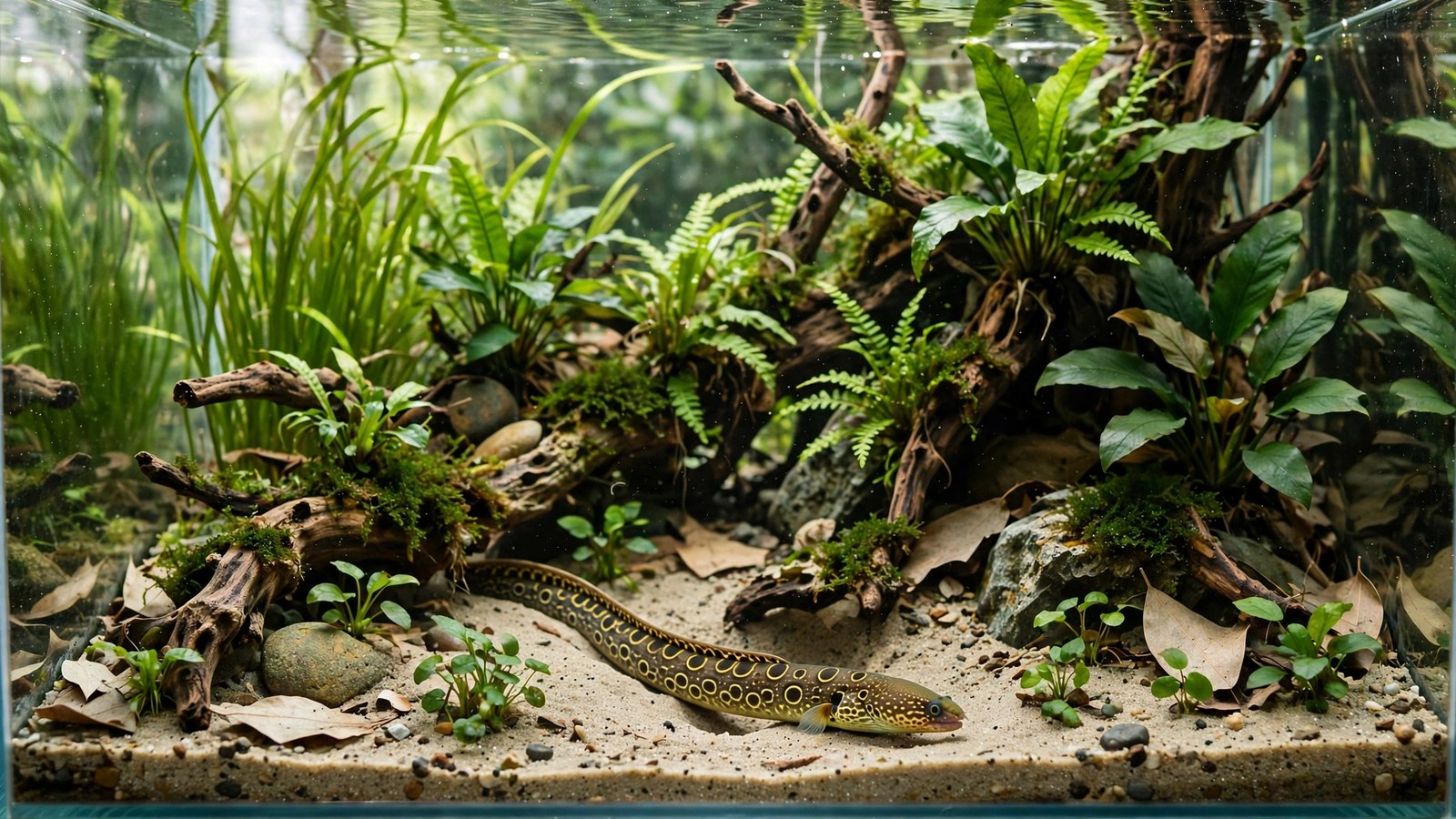
Watch a peacock spiny eel nose-dive into the sand and you will see why a peacock eel planted tank is designed from the substrate up, not from the plants down. Macrognathus siamensis is not a true eel at all — it is a slender, nocturnal burrower from slow-moving Southeast Asian waters that spends its days tucked into the bed and its nights snuffling across it. This guide covers sand depth, burrow-proof plant choices, nighttime feeding, and tank mates that will not become dinner.
Direct answer: Yes, a peacock spiny eel (Macrognathus siamensis) thrives in a planted tank with fine sand at least 4 inches deep and no delicate rooted plants. Adults reach 10–12 inches, burrow nose-first nightly, and uproot anything weakly anchored — so grow Anubias and Java fern tied to rock and wood. Gravel can injure the eel's skin, and a tight-fitting lid is mandatory: peacock eels squeeze through astonishingly small gaps.
Peacock Eel Planted Tank Equipment: Sand, Hides, and a Lid That Actually Seals
Sand comes first: a bed of fine, inert aquarium sand at least 4 inches deep lets the eel burrow without scraping its skin. This comparison of substrate options compared for planted tanks covers which aquarium sands stay soft and plant-friendly. Coarse or sharp gravel is genuinely dangerous — it can injure the eel's nearly scaleless skin and lodge in its mouth.
Caves, driftwood arches, and short lengths of dark PVC pipe (ends just peeking out of the sand) give the eel a daytime retreat. Settle hardscape on the tank floor before the final sand layer so nightly digging cannot undermine it. Keep lighting low and broken up with floating plants — like any kuhli loach setup for nocturnal bottom dwellers, this tank reads calmer with dim light, surface shade, and cover. Bright, bare tanks keep the eel buried permanently.
Finally, the lid — where more peacock eels are lost than anywhere else, probing every seam after lights-out and wriggling through gaps that look impossible. Use a tight-fitting lid and sponge-block every equipment cutout. A 35-gallon rectangular tank is the honest floor for one adult — enough footprint for a 10–12-inch burrower.
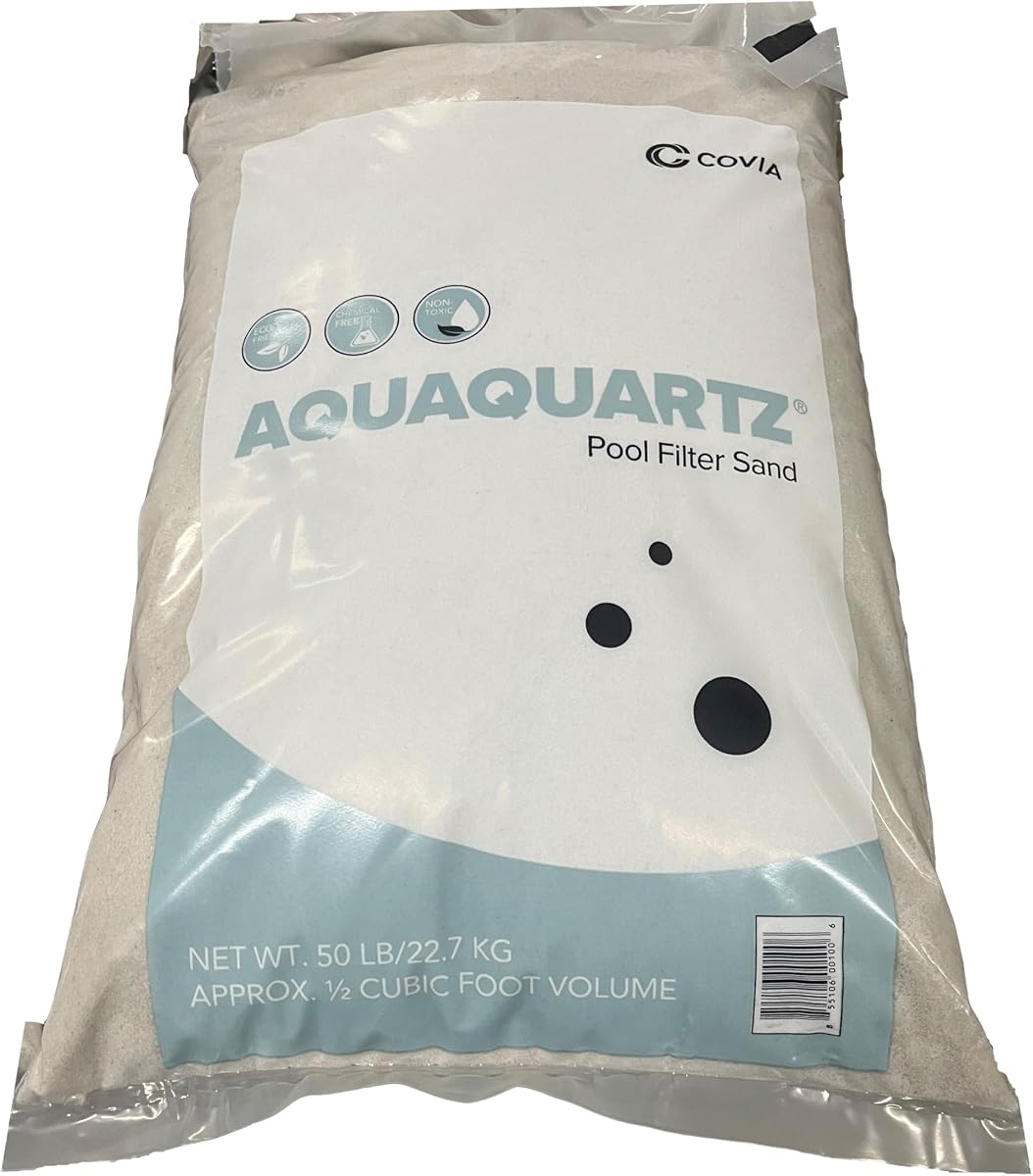
Covia AquaQuartz Pool Filter Sand
Check Price on Amazon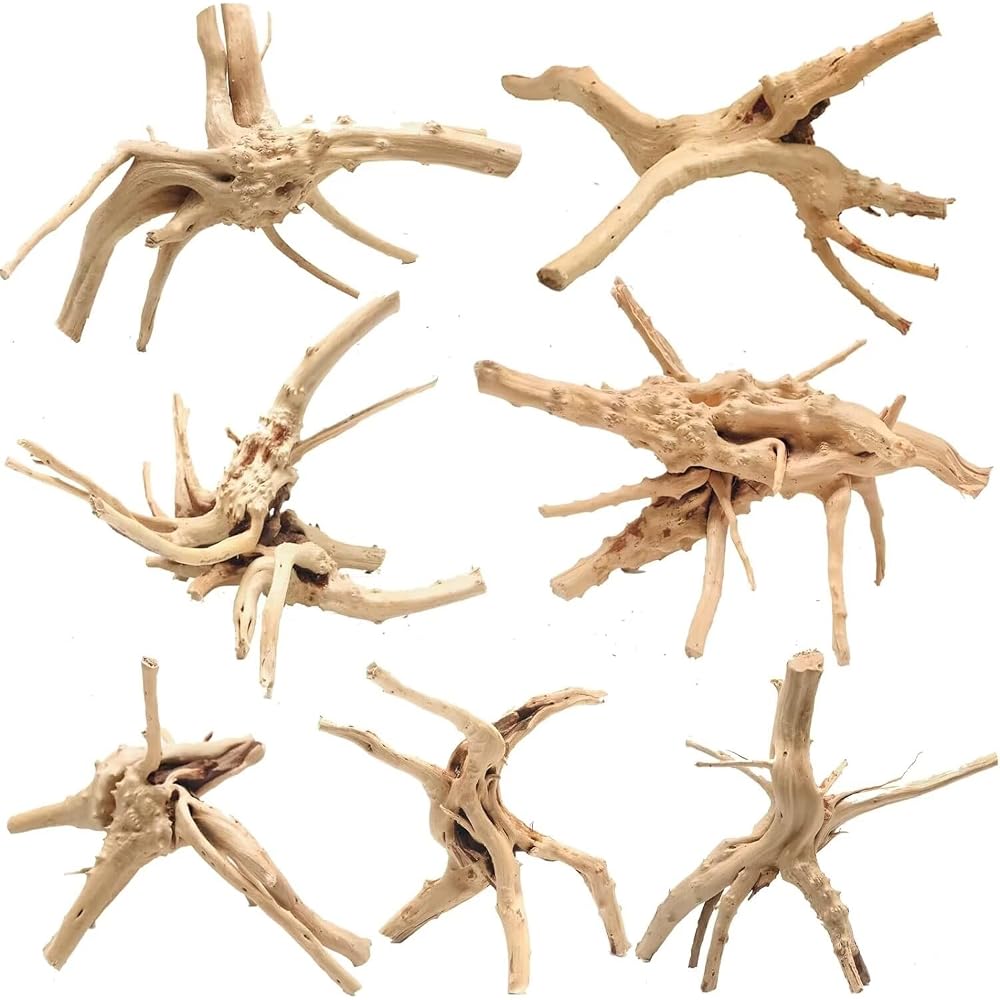 ★4.2
Hamiledyi Natural Spider Wood Driftwood
Check Price on Amazon ★4.2Why Peacock Eels Dig (and What It Does to Your Plants)
Peacock spiny eels push nose-first into soft sediment to rest by day and forage by night, and that instinct does not switch off in a glass box. Expect yours to vanish into the bed within days, resurfacing at dusk with only its snout showing. That is normal, not a stress signal.
The honest trade-off: a burrowing eel is a rototiller. Delicate stems, fresh carpets, and shallow-rooted plants will be dislodged repeatedly — no trick makes a stem garden eel-proof. Build around the animal: if the eel can shove it, the eel will shove it. Anchor your scape to hardscape, not to the bed.
| Plant | How to mount it | Burrow-proof rating |
|---|---|---|
| Anubias barteri | Tied or glued to driftwood and rock | 5/5 |
| Java fern | Tied to rock, wood, or coconut shell | 5/5 |
| Bucephalandra | Wedge rhizomes into hardscape crevices | 5/5 |
| Cryptocoryne wendtii | Deep-rooted in established beds, away from burrow lanes | 3/5 |
| Amazon sword | In a buried pot with root tabs, ringed by heavy stone | 3/5 |
| Vallisneria, stem plants, carpet species | Not recommended — repeated uprooting | 1/5 |
This epiphyte-first approach is the best use of the classic fish-first plant guide — species picked for how they tolerate fish behavior. Floating plants do double duty: frogbit and water lettuce dim the light and absorb nitrates. Feed potted plants with root tabs pushed under them, keeping the open sand undisturbed.
Tank Size, Water, and the Mature-Tank Rule
One adult needs a 35-gallon rectangular tank minimum — footprint matters more than height, because the fish patrols length. The tank must be fully mature before the eel arrives: these fish are sensitive to ammonia and nitrite swings. Keep 75–82 °F, pH 6.5–7.5, gentle-to-moderate flow, and cover filter intake slits so a curious eel cannot explore them at night.
Change 25–30% of the water weekly and vacuum only the sand surface — deep siphoning collapses the burrow structure. Night-shift tank mates follow the same logic as other nocturnal oddball setups, such as a black ghost knifefish planted tank: low light, rich cover, calm water.
Feeding a Nocturnal Hunter
Peacock spiny eels are pure carnivores, and their timetable runs the tank: feed after the lights go down. Frozen bloodworms, blackworms, brine shrimp, mysis, and chopped earthworms are all taken eagerly. Many tank-raised specimens learn to accept sinking carnivore pellets — a bonus, not a plan.
A new eel usually refuses food for a week or two; this is ordinary settling-in. Offer bloodworms on tongs after lights-out each evening; most eels start emerging within 10–14 days. Keep faster day-shift fish away from the dish — hungry tetras strip it before the eel wakes. The species profile for Macrognathus siamensis documents the eel's native range and identifying features.
Tank Mates: Peaceful Fish, Not Bite-Size Ones
Peacock spiny eels are among the most peaceful oddballs you can keep — they ignore anything they cannot swallow. The trouble is the definition of "cannot swallow": neon tetras, guppies, small rasboras, and cherry shrimp are food, not tank mates. Stock congo tetras, larger rainbowfish, gouramis, corydoras, and angelfish. Night-shift loaches, such as those in a zebra loach planted tank, coexist comfortably in the same bottom territory.
Avoid nippy species — fin-nipping barbs and large cichlids stress it into permanent hiding. Multiple peacock eels can share a large tank if each animal has its own hide and all are similarly sized.
Frequently Asked Questions
Can a peacock eel live in a planted tank?
Yes — just plant for the digging. Use fine sand at least 4 inches deep and attach Anubias, Java fern, and Bucephalandra to hardscape rather than rooting plants in the bed. Delicate stems and carpets will be uprooted, so skip them. Cover reduces stress and dim light keeps the eel active at dusk.
How deep should the sand be for a peacock eel?
At least 4 inches across most of the footprint. A 10–12-inch adult burrows nose-first and needs real depth to settle fully; shallow sand keeps it half-exposed and stressed. Use fine, soft aquarium sand only — gravel and sharp substrates can injure its nearly scaleless skin.
Will my peacock eel eat my other fish?
It will eat anything that fits in its mouth — small tetras, guppies, chili rasboras, and all shrimp are at risk. This is instinct, not aggression. Keep it with peaceful community fish clearly too large to swallow — congo tetras, rainbowfish, gouramis, corydoras, angelfish.
Does a peacock eel tank really need a lid?
Absolutely — it is the single most important safety item. Peacock spiny eels are famous escape artists that probe every seam after dark and squeeze through gaps that look impossibly small. Use a tight-fitting lid and block every equipment cutout with sponge.
Why won't my new peacock eel eat?
New eels commonly refuse food for one to two weeks while settling in — normal, not a disease sign. Offer frozen bloodworms or blackworms on tongs after lights-out, in the same spot. Most begin emerging within 10–14 days. Live blackworms can trigger reluctant feeders.
The Calm, Burrowable Tank
Deep sand, plants anchored to stone and wood, dim water, and a lid with no escape routes. Give a burrowing oddball the substrate it evolved for, and it repays you with one of the hobby's most engaging night-time personalities.