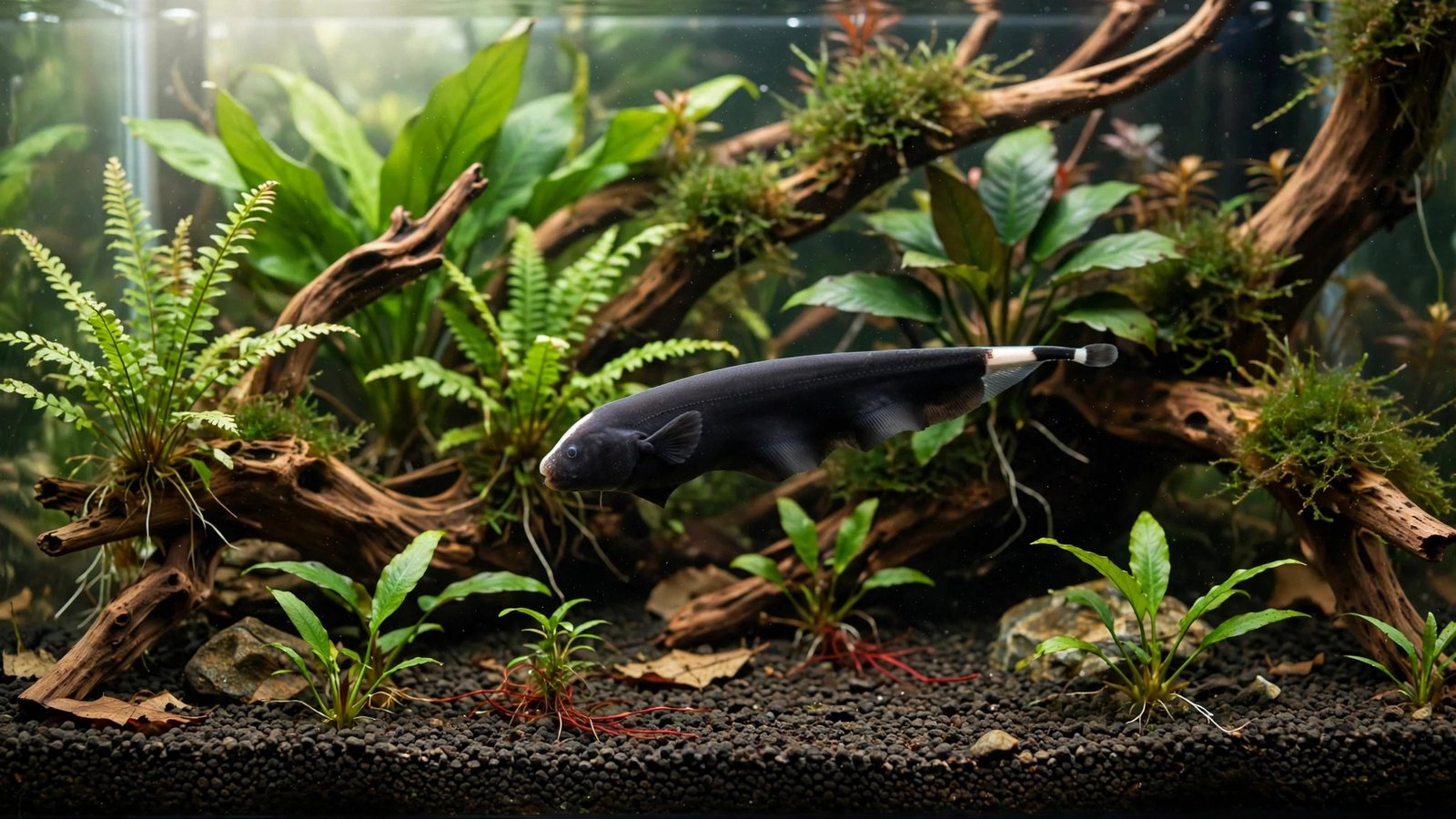
Most black ghost knifefish die long before their tenth birthday — not from disease, but from a tank that fit them at 8 centimeters and strangled them at 50. A black ghost knifefish planted tank is a ten-to-fifteen-year commitment to one of the hobby's most rewarding nocturnal predators. This guide gives you the tank size, plant strategy, and tank-mate rules that let Apteronotus albifrons thrive in a dim, lush aquarium — without it ever eating your schoolers.
Can a black ghost knifefish live in a planted tank? Yes — it is 100% plant-safe and will not tear, dig, or eat live plants; dim, cover-rich water is its natural preference. One adult reaches about 50 cm (20 in) and needs a 100+ gallon tank at 23–28°C with pristine water and a soft sandy bottom. The real constraint is tank mates: it eats anything under ~6 inches, including neon tetras — every companion must be too large to be a food item.
How to set up a black ghost knifefish planted tank that works at full size
Start from a low-tech planted tank setup — dim light, undemanding plants, stable water — then scale everything to a 50 cm predator. Its two non-negotiables are space and shelter: open lanes for backward gliding, plus thick cover it can vanish into by day.
| Life stage | Size | Minimum tank | Notes |
|---|---|---|---|
| Juvenile (store size) | ~8 cm | 55 gal | Absolute minimum; temporary |
| Sub-adult | 20–30 cm | 100 gal | Needs lanes for turning and reverse swimming |
| Adult | ~50 cm / 20 in | 100–125 gal | A 6-foot tank is the realistic long-term home |
| Group of 4+ | adults | 180+ gal | Aggression spreads instead of concentrating |
Daytime shelter turns a surviving knifefish into a confident one. Use caves, driftwood tunnels, and "ghost tubes" — clear acrylic or PVC pipes it rests in while you still watch it. Floating plants diffuse overhead light and make the fish bolder; without shade it stays pinned in its cave all day.
Water, Flow, and Lighting for a Nocturnal Navigator
Black ghost knifefish are effectively scaleless, so water quality must be flawless: zero ammonia and nitrite, low nitrates, 30–50% weekly changes. Keep 23–28°C and pH 6.5–7.5 with gentle-to-moderate flow and oversized canister filtration — a heavy carnivore pollutes far more than community fish.
Choose soft, fine sand over coarse gravel, since this fish rests on the bottom by day — the best substrate for planted tanks comparison covers sand options for roots and bottom-resting fish alike. Dim, warm, soft-water setups suit it far better than bright scapes, much like a planted discus tank setup. A dimmer with a blue moonlight channel pays for itself on the nights you watch it hunt.
Plants a Ghost Knife Cannot Ruin
Here is the good news in full: Apteronotus albifrons is one of the few large predatory fish you can trust completely with plants. It never tears leaves, never digs roots, never grazes. For fish-first plant selection, see the aquarium plants for fish tanks guide.
| Plant | Role | Why it works |
|---|---|---|
| Java fern, Anubias | Epiphyte cover | Tough leaves, attach to driftwood near hides |
| Vallisneria | Background curtain | Tall ribbons give vertical cover |
| Amazon sword | Midground anchor | Broad leaves create shaded alcoves |
| Cryptocoryne | Low mounds | Tolerates dim light |
| Frogbit, salvinia | Floating canopy | Diffuses light — the biggest confidence booster |
Plant the perimeter and leave the middle open — a large night swimmer needs unobstructed lanes, the same periphery-planting logic used in a clown loach planted tank. The Aquarium Wiki's Apteronotus albifrons profile agrees: a well-filtered planted tank with sand, dim light, and large caves is the target.
Tank Mates: The Six-Inch Rule
This is where knifefish setups fail most often. That deceptively small mouth opens wider than it looks, and anything it can fit in at night disappears. Neon tetras are explicitly unsafe — build a planted neon tetra tank as its own project and keep the knifefish away from it. The keeper's rule: tank mates must exceed about 6 inches, so the adult knife never classifies them as food.
Good companions are peaceful mid-to-large fish that will not fin-nip or bully a timid nocturnal predator: angelfish, discus, larger gouramis, medium peaceful cichlids. A planted angelfish tank setup is a natural template — angels own the day shift while the knife works the night.
Never house two knifefish together: pairs dominate each other, likely because their electric fields interfere in confined space. Keep one, or four or more where aggression diffuses — and never mix it with another weakly-electric species.
Feeding After Lights Out
This is a carnivore with strong opinions. In the wild it hunts insect larvae and small worms; in your tank it wants live or frozen bloodworms, tubifex, blackworms, and chopped earthworms — and it will almost always reject dry flake. Feed once daily after lights out; juveniles may need twice-daily feedings until settled.
Drop food near the hide entrance under dim room light, then walk away. Nervous newcomers often ignore food in a lit room but feed confidently within a week of the after-dark routine. AquariumDomain's black ghost knifefish care guide lists bloodworms, tubifex, earthworms, krill, and prawns as staples, and confirms the 6-inch tank-mate rule.
Frequently Asked Questions
What size tank does a black ghost knifefish need?
A juvenile can start in 55 gallons, but that is temporary — an adult reaches ~50 cm (20 in) and needs 100+ gallons, realistically a 6-foot tank. A group of four or more needs 180+ gallons so aggression spreads instead of concentrating. Plan the adult tank before you buy the juvenile.
Will a black ghost knifefish eat neon tetras?
Yes. The knifefish is a nocturnal predator with a deceptively large mouth, and anything under about 6 inches is a potential food item once it is grown. Keepers are explicit: tank mates must be too large to be eaten. Give neon tetras their own setup instead of using them as dither fish.
Is a black ghost knifefish safe with live plants?
Completely. It will not tear leaves, dig roots, or eat plants — 100% plant-safe, which is rare among large predators. It actually prefers dense planting: dim cover lowers its stress and makes it bolder at night. Java fern, Anubias, and floating plants for shade are the ideal combination.
Can I keep two black ghost knifefish together?
No — pairs consistently fail, with two fish dominating each other, likely because their electric fields interfere in confined space. Keep one specimen, or commit to four or more in 180+ gallons where aggression diffuses. Never mix it with another weakly-electric species either.
Why won't my black ghost knifefish eat?
New arrivals are often half-starved from shop tanks and too stressed to feed in daylight. Offer frozen bloodworms or live blackworms after lights out, near the hide entrance under dim room light — then leave. It rejects dry flake almost every time; most settled fish feed confidently within a week.
A Ghost Worth Keeping
A black ghost knifefish is a decade-plus commitment, not an impulse buy — but few large fish reward a planted tank instead of wrecking it. Give it 100+ gallons, dim light, soft sand, heavy planting, and tank mates it cannot swallow. Build for the adult on day one, feed it after dark, and the ghost takes care of the rest.