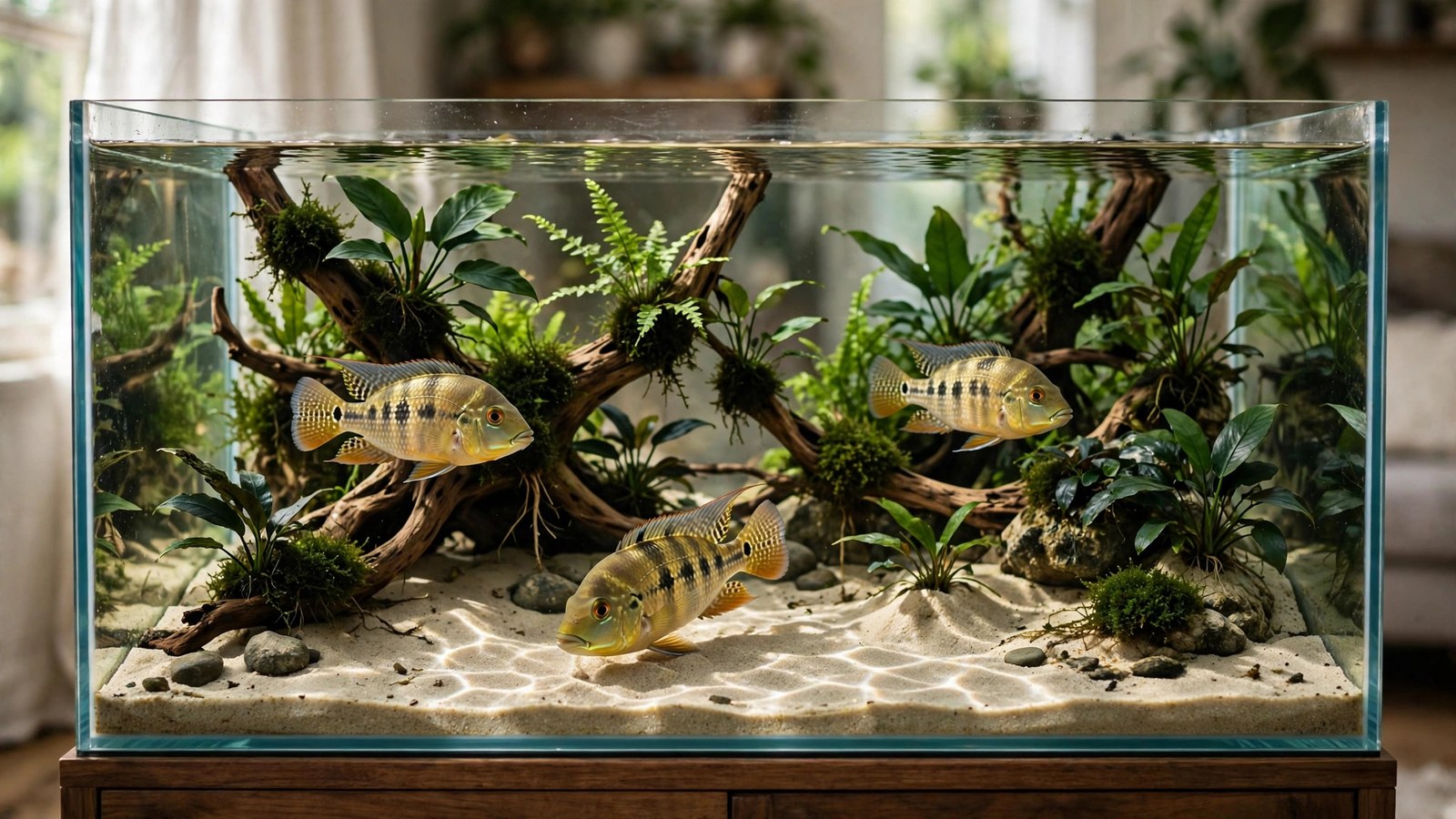
Most planted-tank guides pretend eartheaters will politely leave your carpet alone. They won't. An adult Geophagus takes several mouthfuls of substrate per minute, flinging sand everywhere — and any rooted plant that can't survive excavation will be floating by morning. But a geophagus planted tank is absolutely possible if you design like the fish: sand first, rocks that can't topple, plants that don't need substrate or live in armored pots.
Short answer: Yes — but only with a dig-proof strategy. Use fine soft sand as the sole substrate (coarse gravel injures their gills and mouths), grow epiphytes like Anubias and Java fern tied to hardscape, plant everything else in pots anchored under heavy rocks, and place all rocks before adding sand so digging can never topple them. Filtration should turn the tank over roughly five times per hour.
Building Your Geophagus Planted Tank: The Sand-First Blueprint
The classic aquascaping order — substrate, then hardscape, then planting — is backwards here. Start with your rock and driftwood layout on bare glass, every structure resting on solid glass at two or more stable contact points. Then pour the sand around it. This is the single most important safety rule in the guide: Geophagus excavate constantly, and a rock resting on sand can be undercut and shift — or worse.
Use 2–3 inches of sand, sloped deeper toward the back. Your fish will re-grade it within a week — let them.
Why sand quality is non-negotiable
Geophagus feed by taking mouthfuls of substrate, sifting out food, and expelling the rest through their mouth and gill openings. Sharp or coarse gravel abrades gill filaments and mouths with every pass, and swallowed grit can cause internal injury. Choose fine, soft, inert aquarium sand with no sharp edges. If you're comparing options, the best substrate for planted tanks guide covers seven choices and which budgets they fit; for this tank, pick the softest sand option and ignore everything else.
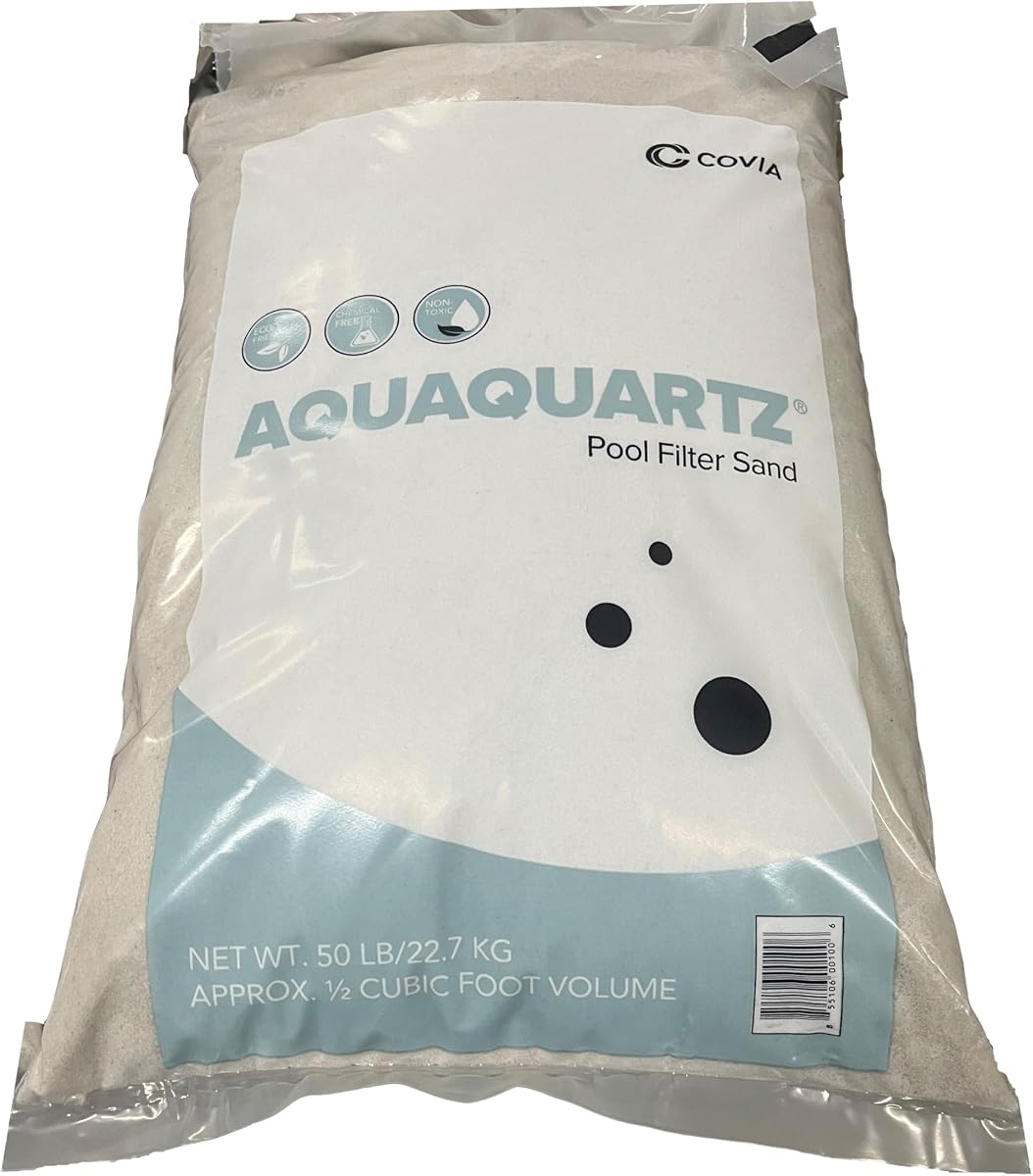
Covia AquaQuartz Pool Filter Sand
Check Price on AmazonDig-Proof Plants: What Actually Survives
Here's the honest trade: Geophagus won't deliberately eat your plants, but their sifting uproots anything loosely planted. That rules out fine carpets and delicate stems in sand. The two strategies that work: epiphytes that never touch the substrate, and rooted plants in pots.
Your safest list is short and proven: Anubias, Java fern, Bucephalandra, and Bolbitis — all tied or glued to rock and wood. For rooted plants, use aquarium soil in sturdy pots buried in the sand, each rim wedged under a heavy rock so it can't be nosed aside. Swords and Cryptocoryne work well this way; cap the pot with tank sand. Repot every 8–12 months as soil exhausts, and dose liquid fertilizer for the epiphytes, which feed from the water column.
For more tough species, see the best plants for cichlid tanks roundup of dig-proof picks.
Filtration and Water: Engineering for Messy Eaters
Sand-sifting clouds fine particles constantly, and cichlid appetites mean heavy feeding. Size filtration to turn the tank over roughly five times per hour — about 400 GPH of real canister output on a 75-gallon tank. Two smaller canisters in parallel also work: they spread intake and output positions and keep the tank running if one needs service. Fit pre-filter sponges on intakes; sifted sand migrating into impellers is the most common cause of premature canister death in these tanks.
Spread the output wide — Geophagus prefer gentle current — and change 30–40% of the water weekly, since heavy feeding plus sand means fast-rising nitrates.
Parameters follow the Amazon brief: 76–82°F, pH 5.0–7.0, soft to moderately soft water. For a fish-first approach to pairing plants with the right community, the aquarium plants for fish tank guide puts fish welfare ahead of scape aesthetics.
Choosing and Stocking Your Eartheaters
Geophagus is a genus, not a species, and adult size ranges from about 6 to 10 inches. Stock to the adult fish, not the two-inch juveniles in the store tank. These are social cichlids — a group of five or six shows their best behavior, including the courtship digging that makes them so watchable.
| Species | Adult size | Min tank (group) | Notes |
|---|---|---|---|
| G. sveni | 8–10 in | 75+ gal | Peaceful; the classic large eartheater |
| G. altifrons | 8–9 in | 75+ gal | Calm; threadfin fin extensions |
| G. steindachneri | 6–7 in | 75 gal | Smaller and active |
| Red Head Tapajos | 6–8 in | 55+ gal (young group) | Popular trade form; upgrade as it grows |
| G. winemilleri | 7–9 in | 90+ gal | Best in groups of 5–8 |
Check the Seriously Fish species profile for Geophagus altifrons before buying — trade names in the eartheater world are famously unreliable, and your actual species matters for adult size and tank planning.
Good tank mates share three traits: similar size, similar water, and no fin-nipping. Severums, angelfish, Congo tetras, larger silver dollars, sturdy Corydoras, and plecos all work. Skip small tetras and shrimp — eartheaters will snack on them without malice. They dig more persistently than other planted-tank cichlids, so if you're weighing a different personality, an oscar planted tank or a gentler blue gourami planted tank setup has a lighter touch on the substrate.
Feeding and Daily Care
Feed sinking pellets or wafers as the staple, plus frozen bloodworms, brine shrimp, and mysis a few times a week. Scatter food across a wide area — it encourages natural sift-and-forage behavior and spreads the digging around instead of letting one pit reach the glass. One fast day per week keeps waste down.
Daily, glance at intake pre-filters and the sand line against the glass. Weekly, hover a siphon just above the sand to lift detritus, change 30–40% of the water, and check no plant pot has been nosed free. Monthly, rinse pre-filter sponges and check canister flow.
Frequently Asked Questions
Will Geophagus destroy all plants in a planted tank?
Not deliberately — they rarely eat plants — but constant sifting uproots anything loosely planted. The fix: epiphytes (Anubias, Java fern, Bucephalandra) tied to hardscape, plus rooted plants in pots wedged under heavy rocks. Fine carpets and delicate loose stems are the only real casualties.
Can I use gravel instead of sand for Geophagus?
No — this is the one non-negotiable. Geophagus sift substrate through their mouths and gill openings, and coarse or sharp gravel abrades gill filaments with every pass. Swallowed grit can also cause internal injury. Use fine, soft aquarium sand only, 2–3 inches deep.
What tank size does a group of Geophagus need?
Plan 75–125+ gallons depending on species. G. steindachneri suits a 75-gallon group; G. sveni or G. altifrons want 75–125 gallons, and G. winemilleri is best in 90+ gallons for five to eight fish. A 55-gallon can house a young Red Head Tapajos group temporarily, with an upgrade planned.
How much filtration does a Geophagus planted tank need?
Target roughly five times the tank volume per hour — about 400 GPH of real output on a 75-gallon tank. Large external canisters are ideal; two in parallel adds redundancy. Add pre-filter sponges to keep sand out of impellers, and change 30–40% of the water weekly.
What tank mates work with Geophagus in a planted tank?
Choose peaceful, similar-sized fish sharing warm, soft water: severums, angelfish, Congo tetras, larger silver dollars, sturdy Corydoras, and plecos. Avoid anything small enough to be eaten — small tetras and shrimp become snacks. A peacock eel planted tank offers a gentler sand-sifter alternative.
Do Geophagus need driftwood or caves?
Not strictly — they're open-water sifters, not cave dwellers — but hardscape anchors all your epiphyte plants and gives pairs a flat spawning surface. The golden rule: place all rocks on bare glass before adding sand so digging can never topple them.
The Payoff: A Tank That Moves
A geophagus planted tank will never be a frozen aquascape — and that's its charm. The sand shifts, the fish sift in synchrony, and the whole tank breathes with activity. Design for the digging instead of fighting it: sand first, everything anchored, roots potted — the eartheaters do the rest.