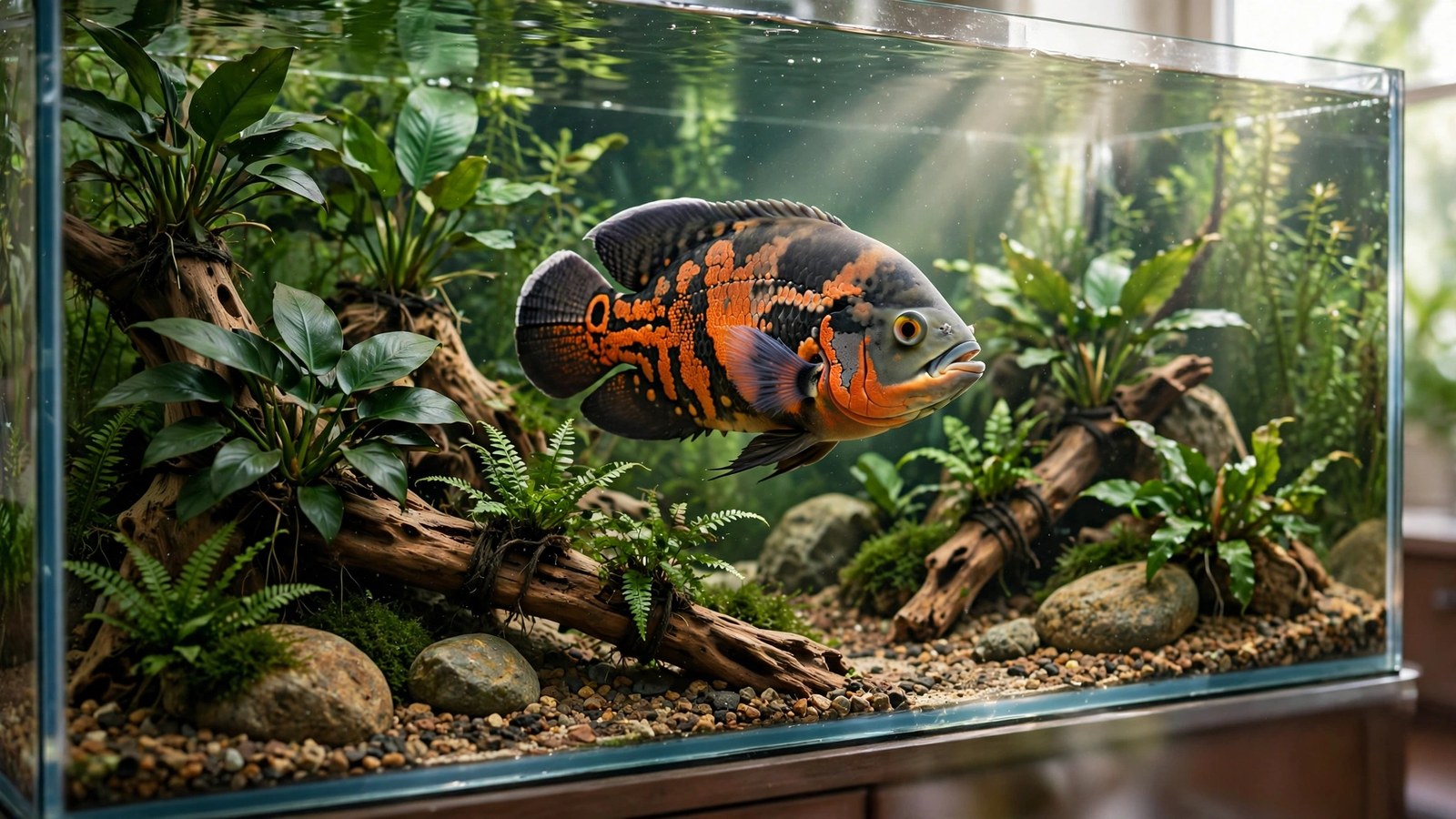
Most aquarists file the Oscar under "plants not allowed" — then watch one night of redecorating turn a carefully aquascaped 75-gallon into a cratered wasteland. An oscar fish planted tank is doable if you build it around the fish: heavy decor, root-proof planting methods, and species an Oscar can't easily destroy.
Yes, Oscars can live with live plants — but only dig-proof species planted the right way. Astronotus ocellatus grows past 12 inches and excavates constantly, so stem plants and carpets fail. Java fern and Anubias tied to driftwood, floating Salvinia natans, and deep-rooted Amazon swords survive, with a 75–80 gallon minimum tank, 24–28°C water, and heavy, stable hardscape that can't be toppled.
Can an Oscar Fish Planted Tank Actually Work?
It works if you think "Oscar tank that happens to contain plants," not "planted tank." None of the conventional aquascape survives a bored Astronotus ocellatus — what survives is a roster that's too tough, too well-anchored, or too inconvenient to destroy. Start with the best plants for cichlid tanks as your shortlist, then narrow to the dig-proof few below.
Don't plant where the Oscar digs — it excavates relentlessly, from spawning instinct, boredom, and plain temperament. The fixes are mechanical: attach epiphytes to heavy hardscape above the substrate line, use floating plants that can't be uprooted, and protect deep-rooted plants with pots, stone rings, or placement in corners the fish patrols least.
The Dig-Proof Plant Roster
These eight species earned their place through toughness, bitter taste, unchewable texture, or attachment methods that defeat digging.
Epiphytes tied to hardscape
Java fern, Anubias, Java moss, and Bolbitis heudelotii attach to driftwood or rock with thread or glue gel — nothing to dig up. Choose thick, heavy pieces a 30+ cm fish can't drag; roots grip the hardscape within weeks.
Floating plants
Salvinia natans is close to cheat-proof: it floats, tolerates 24–28°C water, and absorbs nitrates from the heavy bioload these messy eaters produce. Keep a feeding ring or airline-tubing corral so it doesn't drift into the filter intake; thinned weekly, a handful doubles fast and gives the shade big cichlids prefer.
Deep-rooted survivors
Amazon swords, Cryptocoryne, and Crinum thaianum hold their ground if you help them: plant in nursery pots sunk into the substrate, ring the crown with heavy river stones, or bury 2–3 inches deeper than normal. Crinum is the dark horse — fibrous, practically unchewable strap leaves on a deep-buried bulb. All three want heavy substrate for planted tanks, not fine powder that clouds every digging session.
| Plant | How to plant it | Why it survives | Difficulty |
|---|---|---|---|
| Java fern | Tie/glue to wood or rock | Nothing to dig up; bitter leaves | Easy |
| Anubias spp. | Tie/glue to hardscape | Leathery leaves, thick rhizome | Easy |
| Bolbitis heudelotii | Attach to wood in shaded spots | Tough slow-growing epiphyte | Moderate |
| Java moss | Tie to rock or mesh | Regrows if torn | Easy |
| Salvinia natans | Floats | Floats; absorbs nitrates | Easy |
| Amazon sword | Deep in pot or weighted bed | Massive roots, robust leaves | Easy |
| Cryptocoryne | Deep, ringed with stones | Hardy once established | Easy–moderate |
| Crinum thaianum | Bulb buried deep | Unchewable leaves, deep bulb | Moderate |
Setting Up: Heavy, Stable, Boring-Proof
A single Oscar needs 75–80 gallons minimum, and the layout should assume the fish outweighs the decor. Test every rock and branch by pressing it the way a startled Oscar would — if it shifts under your hand, it won't survive a 12-inch fish. Use large smooth river stones (2–4 inches) and one or two substantial driftwood pieces, and keep the scape open for turning room.
Keep lighting moderate, 6–8 hours on a timer — these are low-to-medium-light plants, and big cichlids are jumpy in bright light. Temperature 24–28°C, pH 6.0–7.5. Filtration should turn the tank over 4–6 times per hour: Oscars are messy, and plants only dent nitrates if the filter handles the rest. Choosing aquarium plants for your fish tank to match your water beats fighting parameters later.
What Will Fail (Don't Waste Money On These)
Carpets (dwarf hairgrass, Monte Carlo) and fine stems (Rotala, Ludwigia) are excavation practice for an Oscar. High-light reds make no sense here — this setup is about durability. Buy one cheap Java fern or Anubias as a canary: if it survives a month, expand; if it becomes confetti, you've learned the fish's personality cheaply.
Stocking, Feeding, and Tank Mates
Oscars do best alone or with a few large tank mates in 125+ gallons — big plecos, silver dollars, or a firemouth that can hold its own. The convict cichlid planted tank uses identical hardscape-first methods at a smaller scale for other digging cichlids.
Feed cichlid pellets as the staple with earthworms and occasional shrimp or krill; skip feeder goldfish (disease, poor nutrition). Two modest meals a day, everything gone in two minutes — extra waste fuels the algae your modest lighting was meant to prevent.
Expect personality: some Oscars ignore plants for years, then excavate the sword you planted six months ago. Learn your fish's temperament in the first month and adjust the planting to the fish, not the other way around.
Frequently Asked Questions
Can Oscars live with live plants at all?
Yes, with the right species and methods. Java fern and Anubias tied to heavy driftwood, floating Salvinia natans, and deep-rooted Amazon swords survive because there's nothing easy to dig up. Delicate stems and carpets will be destroyed — and many Oscars still wreck plants out of boredom, so trial cheap plants first.
What plants do Oscars not eat?
Anubias, Java fern, and Bolbitis heudelotii have tough, bitter leaves Oscars rarely chew. Amazon swords and Crinum thaianum survive through toughness and deep roots. Floating Salvinia natans gets shredded less because the fish can't corner it. No plant is 100% Oscar-proof — individual fish vary enormously.
How do I stop my Oscar from uprooting plants?
Plant in nursery pots sunk into the substrate, ring crowns with heavy stones, bury roots 2–3 inches deep, and establish everything 2–3 weeks before the fish arrives. Better still, skip substrate planting: tie epiphytes to heavy hardscape and use floating plants. No method is foolproof, but a well-fed, un-bored Oscar rearranges less.
What size tank does an Oscar need with plants?
75–80 gallons minimum for one adult Oscar, plants or not. Decor and plant zones need room the fish can still turn in. For an Oscar with tank mates, step up to 125 gallons — bigger tanks also dilute the waste load that makes algae harder to manage.
Is sand or gravel better for an Oscar planted tank?
Coarse gravel or 2–4 mm sand is the sweet spot — heavy enough not to cloud during digging, grippy enough to anchor pots. Very fine sand clouds constantly and holds roots poorly. Keep the bed 2–3 inches deep so pots can be sunk and buried plants get a real hold.
Can I keep CO2 in an Oscar tank?
You can, but it's unnecessary — the dig-proof roster is all low-demand species — and it adds equipment a big fish can knock loose. If you run CO2 anyway, secure the diffuser with a suction-cup mount away from digging zones.
Making It Work Long-Term
An Oscar planted tank is a maintenance rhythm, not a finished scape. Weekly: thin floaters, re-tie loosened epiphytes, 30–40% water change, vacuum the dug craters where waste collects. Monthly: check hardscape hasn't shifted.
It won't look like an aquascaping contest entry — it doesn't need to. A healthy Oscar cruising between Anubias-covered logs under a Salvinia canopy respects the fish's nature instead of fighting it. Start with three or four hardy species, learn your Oscar's demolition style, and build outward from what survives. The WetWebMedia cichlid care reference covers Oscar behavior and water parameters in more depth.