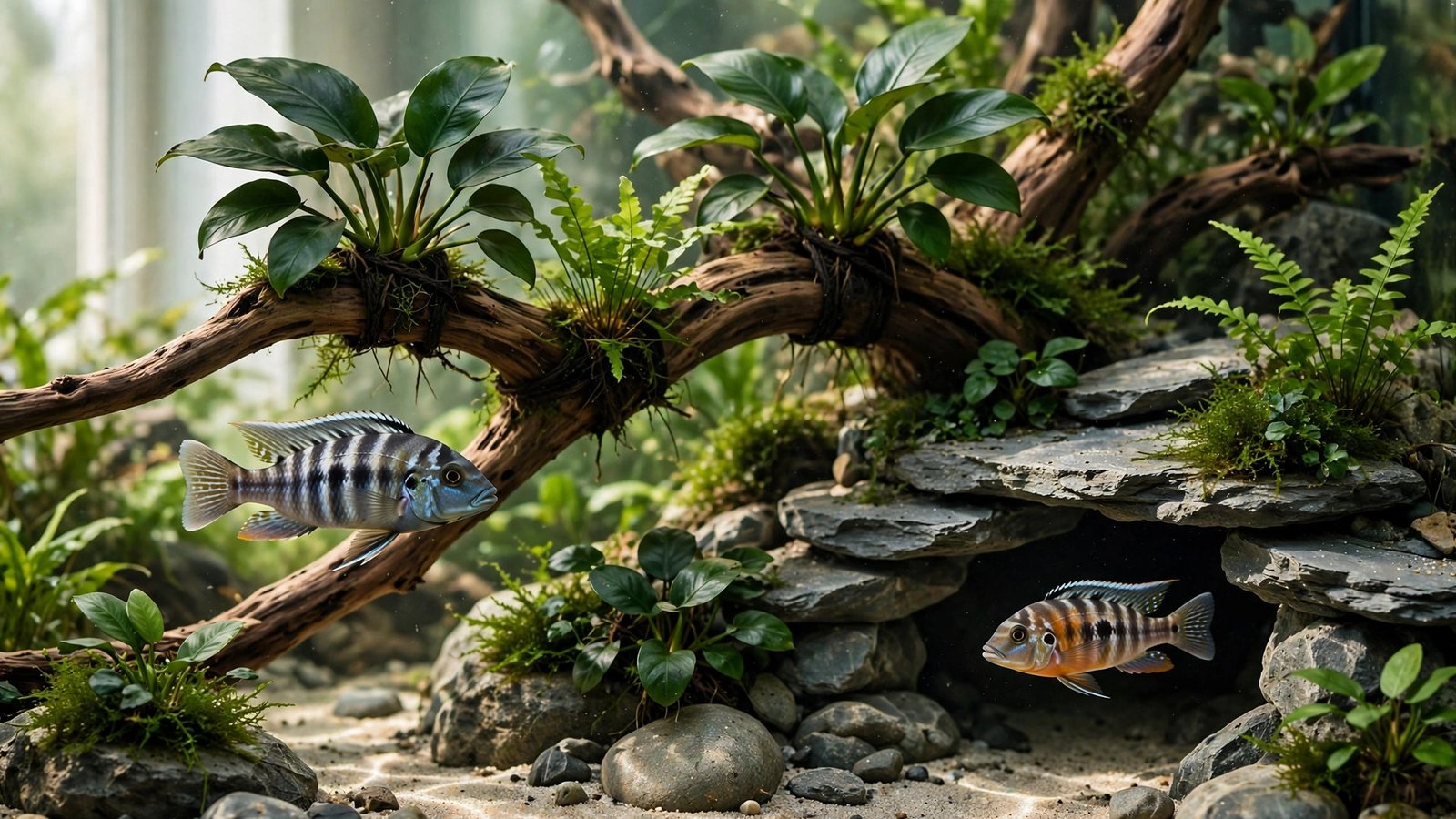
A bonded convict pair will dig a spawning pit the size of your palm within 48 hours — right underneath your prized sword plant. A convict cichlid planted tank must be designed around their engineering, not despite it: cave territories, diggable sand, and plants they cannot kill.
Get the layout right and the reward is unmatched: a pair that spawns every few weeks, guards fry with astonishing devotion, and lives inside an aquascape they can rearrange but never destroy.
Why a Convict Cichlid Planted Tank Fails the Standard Way
Convicts invalidate it. The female (3–4 inches, orange-bellied when ready) and the larger male (5–6 inches) cooperate to dig a saucer-shaped pit 6–8 inches across, wherever they intend to lay eggs. Every stem inside that radius gets uprooted and carried aside. This repeats every 3–4 weeks — parental instinct, not aggression, so no training stops it.
Plant selection must therefore favor aquarium plants for a fish tank that root to wood and rock instead of substrate: plants breeding cichlids can't kill because there is nothing loose to evict.
The 30–40 Gallon Breeding-Pair Layout
Thirty gallons is the working minimum; forty adds territory structure plus margin. Go rectangular — convicts are bottom engineers, and footprint beats height. Stock a proven pair, or start with six juveniles, let a pair form, and rehome the extras. Filter at 1.5× tank volume: diggers keep fine particles suspended, and clear water keeps fry healthy.
Shopping list: a 30–40 gallon tank kit with a decent HOB, a reliable aquarium test kit (pairs spawn more readily in stable parameters), and quality cichlid pellets supplemented with frozen brine shrimp and spirulina flakes.
Sand vs. Gravel: The Substrate Decision
Fine pool-filter sand, 1.5–2 inches deep, is the right call. Convicts sift sand while pit-digging — natural foraging behavior. Gravel traps waste and makes pits collapse inward, so the pair just digs wider. Sand pits hold their shape. Keep it shallow: they excavate to the glass anyway, and a deep bed only means a bigger mess against the front pane. Our guide to the best substrate for planted tanks covers the full digger calculus.
One refinement: slope the sand deeper at the back, shallow at the front — the first pit then lands mid-tank instead of exposing the bottom pane.
Cave Territories: Architecture for a Breeding Pair
Every successful layout starts with caves, not plants. Provide two — one per tank end — so the pair chooses their nursery instead of fighting over a single site. Terracotta pots (2–3 inch openings, laid sideways) are the classic: cheap, repositionable, rough enough inside for eggs to adhere. Back each against glass or rockwork so it has one defensible entrance, and keep a clear sand apron around it — the pair defends the mouth with body slams and mouthfuls of substrate.
Note the scale difference from the hobby's other famous digger: blood parrots reach 8–10 inches, are semi-aggressive but easygoing, and need 75+ gallons — they bulldoze through clumsiness. Convicts are smaller but intensely, deliberately territorial. For the big-tank version, see our Blood Parrot Cichlid Planted Tank: Digger-Proof Plants for Big Aquariums — the plant strategy overlaps, but the temperament logic is completely different.
Dig-Proof Plants: What Survives a Spawning Pair
| Plant | Placement | Why it survives |
|---|---|---|
| Anubias barteri / nana | Superglued to driftwood, rocks | Roots to hardscape — nothing to uproot |
| Java fern | Tied to wood, mid-ground | Rhizome feeder; digging can't touch it |
| Amazon sword | In a terracotta pot, sunk to the rim | Pot contains the root ball |
| Java / Christmas moss | Wrapped on cave roofs, wood | Clings to surfaces; regrows from fragments |
| Frogbit / water sprite (floaters) | Surface | Above the digging zone entirely |
| Crinum calamistratum | Weighted pot, background | Bulb anchors deep; leaves bend, not break |
Buy anubias and java fern portions in multiples — 6–8 rhizome clusters give the woodwork a mature look from day one. Sink potted swords to the rim and top-dress with pebbles so the female can't nose out the root tabs.
Floaters matter: 30% frogbit cover visibly calms breeding convicts — dimmer light, less frantic nest defense. Skim a handful weekly so they don't choke the light entirely. For the opposite problem — fish that eat plants rather than dig them — our Silver Dollar Planted Tank guide shows how the defense strategy differs.
The Spawning Cycle, Week by Week
Week 1 — Surveying. The pair patrols together, the female's belly turns orange-gold, and test pits appear in 2–3 spots. Don't rescape; you're watching them choose real estate.
Week 2 — Excavation and laying. One pit wins: 100–300 adhesive eggs, fanned by both parents for 72 hours.
Week 3 — Fry guarding. Free-swimming fry form a living cloud the parents herd like sheepdogs. Feed newly hatched brine shrimp twice daily.
Week 4 — Independence. Fry disperse, aggression eases, and within days the female is orange again. Have a fry plan BEFORE the first spawn — a grow-out tank, a store that takes them, or a larger tank that accepts live feeders. Hundreds of convict fry with no outlet is the hobby's most common "oops."
Tankmates: Who Survives the Nursery
Almost nothing, during spawning weeks. A breeding pair treats the entire tank as the nest. Between spawns, fast top-dwellers like giant danios (40-gallon minimum) give the pair something to posture at, and a single bristlenose pleco with its own cave eats algae unmolested. Species-only remains the calmest setup — my recommendation for first-time convict keepers.
Never add slow, long-finned, or bottom-dwelling fish — gouramis, angelfish, corydoras will be harassed relentlessly. Quarantine every newcomer: disease in a tank with 200 fry is a total loss, so review our Fish Quarantine Tank Guide: Protecting Your Planted Tank from New Arrivals first.
Frequently Asked Questions
Will convict cichlids kill all my plants?
Not if you choose correctly. Convicts destroy plants by uprooting and burying them during pit excavation — they rarely eat healthy leaves. Epiphytes glued to wood (anubias, java fern), potted swords, mosses, and floaters survive indefinitely. Unprotected stem plants in the digging zone won't last a week.
What size tank does a breeding pair of convicts need?
Thirty gallons is the minimum for one bonded pair; 40 gallons is more comfortable and allows dither fish or a pleco. Below 30 gallons, spawning aggression has nowhere to diffuse and the subordinate partner takes constant punishment. A 20-gallon long can house a single convict, but never a breeding pair.
How often do convict cichlids breed?
A healthy bonded pair spawns every 3–4 weeks year-round in stable 74–79°F water, producing 100–300 eggs per spawn with high survival under parental care. Decide what you'll do with the fry before the first spawn — confirm a local store will take them, because supply quickly exceeds demand.
Do convict cichlids need caves to breed?
They strongly prefer them. Wild convicts spawn in rock crevices and choose a cave over open substrate nearly every time. Two terracotta-pot or slate caves let the pair pick their nursery and dramatically reduce digging damage elsewhere. Without caves, they excavate larger pits and defend a wider, messier territory.
What do convict cichlid fry eat?
Newly free-swimming fry take baby brine shrimp and powdered fry food immediately; parents even chew food and spit it out for them in the first days. Feed small amounts twice daily; hundreds of fry in 30 gallons can crash water quality fast.
This tank is not a compromise between fish and plants — it is an aquascape designed for architects rather than spectators. Give the pair their caves, their sand, and their digging rights; anchor everything green to wood, rock, and pots. For the same breeding-pair logic at dwarf scale, our Kribensis Planted Tank: Caves, Dig-Proof Plants & Breeding Pairs is the natural next read.
Sources: FishLore convict cichlid profile; Animal Diversity Web — Amatitlania nigrofasciata (University of Michigan Museum of Zoology).