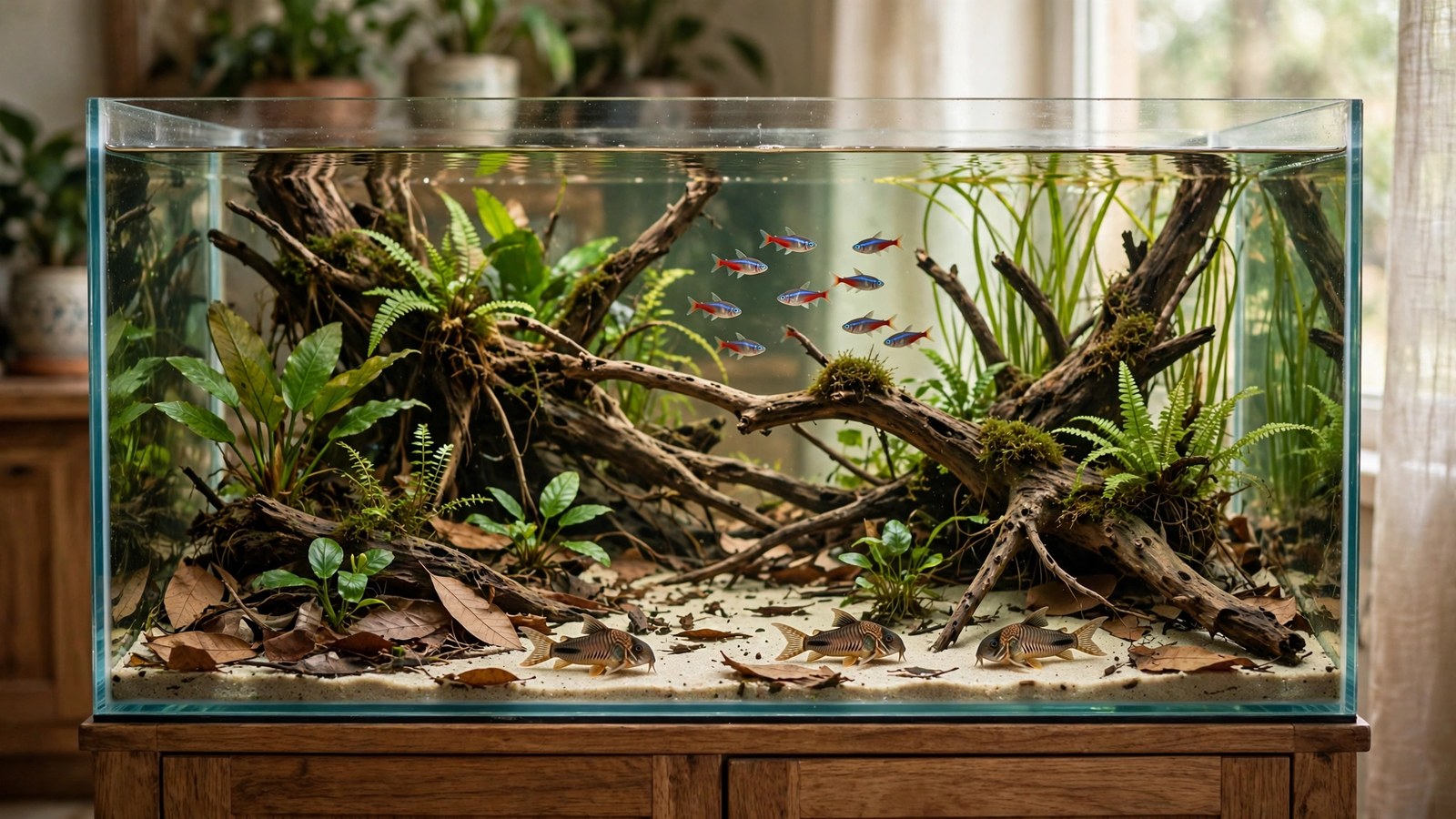
Every rainy season, the Orinoco floods grasslands across an area larger than England, and millions of cardinal tetras ride the floodwater into the submerged savanna to spawn. Rebuilding that world is what makes an orinoco biotope aquarium special — and the first thing to know is that the Orinoco is not the Amazon. This river system runs its own course through Venezuela and Colombia, carrying three strikingly different habitats: blackwater palm forest, clearwater tributaries, and seasonally flooded plains. This guide walks you through choosing one habitat and building it faithfully, from sand and leaf litter to the fish and plants that actually live there.
To build an orinoco biotope aquarium, choose one of the basin's three habitats — blackwater morichal, clearwater riverside, or flooded llanos — in a 40-gallon or larger tank. Lay pale fine sand, tangle branches and roots overhead, and scatter dried leaves. Hold 25–30 °C with soft, acidic water (pH 5.2–6.5 for blackwater, up to neutral for clearwater). Stock only Orinoco natives: cardinal tetras, German blue rams, marbled hatchetfish, and sterbai corydoras. Cycle 4–6 weeks before adding fish.
The three faces of the Orinoco
The Orinoco basin packs remarkable habitat variety into one system. The blackwater morichal is flooded palm forest: tea-colored, acidic water under a closed canopy, floored with decomposing leaves and fallen branches. The clearwater riverside runs sunlit over pale sand, where overhanging trees drop root tangles into the current and tetras flash between them. The flooded llanos are seasonal plains — underwater grassland for half the year, spawning ground for cardinals and rams.
Each flavor needs its own treatment, and mixing them breaks the biotope concept. Because Orinoco tanks are deliberately sparse on vegetation, the layout shares real DNA with a lightly planted aquarium setup — hardscape does the heavy lifting. If you want the classic Rio Negro blackwater look instead, see the site's Amazon biotope aquarium sister guide; the Orinoco deserves its own identity.
Your orinoco biotope aquarium setup: picking the right habitat
Choose by temperament and experience. First-time biotope keepers should start with the clearwater riverside: near-neutral water is forgiving, plants root easily, and the bright sand-and-root look photographs beautifully. If you love dark, tea-stained water and want the most authentic flavor, build the blackwater morichal — but commit to RO/DI water and peat filtration, because tap water will fight you the whole way. Choose the flooded llanos if breeding interests you: rams and tetras spawn readily in the shallow, plant-dotted layout that mimics the flooded plain.
Browse documented entries in the biotope-aquarium.info contest gallery for inspiration from judged Orinoco builds before you commit to a layout.
Hardscape: sand, roots, and leaf litter
Start with pale fine sand, 3–5 cm deep — it reads as riverbed, shows off dark fish, and protects corydoras barbels. The best substrate for planted tanks guide covers grain size and depth. Angle branches and root tangles from the back corners so they break the surface line, then scatter dried leaves (oak or beech work well) across the sand.
Tannins are flavor-dependent: welcome and expected in the morichal, minimal in clearwater. Add leaves gradually — a handful per week in a 40-gallon tank — so the tint and pH shift slowly. Replace decomposing leaves monthly, leaving the oldest layer undisturbed as a foraging zone for corydoras and dwarf cichlids.
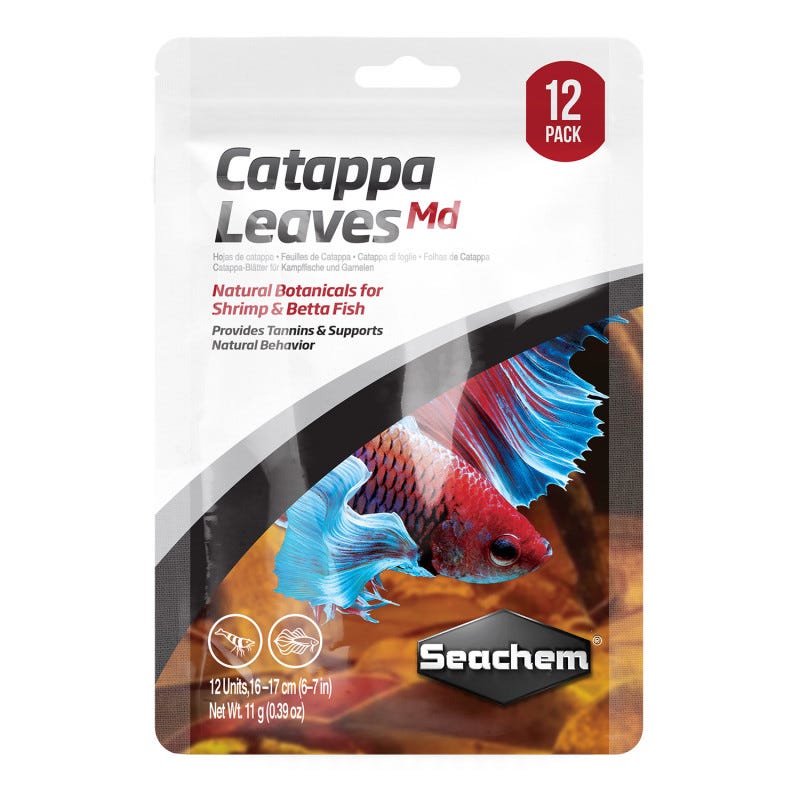 ★4.8
Seachem Catappa Leaves 12-pack
Check Price on Amazon ★4.8Plants that actually grow in the Orinoco
Keep planting sparse — a biotope stuffed with plants looks like a Dutch tank, not a river.
| Plant | Best habitat fit | Placement and notes |
|---|---|---|
| Hydrocotyle leucocephala | Clearwater | Floating or rooted; fast grower for the surface |
| Sagittaria subulata | Clearwater, llanos | Foreground patches, not a full carpet |
| Eleocharis spp. | Llanos | Grassy tufts for the flooded-plain look |
| Bacopa monnieri | Clearwater margins | Background stems along the glass |
| Nymphaea lotus (red tiger lotus) | Llanos | One centerpiece rosette, prune runners |
| Cyperus helferi | Llanos, clearwater | Grasslike background clumps |
Stocking: which fish per habitat
Stock by habitat, not by wishlist — each species below is an Orinoco native that fits one flavor best, and schooling fish need real group sizes to behave naturally.
| Species | Habitat | Group size | Notes |
|---|---|---|---|
| Cardinal tetra (Paracheirodon axelrodi) | Morichal, llanos | 12+ | The signature shoaler; spawns in flooded grass |
| Rummy-nose tetra | Clearwater | 10+ | Tight schooler, red noses signal water quality |
| Marbled hatchetfish | Clearwater | 8+ | Topwater; fit a tight lid, they jump |
| Sterbai cory | Clearwater | 6+ | Sand sifter; needs the fine substrate |
| German blue ram (Mikrogeophagus ramirezi) | Llanos, clearwater | Pair | Keep at 28–30 °C; the warm end of the range |
| Keyhole cichlid | Clearwater | Pair | Peaceful centerpiece, undemanding |
| Checkerboard cichlid (Dicrossus filamentosus) | Morichal | Pair | Leaf-litter spawner; needs the dark water |
A 55-gallon clearwater build might hold 15 rummy-nose tetras, 8 marbled hatchetfish, 6 sterbai corys, and a pair of keyholes. A 40-gallon morichal could carry 15 cardinals and a pair of checkerboard cichlids. Resist the urge to combine flavors — a checkerboard cichlid in bright clearwater loses both its color and its story.
Water parameters and conditioning
Hold 25–30 °C year-round; rams want the top of that range, cardinals sit comfortably at 26–27 °C. For the morichal, aim for pH 5.2–6.5 with near-zero hardness — RO/DI water run through peat in the filter is the documented, reliable way to hold those numbers. Clearwater runs pH 6.0–7.2 with the same soft water but skips the heavy peat.
Cycle the tank 4–6 weeks before any fish, and introduce the leaf litter during the cycle so tannins stabilize early. Test pH weekly for the first two months; decomposing leaves acidify slowly, which is fine, but a sudden drop means you added too many at once. Weekly 20–25% water changes with matched-temperature, pre-treated RO/DI water keep everything steady.
Frequently Asked Questions
Is the Orinoco really that different from the Amazon?
Yes. The Orinoco is a separate river system flowing through Venezuela and Colombia, with its own flood pulse, its own fish assemblages, and habitats — like the flooded llanos plains — that have no Amazon equivalent. Framing it as "Amazon-like" erases the distinction that makes the biotope worth building.
What size tank does an orinoco biotope aquarium need?
Forty gallons (150 L) is the practical minimum, because tetras need long swimming runs and cichlids need defined territories. Fifty-five to 75 gallons is better for a pair of rams or keyholes alongside full schools. Smaller tanks push shy species into permanent hiding, which defeats the purpose of a biotope display.
Can I keep cardinal tetras with German blue rams?
Yes — both are Orinoco natives and they share the llanos habitat. Keep the tank at 28–29 °C to suit the rams, school the cardinals in groups of 12 or more, and give the rams a flat stone as a spawning site. Well-fed rams ignore adult tetras.
How do I create blackwater without chemicals?
Use dried leaves, alder cones, and peat filtered through the canister — all release tannins and humic acids naturally. Add them gradually over several weeks so pH drifts down slowly rather than crashing. RO/DI water is the foundation; no amount of leaf litter will hold pH 5.5 in hard tap water, so start soft and stay soft.
How often should I replace the leaf litter?
Top up monthly and remove fully skeletonized leaves as they break down. Keep the oldest, darkest layer in place — it hosts the microfauna that corydoras and dwarf cichlids graze on. A sudden full replacement strips tannins and pH buffering at once, so rotate in thirds rather than all at once.
Keep the river in mind
An orinoco biotope aquarium succeeds when a visitor can read the habitat in one glance: pale sand, tangled roots, drifting leaves, and a school of fish that belongs to that water. If you enjoy rebuilding river systems, compare the African equivalents — the Congo biotope aquarium and the Sri Lanka biotope aquarium each reconstruct a completely different river. Pick one river, build it faithfully.