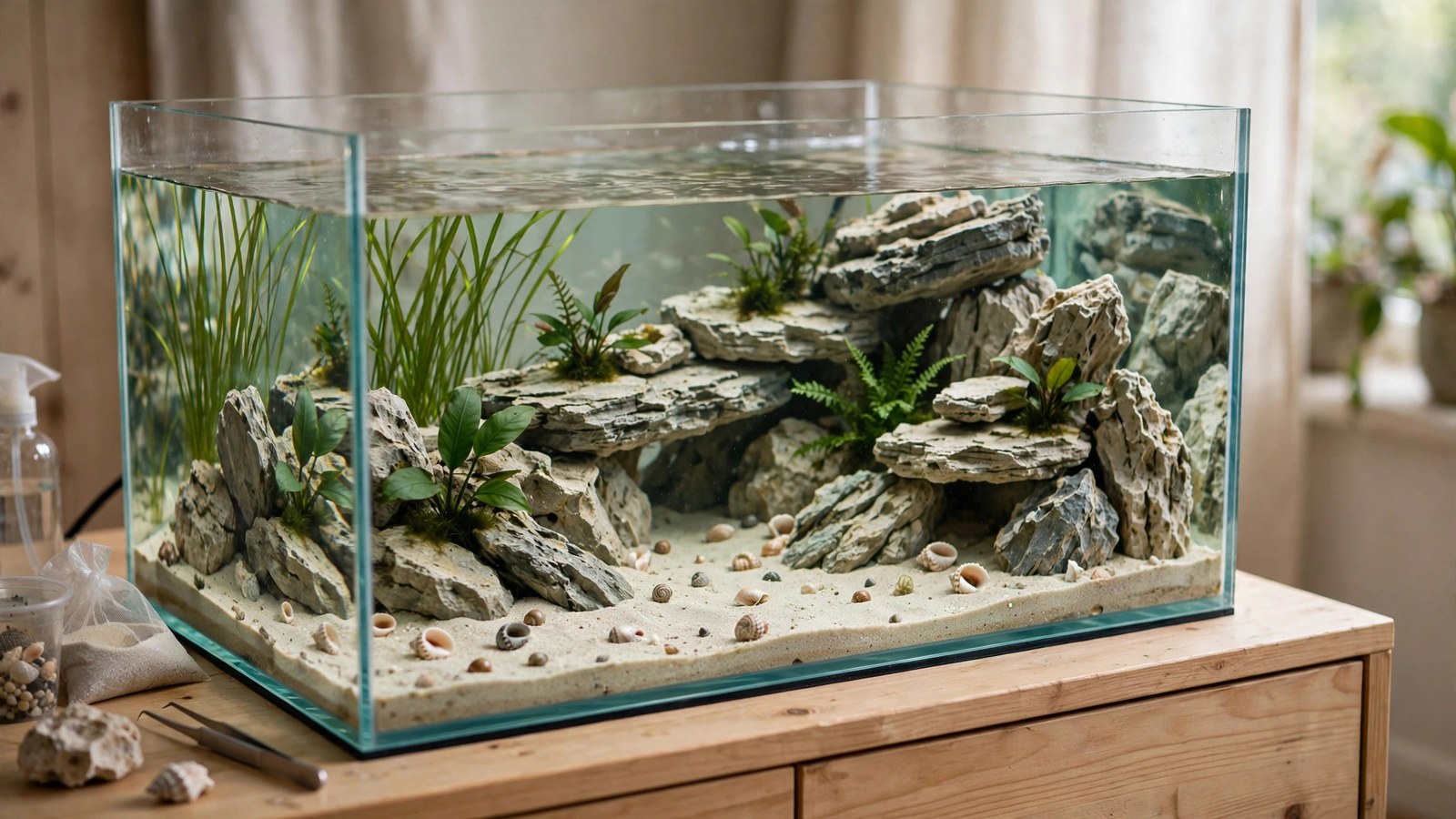
Most "African cichlid" tanks are a mishmash: Malawi fish, driftwood, Amazonian plants, whatever looked good at the shop. A lake tanganyika biotope aquarium does the opposite — it rebuilds one lake's rocky shoreline, water and all. This guide shows you how to harden your water, pile rock into real territories, stock by lake zone, and choose plants that survive a rift lake tank.
Building a Lake Tanganyika Biotope Aquarium That Thrives
Start with a 150-liter (40-gallon) tank or larger, ideally 180 liters with a base of at least 100 × 40 cm. Rock piles need footprint: caves along the back two-thirds, open sand in front as a swimming lane. Before filling, lay lighting egg-crate under the substrate and set every rock directly on the base or the crate — never on sand alone, because julies and shell-dwellers excavate relentlessly.
Plan three zones: a tall rock wall at the back, a shell bed (a dozen or more escargot shells, aperture-up, half-buried) in one corner of the sand, and open water in front. Cycle 2–3 weeks with the buffer system running, confirm pH holds above 8.5 for a full week between water changes, then stock in stages: shell-dwellers first, rock-dwellers two weeks later, the mid-water school last.
Water Chemistry: Hard, Alkaline, and Stable
Tanganyika's water is mineral-rich with a near-constant pH. Stability beats any single number: your fish forgive pH 8.6 or 9.0, but not a swing from 7.8 to 8.8 across a water change. Measure your baseline first (see our guide to planted tank water parameters), then engineer from there.
| Parameter | Lake target | How to reach it |
|---|---|---|
| pH | 8.5–9.3 | Aragonite/crushed coral substrate + rift-lake salt mix |
| KH | 10–15 dKH | 1 tsp baking soda per 40 L of change water |
| GH | 8–20 dGH | Epsom salt or cichlid remineralizer |
| Temperature | 24–28 °C | Standard heater; avoid exceeding 28 °C |
| Nitrate | Below 20 ppm | 20–25% weekly water changes, matched chemistry |
Buffer change water overnight in a bucket, not in the tank: 1 teaspoon of baking soda and 1 tablespoon of Epsom salt per 20 liters, aerated, then tested against the tank before pouring. Pre-mixed rift-lake salts do the same job. Keep nitrates under 20 ppm — Tanganyikans tolerate mineral-rich water beautifully but are notably less forgiving of nitrate than community fish, as WetWebMedia's Tanganyikan cichlid systems guide documents.
Substrate and Rockwork: Engineering Territories
Use fine aragonite sand or a 50/50 aragonite and coarse coral sand mix, 5–7 cm deep — fine enough for shell-dwellers to dig pits (1–2 mm grain), heavy enough not to cloud. Aragonite doubles as your buffer, slowly dissolving carbonate that locks pH high, which is why the usual best substrate for planted tanks advice needs a rift-lake translation: here, buffering beats nutrient content.
Use limestone, tufa or ocean rock — all add carbonate and look right. For 180 liters you need 30–50 kg: build two or three independent piles, each with several caves, separated by sand gaps, since territories are defended per-pile. Stack largest at the base, epoxy wobbles, and leave narrow vertical crevices — Julidochromis spawn in tight slits.
Stocking by Zone: Fish for Every Level
Divide the tank into three leases: rock-dwellers (Neolamprologus brichardi, Julidochromis regani, Altolamprologus compressiceps) take the piles, shell-dwellers (N. multifasciatus or N. brevis) take the shell bed, and one mid-water school (Cyprichromis leptosoma, 10–12) patrols the open lane. One species per genus — two similar cichlids in 180 liters will fight endlessly over the same cave.
| Zone | Example species | Group size | Territory need |
|---|---|---|---|
| Rock caves | Neolamprologus brichardi | Pair or colony of 6 | One rock pile per group |
| Rock crevices | Julidochromis regani | Pair | Vertical slits, separate pile |
| Shell bed | Neolamprologus multifasciatus | Colony of 6–10 | 12+ shells on open sand |
| Open water | Cyprichromis leptosoma | 10–12 | Swimming lane |
Stock conservatively — about 1 cm of adult fish per 2 liters — and never mix in Malawi mbuna: different lake, different water, different social rules. The classic shell-dweller-plus-Cyprichromis pairing works because each species ignores the other's zone; our shell-dweller planted tank setup covers dedicated shell-bed colonies, and the Lake Tanganyika biotope guide at en.aqua-fish.net matches more species to habitat.
Plants That Survive Rift Water
The honest truth: the lake's rocky shores are nearly plant-free, and most aquarium plants melt above pH 8. But the river mouths feeding the lake grow Vallisneria in abundance, so a sparse planting at the margins is authentic. Use a lightly planted aquarium setup guide as your template, not any high-tech aquascape plan.
Vallisneria spiralis is your hero plant: native to the lake itself, thriving in hard alkaline water. Plant it in pots sunk behind rockwork — digging cichlids uproot anything loose. Anubias barteri and Java fern tied to rock faces are the other safe choices; epiphytes need no substrate. See our best plants for cichlid tanks roundup for the full shortlist.
The Authenticity Checklist: What Does Not Belong
A biotope earns its name by subtraction. Check every item against this list before it enters the tank:
- No driftwood — tannins fight your alkaline chemistry.
- No botanicals — catappa leaves soften water your cichlids need hard.
- No Malawi fish — mbuna belong to a different lake entirely.
- No soft-water plants. Crypts, stem plants and carpets melt above pH 8. If it needs aquasoil and CO2, it is not a Tanganyika plant.
- No painted decor. Plastic castles and neon gravel break the illusion and give territorial fish sharp edges.
- No marine salt dosing. Use rift-lake mineral mixes — Tanganyika's minerals are calcium/magnesium carbonates, not sodium chloride.
Frequently Asked Questions
Can I keep Tanganyika cichlids at pH 7.8 instead of 8.5+?
Tank-bred fish often survive at pH 7.8–8.0, but colors dull and disease resistance drops, especially against bloat — wild-caught fish need the full 8.5+ range. Worse, pH 7.8 signals weak buffering, and the swings that follow kill more fish than any steady number. Aim for 8.5–9.3 and hold it.
How many fish fit in a 180-liter Tanganyika biotope?
A colony of 6–8 shell-dwellers, one pair each of two rock-dwelling species, and 10–12 Cyprichromis is a full 180-liter tank. Tanganyikans defend territories fiercely and dislike nitrate, so understocking keeps aggression down. Add each group 2–3 weeks apart, watching behavior before adding the next.
Why do my rocks keep shifting?
Julidochromis and shell-dwellers excavate constantly, undermining piles built on sand alone — a collapse can crack glass or crush fish. Rebuild with rock resting on the tank base or egg-crate, substrate packed around it.
Do Tanganyika biotopes need CO2 or strong lighting?
No to both. Vallisneria, Anubias and Java fern grow fine under moderate light (20–30 PAR) without CO2, and injected CO2 acidifies water against your alkaline buffer. Use bright daylight-spectrum light for fish colors and keep the photoperiod to 7–8 hours — pH 9 water plus long light hours invites an algae bloom.
Your Rift Lake Is Waiting
A Tanganyika biotope asks more upfront — buffering, rockwork, a slow stocking schedule — and returns a tank where every fish acts like itself: julies guarding slits, shell-dwellers rearranging shell cities, Cyprichromis flashing over open sand. Build the water first, the rock second, the fish last.