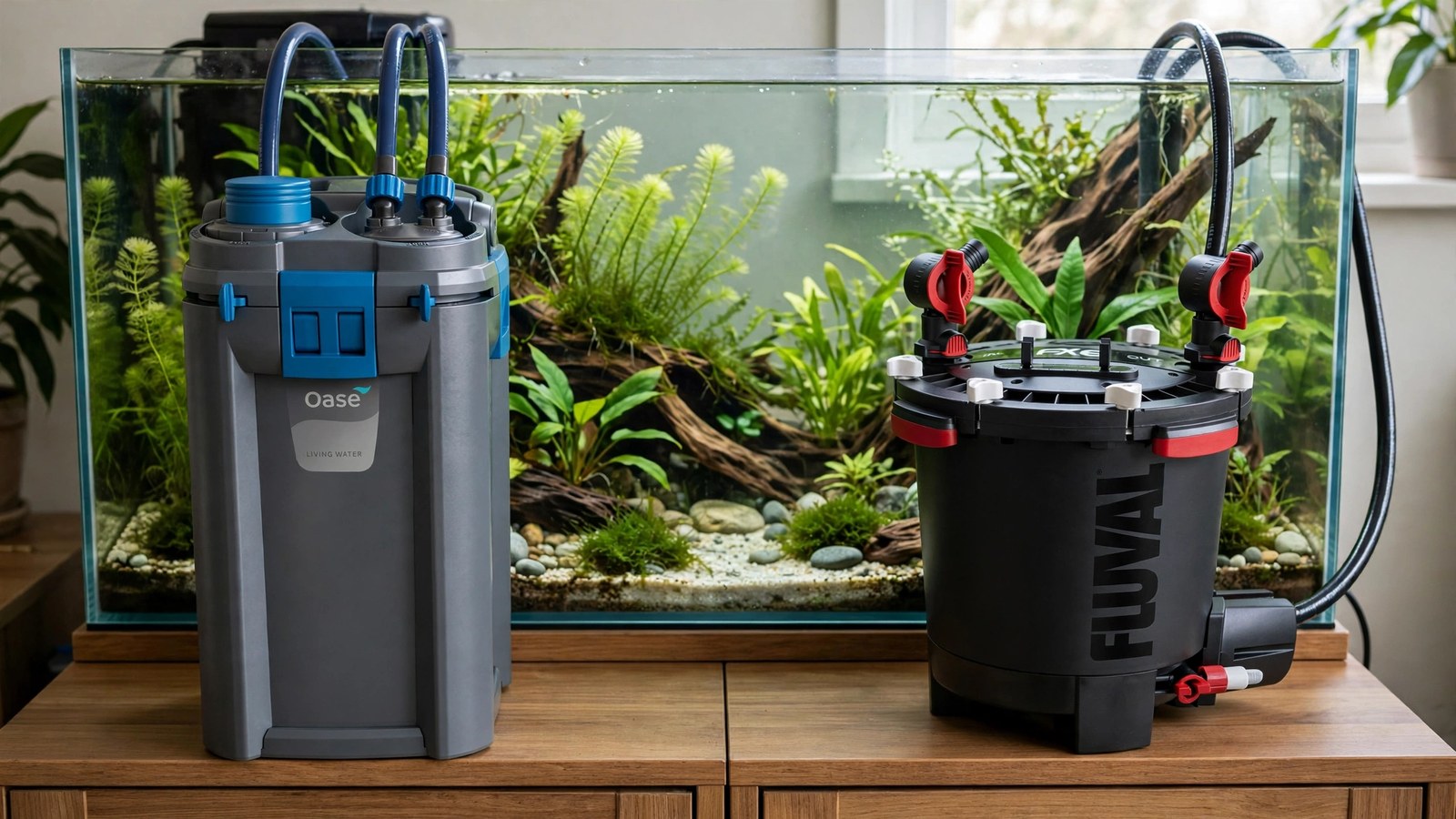
Most planted-tank owners buy one canister filter and live with it for years, so the Oase vs Fluval canister filter decision deserves real thought. Both make excellent filters with opposite philosophies: the Oase BioMaster is designed to be maintained, while Fluval FX and 07 filters are designed to move enormous amounts of water.
First, read our canister filter sizing and setup basics if you haven't sized your canister yet. This guide is the brand head-to-head.
Oase vs Fluval Canister Filter: Which One Actually Wins?
It depends. If your biggest frustration is filter maintenance, Oase's removable prefilter chamber ends the most tedious chore in canister ownership: dragging a full canister from the cabinet and spilling water on the floor. If your frustration is weak circulation — dead spots where algae breeds, debris on carpet plants — the FX series moves so much water those problems rarely start.
Planted tanks sharpen this comparison: you want 4–10x turnover per hour to spread dissolved CO2 evenly without surface agitation stripping it out, detritus kept off the leaves, and equipment — heaters especially — kept out of sight. Those three goals decide the matchup.
Oase BioMaster: the maintenance-first design
Oase built the BioMaster around one insight: the prefilter gets dirty fastest, so it should be easiest to clean. The EasyClean module sits at the top and lifts straight out — rinse the foam, drop it back, two minutes, bacteria colony untouched. Per Oase's official BioMaster technical document, the BioMaster 2 line spans tanks to 850 liters, with rated flows of 900–1,550 L/h and up to 8 liters of media.
The second big idea is the Thermo range, which integrates Oase's HeatUp heater into the filter body — 200 watts on the Thermo 350, up to 400 on the Thermo 850. For aquascapers the filter is the heater: no glass tube in the corner, no suction cups to fail. Fluval has no equivalent.
Fluval FX and 07: the flow-first workhorses
Fluval takes the opposite route: brute-force hydraulics, executed well. Per Fluval's official FX specifications, the FX4 is rated to 250 gallons with 700 GPH (2,650 L/h) of pump output; the FX6 stretches to 925 GPH (3,500 L/h) and a 400-gallon rating. Real-world flow runs lower, but it's roughly double what a similarly priced BioMaster moves.
The FX also self-primes via the Smart Pump (add water, plug in, it evacuates trapped air itself), uses stackable basket-in-basket trays that prevent water bypass, and a utility valve for easy water changes. For 20–75 gallon tanks the FX is usually overkill — that's where the 07 series comes in. The 207/307/407 (206/303/383 GPH) bring Fluval's quiet eTEC motors to the size class most planted tanks sit in, at roughly half the price.
Head-to-Head Comparison Table
| Feature | Oase BioMaster 2 | Fluval FX series | Fluval 07 series |
|---|---|---|---|
| Sizes | 250 / 350 / 600 / 850 | FX2 / FX4 / FX6 | 107 / 207 / 307 / 407 |
| Rated flow | 900–1,550 L/h | 1,800–3,500 L/h | 550–1,450 L/h |
| Rated tank size | Up to 66 / 92 / 160 / 225 gal | 175 / 250 / 400 gal | 30 / 45 / 70 / 100 gal |
| Media volume | 4.4–8 L | 10.6–20 L | ~2.7–7 L |
| Standout feature | Top-access prefilter; Thermo heater models | Smart Pump self-start; huge media baskets | Compact; very quiet |
| Maintenance | 2-min prefilter rinse; open quarterly | Full opening every 2–3 months | Full opening every 2–3 months |
| Noise | Near-silent | Quiet; FX6 hums at full flow | Among the quietest made |
| Street price | ~$220–$450 (Thermo more) | ~$270–$430 | ~$110–$260 |
Noise, Running Cost, and Reliability
On noise the brands are close: the BioMaster 2 and 07 series are essentially silent in a living room; the FX line hums quietly at full tilt. Running cost favors Oase — the BioMaster 2 350 draws 16 watts versus 30 on the FX4 and 43 on the FX6 — a modest but real saving over a year of 24/7 use, and one more reason not to run an FX6 on a 40-gallon tank.
Both carry 3-year warranties with wide retail availability, so impellers, seals, and foam sets stay easy to source for years.
Which One Suits Your Tank?
Choose the Oase BioMaster for aquascapes you want visually clean. The Thermo models delete the heater from the display, the prefilter makes maintenance painless, and the gentler flow suits low-tech and shrimp-heavy tanks — the natural pick for a low-tech planted tank.
Choose the Fluval 07 series for 20–75 gallon tanks: the 307 and 407 are quiet, compact, and strong enough for inline CO2 diffusers, and pair well with prefilter sponges for shrimp or fry. Choose the FX4 or FX6 at 90 gallons and up — heavily stocked, fish-first community tanks with plants, like a fish-first aquarium plants setup, are where the FX earns its space.
If you're still unsure a canister is the right call, our filter-type roundup compares canister, HOB, and sponge filters with specific picks before you spend $300 on one.
Frequently Asked Questions
Is Oase better than Fluval for a planted tank?
Neither is categorically better. Oase suits aquascapers who value easy maintenance and hidden equipment (Thermo models integrate the heater). Fluval suits large tanks needing massive turnover at a lower price per gallon.
Can I use a Fluval FX6 on a 40-gallon planted tank?
An FX6 is oversized for a 40-gallon: 925 GPH of rated flow is hard to tame without flattening plants and stripping CO2. A Fluval 407 or Oase BioMaster 350 gives the same clarity with half the power draw and easier tuning.
Is the Oase BioMaster Thermo worth the price premium?
For aquascapes, usually yes: the integrated heater removes one visible device from the tank and distributes heat through the filter's full output for even temperatures. On a utility tank where looks don't matter, save the money and use the standard BioMaster with a separate heater.
Which is quieter, Oase BioMaster or Fluval FX?
Both are quiet, but the BioMaster 2 and Fluval 07 series are the quietest — essentially inaudible in a living room. The FX4 and FX6 produce a low pump hum at full flow that you may notice in a silent bedroom. For a tank beside a bed or desk, the 07 series or BioMaster is safer.
Will a canister filter remove too much CO2 from my planted tank?
The canister itself doesn't remove CO2 — surface agitation does. Aim the outflow (spray bar or lily pipe) slightly downward or just below the surface to minimize off-gassing. Both brands' outlets work with lily pipes, and good circulation actually improves CO2 distribution.
How often should I clean a canister prefilter?
In a planted tank, rinse the mechanical prefilter every 2–4 weeks — plants shed, aquasoil dust accumulates, and detritus builds fast. This is where the BioMaster's top-access prefilter earns its keep: a two-minute rinse versus a full canister opening.
The bottom line: Oase wins the experience — easier maintenance, invisible heater, quieter daily life — while Fluval wins the spec sheet — more flow, more media, more tank for the money. Aquascapers will be happier with the BioMaster; large-tank keepers maximizing filtration per dollar with the FX. Match the filter to your frustrations, size it at 6–8x rated turnover, and either will run your tank beautifully for years.