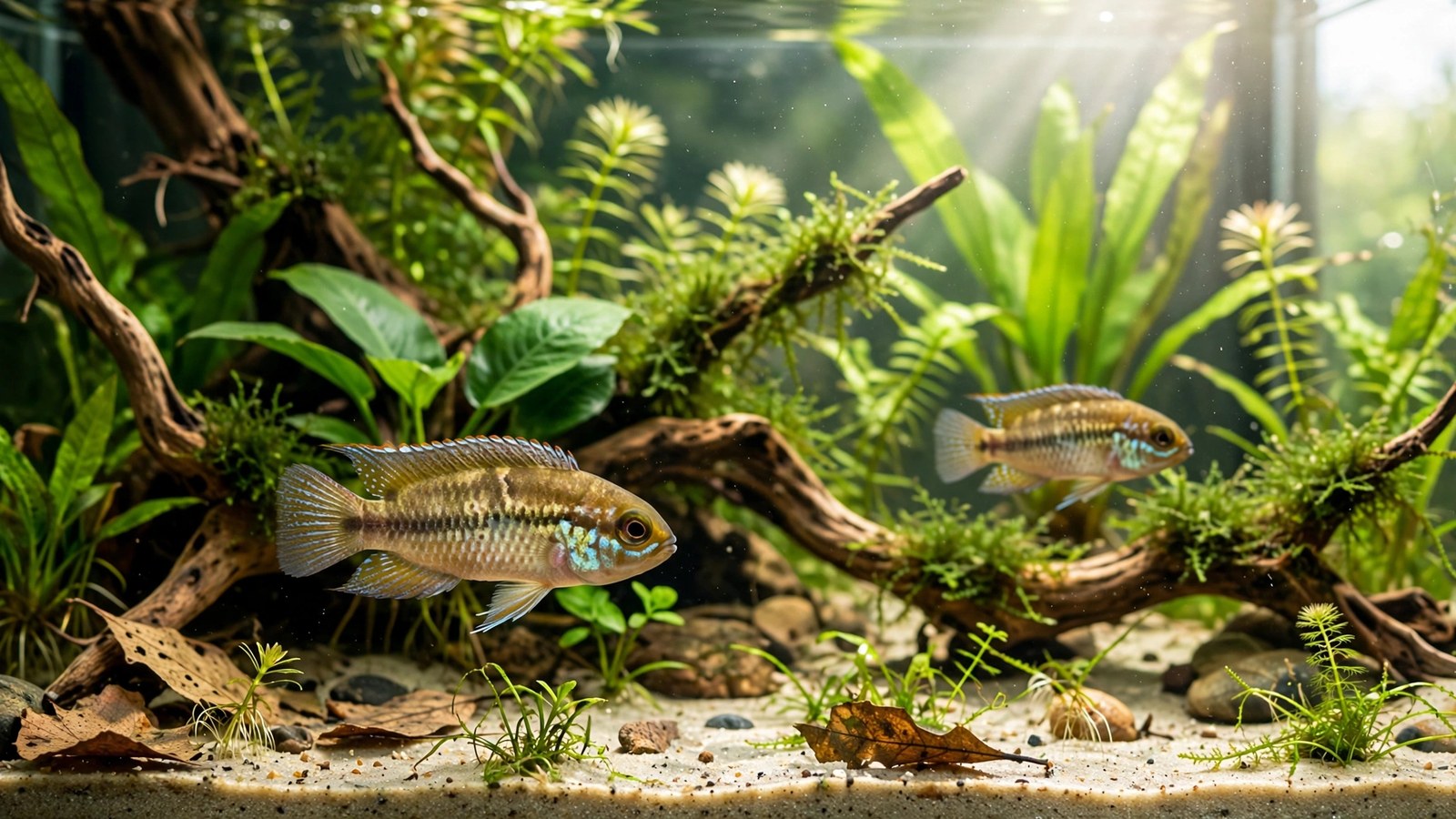
Most dwarf cichlid setups force you to choose: a lush planted tank, or a cichlid that won't shred it. The golden dwarf cichlid breaks that tradeoff — Nannacara anomala is one of the gentlest dwarf cichlids you can keep, and it thrives among roots, leaves, and fine sand. This guide walks you through building a golden dwarf cichlid planted tank that looks beautiful and keeps the fish calm, colorful, and breeding if you want them to.
Why Nannacara Anomala Belongs in a Planted Tank
The golden dwarf cichlid — Nannacara anomala — comes from slow, leaf-littered rivers of the Amazon and Orinoco basins. Its natural home is already planted: overhanging roots, leaf litter, dappled light. A planted tank is habitat replication, and the payoff is immediate — deeper gold, more displaying, less arguing.
Nannacara is unusually planted-tank friendly. Apistogramma species demand very soft, acidic water and can be fussy; Bolivian rams dig with more enthusiasm and rearrange foreground carpets. Golden dwarfs dig too — it's cichlid nature — but lightly, and mostly to sift sand rather than to excavate.
Golden Dwarf Cichlid Planted Tank Setup: The Foundation
A 20-gallon long is the sweet spot for a pair: 30 inches of horizontal territory. A 29- or 40-gallon breeder fits a pair plus dither fish. Golden dwarfs live low in the water, so footprint beats volume.
Substrate: fine sand, no compromises
Nannacara sift mouthfuls of sand all day, filtering out food and expelling it through their gills. On sharp gravel this hardwired behavior causes mouth and gill injuries. Use fine aquarium sand — pool-filter or river sand, 1–2 inches deep. Dark sand is a bonus: it makes the males' gold pop.
Hardscape: roots, caves, and sightline breaks
Build the hardscape before planting. Golden dwarfs claim territories around caves and overhangs: terracotta pots, coconut huts, or stacked driftwood. Arrange the wood to break sightlines across the tank — this is the single most effective aggression reducer in a cichlid planted tank.
Best Plants for a Golden Dwarf Cichlid Planted Tank
Plant selection for cichlids follows one rule: roots that can't be uprooted, or plants that don't need roots at all. Golden dwarfs dig mildly, so you can keep a wider range than with big cichlids — but skip carpets and delicate stems. For general plant-picking principles, start with the best aquarium plants for fish tanks; the table below narrows it down for this fish. If you're starting from zero, the easiest beginner aquarium plants overlap heavily with the safest picks here.
| Plant | Placement | Why it works with Nannacara | Light need |
|---|---|---|---|
| Anubias barteri / nana | Epiphyte on wood | Tough leaves, unrootable, provides overhead cover | Low |
| Java fern | Epiphyte on wood/rock | Indestructible; fry shelter among the roots | Low |
| Cryptocoryne wendtii | Midground | Deep roots resist digging; thrives in soft water | Low–medium |
| Amazon sword (Echinodorus) | Background | Bold centerpiece; broad leaves become display perches | Medium |
| Vallisneria | Background | Fast curtain that divides territories visually | Medium |
| Water sprite | Floating | Dappled shade mimics overhanging jungle; calms shy fish | Any |
Plant heavily from day one — 60–70% of the substrate covered. Dense planting absorbs a cichlid pair's ammonia, shelters a brooding female, and fragments territories so one pair's aggression can't sweep the whole tank. Crypts and swords appreciate a root tab under them in sand; epiphytes need nothing but the wood they're tied to. For more cichlid-specific plant strategy, see our guide to the best plants for cichlid tanks.
Water Parameters and Tank Maintenance
Golden dwarfs are adaptable but color up best in soft, warm, slightly acidic water: pH 6.5–7.0, 3–10 dGH, 75–82°F. Persistent pH above 7.5 dulls them and discourages spawning.
Maintenance is standard planted-tank care with a cichlid twist: 25–30% weekly water changes, and vacuum only the open sand — never deep-clean the whole substrate, since that destroys the plant root zone and the biofilm fry graze on. Use a gentle-flow filter; strong current bothers them. Weekly pruning of background plants keeps sightlines broken without turning the tank into a jungle where you can't see the fish.
Stocking, Tank Mates, and Behavior
A bonded pair is the core. Buy 6 juveniles and let them pair off naturally, then rehome the extras — forced pairs fight. Males reach ~3 inches in golden breeding dress; females stay near 2 inches.
Golden dwarfs are peaceful with anything they can't swallow, which makes them excellent community cichlids. Good dither fish — which reduce cichlid shyness — include cardinal tetras, rummynose tetras, harlequin rasboras, and corydoras. Avoid long-finned fish like bettas during spawning season, and avoid tiny shrimp: a breeding female will hunt cherry shrimp fry.
When a pair spawns, the female claims a cave and turns fiercely protective of about a 6-inch radius. This is where the planted layout earns its keep: plants and wood dividing the tank let tank mates escape her line of sight, so aggression stays local instead of tank-wide. It fades once fry are free-swimming, usually within 2–3 weeks. If you want a calmer cichlid for a true community, keyhole cichlids are even more docile; for something bolder, compare the blue acara planted tank setup.
Feeding is easy: a quality cichlid pellet or flake as the base, plus frozen daphnia, brine shrimp, or bloodworms 2–3 times a week. That live-food variety is what triggers spawning coloration — males on a varied diet glow gold. Confirm species background and exact parameters on an authoritative profile such as the Seriously Fish Nannacara anomala profile before you buy.
Frequently Asked Questions
How big a tank does a golden dwarf cichlid need?
A 20-gallon tank is the minimum for a pair, and a 20-gallon long is better than a 20 high because footprint matters more than volume. Add 10 gallons per extra pair or for a community. Smaller tanks concentrate breeding aggression and make parameters swing, which stresses the fish.
Are golden dwarf cichlids plant-safe?
Mostly yes — among the most plant-safe dwarf cichlids. They dig lightly while sifting sand but rarely destroy plants. Anubias and java fern are completely safe; deep-rooted crypts and swords resist mild digging. Skip delicate stems and carpets until the pair settles.
Can golden dwarf cichlids live with tetras and corydoras?
Yes — excellent community cichlids. Cardinal tetras, rummynose tetras, and corydoras make good tank mates, and their presence reduces cichlid shyness. Keep shrimp out of breeding tanks, since a guarding female hunts shrimplets. Provide plant cover so dither fish can break the pair's line of sight.
How do I get my golden dwarf cichlids to breed?
Provide a cave (terracotta pot or coconut hut), soft slightly acidic water around pH 6.5, temperatures near 79–80°F, and a diet rich in frozen foods. A bonded pair will usually spawn within weeks. The female guards the eggs in the cave for about 3 days, then shepherds the fry — dense plants give the fry grazing surfaces and hiding spots.
Do golden dwarf cichlids need CO2 or high light?
No. Their ideal plants — anubias, java fern, crypts, vallisneria — all grow under low to medium light without CO2. Dimmer light suits the fish, mimicking their shaded native habitat. A floating plant like water sprite gives natural dappled shade and outcompetes algae.
The Calmest Cichlid Tank You'll Ever Keep
Set up right, a golden dwarf cichlid planted tank delivers something rare in the cichlid world: calm and beautiful at the same time. Sand underfoot, epiphytes on driftwood, a bonded pair glowing gold in dappled light. Start with the hardscape, plant heavily from day one, and let the fish show you why Nannacara anomala is so widely recommended.