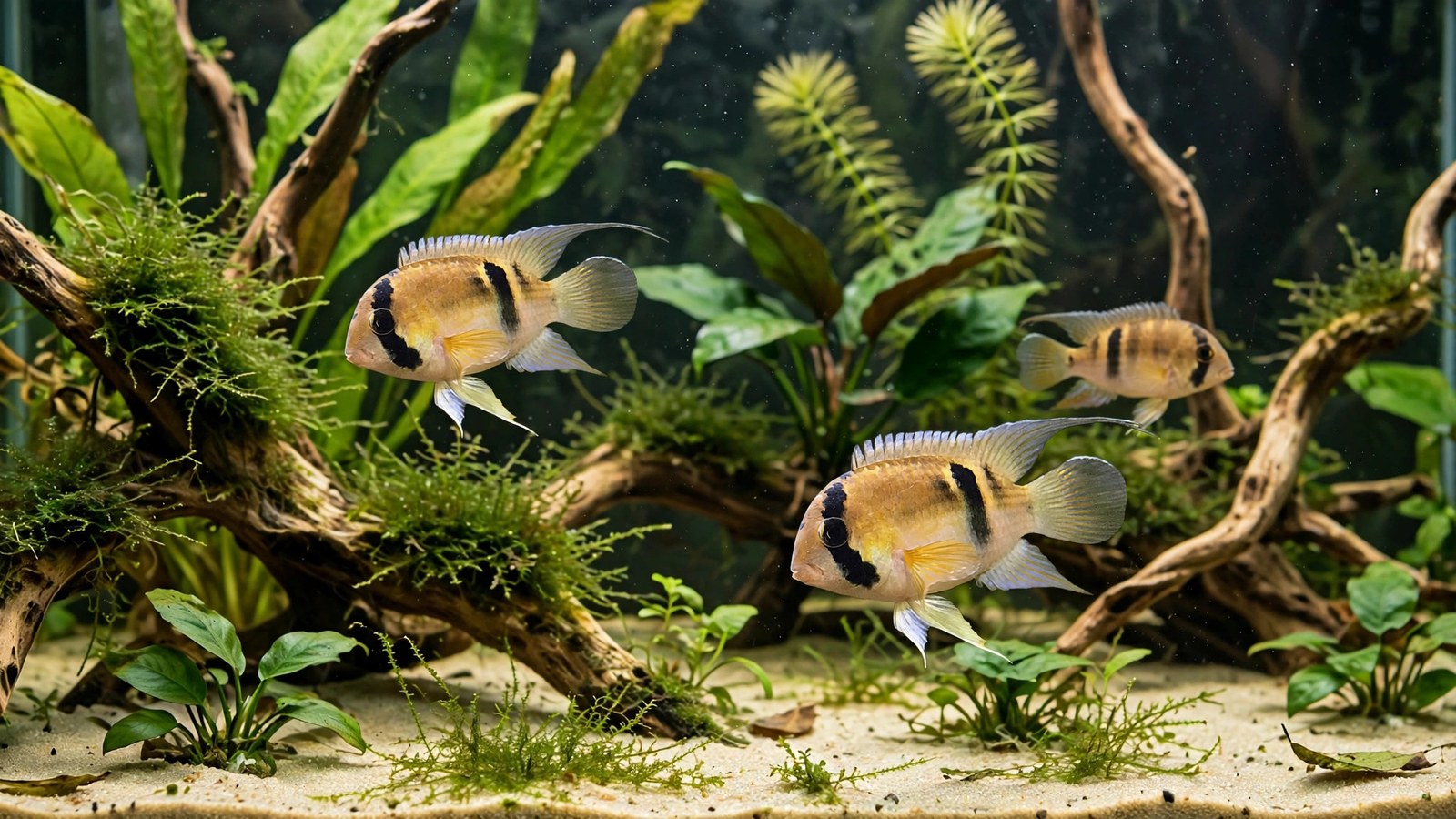
If your "cichlids destroy plants" reflex comes from watching an oscar bulldoze a jungle, meet the fish that breaks the rule. A keyhole cichlid planted tank flips the whole digging-and-destroying script: Cleithracara maronii is a shy South American cichlid that grazes peacefully among leaves with no interest in uprooting your scape. The design problem here isn't protecting plants from the fish — it's protecting the fish's nerves from an exposed, glaring tank.
Why the keyhole is the plant-safe cichlid
Most cichlids treat a planted tank as a remodeling project. Keyholes, topping out around 4 inches, behave more like nervous tetras in a cichlid body. They cruise mid-water in loose groups, sift sand gently rather than excavating craters, and never chew plants. That makes them one of the few cichlids you can pair with moss carpets and fine-leaf species without a protection plan. Start your shortlist with these plant picks for shy cichlids, all tolerant of the subdued light this setup demands.
The catch is temperament. Keyholes earn their name from the dark blotch behind the gill, and their reputation as "shy" fish from vanishing into the foliage the moment a shadow passes. A keyhole that never feels safe becomes a grey, clamped ghost that barely eats. Every design decision here exists to answer one question: does this make the fish feel watched or hidden? Comfortable keyholes develop warm amber coloration with a pink flush on the throat and will spawn on a broad leaf in open view.
Designing your keyhole cichlid planted tank around confidence
A keyhole cichlid planted tank works best when the layout reads as shelter with escape routes rather than a display stage. Aim for a 30- or 40-gallon breeder; footprint matters more than height because keyholes patrol the bottom third of the water column. A tight-fitting lid is non-negotiable — startled keyholes are jumpers. (There's a fuller comparison of open-top versus lidded setups if you're weighing evaporation against safety.)
Break up sight lines with driftwood tangles arranged in two or three loose islands, leaving open sand lanes between them. Each island should offer at least one cave-like overhang a fish can retreat under. Dense planting at the back and sides with an open swimming court in the center gives them a patrol zone and a bolt-hole within a body length. This cichlid tank plant list covers tough-leaved species that hold up under curious cichlid mouths, keyhole-safe included.
Lighting should be gentle: 20–30 PAR at the substrate, six to eight hours daily on a timer. The simplest dimmer is biological — a covering of floating plants to dim the light, thinned to a small feeding hole so it doesn't choke the tank. Water sprite and frogbit thrive in the soft, slightly acidic water keyholes prefer, and the dappling effect alone can turn a chronically hiding group into visible swimmers within days.
Plants that thrive with keyholes
Because the fish won't touch them, you can plant the full low-tech palette: Java fern and anubias tied to wood, Amazon swords and crypts rooted in the sand, Java moss on hardscape, plus floaters up top. Slow growers suit the dim light better than fast stems, which stretch and thin. Skip injected CO₂ — this setup shines as a low-tech build, and strong flow stresses keyholes.
| Zone | Plants | Why they work here |
|---|---|---|
| Floating | Water sprite, frogbit | Dim light, calm the fish, absorb nitrates |
| On wood | Java fern, anubias nana, Java moss | Zero digging risk, slow growers for dim light |
| Midground | Cryptocoryne wendtii, Anubias barteri | Tough leaves, tolerate tannins |
| Background | Amazon sword, Vallisneria | Sight-line breaks keyholes hide behind |
| Botanicals | Catappa leaves, alder cones | Tannins, grazing surfaces, shaded vibe |
Fertilize conservatively: half the label dose of liquid fertilizer once weekly after the first month, plus root tabs under heavy feeders like swords every two to three months. If algae films the glass, cut the dose before shortening the photoperiod. Crypts may melt after planting; leave the roots alone and new growth follows within two weeks.
Stocking the school: dither fish are the secret weapon
The single biggest confidence hack is adding a small school of peaceful dither fish. When tetras swim openly, keyholes read the water column as safe and come out to join them. Without dithers, even a group of keyholes can hug the corners for weeks. Pick calm species that tolerate soft, warm water — ember tetras, rummynose tetras, or harlequin rasboras in schools of 10–12. See the best schooling fish for planted tanks for more pairings.
Keep keyholes in groups of 6–8. Pairs are the shyest configuration and singletons often waste away from stress. In a group, a mild hierarchy forms and the fish become bolder within days. Tank mates should be equally gentle: small tetras, corydoras, otocinclus, and dwarf shrimp colonies all coexist well. Skip fin-nippers and large boisterous species. Feed quality micro-pellets as the staple, frozen daphnia or bloodworms twice weekly, and one fasting day per week.
Weekly routine: 30 minutes to a stable blackwater scape
Once cycled, maintenance is light. Weekly, change 25–30 percent of the water with dechlorinated water matched within 2 °F, siphon debris from the sand surface without deep vacuuming, and thin floaters back to roughly half coverage. Wipe the front glass monthly — keyholes dislike the intrusion. A simple weekly checklist keeps it all on autopilot.
Watch for driftwood leaching white biofilm in month one — harmless, shrimp will eat it. If the tannin tint fades, add one fresh catappa leaf. Keep temperature 75–79 °F with ammonia and nitrite at zero; nitrates under 20 ppm are your water-change trigger.
Frequently Asked Questions
Can keyhole cichlids really live with plants?
Yes — keyholes are among the few genuinely plant-safe cichlids. They neither dig aggressively nor chew leaves, so crypts, swords, mosses, and delicate fine-leaf stems all survive. Their 4-inch adult size and gentle sand-sifting mean even carpeted areas stay intact.
Why are my keyhole cichlids always hiding?
Hiding signals stress, not personality. The three usual causes are too small a group (keep 6–8), no dither fish to signal safety, and lighting that's too bright or exposed. Adding floaters, tannins, and a tetra school fixes most chronic-hiding cases within one to two weeks.
Do keyhole cichlids need a tight lid?
Yes. Startled keyholes bolt, and bolting fish near the surface become jumping fish. A tight-fitting lid or mesh screen prevents losses, especially in the first week when everything in the room still spooks them. Keep any feeding holes covered with a small lid or mesh.
What tank mates work in a keyhole cichlid planted tank?
Peaceful, calm schooling fish like ember or rummynose tetras, harlequin rasboras, corydoras, otocinclus, and dwarf shrimp. Avoid fin-nippers, large active fish, and anything tiny enough to be eaten — adult amano shrimp are fine, but newborn cherry shrimplets may be snacks.
Can I keep keyholes without CO₂ injection?
Absolutely — this is a low-tech showcase tank. Slow growers like anubias, Java fern, crypts, and mosses thrive in its dim, tannin-tinted water without injected CO₂. Light liquid dosing and root tabs give these plants all the feeding they need.
The payoff: a cichlid tank that grows a jungle
A well-settled keyhole group is one of the hobby's quiet rewards: amber fish drifting through sun-mottled floaters, grazing sand without ever touching a leaf, eventually spawning on a sword leaf in open view. Build the tank for their nerves — group, dithers, shade, tannins, cover — and they'll reward you by being visible every single day. For wild habitat parameters see Seriously Fish's Cleithracara maronii profile, and for blackwater-compatible species browse the Tropica plant database.