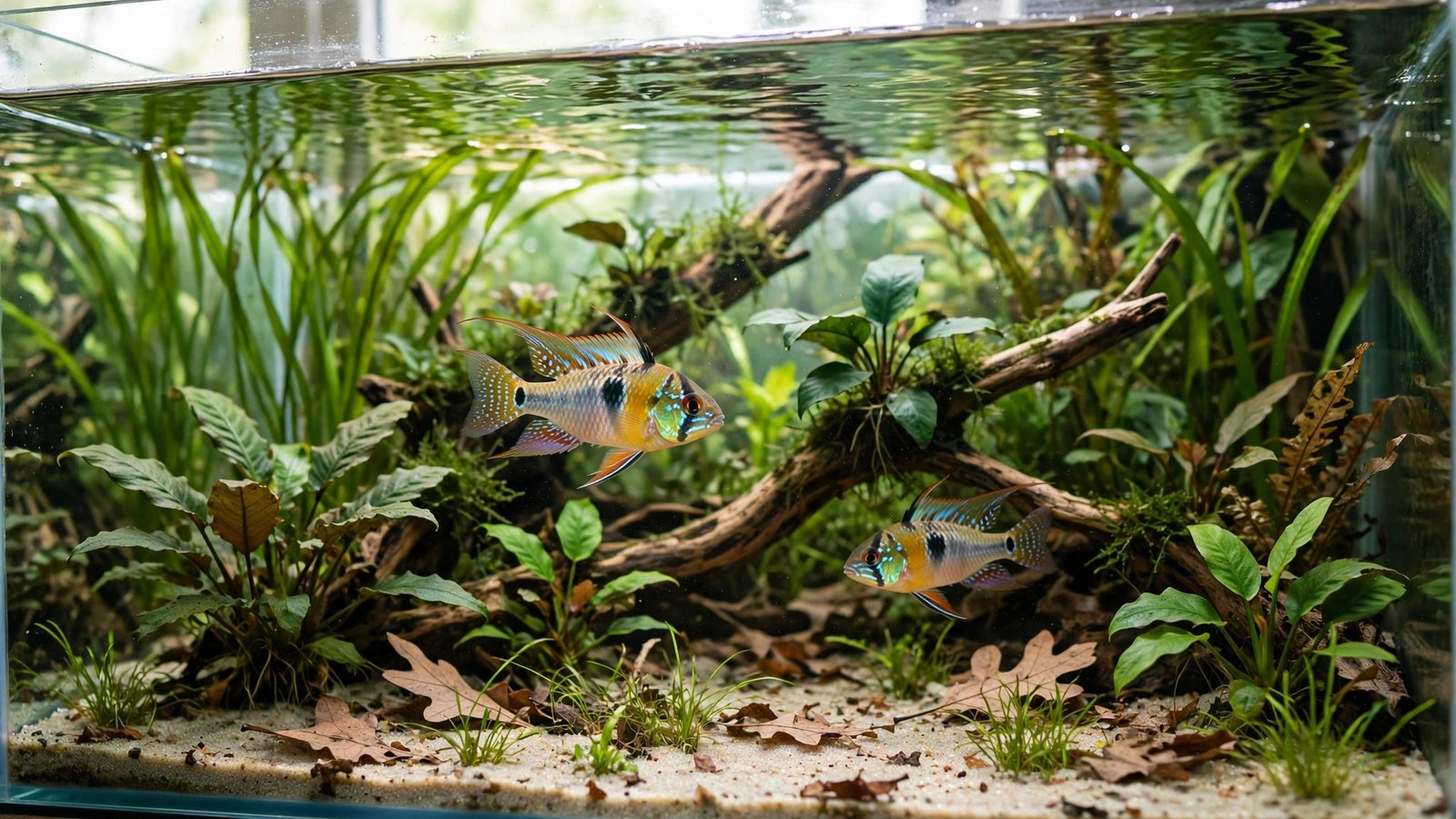
Most dwarf cichlid guides hand you a German blue ram and a thermostat locked at 28°C — and then half your plant wishlist quietly dies. A Bolivian ram planted tank breaks that trade-off: Mikrogeophagus altispinosus thrives at 22–26°C, where swords, anubias and stem plants all grow happily — unlike the German blue ram's 28°C warm-water setup, which forces a heat-tolerant plant list. At ~8 cm and far more forgiving than its blue cousin, it is the dwarf cichlid beginners should start with.
Why a Bolivian Ram Planted Tank Is the Beginner-Friendly Dwarf Cichlid Setup
The Bolivian ram is what shops recommend when German blue rams keep dying on people. It tolerates wider temperature and pH swings, forgives a missed water change, and never demands the near-perfect stability its blue cousin needs — yet still delivers the pair-bonding, sand-sifting and fry-guarding behaviour.
Keep a bonded pair, or run a harem of one male with two to three females so his attention spreads. A harem needs more floor space and sightline breaks, but shows the species' natural social dynamics at their best. At 24°C this is a natural low-tech planted tank setup — no CO2 required.
Tank Size, Sand and Hardscape
Give a pair 75 litres (20 gallons) with a 60 cm footprint — floor space matters more than height, since each pair claims roughly a 30 cm square around its spawning site. For a harem or full community, step up to 110–130 litres. Break sightlines with driftwood and tall plants; rams that cannot see each other argue far less.
Sand is non-negotiable. Rams take mouthfuls of substrate, sift out food particles and expel the grains through their gills — on sharp gravel they simply stop and stress. Use fine aquarium sand 4–6 cm deep, rinsed until the water runs clear; a 9 kg bag covers a 75-litre tank. Add one flat slate or smooth stone per pair as a spawning surface, tilted slightly so you can watch the eggs develop.
Buy an adjustable heater set to 24°C rather than a preset model — a dial holds the target as room temperatures swing. A bag of fine sand and a 100-watt adjustable heater are the two purchases this setup genuinely needs.
The Full Plant Palette at 24°C
This is the payoff for the cooler-water ram: at 24°C you can plant anything. Amazon swords shade the spawning site, cryptocoryne clumps divide territories, and rotala stems soak up nitrates. Confirm ranges in Tropica's plant database, and see our fish-first guide to aquarium plants for livestock-centred ideas.
| Plant | Placement | Why it works here |
|---|---|---|
| Amazon sword | Background | Broad leaves shade a spawning site |
| Anubias / java fern | On driftwood | Epiphytes the rams cannot uproot |
| Cryptocoryne wendtii | Midground | Dense clumps divide territories |
| Rotala rotundifolia | Background | Fast growth absorbs nitrates |
| Dwarf sagittaria | Foreground edges | Tolerates nearby sand-sifting |
Plant the back corners densely, leave the foreground sand open, and feed heavy root-feeders like swords with root tabs. See our best plants for cichlid tanks for more dig-proof options.
Water Parameters and Gentle Filtration
Stable beats perfect: aim mid-range and hold it. Cycle the tank fully before the rams arrive — hardy does not mean ammonia-proof. Weekly 30% changes keep nitrates under 20 ppm and often trigger courtship a day or two later.
| Parameter | Target |
|---|---|
| Temperature | 22–26°C (target 24°C) |
| pH | 6.0–7.5 (6.5–7.0 ideal) |
| Hardness | 3–10 dGH |
| Ammonia / nitrite | 0 ppm |
| Nitrate | Below 20 ppm |
Keep flow gentle: a sponge filter suits a breeding pair, a canister with a spray bar suits a larger community — see our best filters for planted tanks. Seriously Fish's Mikrogeophagus altispinosus profile is the most thorough species reference available.
Feeding: Frozen Foods Keep Them Glowing
Bolivian rams are omnivores with a strong taste for meaty food. Base the diet on sinking micro pellets — flakes get ignored once food lands on the sand — plus frozen daphnia, bloodworm or brine shrimp three to four times a week. A flat pack of frozen daphnia is the best-value purchase here: it conditions pairs for breeding and sharpens their gold-and-blue colour within weeks.
Feed twice daily, only what vanishes in two minutes — rams are enthusiastic beggars. Buried food fouls the substrate they sift, so skip feeding one day a week.
Tank Mates That Won't Ruin the Peace
Outside breeding, Bolivian rams are model community citizens: cardinal or rummynose tetras for midwater movement, corydoras sharing the sand, otocinclus on algae once the tank matures. Stick to amano shrimp — cherry shrimp get hunted.
Match the 22–26°C window and a calm temperament; avoid fin-nippers like tiger barbs. An apistogramma planted tank setup is the classic alternative dwarf cichlid — but never mix the two species. Skip shell dwellers too: a shell-dweller planted tank runs hard, alkaline water, the opposite chemistry.
Breeding Basics
A healthy pair in a stable tank usually breeds unprompted: the female lays 200–300 adhesive eggs in rows on the cleaned slate and guards them while the male patrols. Eggs hatch in two to three days, parents move the wrigglers to a sand pit, and fry swim freely around day five to seven.
First-time parents often eat the first spawn — normal, not bad stock. They typically retry within weeks with far better results. Feed free-swimming fry infusoria for a few days, then newly hatched baby brine shrimp.
Three Mistakes New Ram Keepers Make
The other two: gravel instead of sand, which removes the sifting behaviour the fish are built for; and adding rams to an uncycled tank because "they're hardy" — they tolerate swings, not ammonia. Cycle first.
Frequently Asked Questions
Can Bolivian rams live in a community planted tank?
Yes — among the best dwarf cichlids for a community setup. Outside breeding they ignore midwater fish entirely, coexisting peacefully with tetras, corydoras and otocinclus. A spawning pair defends roughly a 30 cm zone around the slate, so give them a defined territory with plant cover and the rest of the tank stays calm.
Do Bolivian rams eat aquarium plants?
No. Bolivian rams do not eat healthy plants, which is why they suit planted tanks so well. They can uproot freshly planted stems while sifting sand, so let new plants root for two to three weeks before adding the fish, or anchor stems firmly. Established swords, crypts and epiphytes are completely safe.
How many Bolivian rams should I keep together?
Keep a bonded pair in 75 litres, or a harem of one male with two to three females in 110+ litres. Avoid two males under 150 litres — they spar constantly. Growing out six juveniles together often produces natural pairs, the most reliable way to get a compatible breeding pair.
Can I keep Bolivian rams with German blue rams?
Not recommended: Bolivian rams thrive at 22–26°C while German blue rams need 27–30°C, so any compromise stresses one of them. They also compete for the same territories. Choose the species that matches your tank's temperature and plant goals, and keep the group single-species.
Why are my Bolivian ram's colours faded?
Faded colour usually means stress, not disease. Check temperature first — rams held above 27°C wash out quickly. Review diet next: fish fed only flakes lose their gold and blue iridescence within weeks, while frozen daphnia and bloodworm restore it. New arrivals pale for a few days; stable water brings them back.
A Bolivian ram planted tank asks little and gives plenty: cooler water your plants already love, sand the fish were born to sift, and breeding behaviour that turns a quiet corner into must-watch television. Set the heater to 24°C, lay down fine sand and a flat slate, feed frozen foods a few times a week — and let the hardiest little cichlid in the hobby do the rest.