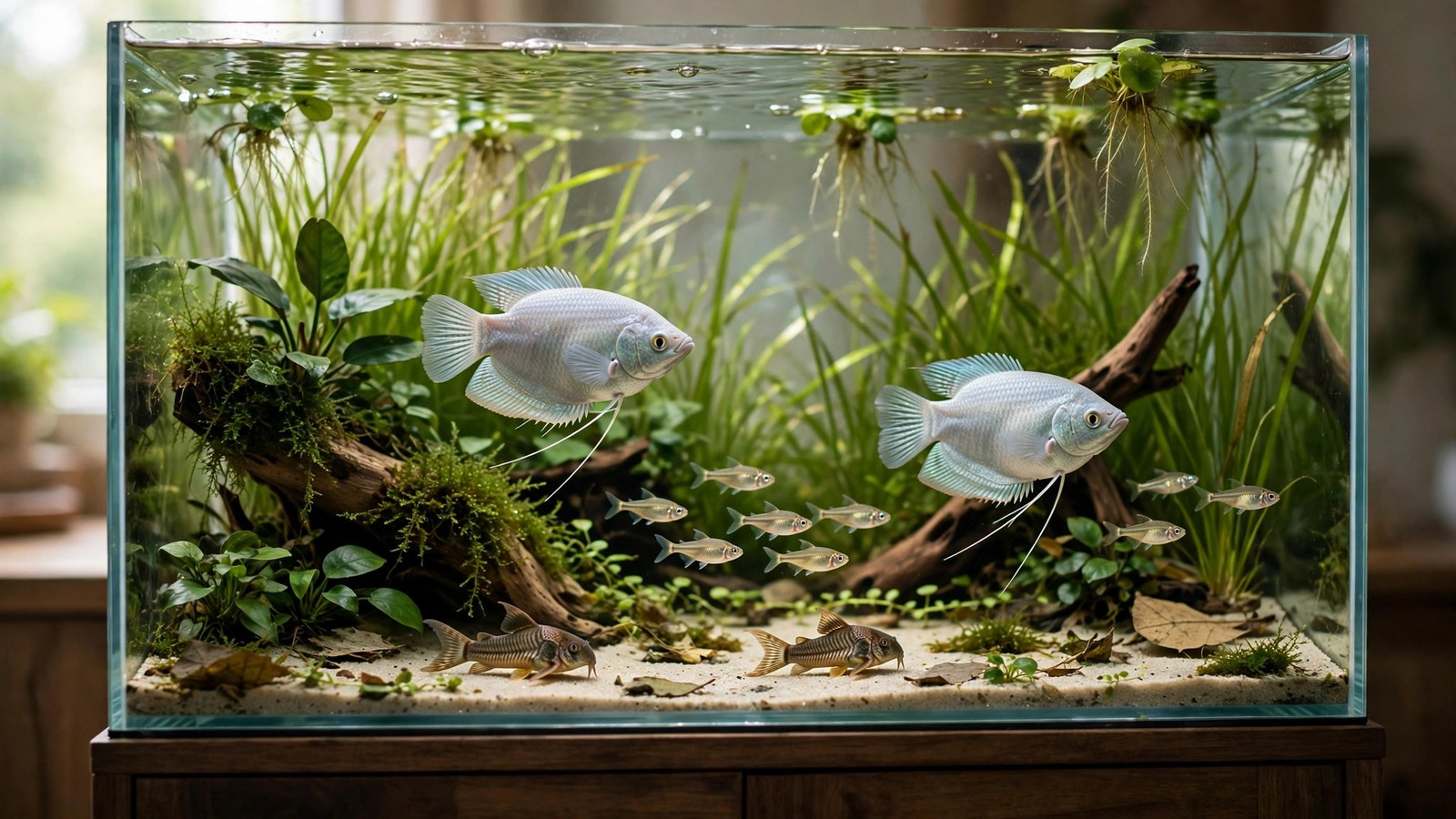
There is a particular disappointment only fishkeepers know: you bring home a moonlight gourami — a shimmering silver slab of calm — and within a week it has vanished behind the filter intake, emerging only to eat. The fish is not broken — a moonlight gourami planted tank without cover is the wrong room for it. In the wild, Trichopodus microlepis glides through dense, vegetated ponds and swamps, and in a bare, bright aquarium it hides instead of showing the soft sheen that gave it its name. Give it dense planting, floating cover, and gentle water, and the same fish becomes one of the most graceful residents you can keep.
A moonlight gourami planted tank works best at around 40 gallons for a small community, with dense midground and background planting, floating plants for surface shade, and gentle, slow-moving water. These shy silver gouramis grow to about 6 inches, nibble soft-leaved plants, and males anchor bubblenests under floating cover — so prescribe tough leaves like Java fern, Anubias, and Cryptocoryne.
Setting up your moonlight gourami planted tank
The moonlight gourami is a labyrinth fish — it surfaces periodically to breathe atmospheric air. That shapes the whole design: the surface matters as much as the substrate. Give them a calm, shaded surface to breathe under, open swimming lanes in the middle, and dense planted walls on the sides and back to retreat into. The flagship Dwarf Gourami in a Planted Aquarium guide covers the shared labyrinth-fish basics, and plants chosen for a fish tank will help you pick plants for function — broad leaves and cover — rather than looks.
Tank size: around 40 gallons for a community
Seriously Fish lists the maximum standard length at about 6 inches, and a community of fish that size needs footprint, not just volume. Around 40 gallons — a 36-inch tank — gives a small group (one male, two females) room to cruise without constant face-to-face contact. Retailers selling juveniles rarely mention how large these fish get, which is exactly why so many end up in tanks they outgrow. Buy the tank for the adult fish, not the juvenile in the store.
Push planting to the perimeter and leave the middle third open — moonlights are slow, deliberate swimmers that like a cruising lane flanked by walls of green.
The planting plan: cover, anchors, and tough leaves
Two problems arrive together with moonlight gouramis: they need visual barriers to feel safe, and they nibble soft leaves — especially when new or underfed. Build a three-zone plan around toughness. Back and sides get dense, broad-leaved species (Java fern on driftwood, Anubias on hardscape, Cryptocoryne in the substrate). The midground stays low and sturdy, breaking sightlines without blocking the swimming lane. The surface — the critical zone — gets frogbit or water lettuce: shade plus bubblenest anchors.
| Plant | Zone | Why it works here |
|---|---|---|
| Java fern | Mid/background on wood | Leathery leaves survive nibbling; slow, low demand |
| Anubias (nana, barteri) | Hardscape | Nearly indestructible leaves; loves dimmer light |
| Cryptocoryne wendtii | Midground | Broad leaves break sightlines; tolerates low light |
| Frogbit / water lettuce | Surface | Shade + bubblenest anchors; the moonlights' favorite zone |
| Amazon sword | Background | Bold backdrop; older leaves toughen against grazing |
Fine-leaved soft stems look great in photos but get shredded fastest, so keep them as accents, not the backbone. The lightly planted setup guide shows how far a handful of hardy species goes in a low-demand tank — moonlights suit exactly that philosophy.
Light, flow, and water: slow and shaded
Moonlights come from dense, slow vegetation — bright, open, high-flow water stresses them. Let the floating plants dim the light, and choose filtration that barely ripples the surface: sponge filters or gentle hang-on-backs with baffled outflows suit them far better than powerheads. Slow flow also protects the bubblenest — a male cannot hold one in a rippled surface.
Parameters are forgiving: pH 6.0–7.5, 77–86°F, wide hardness tolerance. Consistency beats perfection — stable "good enough" water beats a tank where the keeper keeps chasing ideal numbers. Weekly 25–30% water changes and a heater guard (these fish startle into equipment) round out the basics.
Tank mates and feeding: keep it calm
Pair them with calm, mid-sized community fish that will not outcompete them at the surface or nip their trailing pelvic fins: Corydoras, small loaches, peaceful tetras, and other gentle labyrinthfish all work. Avoid boisterous barbs and fin-nippers, and skip anything small enough to be eaten by a six-inch gourami. For family comparisons, the Pearl Gourami planted tank covers a similarly gentle giant, the Honey Gourami planted setup suits a smaller calm community, and the Blue Gourami planted tank shows the family's more assertive end.
Feed them as omnivores: quality flake or small pellets as the staple, supplemented with frozen bloodworms and brine shrimp. Scatter food under the open ring in your floaters so they find it quickly, and feed twice daily rather than one big feeding.
Equipment for a calm moonlight gourami community
This is a low-tech-friendly setup, so the equipment list is short. A 40-gallon breeder kit gives the right footprint in one purchase. For filtration, a large sponge filter (or two, on opposite ends) provides gentle biological filtration with almost no current. Add a reliable adjustable heater, a liquid test kit for ammonia, nitrite, and pH, and a plant bundle of Java fern, Anubias, and frogbit to plant densely on day one. Low, warm-white lighting completes it — no high PAR or CO2 needed.
Breeding behavior: the floating bubblenest
A contented male will blow a bubblenest and anchor it under the floaters — normal behavior, not a problem. Males turn territorial while nesting, which is when dense planting matters most. Deliberate breeding is a specialist project (fry need infusoria-grade first foods), so most keepers simply enjoy the nest as proof the tank is right. The Croaking Gourami planted tank guide shows bubblenester behavior in a nano package, and Seriously Fish's moonlight gourami profile is the authoritative species reference this setup is built on.
Frequently Asked Questions
What size tank do moonlight gouramis need?
Plan on around 40 gallons, since adults reach about 6 inches. A 36-inch footprint gives a male and two females room to cruise and hold loose territories. Smaller tanks can work for a pair, but a cramped footprint is the most common reason these fish stay skittish.
Do moonlight gouramis eat aquarium plants?
They nibble soft, delicate leaves — especially fine-leaved stems and tender new growth. Plant around tough species like Java fern, Anubias, and Cryptocoryne. Floating plants are never grazed, so load up on frogbit or water lettuce for cover that doubles as bubblenest anchors.
Why is my moonlight gourami always hiding?
Hiding almost always means the tank is too open, too bright, or too turbulent. Add dense side and background planting, floating cover to dim the surface, and baffle the filter outflow. Most moonlights become confident swimmers within a week or two once they have cover to retreat behind.
Can I keep just one moonlight gourami?
You can, but a small group of three to five does better — one male with two or more females is the classic ratio. Males kept together in tight quarters may bicker, so if space is limited, a calm pair beats a single showpiece fish.
Do moonlight gouramis build bubblenests?
Yes — a settled male blows a bubblenest and anchors it under floating plants like frogbit or water lettuce roots. That is a sign the conditions suit him, not a problem. Keep the surface calm so the nest holds, and give him nearby plant cover, since he may defend the area while nesting.
A moonlight gourami planted tank rewards one decision: build around the fish's shyness instead of fighting it. Dense planting, floating cover, gentle flow, and calm neighbors turn a ghost behind the filter into a silver centerpiece — the fish you actually bought.