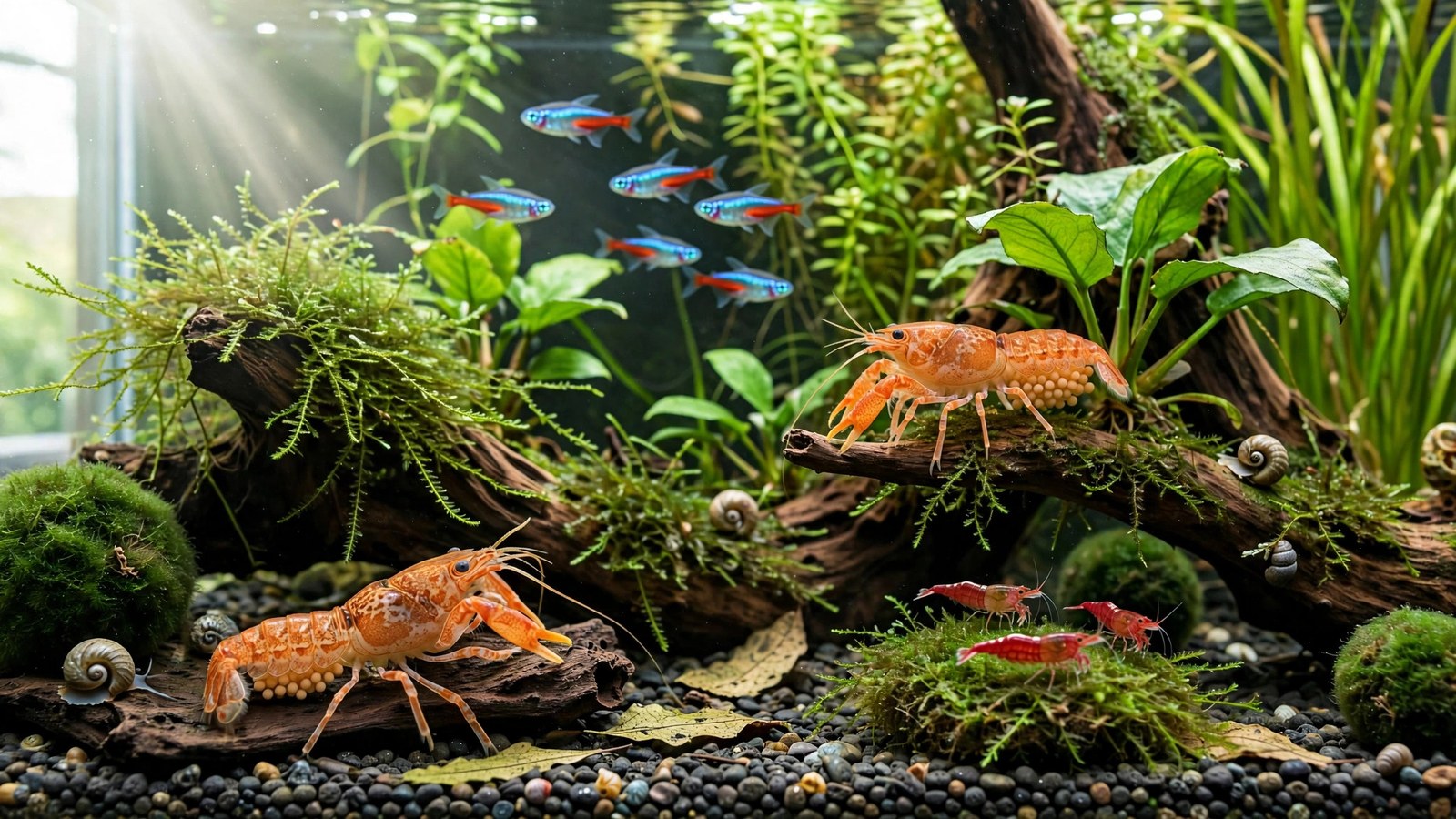
Most crayfish treat a planted tank like a salad bar — stems snipped, roots ripped up, weeks of scaping gone overnight. The Mexican dwarf crayfish (Cambarellus patzcuarensis), the CPO, breaks that rule: at just 1.5–2 inches, it won't demolish a planted tank. Here's the full setup, plus the honest limits most guides skip.
Why the Mexican Dwarf Crayfish Is Different
Every other crayfish in the hobby has destructive power far beyond its size: a full-size one can level a carpeting bed in a night. The CPO avoids that carnage by being tiny — its claws are built for grazing, not demolition. Species profiles confirm it neither digs up nor nibbles established plants.
But "plant-safe" has limits. A CPO won't eat your Anubias, yet it bulldozes freshly planted stems whose roots haven't anchored and snaps delicate shoots by accident. Think of it as a tiny bulldozer — it wrecks by walking, not by eating.
Read our roundup of the best aquarium plants for crayfish tanks — its tough-plant strategy is what makes a CPO setup work.
Setting Up the Tank for Your Mexican Dwarf Crayfish
A pair is comfortable in a 10-gallon; 2–4 fit in 15 gallons. Choose footprint over height — they patrol the floor. The lid is not optional. They climb tubing, filter intakes, and plant stems, and survive hours out of water.
Use sand or fine gravel — coarse gravel can damage their swimmerets. Filter gently — a sponge filter or baffled hang-on-back with sponge intakes protects juveniles. Cycle fully before adding crayfish — they're far more sensitive to ammonia and nitrite. Learn how to cycle a planted tank first.
Every crayfish needs a private cave — slate stacks, coconut huts, clay tubes, driftwood hollows — because a freshly molted CPO is soft and defenseless. Aim for one more cave than you have crayfish, and overgrow them with moss. CPOs like the cool end of tropical, so most setups need no heater; check our heater guide for planted tanks if winters run cold.
Water Parameters: What CPOs Actually Need
Stability beats perfection — except hardness, which is non-negotiable. CPOs build shells from dissolved minerals — in soft water, molts fail and the crayfish dies mid-shed. If your tap water is soft, remineralize or drop a cuttlebone in the tank.
| Parameter | Target range | Notes |
|---|---|---|
| Temperature | 65–78°F (18–26°C) | Cooler water slows growth, lengthens lifespan |
| pH | 6.5–8.0 | Stability matters more than the exact value |
| GH | 6–12 dGH | Critical for molting; below 4 risks failed sheds |
| KH | 3–8 dKH | Buffers pH against swings |
| Ammonia / nitrite | 0 ppm | Inverts are far more sensitive than fish |
| Water changes | 20–25% weekly | Match temperature; avoid large sudden changes |
Plants That Survive a Mexican Dwarf Crayfish
Lean on epiphytes: tie Anubias, Java fern, and Bucephalandra to hardscape, where there's nothing to uproot. Drape Java moss over caves as decor and baby shelter, and add frogbit for the dim light CPOs prefer.
Plant substrate species 4–6 weeks before introducing the crayfish so roots anchor deeply. Cryptocoryne, Vallisneria, and Amazon swords all hold up once established — but a fresh carpet planted the same day will be rubble by morning. Our aquarium plants for fish tank guide covers which easy plants anchor fastest.
Feeding Your CPO
Base the diet on sinking pellets or crab food, fed every other day — only what they finish in two hours. Twice a week add blanched zucchini or spinach, plus occasional frozen bloodworms or daphnia. They'll also graze biofilm off every surface.
Calcium matters for molting: cuttlebone pieces or calcium-rich pellets keep shells hard, while pure fish flakes lead to bad molts. Don't overfeed — uneaten food rots, spikes ammonia, and crayfish suffer first. A planted-tank cleanup crew of nerites and Amanos shares leftovers without competing.
Tank Mates That Work (and Ones That Don't)
CPOs are peaceful for a crayfish, but still opportunistic: a slow or sleeping fish near the bottom at night is fair game. The safe formula: small, fast, mid-to-top dwelling fish. Anything big enough to eat them — cichlids, large gouramis, big barbs — is an automatic no.
| Tank mate | Verdict | Why |
|---|---|---|
| Ember tetras | Safe | Tiny, fast schoolers; never rest on the bottom |
| Chili rasboras | Safe | Peaceful nano fish; too quick to catch |
| Celestial pearl danios | Safe | Active top-dwellers; ignore crayfish |
| Cherry / Amano shrimp | Safe with cover | Same water needs; moss protects shrimplets |
| Nerite snails | Safe | Hard shells the CPO can't crack |
| Bettas | Risky | Long fins invite nipping; bettas may attack molted crayfish |
| Corydoras | Risky | Share the bottom zone and compete for caves |
| Large cichlids / barbs | No | Will hunt the crayfish, especially post-molt |
Shrimp are the best companions — same water needs, complementary grazers. See our Amano shrimp care guide and ghost shrimp in planted tanks; mature biofilm feeds both species' young. New to shrimp? Start with our planted shrimp tank setup.
Breeding Mexican Dwarf Crayfish
Breeding is genuinely easy — most keepers do it by accident. Males are smaller with rigid, forward-pointing gonopods under the tail; females are rounder with a wider tail fan. No conditioning needed.
After mating, the female carries 20–40 dark eggs under her tail, fanning them for 3–4 weeks. Isolate berried females only if the tank is crowded. Babies hatch as miniature crayfish, cling to the mother for days, then scatter; they molt almost daily and need superfine food.
Survival comes down to hiding places: with dense moss, leaf litter, and crevices, most of each brood reaches adulthood. For maximum yield, move the berried female to a sponge-filtered 5-gallon nursery a week before hatching. A low-tech planted tank setup makes an ideal nursery — no CO2, stable, forgiving.
Frequently Asked Questions
Will Mexican dwarf crayfish eat my aquarium plants?
Established plants are safe — CPOs graze biofilm off leaves rather than eating them. The real risk is mechanical: they uproot newly planted stems and snap delicate shoots while climbing. Anchor plants to hardscape and let substrate plants root for a month before adding crayfish.
How many Mexican dwarf crayfish fit in a 10-gallon tank?
A pair or trio works in 10 gallons; up to 4–5 fit in 15 gallons if every crayfish has its own cave. They are mildly territorial, and disputes spike when hiding spots are scarce. Lost claws regrow after the next molt.
Do CPO crayfish really escape from tanks?
Yes — they climb filter intakes, airline tubing, heater cords, and even silicone seams. A tight-fitting lid with no gaps is mandatory, and filter cutouts must be sealed. CPOs do most of their exploring at night, when a gap of just a few millimeters around a cord notch becomes an exit ramp — block every opening with foam or tape. A crayfish found on the floor rarely survives.
Can Mexican dwarf crayfish live with betta fish?
It's risky both ways: CPOs may nip a betta's long fins, and an aggressive betta may attack a freshly molted crayfish. Betta temperament varies wildly between individuals — short-finned plakats nip less but tend to attack more — so a densely planted 15-gallon or larger tank, with the betta added last, is the minimum condition for attempting it. Most keepers choose small, fast nano fish like ember tetras instead, which are far safer for both.
Why did my CPO die during molting?
Failed molts are almost always a water-hardness problem — the crayfish can't build a new shell in water that's too soft. Keep GH at 6–12 dGH with calcium-rich foods or a cuttlebone. Nine times out of ten, hardness is the cause.
Bringing It All Together
The Mexican dwarf crayfish earns its reputation: epiphytes on hardscape, mossy caves, established root feeders — a genuinely planted tank with constant bottom-level activity and the occasional surprise brood. Keep the lid sealed, the water hard enough to molt in, and the plants anchored. Start with a pair, watch one molt cycle, then decide on a colony.
Species reference: Cambarellus patzcuarensis species profile (Diszhal.info, verified loading).