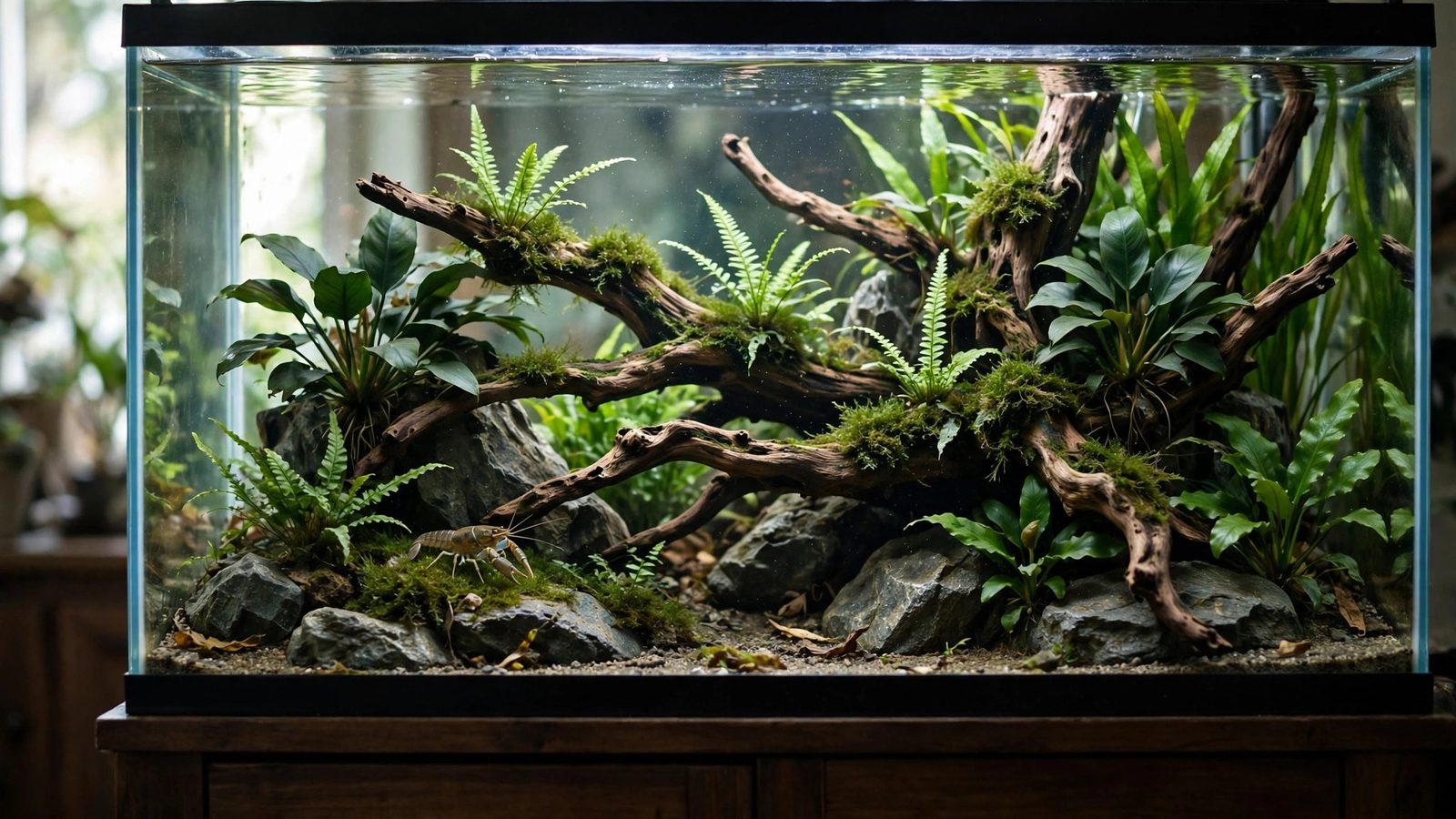
Keeping a planted tank with crayfish feels like setting up a buffet and hoping the guests show restraint. If you are looking for aquarium plants for crayfish tanks that actually survive, you need species chosen for toughness, bitterness, and sheer speed of growth. Most crayfish — from the common red swamp crayfish (Procambarus clarkii) to popular Mexican dwarf varieties — are opportunistic omnivores that dig, clip, and graze on soft leaves. Before acquiring any crayfish, check your local regulations — some species are restricted in certain jurisdictions — and never release pet crayfish into the wild. The good news: a well-chosen plant list, mounted on rock and wood rather than in the substrate, can thrive alongside these fascinating invertebrates.
Why Crayfish Destroy Plants
Crayfish are not being spiteful — they are behaving like crayfish. Understanding their three favorite ways to wreck a scape is the first step to working around them.
Digging and burrowing
Many crayfish burrow to create hides and molt shelters, excavating substrate around plant bases and unearthing freshly planted stems. This is why carpeting plants and delicate foreground species almost never last: the substrate itself is a construction zone. Plants attached to hardscape sit entirely outside the demolition zone.
Clipping and shredding
A crayfish's claws are surprisingly precise. They grab a leaf or stem, snip it, and pass it to the smaller feeding appendages. Soft, thin leaves are shredded overnight — which is why many crayfish keepers wake up to a surface covered in severed stems.
Eating and grazing
When protein food is scarce, plant tissue becomes dinner. Soft, palatable leaves — especially new growth — are grazed down to the stem. Tough, bitter-tasting, or rigid leaves get sampled once and abandoned. Keeping your crayfish well-fed with pellets, blanched vegetables, and the occasional protein treat reduces grazing pressure dramatically, though it will not save the softest species.
What Makes a Plant Tough Enough for Claws
Three traits predict whether a plant can live with crayfish. The best candidates have at least two; the standouts have all three.
1. Tough, unpalatable leaves
Leathery or rigid foliage discourages both shredding and eating. Rhizome plants like Anubias and Java fern have thick cell walls and bitter compounds that most crayfish reject after one test bite. Leaf toughness is the single biggest predictor of survival.
2. Epiphyte growth habit
Plants that grow attached to rock or driftwood rather than in the substrate sidestep the entire burrowing problem. Their rhizomes sit above the crayfish's digging zone. This is why Anubias, Java fern, Bolbitis, and mosses dominate crayfish-safe plant lists.
3. Fast growth that outpaces damage
Some plants survive not by resisting damage but by outgrowing it. Fast-growing floaters like water sprite regenerate faster than a crayfish can eat them, sacrificing leaves without ever losing the colony.
The 10 Best Aquarium Plants for Crayfish Tanks
Ordered from most crayfish-proof to useful supporting players. Individual crayfish vary, so keep yours well-fed and observe before committing to a full scape.
1. Anubias barteri (all varieties)
The gold standard for crayfish tanks. Anubias has thick, leathery, bitter-tasting leaves on a rhizome that must be tied or glued to rock and driftwood — never buried. Nana, coffeefolia, and broad barteri all share the same crayfish-resistant chemistry. Keep it in low-to-moderate light to avoid algae on its slow-growing leaves. See the guide to epiphyte aquarium plants that never need planting.
2. Java fern (Microsorum pterotoides)
Java fern pairs with Anubias as co-champion of crayfish-proof planting. Its leaves are tough, dark, and bitter — crayfish may snip one leaf but rarely return. Tie it to driftwood or rock, keep the rhizome exposed, and let it colonize vertical surfaces where crayfish patrol less. It tolerates the cooler water many crayfish prefer. See the easiest aquarium plants that need no CO2 for similar low-demand choices.
3. Java moss (Taxiphyllum barbieri)
Moss works differently: crayfish pick at it, but it regenerates from every fragment. Tie Java moss to driftwood, rocks, or mesh panels to create permanent green cushions that double as foraging habitat. Christmas moss and flame moss work the same way. Compare options in the best aquarium mosses compared roundup.
4. African water fern (Bolbitis heudelotii)
A more elegant epiphyte, Bolbitis grows like a submerged fern with translucent, rippled leaves that are as tough as Java fern. It prefers the same cooler, shaded, higher-flow conditions many crayfish enjoy. Attach to wood in the midground or background. It grows slowly at first but eventually forms dramatic flowing clumps.
5. Water sprite (Ceratopteris thalictroides)
The classic sacrificial grower. Water sprite is soft and palatable — but as a floating plant it grows explosively, outpacing any grazing. A floating raft absorbs ammonia and nitrates while providing shade that calms nocturnal crayfish. It is also one of the best floating aquarium plants.
6. Duckweed and salvinia
Tiny floating plants are nearly indestructible simply because they are too small and numerous to eliminate. Salvinia is the tidier choice — easy to corral with airline tubing rings — while duckweed spreads everywhere. Both provide shade, soak up nitrogen, and give crayfish the dimmer surface light they prefer.
7. Amazon sword (Echinodorus amazonicus)
The toughest rooted rosette. Amazon swords have broad, rigid leaves that most crayfish leave alone once established, and a massive root system that anchors against digging once mature. Protect young plants by surrounding the base with heavy river stones until roots establish. Compare varieties in the Echinodorus sword varieties guide.
8. Cryptocoryne wendtii
Crypts are tougher than they look. Cryptocoryne wendtii has sturdy, waxy leaves that many crayfish ignore, and it tolerates digging around its base as long as the rhizome is planted deep. Green, bronze, and red varieties add color without adding vulnerability. Give new plantings a stone collar for the first month.
9. Hornwort (Ceratophyllum demersum)
Another fast grower that wins by sheer biomass. Hornwort grows inches per week, shedding older stems faster than crayfish can eat them. Float it or anchor bunches; run a prefilter sponge on your filter since it sheds needles under stress. Its coarser texture seems less tasty to crayfish than water sprite.
10. Marimo moss balls (Aegagropila linnaei)
Yes, crayfish will push them around the tank — and yes, that is part of the fun. Moss balls are dense algae colonies, not delicate plants; a crayfish can roll, nudge, and pick at them all day without destroying them. They tolerate cold water, need almost no light, and cannot be uprooted since they do not root. Expect your crayfish to treat them like toys.
| Plant | Placement | Toughness | Survival strategy |
|---|---|---|---|
| Anubias barteri | Hardscape midground | ★★★★★ | Bitter, leathery leaves; above the substrate |
| Java fern | Hardscape verticals | ★★★★★ | Bitter, tough leaves; cool-water hardy |
| Java moss | Wood/rock mesh | ★★★★☆ | Regenerates from fragments; foraging habitat |
| African water fern | Wood midground | ★★★★☆ | Tough fern foliage; loves shade and flow |
| Water sprite | Floating | ★★★☆☆ | Outgrows grazing; absorbs nitrogen |
| Salvinia/duckweed | Floating surface | ★★★☆☆ | Too numerous to eradicate |
| Amazon sword | Substrate background | ★★★☆☆ | Rigid leaves; massive anchoring roots |
| Cryptocoryne wendtii | Substrate midground | ★★★☆☆ | Waxy leaves; deep-planted rhizome |
| Hornwort | Floating/anchored | ★★★☆☆ | Extreme growth rate outpaces eating |
| Marimo moss balls | Loose on substrate | ★★★★★ | Unrooted; rolled, not destroyed |
Plants to Avoid in Crayfish Tanks
Some plants are crayfish candy. Skip these unless you enjoy replanting every morning.
- Carpeting plants (dwarf baby tears, Monte Carlo, dwarf hairgrass): live in the exact digging zone and are shredded or uprooted within days.
- Soft stem plants (Cabomba, ambulia, many Ludwigia): snipped at the base by claws — you will find the pieces floating.
- Tender red plants (most red Rotala and Alternanthera): palatable and soft, double-targeted by grazers.
- Vallisneria and sagittaria: their long, soft, sweet leaves are grazed like pasta.
- Fresh shoots of anything: new growth is softer and sweeter than mature leaves, so even tough plants should be well-established before introduction.
Crayfish-Proof Planting Techniques
Technique matters as much as species. These methods put plants physically beyond the crayfish's reach.
Glue and tie to hardscape
Use cyanoacrylate gel superglue (reef-safe, cures underwater) or dark cotton thread to attach Anubias, Java fern, Bolbitis, and mosses to driftwood and stone. Position pieces a few inches above the substrate, beyond the burrowing zone. Glue is non-toxic once cured and stronger than thread — crayfish can snip thread but cannot lever off a glued rhizome.
Anchor rooted plants with stone collars
For swords and crypts, plant deep and ring the base with heavy river stones for 4–6 weeks while roots establish. Once the root mass matures, it holds against casual excavation. A low terracotta pot sunk into the substrate achieves the same thing.
Float what you cannot protect
Water sprite, hornwort, and salvinia need no anchoring at all. Corral floaters with airline tubing rings if you want them kept to one side. Floating plants also dim the light for shy, nocturnal crayfish, which reduces stress-related plant destruction.
Weight bundles instead of planting delicate stems
If you must try stem plants, use weighted bunches (plant weights or lead-free strips) resting on the substrate rather than individually planted stems. This makes repositioning easy when your crayfish redecorates. Treat these as expendable trial plants — candidates from the fast-growing plants for new tanks list are cheapest.
A reliable pick here is Seachem Flourish Glue.
Tank Setup Tips That Protect Your Plants
- Feed the crayfish well. Sinking pellets, blanched zucchini, and occasional protein treats keep grazing off your scape. A hungry crayfish eats your plants.
- Provide hides. PVC pipes, stacked rocks, and driftwood caves reduce the urge to excavate hiding spots through your plant bed. A crayfish with a good den digs less.
- Use coarse substrate. Fine sand is easy digging; gravel is harder work. Neither stops a determined burrower, but gravel slows casual excavation near plant bases.
- Keep plants on high ground. Mound hardscape and plant epiphytes high; leave the crayfish's ground-level patrol zone sparse. Vertical planting beats flat planting.
- Dim the lighting. Crayfish are nocturnal and calmer under moderate light. Floaters plus no-substrate plants on the surface create natural shade, which also keeps algae off slow-growing Anubias leaves.
- Quarantine new plants. New plants can carry pesticides that are far more dangerous to invertebrates than to fish. An alum dip is cheap insurance before anything goes in the tank.
A reliable pick here is Seachem Flourish Tabs.
Frequently Asked Questions
Will crayfish eat every plant I put in the tank?
Not every plant — but expect them to sample everything. Most crayfish test-bite new foliage and abandon tough, bitter, or leathery leaves after one try. Anubias, Java fern, and mosses are consistently rejected, while soft species like Cabomba are eaten enthusiastically. Keeping your crayfish well-fed with pellets and vegetables sharply reduces grazing, since most plant-eating is opportunistic feeding rather than preference.
What is the safest single plant for a crayfish tank?
Anubias barteri — any variety — is the consensus safest choice. Its leaves are thick, leathery, and bitter-tasting, and it grows on a rhizome attached to rock or wood above the digging zone. It tolerates the cooler water and lower light crayfish prefer. Glue a few pieces to driftwood and you have permanent, maintenance-free greenery that virtually every crayfish keeper reports surviving long-term. You can compare leaf structures across the range in Tropica's Anubias barteri plant profile.
Are dwarf crayfish safer for planted tanks than large species?
Yes, significantly. Mexican dwarf crayfish and similar small species cause far less damage than 4–6 inch Procambarus or Cherax — their claws are too small to shred leathery leaves and their digging is shallower. Dwarf crayfish keepers successfully maintain broader planted scapes, including some softer stems. This guide's plant list is written for destructive large species, so it is conservative for dwarfs.
Do floating plants count as crayfish-proof?
Effectively, yes. Water sprite, hornwort, and salvinia float above the crayfish's main activity zone and grow fast enough to replace any grazing losses. Floating plants also shade the tank — which calms nocturnal crayfish — and absorb ammonia and nitrates directly from the water column. Many keepers of the most destructive species rely on floaters as their primary greenery.
How do I attach Anubias so a crayfish cannot pull it off?
Use reef-safe cyanoacrylate gel superglue: dab a small amount on the rhizome, press it against the wood or rock for 30 seconds, and let it cure. It is non-toxic once cured and bonds in seconds, even underwater. Dark cotton thread works too, but crayfish may snip it before roots attach. Glue is stronger and permanent, leaving nothing for the crayfish to grab.
Should I just use silk plants instead of live ones?
Live plants are worth the effort: they absorb nitrates, oxygenate the water, and provide natural foraging and hiding that reduces crayfish stress and aggression. But if your priority is a zero-maintenance scape, high-quality silk plants on hardscape are a reasonable fallback — see the silk vs plastic plants comparison before buying. Most keepers find a hybrid works best: tough live epiphytes plus silk accents.
Build Around the Crayfish, Not Against It
The secret to a beautiful crayfish tank is not fighting your crayfish's nature — it is designing around it. Anchor your structure on hardscape-mounted epiphytes like Anubias and Java fern, fill the surface with fast-growing floaters that outpace grazing, and protect rooted plants with stone collars until they are established. Claws and greenery can coexist — you just have to pick plants that play defense. If you also keep invertebrates alongside your crayfish, the best plants for shrimp tanks make excellent complementary choices.