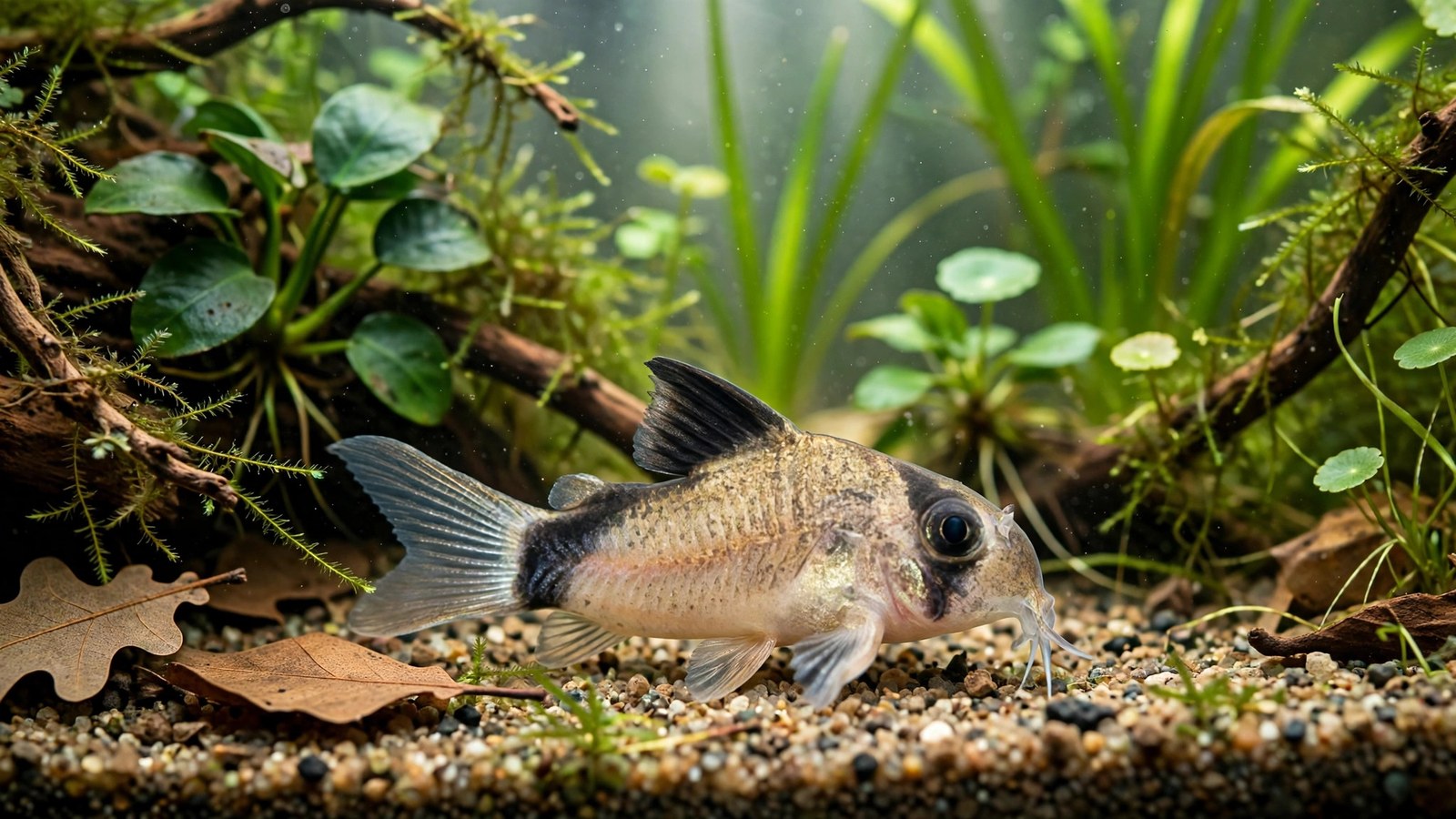
Half the fish sold as "bandit corys" are impostors — the mix-up has run at wholesalers for decades. The true bandit cory is Corydoras metae, named for Colombia's Rio Meta: a bold black mask stripe across its eyes, and a dark bar from its dorsal fin down to the tail base — where it stops cleanly. If that bar splits or runs into the tail fin, you're holding Corydoras melini, the false bandit.
Both are gentle, plant-safe catfish, but different species — so run the two-second tail check below before you buy. Then the recipe: fine sand for their barbels, soft slightly acidic water at 72–78°F (22–26°C), dim shaded corners, and a school of six or more. This guide companions our fish-first guide to aquarium plants for fish tanks, and the layout is one of the lightly planted setups corys love.
Should you keep bandit corys in a planted tank? Yes — the true bandit cory (Corydoras metae) is an ideal planted-tank catfish. Keep 6+ together on fine 0.1–0.5 mm sand in soft, slightly acidic water (pH 6.0–7.2) at 72–78°F (22–26°C), with shaded cover under plants or driftwood, feeding sinking foods daily. Adults reach 2 inches (5 cm) and leave plants untouched. Citable ID rule: in the true bandit cory the dark dorsal-to-tail bar stops cleanly at the caudal peduncle; in the false bandit (C. melini) it splits above the peduncle or enters the tail fin.
Bandit cory vs false bandit: the two-second ID check
Shop tanks labeled "bandit cory" routinely mix both species — juveniles look near-identical and exporters treat them interchangeably. The mask tells you nothing, since both wear it. Follow the dark bar from the dorsal fin toward the tail instead: in the true bandit cory it ends cleanly at the caudal peduncle; in the false bandit it splits above the peduncle or enters the tail fin.
Size won't separate them — both reach about 2 inches. (Also sold as Hoplisoma metae after recent revisions — shops still list it as Corydoras metae.) For the full side-by-side, see our guide on how to tell the true bandit cory from the false bandit cory. The authorities agree on the tail rule — compare the Seriously Fish profile of Corydoras metae with the Seriously Fish profile of Corydoras melini.
| Feature | True bandit (Corydoras metae) | False bandit (Corydoras melini) |
|---|---|---|
| Eye mask | Bold black stripe through the eyes | Bold black stripe through the eyes |
| Dark back bar | Runs from dorsal fin down the back | Runs from dorsal fin down the back |
| Tail base | Bar stops cleanly at the caudal peduncle; tail fin clear | Bar splits above the peduncle or extends into the tail fin |
| Adult size | ~2 in (5 cm) | ~2 in (5 cm) |
| Wild origin | Upper Rio Meta basin, Colombia | Rio Negro drainage |
Sand, shade and layout: the planted-tank recipe
Bandit corys live nose-down in the substrate, sifting sand through their gills and tasting for food with their barbels. Use fine sand at 0.1–0.5 mm grain size, 1–2 inches deep; washed play sand or pool filter sand both work. Avoid sharp-edged materials — crushed coral, coarse river gravel, rough coated gravels — because barbel erosion is almost always a substrate or water-quality problem.
For planting, think shelter rather than density. A 20-gallon long works well: background stems or swords, a couple of driftwood pieces, floating plants to dim the light. Corys are crepuscular foragers that feel exposed under bright open light — shaded corners with anubias or java fern tied to wood keep them out all day. Let new stems root 2–3 weeks before adding the school; a startled cory can uproot fresh cuttings.
Water parameters: soft, slightly acidic, 72–78°F
Corydoras metae comes from soft, slightly acidic Colombian tributaries. Aim for pH 6.0–7.2, 2–12 dGH, and 72–78°F (22–26°C). Ammonia and nitrite must read zero; keep nitrate under 20 ppm with 25–30% weekly water changes, because dirty water inflames barbels faster than any substrate will.
Keep flow gentle — a sponge filter or baffled hang-on-back is plenty. Strong current stresses them and blows food away before they can find it. If your tap water is very hard, blend in RO or rainwater at water-change time rather than chasing pH with chemicals; stability beats an exact number. Corys are salt- and medication-sensitive, so use half-dose, scaleless-fish-safe treatments only.
School size and the best tank mates
Six is the honest minimum; eight to ten is where bandit corys truly come alive. Below six they hide, eat nervously and fall sick more easily. A proper group shoals, clicks softly to each other and forages in the open. Add the full group at once to a cycled tank.
For tank mates, think small, calm and mid-water: ember tetras, harlequin rasboras, honey gouramis and otocinclus share their water preferences and leave them alone. A separate school of peppered corys or sterbai corys also works, but each species needs its own group of six-plus. Avoid large or boisterous fish: big cichlids, tiger barbs and crayfish will bully or injure them.
Feeding: sinking foods on a schedule
Bandit corys are omnivores with a carnivore lean — they cannot live on other fishes' leftovers. Feed a small sinking wafer or 2–3 mini pellets per fish once daily, plus frozen bloodworms or daphnia 2–3 times a week. Drop food after lights dim if faster fish steal it.
Watch the bellies, not the clock: slightly rounded is right, sunken means underfed, food still on the sand after 10 minutes means overdone. Feed over open sand, not into dense planting, so you can see what's eaten.
Frequently Asked Questions
How can I tell if my bandit cory is really Corydoras metae?
Ignore the eye mask — both species wear it. Follow the dark bar from the dorsal fin toward the tail: in the true bandit cory it stops cleanly at the caudal peduncle, leaving the tail fin clear. In the false bandit (Corydoras melini) it splits above the peduncle or runs into the tail fin.
How many bandit corys should I keep together?
Six is the minimum; eight to ten is noticeably better. Bandit corys are obligate schoolers — small groups hide, eat nervously and get sick more easily, while a proper school forages in the open, rests in piles and clicks softly to each other. Add the whole group at once to a cycled tank.
Will bandit corys eat my aquarium plants?
No — they are completely plant-safe and never graze leaves. The only risk is mechanical: a startled school can uproot fresh cuttings. Let new stems root 2–3 weeks before adding corys, choose sturdy rooted plants like swords and crypts, and you'll have zero plant damage.
Can bandit corys live on gravel?
They can survive on smooth, rounded gravel, but fine sand is far better. Bandit corys sift substrate through their gills and probe it with delicate barbels; sharp or coarse gravel abrades the barbels and invites infection. Use washed fine sand at 0.1–0.5 mm, 1–2 inches deep.
What do bandit corys eat?
They are omnivores that need sinking food: small wafers or mini pellets daily, plus frozen bloodworms, daphnia or brine shrimp 2–3 times a week. They can't live on leftovers from mid-water fish — feed them directly after lights dim, when they forage most actively. Slightly rounded bellies mean portions are right.
Why the true bandit earns its place
Get the ID right, give them sand, shade, soft water and a real school, and bandit corys repay you with one of the most charming bottom-dwelling displays in the hobby. Set the stage well, and they will do the rest.