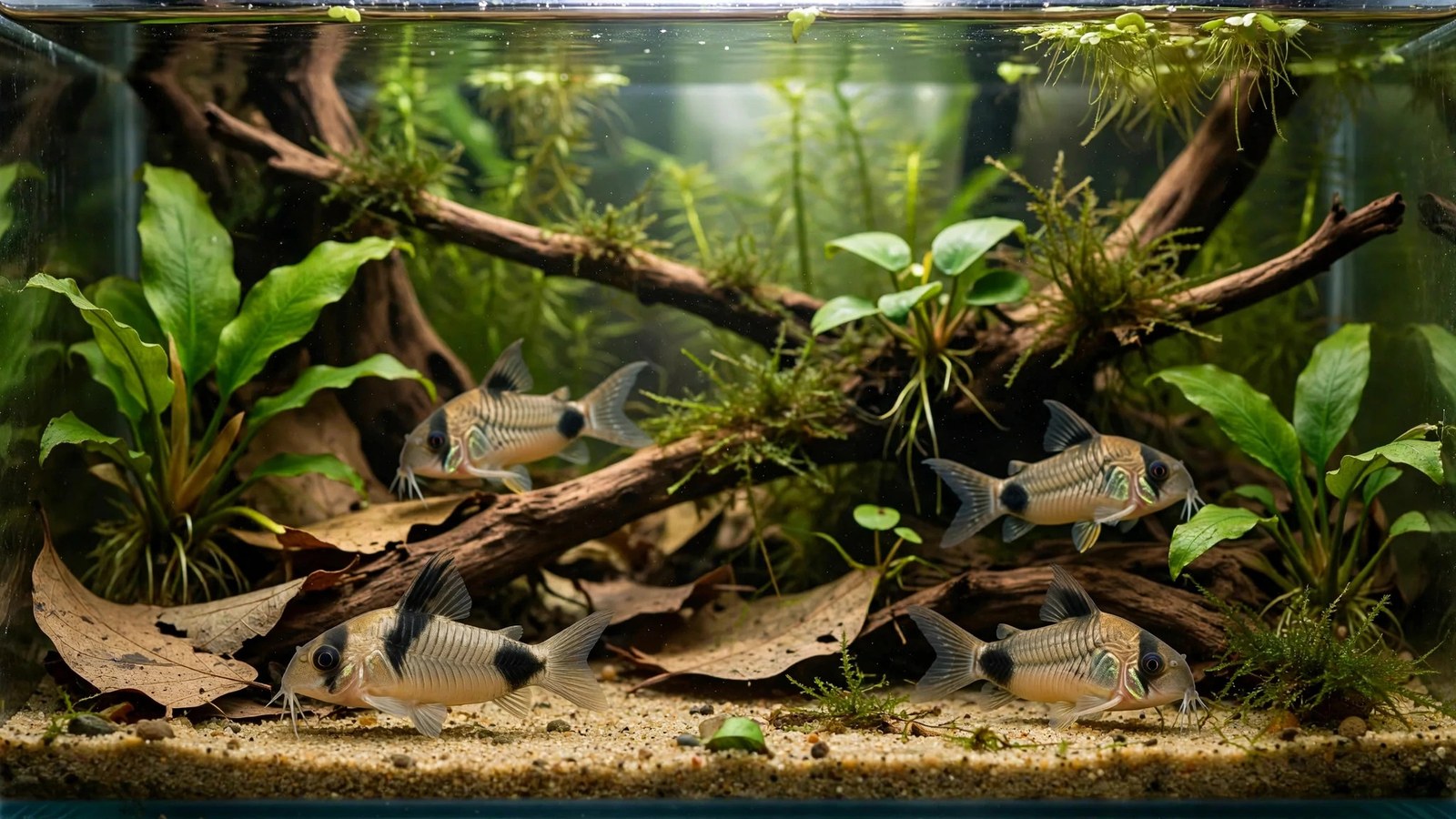
The bag at the shop said "bandit cory," but the dark body bar bleeding into its tail fin says otherwise. The false bandit cory you brought home is Corydoras melini — a peaceful Rio Negro native that forages across warm, tea-tinted sand in schools. By the end of this guide you will know how to tell it from the true bandit cory and how to build it a blackwater planted tank it can genuinely thrive in.
Why the "Bandit Cory" Name Covers Two Different Fish
The confusion starts at the wholesaler: the trade has lumped both Corydoras melini and the true bandit Corydoras metae under "bandit cory" for decades, and most fish sold under that label today are melini — the false bandit.
| Feature | C. melini (false bandit) | C. metae (true bandit) |
|---|---|---|
| Eye mask | Dark band through the eye | Dark band through the eye — both species wear it |
| Key marking | Dark body bar forks above the tail base or runs into the tail fin | Dark body bar stops cleanly at the tail base; tail fin clear |
| Origin | Upper Rio Negro basin, Brazil | Rio Meta basin, Colombia |
| Adult size | Around 2 inches (5 cm) | Around 2 inches (5 cm) |
The fastest check at the shop counter: look at where the dark body bar ends. If it stops cleanly at the tail base with a clear tail fin, you are looking at the true bandit cory (Corydoras metae), covered in its own setup guide. If the bar forks above the tail base or bleeds into the tail fin, it is melini — the false bandit. Either is a fine purchase; you just want to give it the right river.
Setting Up the false bandit cory Planted Tank
A 20-gallon long is the minimum for a school of eight; a 29-gallon leaves room for midwater companions. Long footprints beat tall ones: wider sand means more of the school feeds at once. Build around the Rio Negro: fine sand, low driftwood, fallen leaves, and shade-tolerant plants. Pick plants the way a fishkeeper does — our fish-first guide to aquarium plants for fish tanks explains the difference — because contest-style aquascapes rarely survive tannin-tinted water.
Water Parameters: Soft, Warm, Tinted
Rio Negro water is nearly rain-soft, acidic, and dark with tannins; aquarium-bred melini tolerate a wider band, but soft and mildly acidic is where they thrive.
| Parameter | Target range | Notes |
|---|---|---|
| Temperature | 75–82°F (24–28°C) | Hold 76–80°F for everyday keeping |
| pH | 5.5–7.0 | Stability matters more than the exact number |
| GH / KH | 1–8 dGH, KH under 4 | Blend RO with tap if yours is hard |
| Water changes | 25–30% weekly | Match temperature within 2°F |
Get the tint from botanicals, not dye: add dried catappa or guava leaves plus a few alder cones gradually over two weeks. Skip carbon media — the amber water is the point.
Substrate, Hardscape, and Botanicals
Sand is non-negotiable: sharp gravel wears cory barbels to stubs and invites infection. Lay fine sand at least 2 inches deep, run driftwood low and wide over it, and lay leaf litter into the open sand lanes where the corys feed. For which leaves and pods tint strongest, Tannin Aquatics' guide to tint-producing blackwater botanicals ranks them from real-world experience.
Plants That Thrive in Dim Blackwater
Attach Anubias and Java fern to the driftwood above the litter line; plant Cryptocoryne wendtii and Amazon swords in the back sand — all tolerate low pH. Most important are the surface plants. Floating plants that give a blackwater tank its dim shade — frogbit, water lettuce, red root floaters — dapple the light to forest-canopy levels, and their hanging roots become a second feeding zone. Keep one corner clear so food reaches the sand.
Schooling and Tank Mates
Eight is the number where melini relaxes — smaller groups hide, while eight-plus roam the front glass in loose foraging runs. Stock the school first, then add peaceful midwater fish that share the same water.
| Tank mate | Group | Why it works |
|---|---|---|
| Cardinal tetras | 10–12 | Rio Negro classic; same water |
| Rummy-nose tetras | 8–10 | Tight schoolers that calm the corys below |
| Hatchetfish | 6–8 | Surface dwellers; never compete for the sand |
A second cory school works too — Corydoras adolfoi, another Rio Negro blackwater species, shares the water and shade. Skip large or boisterous fish that steal sinking food, and fin-nippers like tiger barbs.
Feeding: More Than Leftovers
The biggest myth in cory keeping is that they "clean up" after other fish. Wild melini hunt worms, crustaceans, and insect larvae in the litter bed — not your glass algae. Feed a sinking pellet or wafer every evening, rotating frozen bloodworms, daphnia, and blackworms two or three times a week. The false bandit cory profile on Aqua-Fish.net confirms it: protein variety keeps color and breeding condition up.
Note the temperature gap: our peppered cory setup runs 5–10°F cooler, so the two should not share a tank despite both wearing "cory" on the label.
Frequently Asked Questions
Is the false bandit cory the same fish as the bandit cory?
Not quite. "Bandit cory" is a trade name applied to two species: Corydoras melini (the false bandit) and Corydoras metae (the true bandit). Both wear the dark eye mask, so ignore it — check where the dark body bar ends instead. In melini the bar forks above the tail base or runs into the tail fin; in metae it stops cleanly at the tail base and the tail fin stays clear. Care is nearly identical either way.
How many false bandit corys should I keep together?
Keep at least six, and aim for eight to ten in a 20-gallon long or larger. Small groups turn shy and hide most of the day; a proper school forages across the sand in loose, synchronized runs and spends far more time in the open. Buy the whole group at once.
What water parameters does Corydoras melini need?
Soft, warm, slightly acidic water: 75–82°F, pH 5.5–7.0, GH 1–8 dGH. The tannin tint from leaf litter mimics their Rio Negro habitat and lowers stress. If your tap water is hard, blend with RO water and add botanicals gradually. Stability matters more than the exact value.
Do false bandit corys eat algae or clean the tank?
No. They are omnivorous foragers, not algae eaters, and they cannot survive on leftovers. In the wild they hunt worms, crustaceans, and insect larvae in the leaf litter. Feed a sinking pellet or wafer daily, plus frozen bloodworms, daphnia, or blackworms several times a week.
Can I keep false bandit corys with shrimp or a betta?
Cherry and Amano shrimp are fine — corys may snack on newly hatched shrimplets but ignore adults. A betta is riskier: a feisty one will guard the bottom where the corys feed. Use a planted 20-gallon long with broken sightlines.
Bringing Your Rio Negro Tank Together
Set the sand, wood, and leaf litter first, add the floaters, then run the tank dark and tannin-stained for two weeks before the school arrives. When eight banded backs fan out across the sand in the evening, you will know why this misnamed catfish earned its own article.