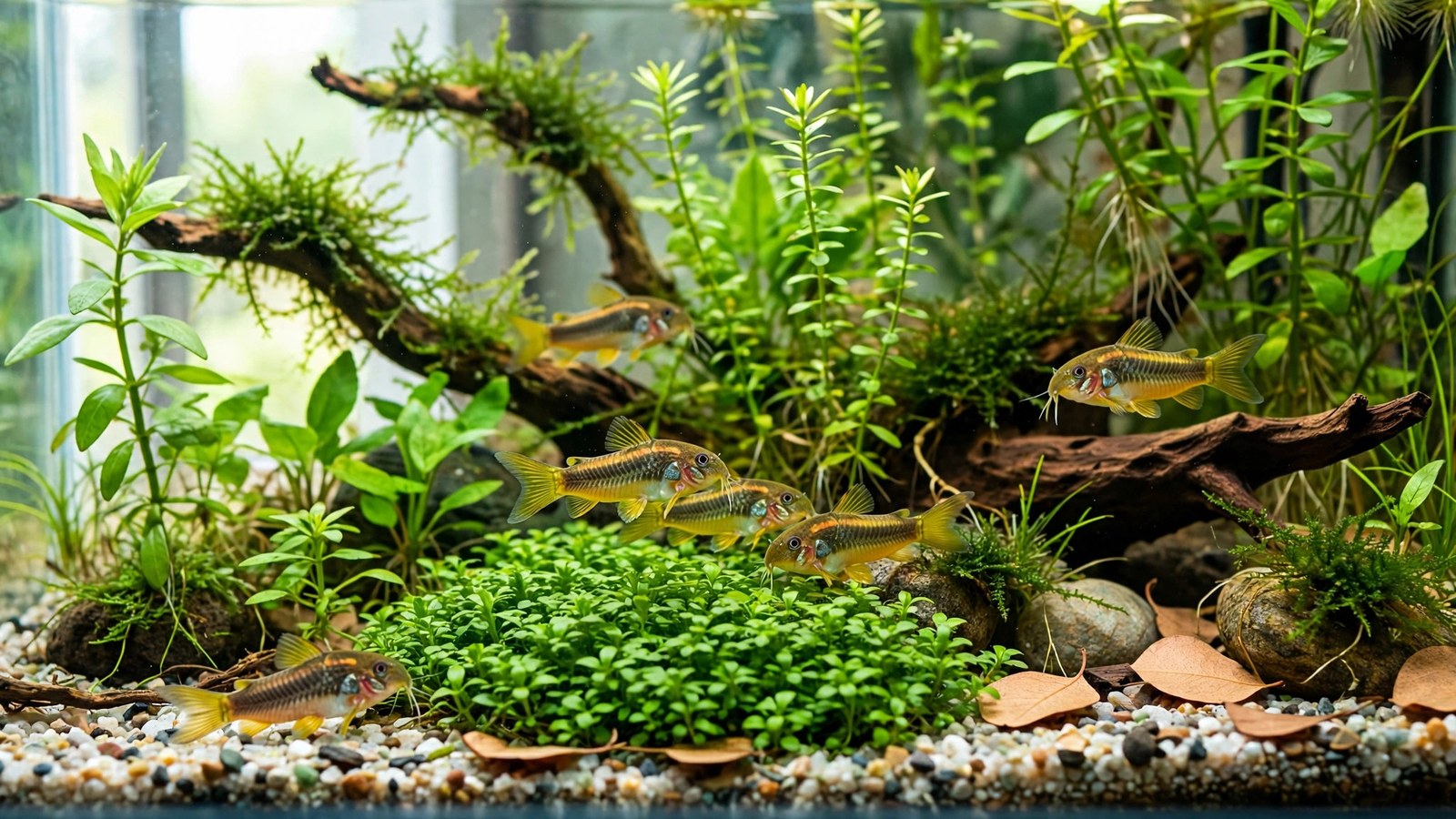
The orange-gold stripe down a laser cory's flank is why a laser cory planted tank is one of the hardest setups to stock — retailers sell out of Corydoras sp. CW010 within days of each shipment. This guide gives you the exact sand depth, plant list, school size, and parameters this hype fish needs to thrive.
The quick answer: A laser cory planted tank needs 2–3 inches of fine, smooth sand, a school of at least 6 Corydoras sp. CW010, water at 72–78°F and pH 6.5–7.5, and cory-safe plants like anubias and java fern. Retailer care guides specify a 20-gallon minimum for a school of four to six. CW010 is an undescribed Peruvian species — its taxonomy is unsettled, so never buy it under a settled species name. Sharp gravel is the biggest equipment mistake: it damages barbels and invites infection.
Meet Corydoras sp. CW010
The laser cory is sold under the hobby-standard designation Corydoras sp. CW010 — the fish is undescribed, meaning scientists have not formally named it yet. Its origin is Peruvian waters, and the single unmistakable trait is the bright orange-gold stripe along each flank, usually over an olive-to-bronze body. Some retailers list it as "Corydoras aeneus CW010," but that is seller shorthand, not settled taxonomy — always use the CW010 designation.
A genuinely different fish from every other cory: the sterbai cory planted tank guide covers a formally described warm-water species, while CW010 is an unclassified novelty — why it sells out while sterbai sits on shelves. Adults reach 2.5 inches, live 8–10+ years, and are peaceful toward tank mates — safe with snails and adult shrimp, though tiny fry may occasionally be eaten. Most trade stock is commercially bred, so groups acclimate fast.
Laser Cory Planted Tank: The Sand-First Setup Formula
Design this tank from the bottom up. Use 2–3 inches of fine, smooth sand — pool filter sand or well-rinsed play sand — so plants root firmly while the corys sift and forage without barbel damage. Rinse the sand until the water runs clear first: dusty fines cloud the tank for days and irritate gills.
This is a low-tech planted tank setup at heart — CW010 needs no CO2 or high-light farm. Moderate LED lighting, a gentle hang-on-back or sponge filter, and a 20-gallon-long footprint give a school of six the floor space it uses. The bronze cory planted tank setup runs on similar bones but suits a more forgiving fish.
Scape open sand lanes ringed with driftwood, a couple of caves, and plants at the back and sides — the corys rest under cover by day and patrol the lanes at dusk. Finish with a tight lid: they dart to the surface for gulps of air, and an open tank loses fish overnight.
Cory-Safe Plants That Foraging Will Not Destroy
Corys do not eat plants, but a school of six rooting daily will bulldoze anything fragile. Pick tough, deep-rooted plants: anubias and java fern tied to driftwood (never planted), crypts and swords with established roots, vallisneria along the back glass, and frogbit to soften the light.
For the full fish-first selection logic, see the guide to cory-safe plants for community fish tanks. Skip delicate foreground carpets in the foraging lanes — keep them outside the corys' patrol routes or the school will lift them within a week. Give newly planted stems a 2–3 week settling period before the corys go in.
| Parameter | Laser cory value | Why it matters |
|---|---|---|
| Tank size | 20 gal long minimum | Floor space for a foraging school |
| Temperature | 72–78°F (22–26°C) | Cooler than sterbai setups; watch summer heat |
| pH | 6.5–7.5 | Stable beats "perfect" — avoid chasing numbers |
| Substrate | Fine smooth sand, 2–3 in | Barbel safety + rooting depth |
| School size | 6 minimum, 8–10 ideal | Smaller groups stay stressed and hide |
| Filtration | Gentle HOB or sponge | Strong current stresses bottom-dwellers |
| Lighting | Moderate LED, 6–8 hrs/day | Supports low-tech plants without algae |
Feeding a School That Shops at the Bottom
Feed sinking pellets, wafers, frozen bloodworms, daphnia, and brine shrimp after lights-out, when mid-water fish are calm and food reaches the floor. A varied diet keeps the laser stripe bright; single-food routines fade coloration over months. If the fastest three hog every pellet, you are underfeeding the school.
The peppered cory sand and barbel debate makes the same point: intact barbels mean healthy, visibly foraging fish. Never add aquarium salt — corys are scaleless in places and intolerant of it. Quarantine sick fish separately instead.
Water, Maintenance, and the Sellout Problem
Keep parameters steady rather than chasing ideals: 72–78°F, pH 6.5–7.5, soft to moderately hard water, with 25–30% weekly water changes and low nitrates. Let the tank mature 3–4 weeks before the school arrives — plants alone do not make a tank cory-ready.
Because CW010 shipments sell out in days, join a waitlist or ask your shop to hold a full group. A fractured school introduced in waves takes weeks to settle; eight added together forage within hours. The documented retailer care guide for the orange laser cory confirms the 20-gallon minimum, and the gold laser cory species profile notes most stock is commercially bred — both worth reading before you buy.
Frequently Asked Questions
How many laser corys should I keep together?
Keep at least six, with eight to ten being the sweet spot. Laser corys are true schooling fish: groups smaller than six stay stressed, hide by day, and show faded striping. A full school forages openly across the sand lanes — the behavior you are paying the premium for. In a 20-gallon long, ten adults make a comfortable group.
Can laser corys live with gravel instead of sand?
Smooth, rounded fine gravel is tolerated, but fine sand is strongly recommended. Laser corys push their barbels into the substrate to find food, and sharp or coarse gravel abrades those whiskers, inviting infection. The safe setup is 2–3 inches of fine smooth sand across the whole tank floor — and if you use planted-tank aquasoil, cap it completely with sand.
What does Corydoras sp. CW010 actually mean?
CW010 is the hobby's catalog code for an undescribed Peruvian cory species. "Sp." signals that scientists have not formally described it, so no settled species name exists. Some retailers label it Corydoras aeneus CW010, but that is seller shorthand, not taxonomy. When buying, confirm the fish is sold as CW010 with the orange-gold flank stripe.
Will laser corys uproot my aquarium plants?
Established plants are safe; fresh plantings are not. A foraging school will lift newly planted stems and delicate carpets within days. The fix: let new plants root for two to three weeks before adding the corys, and tie anubias and java fern to hardscape instead of planting them. Once rooted, crypts and swords withstand daily foraging.
Are laser corys harder to keep than other corys?
No — most trade stock is commercially bred, making them hardier than many wild-caught cory species. They need the same basics: sand, a proper school, 72–78°F water, and sinking food. Their difficulty is procurement, not husbandry: shipments sell out fast, so plan your purchase. Beginners do well with them once the group is home.
A laser cory planted tank rewards the bottom-up design: sand first, a school of six or more, cory-proof plants tied to hardscape, and steady low-tech parameters. Get those four right and the orange-gold stripe stops being a retail novelty and becomes the brightest thing on your tank floor — for the next eight to ten years.